In Florida, you can start physical therapy without a doctor’s referral or prescription, but your insurance plan may still require one. Knowing how to choose a physical therapist in Sunny Isles starts with distinguishing what state law allows from what your coverage requires. That can help you plan your next step with confidence.
It’s understandable to want a clear path before arranging care, especially when you’re weighing recovery needs, insurance rules, and travel to appointments. A referral may not be legally necessary to begin, but your plan’s requirements can affect access to treatment and coverage.
This guide explains how referrals and insurance affect your decision, how to match therapy services to your goals, and what to consider when finding care near Sunny Isles Beach. You’ll also learn which practical details can make appointments easier to attend consistently.
Key Takeaways
- Separate Florida’s direct-access rules from your insurance plan’s referral requirements before arranging care.
- Match the therapy services you need to your recovery goals, mobility, and daily activities.
- Share relevant medical information with your therapist and coordinate care with other professionals involved in your treatment.
- Compare practical factors near Sunny Isles Beach, including travel convenience and whether the clinic’s services fit your needs.
- Learn how to review a therapist’s Florida license and understand what specialty credentials can tell you.
Insurance coverage and referrals
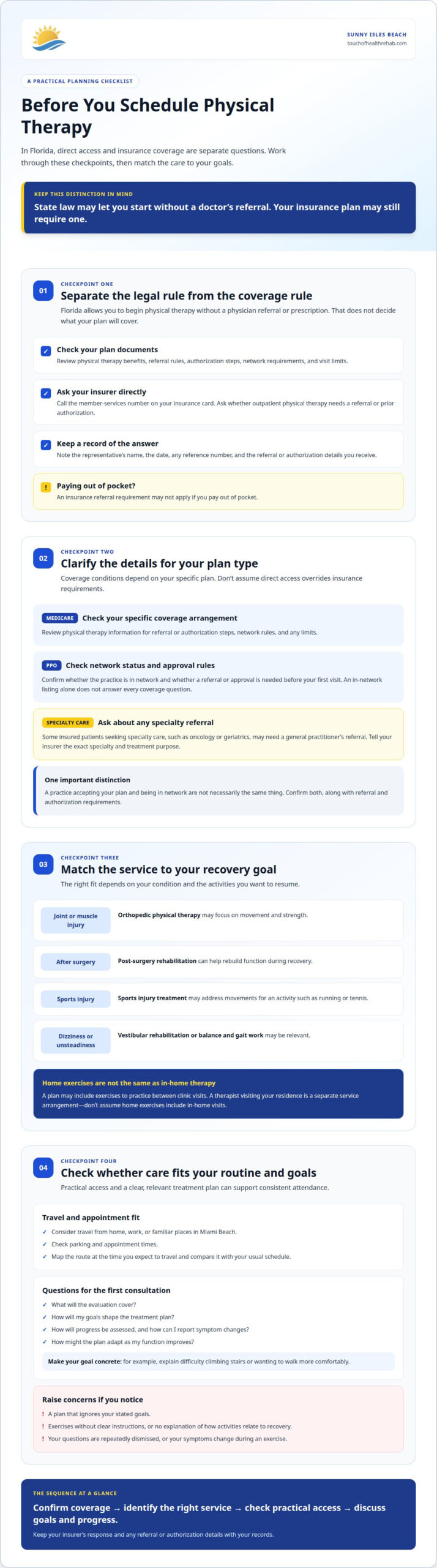
In Florida, you can begin physical therapy without a physician referral or prescription. That direct-access rule answers whether a doctor’s order is legally required to start. It does not determine what your insurance covers. Your insurer may require a referral even when state law allows you to begin care directly. If you pay out of pocket, that insurance requirement may not apply.
Separate the legal question from the coverage question before scheduling. Review your plan documents for physical therapy benefits, referral rules, authorization steps, network requirements, and visit limits. Then call the member-services number on your insurance card and ask whether outpatient physical therapy requires a referral or prior authorization. Record the representative’s name, the date, and any reference number.
Medicare coverage depends on your specific coverage arrangement and the requirements of your plan. Review its physical therapy information, including referral or authorization steps, network rules, and any limits. Don’t assume Florida’s direct-access rule overrides insurance conditions. The legal ability to start treatment and the terms for insurance payment are separate considerations.
With a PPO plan, check whether the physical therapy practice is in network and whether your plan requires a referral. PPO coverage terms vary, so your plan documents and insurer determine the applicable conditions. Ask whether you need approval before your first visit. An in-network listing alone does not answer every coverage question: referral and authorization rules may still apply.
Some insured patients seeking specialty care, such as oncology or geriatrics, may need a referral from a general practitioner. If your rehabilitation relates to geriatric care, ask your insurer whether a general practitioner’s referral is required. Give the exact specialty and treatment purpose to help clarify what documentation your plan expects.
Use this sequence to clarify insurance acceptance and avoid surprises:
- Identify your plan type, such as Medicare coverage or a PPO.
- Ask the insurer about referrals, authorization, network status, and coverage conditions.
- Confirm that the practice accepts your plan, and distinguish acceptance from in-network participation.
- Keep the insurer’s response and any referral or authorization details with your records.
These steps help you understand the financial and administrative path before care begins. Once referral and coverage requirements are clear, you can focus on whether the treatment plan supports your mobility, motion, and rehabilitation goals.
Physical therapy services for Sunny Isles
Physical therapy can support recovery after injury or surgery, and help address changes in balance and movement. The U.S. Department of Labor describes physical therapists as important in rehabilitation, treatment, and prevention for people with chronic conditions, illnesses, or injuries. A therapist reviews your medical history and assesses mobility and physical function, then connects your current abilities with practical goals such as walking comfortably or returning to a sport.
Services vary by need. Orthopedic physical therapy may focus on movement and strength after a joint or muscle injury. Post-surgery rehabilitation can help rebuild function during recovery. Sports injury treatment may address movements involved in a specific activity, such as running or tennis. For dizziness or unsteadiness, vestibular rehabilitation or balance and gait work may be relevant. The right fit depends on your condition and the activities you want to resume.
In-home therapy and exercises performed at home are different arrangements. A treatment plan may include movements or strength exercises for you to practice between clinic visits. Those home exercises can help you apply what you learn during supervised sessions to daily tasks, such as standing from a chair. A therapist visiting your residence is a separate service arrangement; don’t assume a home exercise plan includes in-home visits. Clarifying the distinction helps you understand where each part of care takes place.
For Sunny Isles Beach residents, location can affect how easily you attend consistently. Consider travel from home, work, or familiar places in Miami Beach, along with parking and appointment times. Map the route at the time you expect to travel and compare it with your usual schedule. Also check whether the clinic’s services match your needs, such as recovery after surgery or balance support. Convenient access matters when it makes regular attendance realistic.
At your first consultation, ask what the evaluation will cover, how your goals will shape the treatment plan, and how progress will be assessed. Give a practical example, such as difficulty climbing stairs, so the therapist can relate care to daily movement.
Warning signs include a plan that ignores your stated goals, exercises without clear instructions, or no explanation of how activities relate to recovery. Raise concerns if your questions are repeatedly dismissed or your symptoms change during an exercise.
Before choosing, consider whether the therapist explains each step and adapts activities to your abilities. A clear plan connects assessment findings with exercises, education, and functional goals. Someone hoping to walk more comfortably, for example, may need to discuss balance, gait, and strength rather than receive a generic list of movements. Ask how to report symptom changes and how the plan may adapt as your function improves.
If you’re comparing care options near Sunny Isles Beach, explore local physical therapy services and consider how their focus aligns with your recovery goals.
Coordination with other medical professionals
Your physical therapist may work alongside other professionals involved in your care. The U.S. Department of Labor describes physical therapists as important in rehabilitation, treatment, and prevention for people with chronic conditions, illnesses, or injuries. Coordination helps each professional understand your functional goals. After surgery, for example, your therapist and surgeon can share information about recovery and movement needs.
Tell your therapist which clinicians are involved in your care and why. This could include a primary care clinician, surgeon, neurologist, or another specialist. Share relevant diagnoses, recent procedures, and changes in daily function. Be specific: explain whether a shoulder injury affects dressing, reaching, or work tasks. This context helps your therapist assess mobility and plan exercises.
Bring useful records to your first appointment, such as a referral, discharge instructions, or imaging report, if you have them. Include a current medication list and note any recent changes. If a clinician has given you movement restrictions, share the exact instructions rather than relying on memory. Clear information can help prevent conflicting guidance.
Agree on a practical communication plan. Ask what information your therapist needs from other clinicians and how they’ll coordinate updates. Let your medical team know you’re beginning physical therapy and share your functional goals. After a knee procedure, for example, you might say your priority is returning to comfortable walking. A specific goal helps each professional understand what matters to you.
- Bring your medication list and relevant care instructions.
- Describe changes in pain, balance, or daily movement since your last appointment.
- Tell your therapist about new diagnoses, procedures, or clinician recommendations.
- Share exercises or activity restrictions prescribed by another professional.
Coordination is particularly important when care involves several needs. Someone managing a chronic condition while recovering from an injury may see different clinicians. Keep a brief record of questions, new symptoms, and guidance received. At your next therapy visit, use it to explain what has changed and how rehabilitation fits with the rest of your care.
Speak up when instructions seem different or unclear. If a home exercise appears to conflict with written post-surgery guidance, pause the exercise and ask your treating professionals to clarify. Don’t try to reconcile separate recommendations on your own. Accurate details, shared goals, and timely updates help the professionals involved coordinate your care.
Finding physical therapists near Sunny Isles Beach
Start with a map centered on Sunny Isles Beach, then compare nearby clinics by travel time and whether their services fit your needs. North Miami Beach may also be practical, depending on your starting point and route. Three hospitals near Sunny Isles Beach have affiliated physical therapy specialists, providing another way to identify care options. A nearby location can make appointments easier to fit into work and daily routines.
How can you compare physical therapy clinics in Sunny Isles Beach by reviews, experience, and outcomes? Compare review patterns, not just star averages, then look for experience related to your needs, such as post-surgery recovery or balance support. Sunny Isles Beach specialists have an overall average rating of 4.5 stars, but that figure alone can’t show whether a clinic fits your goals.
Treat reviews as one source of information, not a guarantee of your own experience. Look for specific comments about communication, appointment organization, and whether care addressed functional goals. Compare them with your priorities, such as returning to work, walking comfortably, or improving balance. Ask how the therapist tracks progress, using practical measures such as walking distance, stair use, or completing a daily task more easily.
Experience matters most when it relates to your treatment needs. A therapist who regularly treats sports injuries may suit a runner with recurring knee symptoms. Someone recovering after surgery may prioritize experience in post-surgery rehabilitation. During your evaluation, the therapist reviews your medical history and assesses mobility and physical function. Use the discussion to understand how the assessment connects to your goals.
Are there physical therapy clinics near you in Sunny Isles Beach with convenient hours and accessible parking? Compare clinic hours with your schedule, and use a map or listing to review parking and access. Three nearby hospitals have affiliated specialists, but hours, parking, and travel time vary by location. Consider the full trip from home or work.
Make a short comparison list before choosing. Note each clinic’s location, relevant services, hours, parking, review themes, and how its approach matches your recovery priorities. Compare practical fit instead of relying on one rating. A clinic that is easy to reach and offers relevant care may support consistent attendance better than a distant option with a higher score.
- Reviews: Note repeated comments about communication and organization.
- Experience: Match the therapist’s focus with your rehabilitation needs.
- Progress: Look for clear functional goals and ways to track them.
- Access: Compare travel routes, posted hours, and parking information.
This comparison can help you find a nearby option that fits your goals, schedule, and usual route through Sunny Isles Beach or North Miami Beach.
Nearby clinics and hospital-affiliated specialists are options, but convenience depends on your schedule, route, and each location’s parking and access. Compare hours and parking on a map or listing, and consider the full trip from home or work.
How do I verify a physical therapist’s Florida license and credentials?
Start with the therapist’s full name and Florida license number. Search the professional record using Florida’s official license-verification service, then compare the name and license details. If a clinic lists several therapists, verify the person who will assess and treat you, not just the practice. This distinguishes an individual clinician’s credentials from the clinic’s general services.
Review the record for the information displayed, including license status and any listed restrictions or disciplinary details. If you find a spelling difference or cannot identify the correct clinician, ask for the therapist’s full professional name and license number. Don’t rely on a directory profile alone. A clinic biography may describe experience, while the state record provides licensure information.
Credentials can include education, clinical experience, and specialty certification. These terms are not interchangeable. A physical therapist may have experience treating a condition without holding a board specialty certification. If your needs are specific, such as balance concerns or recovery after surgery, ask which experience and credentials relate directly to that care.
Board specialist certification has defined requirements. A physical therapist must complete a minimum of 2,000 hours of clinical work in a specialty area and pass an exam to receive board specialist certification. A physical therapist can become board certified in one of nine specialty areas. Treat certification as one useful detail, not the only measure of fit. Your goals and the therapist’s relevant clinical experience also matter.
Use these steps to organize your review:
- Write down the treating therapist’s full name and Florida license number.
- Search the official state license-verification service and compare the record details.
- Note any specialty certification and identify whether it relates to your treatment needs.
- Ask how the therapist’s experience connects to a practical goal, such as walking more steadily or returning to daily activities.
During your first discussion, listen for clear explanations of the therapist’s role and treatment approach. Ask how their experience applies to your injury, surgery, or mobility goal. A useful answer connects their background to your needs instead of relying on broad claims. You can also ask how progress will be measured, such as changes in balance or ability to perform a daily task.
Keep the license details and credential notes with your appointment records. This makes it easier to compare clinicians consistently and revisit your questions later. If you’re ready to discuss physical therapy with a local team, connect with a Sunny Isles Beach physical therapy provider.
Touch of Health Rehab: Physical Therapy
Touch of Health Rehab Inc. provides physical therapy to support movement, comfort, and everyday function. If your goals involve posture, dizziness, or recovery after surgery, its services include Postural Education, Vestibular Rehabilitation, and Post Surgery Physical Rehabilitation.
These services can provide guided support for postural habits, vestibular concerns, or rehabilitation after a procedure. Share your goals and the activities you hope to return to, so care can focus on what matters in your daily life.
If you’re looking for physical therapy near Sunny Isles Beach, Touch of Health Rehab Inc. is a local option. Visit the practice website or contact the team to learn more about its physical therapy services.
Take the Next Step Toward Your Recovery
Choosing care is personal, and your next step should reflect your priorities. Think about what you want to regain, whether that’s confidence in everyday movement, greater comfort, or a return to a valued routine. Knowing how to choose a physical therapist in Sunny Isles can help you have a focused conversation about your goals and the support you need.
Touch of Health Rehab Inc. provides physical therapy, including Postural Education and Vestibular Rehabilitation. If you’re ready to discuss your needs and explore a path forward, contact Touch of Health Rehab Inc. Take the next step at your pace, with your recovery goals guiding the conversation.
Frequently Asked Questions
Do I need a referral from my doctor first?
Not necessarily. Florida allows you to begin physical therapy without a physician referral or prescription, but your insurance plan may require one for coverage. If you’re using insurance after an injury, confirm whether the plan needs documentation before your first visit. If you’re paying out of pocket, the insurer’s referral requirement may not apply. Keep any referral you already have with your medical records.
What is the typical wait time to get an appointment?
Appointment timing depends on the clinic’s schedule, therapist availability, and the days and times you can attend. Requesting a specific therapist or appointment window may affect which openings fit. Have your available times and referral documents ready when arranging an evaluation. If your schedule changes, ask about cancellation openings. Posted business hours do not mean every appointment time is available.
What should I look for when choosing a physical therapist in Sunny Isles Beach?
Look for a therapist whose experience and approach fit your main goal, then consider whether the clinic works with your schedule and route. Bring a concrete example of what you want to do more comfortably, such as carrying groceries or returning to recreation. Notice whether the therapist listens and explains recommendations clearly. A thoughtful discussion can help you decide whether the care suits your priorities.
Do I need a doctor’s referral to see a physical therapist in Florida?
No, Florida’s direct-access law allows you to start physical therapy without a doctor’s referral or prescription. That answers the state-access question, but it doesn’t automatically satisfy your insurance plan’s conditions. If your coverage requires a referral, clarify who must provide it and what information it should include. This distinction matters whether you’re considering care for back discomfort, limited movement, or recovery following surgery.
What conditions and treatments do physical therapy clinics in Sunny Isles Beach specialize in?
Services vary by clinic, but physical therapy may address orthopedic injuries, sports-related problems, post-surgery recovery, posture, dizziness, and balance or gait challenges. Someone who feels unsteady while walking may look for balance and gait rehabilitation, while someone experiencing vertigo may seek vestibular rehabilitation. Describe your symptoms and daily challenges clearly to identify care relevant to your situation.
Which insurance plans do physical therapists in Sunny Isles Beach accept?
Accepted plans vary by clinic, and an insurer’s brand name alone does not confirm whether your specific plan is accepted. Check the plan name and network status on your insurance card, then ask about outpatient physical therapy coverage and any required authorization. Medicare and PPO policies can have different terms. Keep a note of the answers and reference details for reviewing your benefits and planning care.