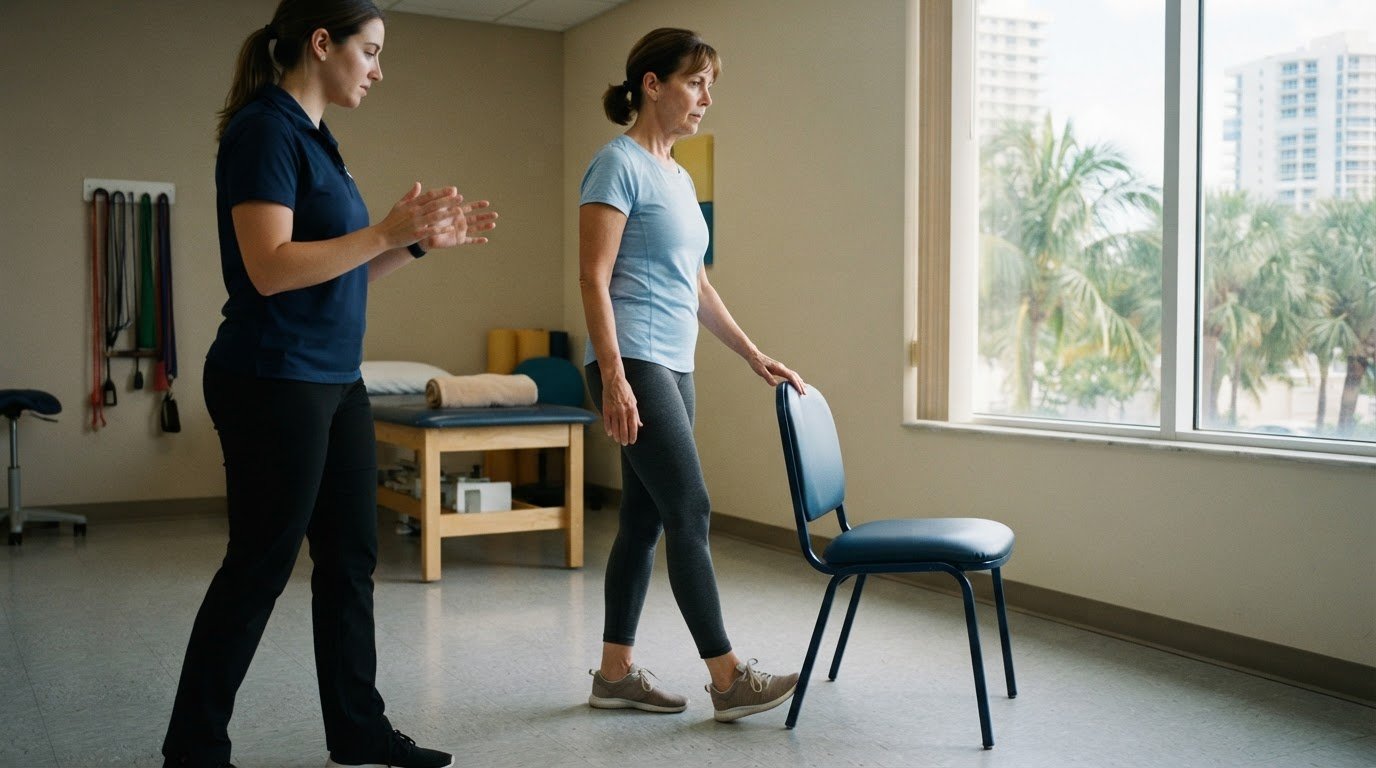
A balance exercise doesn’t need to be complicated to be useful. A practical starting point for exercises to improve balance and coordination for adults is heel-to-toe walking for at least 5 steps, practiced beside a stable chair or wall for support.
If you feel cautious about standing or stepping, that’s understandable. Support can help you practice with greater confidence, especially when movements reflect everyday tasks such as turning in the kitchen or stepping around objects at home.
This guide covers heel-to-toe walking, weight shifts, and single-leg balance, with chair-supported options to make each movement more accessible. You’ll also learn how to match exercises to daily challenges and build up gradually.
Key Takeaways
- Practice balance near a stable support, and seek guidance from a healthcare professional before starting if you have serious balance concerns or a condition affecting your bones, joints, or muscles.
- Use controlled weight shifts and brief single-leg holds to build steadiness, keeping your hips level and your standing knee slightly bent.
- Choose movements that mirror everyday tasks, such as turning, stepping around objects, or reaching while standing.
- Begin with manageable repetitions and gradually increase them as your control improves.
- For exercises that feel difficult to adapt safely, balance and gait rehabilitation can help tailor practice to your needs.
Heel-to-toe walking
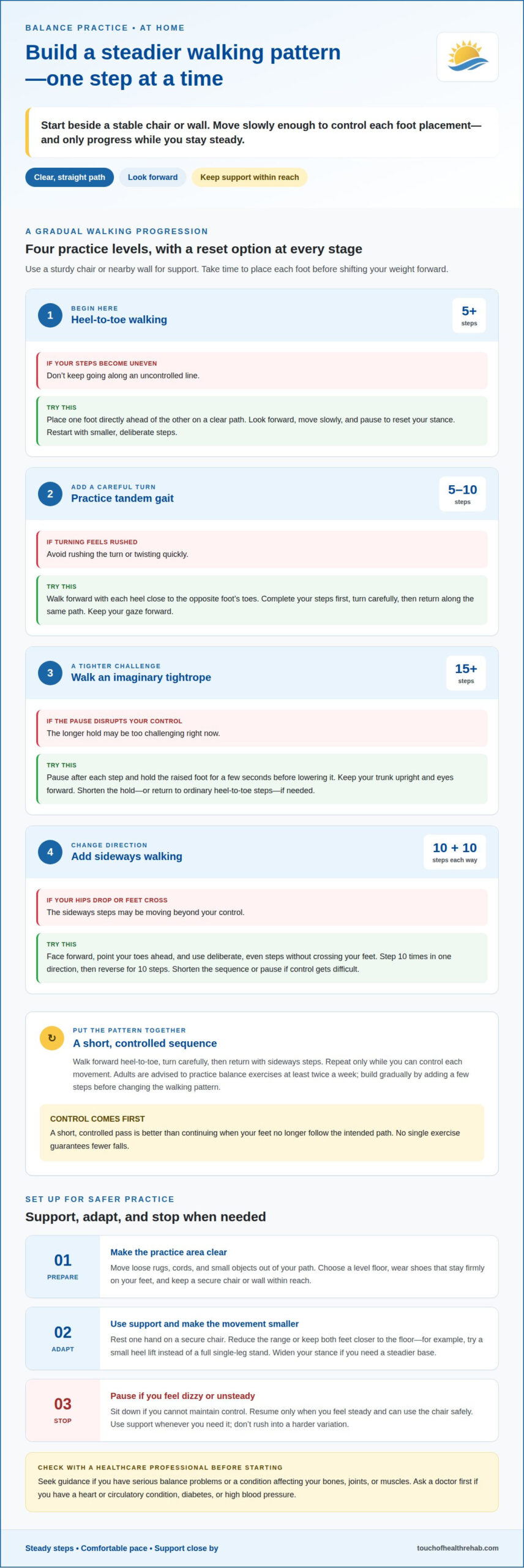
A beginner routine can start with 5 heel-to-toe steps, then add controlled turns and sideways walking. Tandem gait and side-stepping also practice balance used in everyday walking, though no single exercise guarantees fewer falls.
- Walk heel-to-toe along a clear, straight path, placing one foot directly ahead of the other. Begin with at least 5 steps, and look forward rather than down. Move slowly enough to control each foot placement. If your steps become uneven, pause, reset your stance, and continue with smaller steps.
-
Practice Tandem Gait and Turns
Walk forward in a straight line, placing each heel close to the opposite foot’s toes. Try 5 to 10 steps, then turn carefully and return along the same path. Keep your gaze forward during the walking movement. Avoid rushing the turn or twisting quickly; steady foot placement matters more than covering distance.
-
Walk a Tightrope
Use an imaginary line for a tighter tandem-walking challenge. Take at least 15 steps, pausing after each step and holding the raised foot for a few seconds before lowering it. Keep your trunk upright and eyes forward. If the pause disrupts your control, shorten the hold or return to ordinary heel-to-toe steps.
-
Add Sideways Walking
Stand facing forward and step sideways for 10 steps, then reverse direction for 10 steps. Keep your toes pointing ahead and avoid dropping your hips as you step. Use deliberate, even movements instead of crossing your feet. If the path ends sooner, walk from one side of the room to the other.
- Combine the movements into a short sequence: walk forward heel-to-toe, turn, then return with sideways steps. Repeat only while you can control each movement. Adults are advised to practice balance exercises at least twice a week. Increase the challenge gradually, for example, by adding a few steps before changing the walking pattern.
During each heel-to-toe pass, take time to place your next foot before shifting your weight forward. Look ahead rather than down at your feet. If your line becomes uneven, stop and regain a comfortable stance before restarting with smaller, deliberate steps. A short, controlled pass is better than continuing when your feet no longer follow the intended path. When adding a turn, finish the forward steps first, change direction carefully, then resume at a pace you can control.
For sideways walking, face forward as you step in one direction, then return the other way. Avoid dropping your hips or crossing your feet, and place each foot deliberately. If the steps become difficult to control, shorten the sequence or pause and reset. You can combine the movements by walking heel-to-toe, turning carefully, and side-stepping on the return. Look ahead during the heel-to-toe portion, and continue only while each movement stays controlled. Progress gradually by adding a few steps before making the pattern more challenging.
Safety and chair-supported modifications
A sturdy chair or nearby wall can support balance practice; no specialized equipment is needed. Speak with a healthcare professional before starting if you have serious balance problems or a condition affecting your bones, joints, or muscles. Ask a doctor first if you have a heart or circulatory condition, diabetes, or high blood pressure.
-
Use a Chair for Support
Place a secure chair beside you before trying a standing exercise. Rest one hand on its back, then try a movement such as lifting one foot a short distance. Keep your body upright and the chair within reach. If you feel wobbly, use both hands or sit down before adjusting your position.
-
Modify Exercises and Practice Safely
Make a movement easier by reducing its range or keeping both feet closer to the floor. For example, replace a full single-leg stand with a small heel lift while holding the chair. Keep your feet together only if you feel in control; widen your stance for a steadier base. Don’t rush into a harder variation.
- Prepare the practice area before standing. Move loose rugs, cords, and small objects out of your path, and choose a level floor with a wall or secure chair nearby. Wear shoes that stay firmly on your feet. Position the chair within easy reach, and keep essential items outside the exercise area.
- Choose support that suits the movement. For a standing weight shift, hold the chair with one hand and gently move your hips from side to side. For a supported one-leg position, hold the chair and lift the opposite foot only as far as you can control. Place both feet on the floor before changing sides.
- Stop the movement if you become dizzy, feel unsteady, or cannot maintain control. Sit down, then resume only when you feel steady and can use the chair safely. If these concerns make independent practice difficult, balance and gait rehabilitation can help tailor exercise support to your needs.
People doing standing balance exercises should stay near a wall, table, or secure chair for support if they feel wobbly. Choose the support before beginning, and position yourself so it is within reach throughout the movement. A wall, table, or chair can provide a steady point to hold while you make a smaller, more controlled movement. If the available support does not feel secure or you cannot reach it comfortably, adjust your position before continuing. Keep your attention on maintaining control rather than trying to complete a larger movement, and use the support whenever you need it.
For a flamingo stand, lean on a chair, countertop, or wall for extra support. Steady yourself as you raise one foot only as far as feels manageable. If you feel wobbly, keep hold rather than trying to balance without support. Make the movement gentler by lifting your foot only slightly, then placing it down before changing sides. If you cannot stay in control, stop and sit down. Support helps you adapt the exercise to what feels steady; you do not need to attempt a harder position. Resume only when you feel steady and can reach your support safely.
Single-leg stability and weight-shifting activities
Tai chi may improve balance and stability and make people less likely to fall. Try controlled movements from tai chi, yoga, or strength training only if you can maintain a steady standing position.
-
Practice Single-Leg Stands
Stand beside a stable support, shift your weight onto one foot, and lift the opposite foot. Hold the position for 5 to 10 seconds, keeping your hips level and your standing knee slightly bent. Lower your foot with control, then repeat on the other side. Perform 3 lifts on each side, and use support rather than forcing a longer hold.
-
Pass Weight While Balancing
Stand with your feet apart and shift your weight slowly from one leg to the other. Keep each foot planted as your body moves over it, then pause in the balanced position for up to 30 seconds while maintaining good form. Avoid leaning your shoulders far beyond your feet. This movement trains controlled weight transfer without adding a step.
- Build single-leg stability gradually. Start with a brief lift and a light handhold, reducing your support only when you can stand steadily. Fix your gaze on a point ahead rather than turning your head during the hold. If your hips tilt or your supporting foot shifts, lower the lifted foot and reset.
- Use a repeatable sequence to practice both sides evenly. Complete 3 lifts on one leg, place both feet down, then switch legs for 3 lifts. Hold each lift for 5 to 10 seconds, and rest between sides if your leg muscles begin to fatigue. Aim for smooth starts and finishes; a controlled return to standing is part of the movement.
- Make the exercise more challenging by changing one element at a time. For example, first loosen your grip on the support, then try holding the position slightly longer while keeping your hips level. Don’t add reaching or turning until the basic stance is controlled. The goal is to improve stability through precise weight shifts, not to test how long you can resist wobbling.
- Choose tai chi, yoga, or strength movements that suit your current ability. Tai chi uses deliberate weight transfers; a standing yoga pose may involve holding one position, while strength exercises can include controlled leg movements. Keep stable support nearby, and stop if you can’t maintain alignment. A movement is useful practice when you can perform it with control.
Matching balance exercises to functional challenges at home
Practice balance exercises at least twice a week; a daily balance-and-strength routine takes only a few minutes. Match each movement to a challenging task at home, such as turning in the kitchen or reaching for an item.
- Identify one specific task before choosing an exercise. For example, an adult who had 2 falls in the kitchen might focus on controlled turns and stepping around obstacles. Notice which part feels difficult: changing direction, shifting weight, or placing a foot accurately. That detail helps you select a movement that practices the needed action.
- If reaching while standing is difficult, practice a small forward weight shift beside stable support. Move your body forward without letting your feet slide, then return to the starting position. Stay in control and stop where your balance remains steady. This rehearses shifting your center of weight without adding an unfamiliar step.
- If turning around furniture feels uncertain, practice changing direction gradually in a clear area. Take several small steps through the turn instead of pivoting quickly on one foot. Look toward the space ahead as you move. This rehearses the sequence for turning from a counter toward a table.
- For trouble placing your foot around household objects, use clock toe-taps to practice direction and precision. Tap one foot forward, return it to the starting position, then try a comfortable diagonal or side direction. The target distance can be around 30 centimeters, or whatever feels comfortable. Keep the tap small enough to maintain control.
- If stepping over a threshold feels difficult, practice a slow step over a low, stable marker in a clear space. Lift your foot enough to clear it, place it deliberately, then return the same way. Avoid loose objects that might shift underfoot. Older adults can adapt the distance and height to the task they want to practice at home.
- Focus on one practical goal at a time, such as turning safely from the kitchen counter or stepping over a doorway threshold. Practice the chosen movement at least twice a week, adjusting its direction or range only when your control stays consistent. This keeps the routine connected to daily activities instead of adding harder movements without a purpose.
Best At-Home Balance Exercises for Adults
- Begin with standing marches beside a stable support. Lift one knee, lower it with control, then alternate legs. Start with 5-10 repetitions per leg, keeping your trunk upright instead of leaning backward. This movement practices shifting weight from foot to foot while lifting each leg. Reduce the lift height if you struggle to stay steady.
- Add calf raises to practice rising onto your toes. Hold the raised-heel position for 8 to 12 seconds, then lower your heels slowly. Keep your weight balanced across both feet and use a chair for support if needed. A controlled descent matters; avoid dropping your heels quickly after the hold.
- Try rock-the-boat to practice transferring weight between sides. Shift onto one leg and lift the opposite foot, holding it for 10 to 30 seconds, or as long as you’re able. Work toward 3 to 5 sets of 5 to 10 repetitions on each side. Keep the movement within a range you can control.
- Use a simple grapevine to practice crossing steps. Step sideways, then bring the trailing foot across, completing 5 cross-steps on each side. Take smaller steps for more balance practice, and keep a clear path around you. Avoid rushing the sequence or crossing your feet farther than your control allows.
- Practice step-ups on a stable step, moving up and down slowly. Complete up to 5 steps with each leg, placing your whole foot securely before shifting your weight. Use a hand support if needed, and avoid bouncing or dropping quickly. This exercise rehearses controlled changes in height, as when stepping onto a low threshold.
- For clock toe-taps, stand near support and tap one foot forward, then return it. Aim about 30 centimeters ahead, or choose a comfortable distance. Add side and diagonal taps while keeping your standing leg steady. Start with the direction that feels easiest, then include another direction only while your posture stays controlled.
- Choose two or three movements for a manageable home sequence, such as marches, calf raises, and toe-taps. For most older adults, a balance session can include 2 or 3 sets of each exercise. Build up gradually by increasing repetitions over time, rather than making every movement harder at once. Explore support for balance exercise and rehabilitation if you need help adapting movements to your needs.
Touch of Health Rehab: Balance and Gait Rehabilitation
Touch of Health Rehab Inc. offers Balance and Gait Rehabilitation to help you address challenges with steadiness, walking, and movement. If home exercises feel difficult to adapt, or balance concerns affect everyday tasks, guided physical therapy can help tailor practice to your needs. Postural Education may support better awareness of body position, while Vestibular Rehabilitation addresses balance concerns related to the vestibular system. Your care can focus on practical goals, such as moving more confidently through daily activities, with exercise choices suited to your abilities and progress.
Contact Touch of Health Rehab Inc. to discuss support for your balance and walking goals.
Choose a Next Step That Fits Your Daily Life
Let a meaningful daily goal guide your next exercise. You might want to feel steadier when turning, reaching, or moving through a familiar room. A plan of exercises to improve balance and coordination for adults can reflect these priorities while respecting your current comfort and control. Choose exercises to improve balance and coordination for adults that connect to movements you want to manage in daily life. Notice which activities feel manageable and where you need more support. Use that insight to progress gradually instead of making every exercise harder at once.
If professional guidance would be helpful, Touch of Health Rehab offers Physical Therapy, Postural Education, and Vestibular Rehabilitation. These services can address different needs connected with posture, movement, and balance. You can discuss your daily goals and the challenges you’d like to work on, then consider a suitable next step with a care professional. Progress is personal, and a steady approach can support greater confidence. Contact Touch of Health Rehab Inc. to talk about support for your balance goals.
Frequently Asked Questions
What exercises improve coordination in adults?
Try stepping over a line of 4 to 6 cones, then weave around them at a controlled pace. This combines foot placement with direction changes. Begin with widely spaced markers and a clear route, focusing on accurate steps rather than speed. If you lose the sequence, pause and restart from the beginning. You can also practice reaching toward targets while standing, keeping movements smooth and deliberate.
How can adults safely progress balance and coordination exercises?
Progress only when you can repeat a movement with steady control. Keep a simple record of the exercise, repetitions, and support used, then compare sessions to see whether your form stays consistent. Adjust one feature at a time, such as the direction of a step. For example, add a diagonal toe tap before increasing the movement’s speed or range.
What are the risks and precautions for balance exercises, especially for older adults?
The main concern is losing balance during a movement, and fall risk increases for adults after age 65. Avoid adding challenging conditions, such as closing your eyes or using an unstable surface, before you can control easier movements. People with serious balance problems or conditions affecting bones, joints, or muscles should get healthcare professional approval first. Stop if you cannot maintain steady control.
What equipment is useful for balance exercises, and how much does it cost?
A sturdy chair or nearby wall can provide support; no specialized equipment is needed.