
That sudden, violent spin you feel when your head hits the pillow isn’t usually a sign of a brain issue; it’s actually a mechanical “plumbing” problem inside your inner ear. If you’ve been searching for what causes dizziness when lying down and turning over, you’re likely familiar with the jarring sensation of the room tilting the moment you try to rest. It’s an experience that can leave you feeling anxious about your health and hesitant to even get into bed at night.
We understand how frightening it is when your sense of balance betrays you, especially when it disrupts your sleep and triggers waves of morning nausea. You’re not alone in this struggle, as research shows nearly 86% of people with this condition find it significantly impacts their daily activities. The good news is that this common form of vertigo is highly treatable through specialized physical therapy rather than long-term medication or invasive procedures.
In this guide, you’ll discover the science behind Benign Paroxysmal Positional Vertigo (BPPV) and how displaced “ear crystals” create these dizzy spells. We’ll explain the professional techniques used to restore your balance and provide a preview of safe movements you can use to find relief. By understanding the path to recovery, you can reclaim your confidence and return to a life of steady, vibrant movement here in Sunny Isles Beach.
Key Takeaways
- Understand the crucial difference between simple lightheadedness and true vertigo, which is the false sensation of movement or spinning.
- Discover exactly what causes dizziness when lying down and turning over, focusing on the role of dislodged calcium carbonate crystals within your inner ear.
- Learn how professional maneuvers like the Epley Maneuver work to reposition these crystals and restore your natural sense of balance.
- Gain insights into why specialized vestibular rehabilitation is essential for identifying the specific canal affected and ensuring a safe, effective recovery.
- Find out how a personalized therapy plan in Sunny Isles Beach can help you overcome the fear of falling and return to your normal morning routine.
Understanding the ‘Spinning’ Sensation: Why Dizziness Occurs When Lying Down
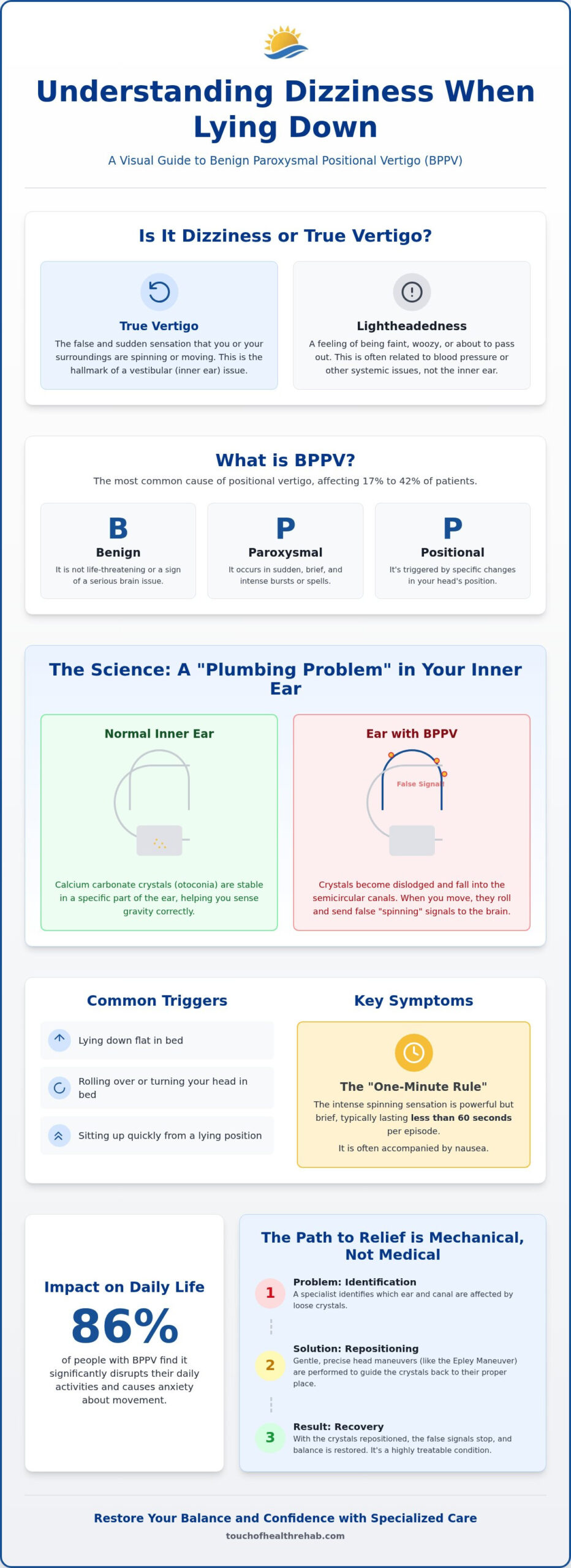
Many people use the word “dizzy” to describe everything from feeling lightheaded to a full-blown room spin. However, clinical vertigo is a very specific sensation. It’s the false feeling that you or your surroundings are moving. If you are investigating what causes dizziness when lying down and turning over, you are likely dealing with a mechanical issue in your inner ear. Your vestibular system acts like a sophisticated GPS for your body; it uses fluid and tiny sensors to tell your brain where your head is in space. When this system is disrupted, your brain receives conflicting signals that result in that disorienting “spinning” sensation. Between 17% and 42% of patients seeking help for vertigo are eventually diagnosed with BPPV, so you are certainly not alone in this experience.
One hallmark of this specific type of dizziness is the “one-minute rule.” Unlike other medical conditions that cause constant imbalance, positional vertigo usually lasts for less than sixty seconds. It hits hard when you move, then settles as the fluid in your ear stops moving. This brief but intense window is often the most frightening part, but knowing it will pass quickly can help lower the immediate anxiety you feel during an episode. At Touch of Health Rehab Inc., we focus on helping you recognize these patterns so you can move with more confidence and less fear throughout your day.
What is Benign Paroxysmal Positional Vertigo (BPPV)?
Benign Paroxysmal Positional Vertigo (BPPV) is the most common diagnosis for this sensation, especially for adults over 50. Let’s break that down: “Benign” means it isn’t life-threatening; “Paroxysmal” means it comes in sudden, brief bursts; and “Positional” means it’s triggered by specific head movements. While the fear of a stroke or brain issue is a natural response to a spinning room, BPPV is a localized problem in the ear rather than a neurological crisis. Understanding this distinction is the first step toward emotional relief and physical recovery. It allows us to focus on the mechanics of the ear rather than the mysteries of the brain.
Common Triggers in the Bedroom
Sleep should be a time of restoration, yet the bedroom is where BPPV symptoms are often most aggressive. Lying flat allows gravity to pull displaced crystals into sensitive areas of your ear canals. Rolling onto your side often provides the specific “sloshing” motion that triggers a fresh wave of vertigo. Even sitting up quickly can cause a “rebound” effect that makes the morning feel overwhelming. Our specialized vestibular rehabilitation at Touch of Health Rehab Inc. helps you navigate these movements safely while we work to resolve the underlying cause. We believe that every person deserves a peaceful night’s sleep and a morning free from the fear of falling.
The Science of BPPV: How Dislodged ‘Ear Crystals’ Disrupt Your Balance
To understand why your world starts spinning, it helps to imagine a snow globe. When the globe sits still, the glitter rests quietly at the bottom. If you shake it or turn it over, the glitter swirls through the liquid, taking time to settle back down. Your inner ear functions in a very similar way. When you investigate what causes dizziness when lying down and turning over, you are looking at the movement of tiny “glitter” particles called otoconia. As explains Johns Hopkins Medicine, these are microscopic crystals of calcium carbonate that normally sit in a specific part of your inner ear to help you sense gravity.
The problem begins when these crystals become loose and fall into the semicircular canals, which are the fluid-filled loops responsible for detecting rotation. When you lie down or roll over, these loose crystals roll through the canal like pebbles in a pipe. This movement pushes the fluid in your ear, sending a powerful but false signal to your brain that your head is spinning rapidly. Because your eyes and your body’s sensors tell your brain that you are actually lying still, this conflict of information creates the jarring, nauseating sensation of vertigo. It’s a mechanical error, not a permanent illness, and it’s something we can address at Touch of Health Rehab Inc. through precise physical movements.
The Mechanics of the Inner Ear
Your inner ear contains the utricle, which is the “home” where otoconia are supposed to stay, and three semicircular canals positioned at different angles. These canals use a fluid called endolymph to move tiny hair cells that communicate with your brain. When dislodged otoconia stimulate the nerves in your semicircular canals, your brain triggers nystagmus, an involuntary rhythmic eye movement, as it attempts to track a motion that isn’t actually happening. This eye movement is the physical proof that your vestibular system is receiving “ghost” signals from the displaced crystals. Identifying which of the three canals the crystals have entered is the first step in our vestibular rehabilitation process.
Why Crystals Become Dislodged
Crystals don’t usually wander out of place without a reason. As we age, the protein “glue” that holds these otoconia in the utricle can weaken, making BPPV more common in adults over 50. However, head trauma is another significant factor; even a minor bump or a sudden jar to the head can knock these particles loose. We also see cases following prolonged periods of bed rest, such as after a surgery or a long illness, where gravity has had more time to pull the crystals into the canals. If you’ve recently dealt with a fall or a minor injury, the experts at Touch of Health Rehab Inc. can help determine if your symptoms are linked to crystal displacement through expert vertigo recovery. We focus on getting those crystals back where they belong so you can move without hesitation.
Identifying the Triggers: Is Your Vertigo Positional or Something More?
While the mechanics of dislodged crystals explain most cases of Benign Paroxysmal Positional Vertigo (BPPV), it’s vital to ensure your symptoms don’t point toward another vestibular issue. When you’re trying to figure out what causes dizziness when lying down and turning over, keeping a “dizziness diary” is your most powerful tool. Record when the spin starts, how long it lasts, and what specific movement triggered it. This data helps your therapist distinguish between BPPV and conditions like Meniere’s Disease, which often includes hearing loss and longer-lasting episodes — and for which physical therapy for Meniere’s disease offers a specialized path to restoring balance — or Vestibular Neuritis, which typically causes constant dizziness that doesn’t stop when you hold still and for which vestibular neuritis physical therapy provides a targeted approach to retraining your brain’s balance responses.
In some cases, the issue isn’t in your ear at all, but in your neck. Cervicogenic dizziness can occur when tight muscles or joint issues in the upper cervical spine send faulty signals about your head position to your brain. This often feels more like a sense of “off-balance” rather than a violent spin. Because the systems for balance and vision are so closely linked, even slight neck tension can disrupt your equilibrium. This is why we prioritize a holistic view of your health, often incorporating balance and gait rehabilitation to ensure your body feels grounded once the initial spinning is resolved.
For many of our neighbors in Sunny Isles Beach, especially seniors, the real danger of dizziness is the risk of a tumble. We bridge the gap between treating the “spin” and ensuring you can walk safely through your home. Addressing the root cause is only half the battle; the other half is fall prevention therapy to restore your confidence and physical stability. We believe that recovery is a collaborative journey that goes beyond just stopping the symptoms.
Self-Assessment: Questions to Ask Yourself
- Does the spinning sensation last less than 60 seconds?
- Is the dizziness only triggered by specific head movements, like rolling over or looking up?
- Do you feel steady once you are standing and walking, or is your balance constantly off?
When Dizziness is an Emergency
While BPPV is uncomfortable, it isn’t a medical emergency. However, we want you to stay safe. Seek immediate care in Sunny Isles Beach or North Miami if you experience any of the “5 Ds”: Double vision, Difficulty speaking (dysarthria), Difficulty swallowing (dysphagia), severe Dizziness that won’t stop, or Drop attacks. If you aren’t experiencing these red flags, a professional vestibular rehabilitation evaluation is the safest next step before you try any home maneuvers that might inadvertently move crystals into the wrong canal.
How to Find Relief: Vestibular Exercises and the Epley Maneuver
Understanding what causes dizziness when lying down and turning over is the first step toward recovery, but the second step is taking physical action to guide those crystals back home. The primary goal of treatment is repositioning. We want to move the loose otoconia out of the semicircular canals and back into the utricle, where they can no longer disrupt your fluid dynamics. While your body can sometimes reabsorb these crystals on its own, professional vertigo recovery techniques significantly speed up this natural healing process, often providing relief in just one or two sessions.
Safety is our absolute priority during this process. Because these maneuvers intentionally trigger a brief window of vertigo to move the crystals, you should always perform them in a controlled environment. We recommend having a partner present or working directly with a therapist to prevent falls. When done correctly, these exercises don’t just stop the spinning; they help your brain “re-calibrate” and ignore the lingering false signals that often cause a sense of “fuzziness” even after the main vertigo has passed.
The Epley Maneuver: A Step-by-Step Guide
The Epley maneuver is the gold standard for clearing the posterior semicircular canal. To prepare, clear a space on your bed and place a pillow so that when you lie back, it sits under your shoulders rather than your head. This allows your neck to extend slightly. Follow this sequence carefully:
- Step 1: Sit upright on the bed and turn your head 45 degrees toward the side that triggers the dizziness.
- Step 2: Lie back quickly so your shoulders rest on the pillow and your head is reclined at a 30-degree angle. Hold this position for at least 30 seconds or until the spinning stops.
- Step 3: Without raising your head, turn it 90 degrees toward the opposite side. Hold for another 30 seconds.
- Step 4: Roll your entire body onto your side in the direction your head is facing, so you are now looking toward the floor. Hold for 30 seconds.
- Step 5: Carefully sit up on the side of the bed.
Brandt-Daroff Exercises for Home Habituation
While the Epley maneuver is a repositioning tool, Brandt-Daroff exercises are used for habituation. These are ideal for individuals who have lingering sensitivity or for those where the Epley maneuver isn’t immediately appropriate. The method involves “repeating and desensitizing.” You move into the dizzy-triggering position, wait for the spin to subside, and then move to the other side. This repetition trains your brain to accommodate the signals from your inner ear. It’s normal to feel a temporary increase in dizziness during the first few repetitions, but this typically diminishes as your nervous system learns to compensate. If you’re feeling overwhelmed by the process, our experts in vestibular rehabilitation can guide you through these movements with one-on-one support.
Professional Recovery: Vestibular Rehabilitation in Sunny Isles Beach
While the home exercises discussed earlier provide a great starting point, many people find that their symptoms linger or return unexpectedly. This often happens because it’s difficult to self-diagnose which of the three semicircular canals is housing the displaced crystals. If you’ve been struggling to figure out what causes dizziness when lying down and turning over, professional intervention at Touch of Health Rehab Inc. is the most reliable way to find lasting relief. Our specialized vestibular rehabilitation program is designed to move beyond guesswork and target the precise mechanical cause of your vertigo.
Our approach doesn’t stop once the room stops spinning. We recognize that even a brief episode of vertigo can leave you feeling unsteady and anxious about your next move. By integrating balance and gait training into your recovery, we help you regain the confidence to move freely again. Your journey at Touch of Health Rehab Inc. starts with a physical therapy plan that is uniquely yours, focusing on total restoration rather than just symptom management. We believe that healing is a collaborative effort between our experts and the individuals we serve.
The Clinical Advantage: One-on-One Specialized Care
Precision is everything when it comes to the inner ear. Our therapists in Sunny Isles Beach utilize the Dix-Hallpike test to observe involuntary eye movements, which tells us exactly where those crystals are hiding. This clinical accuracy ensures that the maneuvers we perform at Touch of Health Rehab Inc. are effective from the very first session. We also address secondary issues like the intense neck stiffness that develops when you’re afraid to move your head. Our expert team works as your dedicated guide, addressing both the physical and emotional hurdles of your recovery journey with compassion and authority.
Long-Term Wellness and Fall Prevention
For our neighbors in Sunny Isles Beach and Aventura, maintaining an active, independent lifestyle is a top priority. We ensure that a temporary bout of dizziness doesn’t lead to a permanent loss of confidence. By incorporating fall prevention therapy into your routine, we strengthen your body’s ability to stay upright even in challenging environments. We also provide postural education to help you understand how your daily movements affect your vestibular health over the long term. Taking the next step is simple; scheduling an evaluation at our clinic is the most direct path back to a life of stability and peace of mind.
Reclaim Your Balance and Peace of Mind
You now understand that what causes dizziness when lying down and turning over is typically a mechanical issue within your inner ear rather than a serious neurological threat. By identifying the specific canal where crystals have wandered, you can stop the spinning and start the journey toward restoration. Whether through targeted maneuvers like the Epley or personalized habituation exercises, relief is well within your reach. Our expert vestibular rehabilitation specialists are here to serve residents of Sunny Isles, Aventura, and North Miami Beach with compassionate care plans tailored to your unique path to health.
You don’t have to navigate this disorienting experience alone. We are dedicated guides, ready to help you move with confidence and wake up every morning feeling steady and grounded. Stop the room from spinning; schedule your specialized vestibular evaluation in Sunny Isles Beach today. Your path to long-term vitality starts with a single step toward professional care. We look forward to partnering with you on your journey back to peak physical health and lasting stability.
Frequently Asked Questions
Can BPPV go away on its own without treatment?
Yes, BPPV can eventually resolve on its own as your body naturally reabsorbs the displaced crystals, but this process often takes several weeks or even months. During this waiting period, you remain at a significantly higher risk for falls and persistent nausea. Seeking professional vestibular rehabilitation usually resolves the issue in just a few targeted sessions, allowing you to return to your daily life without the constant fear of a sudden dizzy spell.
Why is my dizziness worse in the morning when I first wake up?
Your dizziness is often most intense in the morning because the displaced crystals have had several hours to settle in one part of your ear canal while you slept. The first major movement you make, such as sitting up or rolling over to reach for your phone, sends those crystals tumbling through the canal fluid all at once. This creates a powerful false signal to your brain, which is a primary reason people search for what causes dizziness when lying down and turning over.
Is it safe to drive if I have positional vertigo?
You should avoid driving if your vertigo is actively being triggered by head movements or if you feel a lingering sense of unsteadiness. While positional vertigo episodes are brief, a sudden “spin” while you are checking your blind spot or navigating a busy intersection could lead to a dangerous loss of control. It is much safer to wait until a specialist has confirmed the crystals are repositioned and your balance has been fully restored through professional therapy.
How many sessions of vestibular rehabilitation are usually needed?
Most patients experience significant relief from BPPV within one to three specialized treatment sessions. While the initial repositioning maneuver often provides immediate results, follow up visits allow us to ensure the crystals remain in the “safe zone” and address any secondary balance issues. We focus on a methodical approach that prioritizes your long term stability, ensuring you feel completely confident in your physical movements before concluding your personalized care plan.
Can stress or dehydration cause dizziness when lying down?
Stress and dehydration don’t typically cause the mechanical displacement of ear crystals, but they can certainly make your vertigo symptoms feel much more severe. Dehydration can affect the fluid volume and density within your inner ear, while stress heightens your nervous system’s sensitivity to conflicting balance signals. Maintaining proper hydration and managing your stress levels are excellent ways to support your vestibular health and improve your overall resilience during the recovery process.
What should I do if the Epley Maneuver makes me feel nauseous?
Feeling nauseous during the Epley Maneuver is a common reaction because the exercise is intentionally moving the crystals that trigger your vertigo. If the sensation is overwhelming, it is best to perform these maneuvers under the direct guidance of a professional who can provide physical support and pacing. We use specific clinical techniques to help manage this discomfort, ensuring the treatment remains a positive and productive step toward your ultimate healing.
Is dizziness when turning over a sign of a stroke?
Dizziness that only occurs with specific head movements is rarely a sign of a stroke, but we always prioritize your safety by screening for other neurological symptoms. A stroke typically presents with “red flag” signs such as slurred speech, facial drooping, or sudden weakness in your limbs. If your spinning is brief and only happens when you are investigating what causes dizziness when lying down and turning over, it is much more likely to be a localized inner ear issue.
Can I do dizziness when turning head exercises by myself at home?
You can perform specific habituation exercises at home once a professional has correctly identified which ear canal is affected and shown you the proper form. Attempting maneuvers without a diagnosis can sometimes move crystals into a different canal, which makes your symptoms more complex and difficult to treat. We provide you with a clear, safe roadmap for home care after your initial clinical evaluation, empowering you to maintain your progress and prevent future episodes independently.