Imagine waking up, shifting your weight to get out of bed, and suddenly feeling like the entire room is spinning out of control. It’s a terrifying moment that often leads to a morning of nausea and a lingering fear that something is seriously wrong with your health. If you’ve spent your morning searching for what causes dizziness when lying down and turning over, you aren’t alone. Approximately 1 in 5 adults face this unsettling sensation every year, often worrying it might be a sign of a stroke or a permanent loss of balance.
We understand how this spinning can steal your confidence and make even a simple night’s sleep feel like a gamble. It’s exhausting to live with the constant anxiety of a potential fall. The good news is that this sensation is rarely a sign of a dangerous illness; instead, it’s usually a mechanical issue within your inner ear that we can resolve together. In this guide, you’ll discover why your internal GPS is misfiring and how specialized vestibular therapy at Touch of Health Rehab can restore your stability. We’ll explore the common causes of vertigo, explain how our experts in Sunny Isles Beach and Aventura provide relief, and show you the path back to a life of steady, confident movement.
Key Takeaways
- Identify why displaced inner ear crystals are often what causes dizziness when lying down and turning over, transforming a routine movement into a disorienting spin.
- Learn to recognize the “5 Ds” of vertigo red flags to help you distinguish between a mechanical ear issue and more serious conditions that need urgent care.
- Understand how specialized canalith repositioning maneuvers work to gently guide your body’s internal GPS back into alignment for rapid, non-invasive relief.
- Discover how a collaborative, personalized approach to vestibular rehabilitation can help you overcome the fear of falling and regain your morning vitality.
Understanding the Sensation: Why the Room Spins When You Turn Over
The moment your head hits the pillow or you roll over to reach for the alarm, the world suddenly tilts. This isn’t the vague lightheadedness you might feel after standing up too quickly. Instead, it’s a distinct, violent sensation of motion, as if you’re on a carousel that won’t stop. When patients visit us at Touch of Health Rehab to ask what causes dizziness when lying down and turning over, they’re often describing true vertigo. Unlike general dizziness, vertigo creates a false sense that you or your surroundings are spinning, tilting, or swaying. It’s an illusion of movement that can leave you feeling physically and emotionally drained.
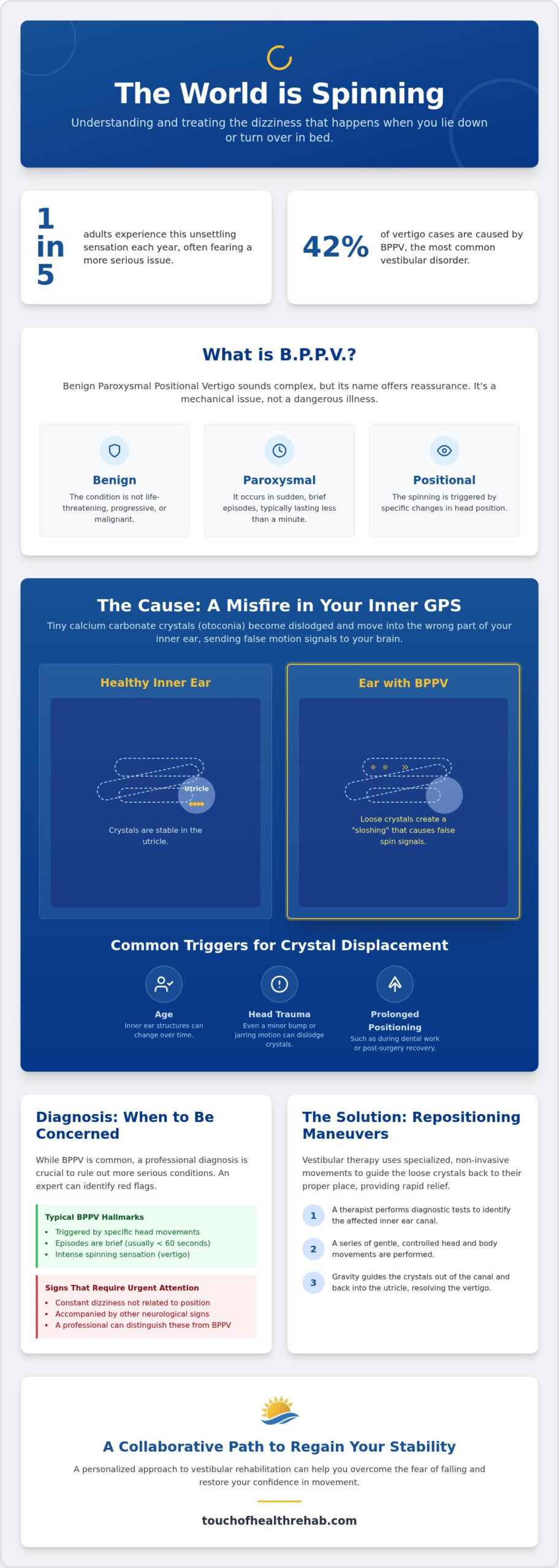
While this experience is incredibly disorienting, it’s frequently the result of a condition known as Benign Paroxysmal Positional Vertigo (BPPV). This is the most common peripheral vestibular disorder, accounting for up to 42% of vertigo cases seen in clinics. The good news is that while the sensation is intense, it’s remarkably responsive to the right clinical care. We view this not as a permanent illness, but as a mechanical hurdle that we can clear together through specialized treatment.
Is Dizziness When Lying Down Normal?
Occasional dizziness happens to everyone, but frequent episodes triggered by head position changes are a clear signal from your vestibular system that something is out of balance. This isn’t just a minor annoyance; it actively disrupts your sleep hygiene and leaves you feeling exhausted before your day even begins. In our South Florida community, particularly among the active senior population in Sunny Isles Beach and Aventura, these symptoms can lead to a dangerous cycle of inactivity and an increased fear of falling. Addressing these signals early through vestibular rehabilitation is a vital step in maintaining your independence and long-term vitality.
The “Benign” in BPPV: Why It’s Not Usually Serious
The medical name for this condition can sound intimidating, but breaking down the acronym offers immediate reassurance. “Benign” means the condition isn’t life-threatening or progressive. “Paroxysmal” refers to the sudden, brief nature of the episodes, which usually last less than a minute. “Positional” highlights that the spinning is triggered by specific movements, like tilting your head back or rolling over in bed. BPPV is essentially a mechanical inner ear mismatch where tiny particles have wandered into the wrong canal, rather than a disease or a sign of a stroke.
The Science of the Inner Ear: What Causes the “Crystals” to Move?
Your inner ear houses a sophisticated biological instrument known as the vestibular system. Think of it as your body’s internal GPS. It constantly sends data to your brain about where your head is in space, ensuring you stay upright and balanced. Inside this system, specifically in a small pouch called the utricle, sit tiny calcium carbonate crystals known as otoconia. In a healthy ear, these crystals are weighted and help you sense gravity and linear movement. However, when these crystals become dislodged and migrate into the fluid-filled semicircular canals, they turn your internal GPS into a source of confusion.
When you ask what causes dizziness when lying down and turning over, the answer lies in the unintended movement of these loose particles. As you rotate your head in bed, gravity pulls these crystals through the canal fluid. This movement creates a “sloshing” effect that mimics actual head rotation, sending a false signal to your brain that you’re spinning when you’re actually stationary. This sensory conflict is at the heart of the causes and symptoms of BPPV, creating that brief but intense whirlwind sensation that disrupts your rest.
Common Triggers for BPPV and Dizziness
While crystals can shift for no obvious reason, certain factors make displacement more likely. Age is a significant factor; as we get older, the inner ear structures can become less robust, allowing crystals to detach more easily. Head trauma, even a minor bump or the jarring motion of a car accident, can also shake them loose. We’ve also observed that prolonged periods of inactivity, such as recovery from surgery or long dental procedures where the head is tilted back for an extended time, can increase the risk of crystals migrating into the canals. Understanding these triggers is the first step toward a collaborative journey to health.
The Role of the Semicircular Canals
Your inner ear contains three semicircular canals arranged at different angles to detect all types of movement: up and down, side to side, and tilting. Because these canals are oriented specifically, your dizziness might only happen when you roll to the left or when you look up at a high shelf. This specificity is actually helpful for diagnosis. Our team uses these triggers to identify exactly which canal is affected. By utilizing targeted vestibular rehabilitation, we can create a customized plan to move those crystals back where they belong. If you’re feeling unsteady, our expert balance and gait training offers a supportive environment to regain your footing and your confidence.
Diagnosis and Red Flags: When Dizziness Requires Immediate Attention
It’s natural to feel a wave of anxiety when your balance suddenly fails you. Many of our patients come to us with a deep-seated fear that their symptoms might be a sign of a stroke or another serious neurological event. While Benign paroxysmal positional vertigo (BPPV) is the most frequent reason for these sensations, we prioritize your safety by screening for specific red flags. Determining exactly what causes dizziness when lying down and turning over requires a precise clinical approach to rule out central nervous system issues.
Clinical experts use a simple mnemonic known as the “5 Ds” to identify when dizziness might stem from the brain rather than the inner ear. If you experience any of these alongside your vertigo, you should seek medical attention immediately:
- Diplopia: Double vision or sudden changes in your sight.
- Dysarthria: Slurred speech or difficulty forming words.
- Dysphagia: Sudden difficulty swallowing.
- Dysmetria: A new lack of coordination or clumsiness in your limbs.
- Dizziness: Specifically when it’s constant and accompanied by any of the above.
If your symptoms are brief and only triggered by movement, it’s likely a mechanical issue. To confirm this, we use the Dix-Hallpike maneuver. This gold-standard diagnostic test involves guided head movements that allow us to observe your body’s reaction in a controlled, supportive environment.
BPPV vs. Other Causes of Vertigo
Not all vertigo is created equal. While BPPV is triggered by movement and lasts only seconds, other conditions like Meniere’s Disease or Vestibular Migraines can cause spinning that lasts for hours or even days. Meniere’s often includes a feeling of fullness in the ear or ringing (tinnitus), while Vestibular Migraines might not involve a headache at all. For those seeking a comprehensive vertigo treatment, identifying the duration and triggers of your episodes is the first step in our collaborative journey toward restoration.
What to Expect During a Vestibular Evaluation
When you visit a physical therapist in Sunny Isles Beach for an evaluation, the process is entirely non-invasive and focused on your comfort. We look for “nystagmus,” which are involuntary, rhythmic eye movements that occur when the displaced crystals move through your ear canals. These eye patterns act as a map, telling us exactly which canal the crystals have entered. By observing these subtle signs, we can move from uncertainty to a clear, personalized plan for your recovery.
The Path to Recovery: Vestibular Rehabilitation and Maneuvers
Once we identify the specific canal where those wandering crystals have settled, we can begin the process of guiding them home. The most effective treatment for this condition involves canalith repositioning maneuvers, such as the Epley maneuver. These are not exercises in the traditional sense; they are a precise sequence of head and body movements designed to use gravity to roll the crystals out of the semicircular canals and back into the utricle. By returning these particles to their proper place, we resolve the underlying mechanical issue that is what causes dizziness when lying down and turning over, allowing your brain to receive accurate signals once again.
While it might be tempting to try these movements at home based on a video, professional guidance is vital for a safe recovery. Attempting a maneuver on the wrong side or for the wrong canal can lead to “canal conversion,” where the crystals move into an even more difficult position. When performed by a skilled physical therapist, these repositioning techniques are incredibly successful. Research shows that professional repositioning has a success rate of 80% to 90% within just one or two visits. This rapid relief is a cornerstone of our specialized vestibular care, helping you return to your daily routine with minimal downtime.
Beyond the Maneuver: Comprehensive Balance Training
Many patients find that even after the intense spinning stops, they still feel “off,” “foggy,” or slightly unsteady for several days. This residual dizziness happens because your brain needs time to recalibrate after weeks or months of receiving conflicting data. We address this through balance and gait rehabilitation, which includes gaze stabilization exercises. These movements retrain the connection between your eyes and your inner ear, ensuring your vision remains clear and your footing stays firm as you move through your home or enjoy a walk in Sunny Isles Beach.
At-Home Safety and Postural Tips
The first 24 hours after a successful maneuver are a critical window for your recovery. We often recommend sleeping propped up on a few pillows rather than lying completely flat to ensure the crystals settle firmly back into the utricle. It’s also a good time to clear any trip hazards, like loose rugs or cluttered hallways, to prevent accidental falls while your system resets. Our team integrates postural education into your plan to help you avoid the neck stiffness that often comes from holding your head too rigidly during an episode of vertigo. This holistic approach ensures you don’t just stop the spinning, but also regain the full, comfortable range of motion your body deserves.
Specialized Care in Sunny Isles Beach: The Touch of Health Rehab Approach
Finding lasting relief from the disorientation of vertigo requires more than just a quick maneuver; it requires a partner who understands the nuances of your specific recovery. At Touch of Health Rehab, we’ve established ourselves as the local leader in vestibular health, serving the vibrant communities of Sunny Isles Beach and Aventura. When you’re struggling to understand what causes dizziness when lying down and turning over, you deserve a clinical environment that feels less like a cold hospital and more like a sanctuary for restoration. Our approach is built on a one-on-one therapy model, ensuring that every minute of your session is dedicated to your unique needs and long-term vitality.
We believe that healing is a collaborative journey. Your therapist isn’t just a practitioner but a dedicated guide who works alongside you to attain peak physical health. This personalized attention allows us to identify the subtle mechanical mismatches in your inner ear that generic protocols often miss. We take the time to listen to your history, understand your specific triggers, and monitor your progress with clinical precision. By focusing on the individual rather than just the symptom, we empower you to move past the fear of the next spinning episode and reclaim your active lifestyle. This steady progression from instability to strength is the ultimate goal of our partnership.
A Sanctuary for Healing Near Miami Beach
Located conveniently for residents of Bal Harbor and North Miami Beach, our clinic offers a warm, empathetic atmosphere designed to instill confidence from the moment you walk through our doors. We’ve intentionally moved away from the detached feel of traditional medical settings to create a space where you feel heard and supported. Our lead therapist brings a deep passion for the craft of healing, with a specialized focus on geriatric physical therapy to help our senior neighbors maintain their independence and grace. This commitment to specialized care ensures that your path to recovery is handled with the patience and thoroughness it deserves.
Your First Step Toward a Steady Life
Don’t wait for an accidental fall to take your symptoms seriously. Early intervention is the most effective way to prevent secondary injuries and stop the cycle of anxiety that often accompanies vestibular disorders. Scheduling an evaluation with our compassionate experts is the first step toward a steady, confident life. By addressing the root of what causes dizziness when lying down and turning over today, you’re investing in your future mobility and peace of mind. Schedule your vestibular evaluation today and stop the spinning.
Step Back Into a Life of Steady Confidence
Waking up without the fear of a spinning room is more than a possibility; it’s a goal we can achieve together. By uncovering what causes dizziness when lying down and turning over, you’ve already moved past the uncertainty that often fuels anxiety. We’ve seen how displaced inner ear crystals create a mechanical mismatch in your body’s internal GPS and, more importantly, how specialized vestibular rehabilitation can gently guide them back to where they belong. This process isn’t just about stopping the vertigo; it’s about restoring your vitality and ensuring you feel secure in every movement you make.
At Touch of Health Rehab, we provide a sanctuary for healing where your recovery is our shared priority. Through personalized care in Sunny Isles Beach and compassionate, expert guidance, we help you navigate the recalibration of your balance system with clinical precision. You don’t have to manage this journey alone. Reclaim your balance and schedule a vertigo consultation at Touch of Health Rehab. We’re here to partner with you as you transition from disorientation to lasting stability and peak physical health. Your path to a steady life starts with a single, supported step.
Frequently Asked Questions
Can BPPV go away on its own without treatment?
While you’re searching for what causes dizziness when lying down and turning over, you might also wonder if BPPV resolves on its own. It can occasionally subside as your body reabsorbs displaced crystals, but this can take months. During that time, you’re at a higher risk for falls and anxiety. We recommend professional intervention because a single repositioning session often provides immediate relief. This proactive approach helps you avoid the exhaustion of interrupted sleep and returns you to your daily routine.
Is dizziness when rolling over a sign of a stroke?
While it’s a common fear, dizziness triggered specifically by head movement is rarely a sign of a stroke. Strokes typically cause constant dizziness accompanied by neurological red flags like double vision, slurred speech, or sudden facial drooping. If your spinning only lasts for a few seconds when you move your head, it’s likely a mechanical ear issue. However, if you experience persistent vertigo or any loss of coordination, you should seek medical attention immediately to ensure your safety.
How many physical therapy sessions are needed for BPPV?
Most patients find that their symptoms resolve in just one or two sessions of specialized repositioning. Once the crystals are back in place, the intense spinning usually stops immediately. You might need a few additional visits for balance and gait training if you still feel slightly unsteady. Our goal is to ensure your recovery is thorough, addressing both the mechanical cause and any residual fogginess so you can move with complete confidence and peak physical health.
What should I do if I feel dizzy while lying down at night?
If you’re wondering what causes dizziness when lying down and turning over while you’re trying to rest, the best immediate step is to remain still. Keep your head in a neutral position until the spinning subsides, which usually takes less than a minute. To prevent another episode during the night, try sleeping with your head slightly elevated on two pillows. This elevation helps keep the crystals from drifting into the sensitive canals of your inner ear while you sleep.
Are there exercises I can do at home for dizziness?
You might find Brandt-Daroff exercises recommended online, but it’s vital to receive a professional diagnosis before trying them. Performing the wrong maneuvers can actually push the crystals deeper into the ear canals or move them into a different canal entirely. Once we identify your specific condition, we can provide a personalized home program. These tailored exercises complement your clinical sessions, ensuring your recovery is a collaborative journey that fits your specific needs and long-term vitality.
Why do I feel nauseous when I roll over in bed?
Nausea is your brain’s natural response to a sensory mismatch. When you roll over, the loose crystals in your ear send signals that you’re spinning, but your eyes and muscles report that you’re lying still. This conflict confuses your nervous system, triggering a reaction similar to sea sickness. Resolving the mechanical issue in your inner ear stops these false signals, which in turn settles your stomach and allows you to wake up feeling refreshed and ready for your day.
Can neck problems cause dizziness when lying down?
Yes, a condition called cervicogenic dizziness can occur when the joints or muscles in your neck send incorrect balance information to your brain. This often happens if you’ve been holding your neck stiffly to avoid vertigo triggers. While it feels different from the intense spinning of BPPV, it contributes to a general sense of unsteadiness. Our team integrates postural education into your recovery plan to address these neck-related issues, ensuring your path to health is truly holistic and supportive.
Is it safe to drive if I have positional vertigo?
It’s generally not safe to drive until your symptoms are fully resolved. A sudden head movement, like checking your blind spot or looking at a side mirror, could trigger an intense spinning episode while you’re behind the wheel. This puts you and others at significant risk. It’s much safer to wait until a therapist confirms that your balance is restored. We prioritize your safety and long-term vitality, helping you get back on the road with total confidence and peace of mind.