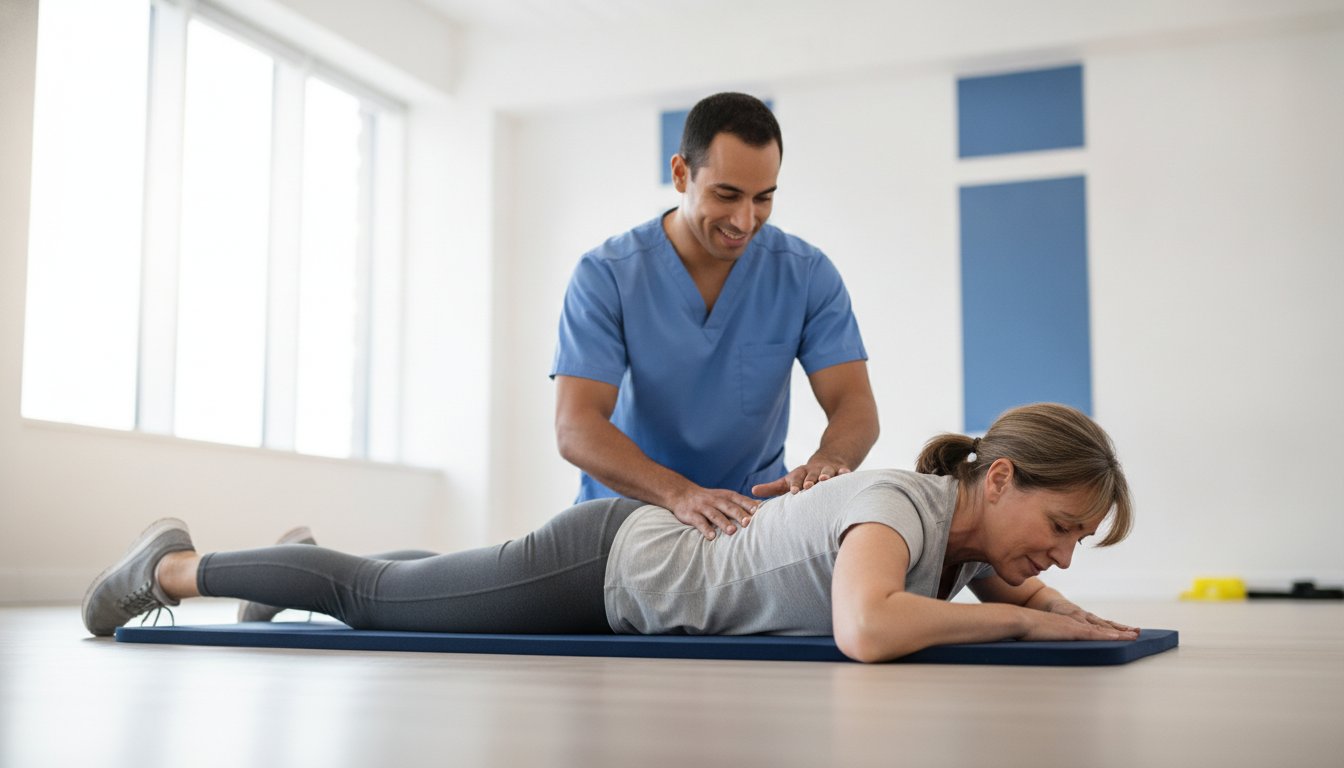
Did you know that 39% of American adults reported experiencing back pain within just a three-month window? This startling reality highlights how many of us are searching for effective exercises to improve posture and reduce back pain to reclaim our quality of life. You’ve likely felt that persistent dull ache in your lower back or the stubborn stiffness in your neck and shoulders after a long day at your desk. It’s frustrating to feel “crooked” or unbalanced during a simple walk; we understand how these physical limitations can weigh on your spirit. You deserve to move through your day with ease and confidence rather than managing constant irritation.
We’ve designed this 2026 clinical guide to provide you with a professional-grade roadmap for restoration. Our goal is to help you reclaim your body’s natural alignment and achieve lasting relief through specialized postural education. By focusing on functional fitness and movement patterns, you can look taller and feel more empowered while avoiding the risks associated with surgery or heavy medication. This guide previews essential corrective movements, explains the vital role of spinal stabilizers like the multifidus muscle, and offers a step-by-step path toward your peak physical health.
Key Takeaways
- Learn to identify a “Neutral Spine” and implement decompression movements that provide your vertebrae with the space they need to heal.
- Discover why shifting from simple stretching to posterior chain “bracing” is the secret to protecting your spine and building long-term stability.
- Master specific exercises to improve posture and reduce back pain that target the chest and glutes to restore your body’s natural balance.
- Understand the concept of “Muscle Amnesia” and why professional guidance is necessary to reprogram the way your brain controls movement.
- Explore how personalized postural education empowers you to move with confidence and vitality so you don’t have to rely on temporary fixes.
The Science of Alignment: Why Posture and Back Pain are Linked
Achieving a neutral spine is more than just sitting up straight. It represents the gold standard for your musculoskeletal health, where your vertebrae are stacked in a way that minimizes strain on supporting ligaments and muscles. The Science of Spinal Alignment shows that when you maintain this balance, your body distributes weight efficiently and reduces the risk of injury. Unfortunately, gravity and modern habits often lead to the “slump” effect. This happens when your shoulders roll forward and your head drifts past your center of gravity, causing muscles to shorten and tighten over time. This forward head posture is a primary driver of chronic neck and upper back tension, making professional postural education a clinical necessity for long-term relief.
Understanding Upper and Lower Cross Syndromes
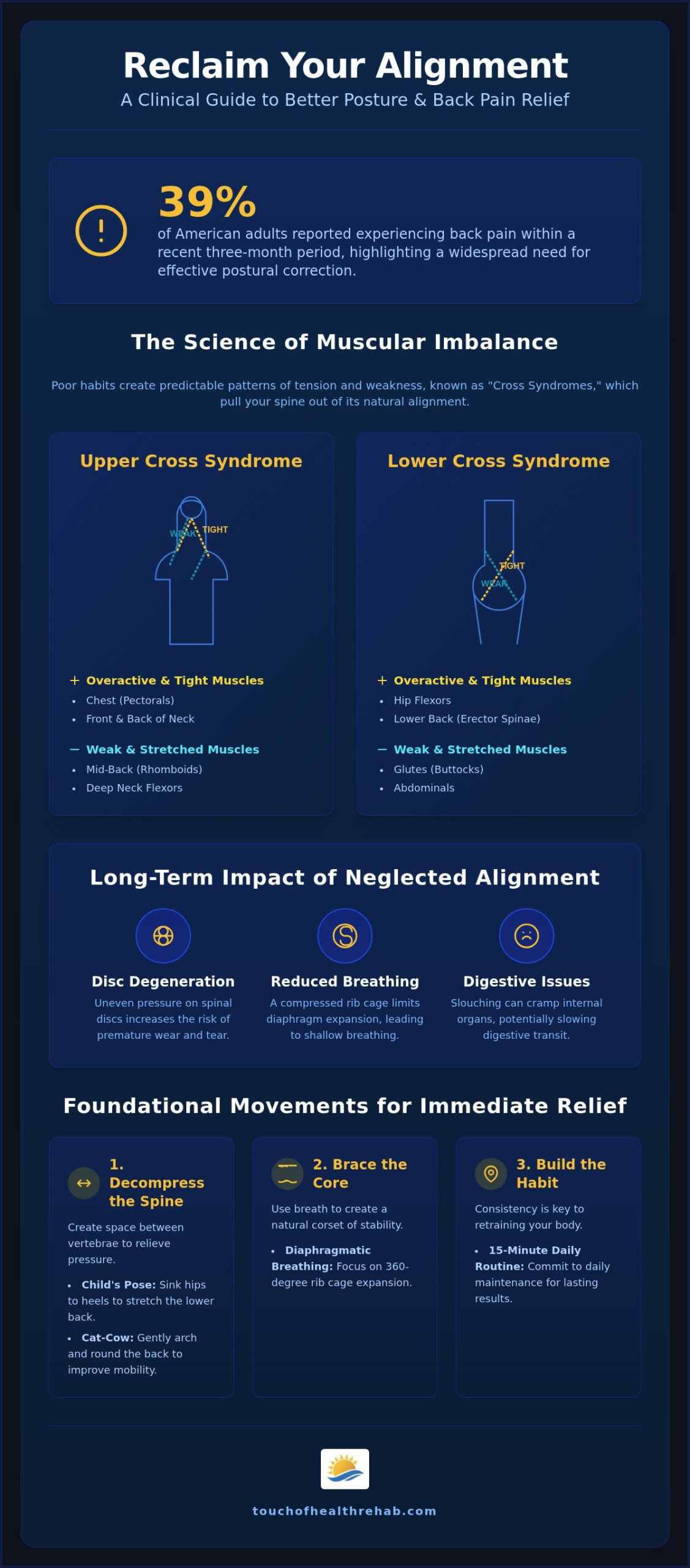
Your body often compensates for poor habits through predictable patterns known as Upper and Lower Cross Syndromes. In Upper Cross Syndrome, your chest and neck muscles become overactive and tight, while your upper back muscles become weak and overstretched. This imbalance pulls your shoulders forward and strains the cervical spine. It’s a common result of prolonged screen time and sedentary work environments.
Lower Cross Syndrome involves a similar imbalance in your pelvic region. Here, tight hip flexors and lower back muscles pull against weak glutes and abdominals. This creates an excessive arch in your lower back, leading many to seek exercises to improve posture and reduce back pain to restore functional harmony. These imbalances create a constant tug-of-war on your spine, where one group of muscles is always fighting against the tension of another.
The Long-Term Impact of Neglected Alignment
Ignoring these structural shifts can lead to more than just a sore back. Chronic misalignment places uneven pressure on your spinal discs, significantly increasing the risk of degenerative disc disease over time. When your rib cage is compressed by a slouched position, your breathing capacity diminishes because your diaphragm cannot expand fully. This compression can even impact your digestive health by cramping internal organs and slowing transit times.
Postural Stress is the cumulative load placed on your joints and soft tissues by improper positioning throughout your daily life. By committing to targeted exercises to improve posture and reduce back pain, you aren’t just fixing a “look”; you’re protecting your body’s internal systems for years to come. This proactive approach ensures that your journey toward recovery is built on a foundation of structural integrity and long-term vitality.
Foundational Posture Exercises for Immediate Back Relief
Finding immediate relief starts with creating space within your spine. By prioritizing low-impact movements, you can decompress your vertebrae and signal your nervous system to let go of protective tension. A critical part of this process involves opening your “front chain,” which includes your chest and hip flexors. When these areas are tight, they pull your body into a slouch, forcing your back muscles to work overtime. Learning how to prevent back pain through these exercises to improve posture and reduce back pain allows your body to find its natural equilibrium again.
Diaphragmatic breathing is another essential tool for spinal stabilization. Instead of shallow chest breaths, focus on expanding your rib cage 360 degrees. This creates internal pressure that acts like a natural brace for your lower back. For lasting results, we recommend a 15-minute daily maintenance routine. Consistency is the key to retraining your tissues and ensuring your progress sticks. If you find that these movements are difficult to perform correctly on your own, our team at Touch of Health Rehab can provide the personalized guidance you need to move safely.
Decompressing the Spine: The Child’s Pose and Cat-Cow
Child’s Pose is a sanctuary for a tired lower back. Start on your hands and knees, then slowly sink your hips back toward your heels while reaching your arms forward. Focus on the connection between your hips and heels to maximize the stretch in your lumbar region. Transition into the Cat-Cow sequence to improve segmental mobility. As you arch and round your back, use the clinical cue: “Imagine moving one vertebra at a time.” This focus maximizes neurological feedback and ensures you aren’t skipping over stiff segments of your spine.
Opening the Thoracic Cage: Wall Chest Stretches
Your thoracic mobility is often the “secret” to reducing lower back compensation. If your mid-back is stiff, your lower back has to move more than it should. To address this, use a doorway to safely stretch the pectoralis minor. Place your forearm on the door frame with your elbow at shoulder height and gently lean forward. For desk workers, the “Reverse High Five” is a perfect reset. Reach your arms behind you with palms facing back and squeeze your shoulder blades together. This simple action counters the “slump” and resets your shoulder position instantly. These exercises to improve posture and reduce back pain are most effective when performed multiple times throughout your workday.
Core and Posterior Chain Strengthening for Long-Term Stability
Once you’ve achieved initial relief through decompression, your focus must shift toward building a resilient internal framework. While stretching provides temporary ease, “bracing” is what truly protects your spine during the unpredictable movements of daily life. This transition requires moving beyond superficial abdominal work to activate your deep core, specifically the transverse abdominis. By integrating these targeted exercises to improve posture and reduce back pain, you transform your body from a fragile structure into a stable one. True stability also relies on your posterior chain, particularly your glutes, which act as the primary engines for movement and support for your lumbar spine.
Stability isn’t just about strength; it’s about how your brain and body communicate. This is why we often connect postural work to balance and gait rehabilitation. Your vestibular system and your sense of proprioception work together to keep you upright. If your core is weak, your balance suffers, and your body defaults to poor postural habits to compensate. Challenging your body in multiple planes, such as adding rotational or lateral movements, ensures that your stability is functional and ready for real-world demands.
The Bird-Dog: The Gold Standard for Spinal Stability
The Bird-Dog is a masterclass in coordination and control. Start on all fours with a flat back. Simultaneously extend your opposite arm and leg, reaching toward the walls rather than the ceiling. Your goal is to maintain a perfectly still torso, as if you’re balancing a glass of water on your lower back. A common mistake is arching the back or letting the hips tilt, which negates the bracing effect. The Bird-Dog activates the multifidus muscles, which are crucial for spinal support.
Glute Bridges and Pelvic Tilts
Glute bridges are essential to “wake up” posterior muscles that often go dormant from too much sitting. Lie on your back with knees bent and lift your hips toward the ceiling, squeezing your glutes at the top without over-arching your spine. If you’re just starting, pelvic tilts are a wonderful tool for finding a “Neutral Spine” while lying down. Simply flatten your lower back against the floor and then gently arch it, finding the comfortable middle ground. To progress, try single-leg glute bridges to further challenge your stability. These exercises to improve posture and reduce back pain create the lasting foundation you need for a life in motion.
The Clinical Perspective: When Exercises Aren’t Enough
Many people find themselves in a frustrating cycle where they diligently perform exercises to improve posture and reduce back pain, yet the discomfort returns just hours later. This isn’t necessarily a failure of the movements themselves. Instead, it’s often a result of “Muscle Amnesia.” This phenomenon occurs when your brain defaults to ingrained, inefficient postural habits despite your efforts to change them. To break this cycle, you need more than a workout; you need a professional orthopedic physical therapy assessment to identify the root cause of these neurological shortcuts. Clinical rehabilitation focuses on re-educating the nervous system, whereas general fitness simply builds capacity on top of existing imbalances.
The Role of Gait and Vestibular Health in Posture
Your posture isn’t just about your spine. It’s heavily influenced by your inner ear and your walking pattern. Issues within your vestibular system can cause you to unconsciously lean or tilt to one side, creating a chain reaction of tension through your back. For those experiencing dizziness or a sense of being “off,” specialized vestibular rehabilitation is often the missing piece of the puzzle. Similarly, a clinical gait analysis reveals how your feet and hips impact your lumbar health. Assessing your walking pattern is essential for long-term relief because even a minor stride imbalance can place excessive load on your lower back joints.
Customized Therapy vs. Generic Online Lists
While generic online lists offer a starting point, they can’t see the subtle form errors that prevent you from healing. One-on-one sessions allow for real-time corrections that ensure you’re activating the right muscles at the right time. Our team uses manual therapy and targeted physical conditioning to accelerate your recovery, moving beyond simple stretches to restore true function. We take a “Compassionate Expert” approach, tailoring every plan to the specific lifestyle needs of our neighbors in Sunny Isles Beach. Whether you’re commuting to Aventura or walking the shores of Miami Beach, your path to health should be as unique as you are.
Ready to stop the cycle of recurring pain? Contact our experts at Touch of Health Rehab today to begin your personalized restoration journey.
Personalized Postural Education at Touch of Health Rehab Inc.
Located in the heart of Sunny Isles Beach, Touch of Health Rehab Inc. serves as a welcoming sanctuary for those seeking a return to vitality. We believe that healing is a collaborative journey, and our team, led by Berlin, is dedicated to acting as your compassionate guide. We don’t just look at where it hurts; we look at how you move, breathe, and stand. By focusing on the unique needs of your body, we provide a professional roadmap that moves you beyond temporary relief toward lasting restoration. Our goal is to empower you with the knowledge and exercises to improve posture and reduce back pain so you can reclaim your active lifestyle with confidence.
Our Approach to Postural Correction in Sunny Isles
Our methodology focuses on comprehensive physical therapy that addresses the root cause of your discomfort rather than just masking the symptoms. We’re proud to support our neighbors in Aventura, Miami Beach, and North Miami Beach, offering a high-end clinical experience that remains deeply human-centered. This process often begins with corrective strategies and evolves into a long-term plan for wellness and preventative care. Many of our patients have shared their success stories, detailing how they regained their mobility and confidence through the specialized care at Touch of Health Rehab Inc. We treat every individual as a unique case, ensuring that your path to health is never a generic one but a tailored experience built for your life.
Start Your Recovery Journey Today
Your first visit to our facility is designed to be steady, methodical, and deeply reassuring. You’ll undergo a personalized posture analysis where we evaluate your alignment, gait, and specific pain triggers. This assessment allows us to create a tailored program that includes the right exercises to improve posture and reduce back pain for your specific structural needs. We’ll explain every step of the process, ensuring you feel stable and informed as you begin your rehabilitation. Recovery isn’t just about avoiding surgery; it’s about attaining your peak physical health and moving through the world with grace and strength.
You don’t have to live with the stiffness and aches that hold you back from enjoying South Florida’s vibrant life. We’re here to help you stand taller and feel better through expert guidance and personalized attention. Schedule your postural education session at Touch of Health Rehab Inc. and take the first step toward a pain-free, aligned future today.
Reclaim Your Mobility and Stand Tall
You’ve now explored how the transition from simple stretching to clinical stabilization creates the structural resilience your body needs. By committing to targeted exercises to improve posture and reduce back pain, you aren’t just managing discomfort; you’re actively reprogramming your nervous system for long-term health. We’ve discussed the vital role of the deep core and the importance of addressing vestibular health to ensure your alignment is supported from every angle. This comprehensive approach is what differentiates a clinical roadmap from a temporary fix, allowing you to move through life with newfound ease and vitality.
At Touch of Health Rehab Inc., we are ready to serve as your dedicated guides on this path to restoration. Led by Berlin, our team provides the specialized expertise and compassionate care required to help you achieve your peak physical health. Whether you are living in Sunny Isles Beach, Aventura, or Miami Beach, our facility offers the professional environment you need to succeed. Book Your Personalized Posture Assessment at Touch of Health Rehab Inc. and take the definitive step toward a pain-free, aligned future. You deserve a body that supports your lifestyle without limitation.
Frequently Asked Questions
How long does it take to fix years of bad posture?
Correcting long-standing postural habits is a steady journey that requires consistent neurological retraining. While most people notice a reduction in muscle tension within two to four weeks, meaningful structural changes typically take three to six months of dedicated effort. At Touch of Health Rehab Inc., we focus on reprogramming these patterns so your body defaults to a neutral spine naturally, ensuring your progress is both measurable and permanent.
Can exercises really reduce chronic lower back pain?
Targeted movements are highly effective at reducing chronic pain by addressing the mechanical root of the discomfort. By performing specific exercises to improve posture and reduce back pain, you build an internal “brace” that supports your vertebrae and reduces pressure on sensitive nerves. This shift from simple stretching to clinical stabilization helps prevent the recurring flare-ups that many South Florida residents face during their daily activities.
What is the best exercise for someone who sits at a desk all day?
The Wall Chest Stretch is the most impactful movement for countering the “slump” associated with desk work. This exercise opens the pectoralis minor and resets the shoulders, which are often pulled forward by hours of typing. We recommend performing these resets several times a day to maintain thoracic mobility. This simple habit prevents the cumulative load of postural stress from turning into chronic stiffness in your neck and shoulders.
Is it possible to have back pain because of a balance or inner ear problem?
Yes, inner ear issues can cause your brain to unconsciously tilt your body to maintain stability, leading to significant spinal strain. If your vestibular system is compromised, your back muscles must work harder to keep you upright. At Touch of Health Rehab Inc., we specialize in vestibular rehabilitation to resolve these underlying balance issues. Treating the ear and the spine together ensures that your posture is supported by an accurate sense of balance.
How often should I perform these posture exercises for the best results?
For the best results, you should engage in a 15-minute maintenance routine every day. Consistency is the primary factor in retraining the soft tissues and the nervous system to accept a new, healthier alignment. If you live in Sunny Isles Beach or Aventura, integrating these movements into your morning or evening routine ensures your body remains resilient. Daily practice prevents the return of “muscle amnesia” and reinforces your clinical progress.
When should I see a physical therapist for my back pain instead of exercising at home?
You should seek professional care if your pain is persistent, radiates into your limbs, or if you find yourself unable to maintain a straight position. A physical therapist at Touch of Health Rehab Inc. can identify subtle form errors that might be making your pain worse. Professional intervention is also necessary if your pain stems from complex issues like post-surgical recovery or vestibular dysfunction that require specialized clinical equipment and expertise.
Does Medicare or insurance cover postural education and physical therapy?
Medicare Part B and most private insurance plans cover physical therapy when it is medically necessary for your recovery. For 2026, the Medicare Part B annual deductible is $257, after which Medicare typically covers 80% of the approved amount. The 2026 therapy threshold is $2,480, but care can continue beyond this with a clinical certification of necessity. We recommend that our Miami Beach patients verify their specific plan details before starting treatment.
Are these exercises safe for seniors with arthritis?
These movements are specifically designed to be safe and beneficial for seniors managing arthritis. We focus on low-impact exercises to improve posture and reduce back pain that decompress the joints and improve circulation without causing irritation. By strengthening the muscles around arthritic joints, you provide your body with better natural support. Our team at Touch of Health Rehab Inc. ensures every movement is adjusted to your comfort level and physical capacity.