
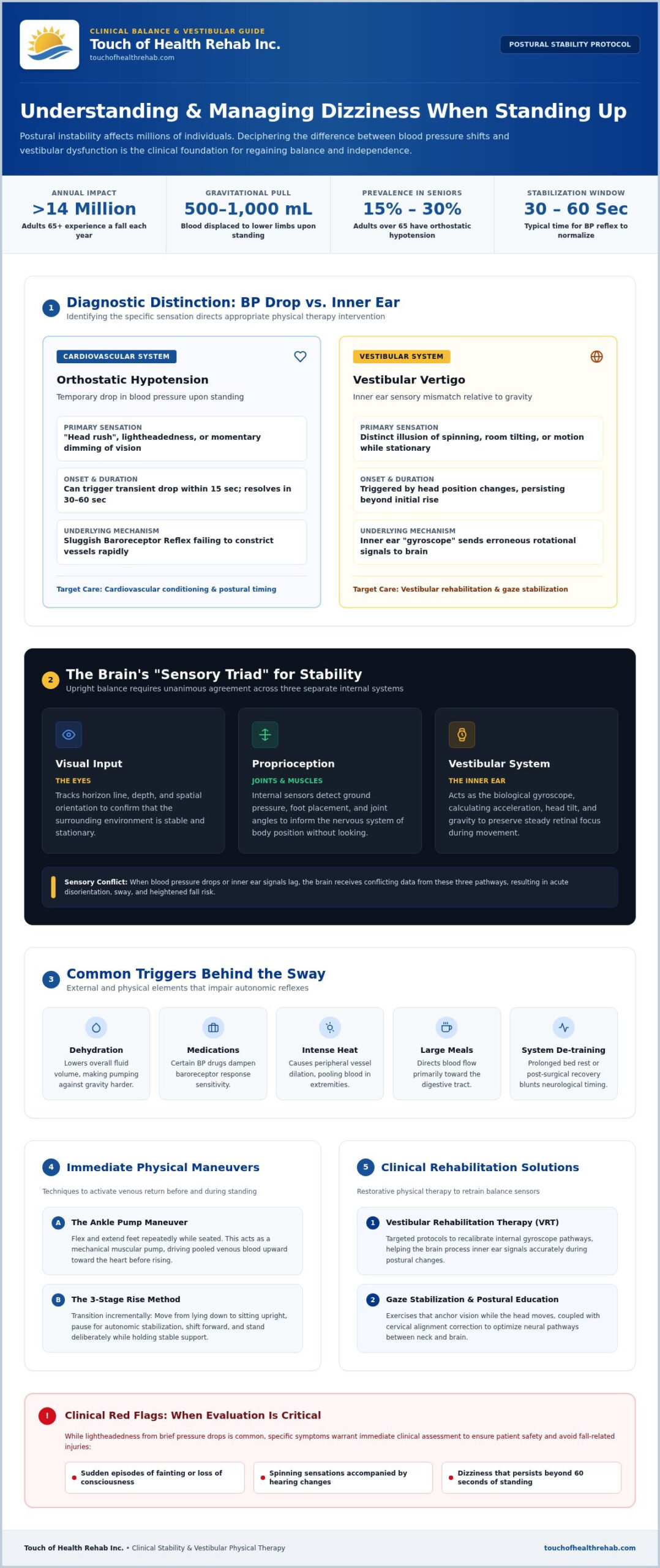
You rise from your favorite chair to answer the door, but before you can take a step, the room begins to tilt. It’s a disorienting moment that leaves you reaching for a wall, wondering how to stop feeling dizzy when I stand up without the fear of a fall. If you’ve felt that sudden rush of lightheadedness, you know it’s more than just a nuisance; it’s a threat to your independence and security. You aren’t alone, as more than 14 million adults aged 65 and older experience a fall each year, often triggered by these moments of instability.
We believe your path to steady ground is a collaborative journey, and understanding the why behind your dizziness is the first step toward restoration. This guide will help you discover the underlying causes of lightheadedness, from blood pressure shifts to inner ear imbalances, and provide clinical techniques to regain your stability. You’ll learn immediate maneuvers to halt a dizzy spell and gain a clear understanding of when it’s time to partner with a specialist. By the end, you’ll have the tools to move through your day with renewed vitality and the confidence you deserve.
Key Takeaways
- Distinguish between the faintness of blood pressure drops and the spinning sensation of vertigo to better understand your body’s unique signals.
- Master immediate physical maneuvers like the ankle pump and 3-stage rise to learn how to stop feeling dizzy when I stand up and regain control.
- Identify specific red flags that indicate when a dizzy spell requires a specialist’s evaluation to ensure your long-term safety and peace of mind.
- Explore how specialized vestibular rehabilitation and gaze stabilization exercises can recalibrate your balance sensors for a more confident return to daily movement.
Understanding Why You Feel Dizzy When Standing Up
When you move from a seated position to standing, your body performs a complex internal dance. Gravity immediately pulls about 500 to 1,000 mL of blood toward your lower limbs. To compensate, your body relies on the “Baroreceptor Reflex.” These specialized sensors in your neck and chest detect the pressure drop and signal your heart to beat faster and your vessels to constrict. If this reflex is sluggish, you experience orthostatic hypotension, which is the technical term for a temporary drop in blood pressure. This condition is quite common, affecting roughly 15% to 30% of adults over age 65, making it a frequent hurdle in maintaining an active lifestyle.
Stability isn’t just about blood flow; it’s about information. Your brain relies on a “Sensory Triad” to keep you upright. This system includes your eyes for visual input, your joints and muscles for “proprioception,” and your inner ear, known as the vestibular system. When you stand, these three systems must agree on your position. If there’s a delay in blood reaching the brain or a mismatch in these sensory signals, you’ll find yourself searching for vestibular rehabilitation to recalibrate your internal gyroscope. We focus on this synergy to ensure your recovery is thorough and lasting.
Is It Orthostatic Hypotension or Vertigo?
Identifying the exact sensation you feel is the first step in our collaborative journey toward healing. Lightheadedness usually feels like a “head rush” or a momentary dimming of your vision. It typically resolves within 30 to 60 seconds as your blood pressure stabilizes. Vertigo, however, creates a distinct sensation of spinning or tilting, even when you’re standing perfectly still. This distinction is crucial because it helps us determine if you need cardiovascular support or specialized vertigo treatment. Common triggers like intense heat, large meals, or sudden movements can often make these sensations feel more intense.
Common Culprits Behind the Sway
Several daily factors can disrupt your body’s natural ability to stay balanced. Dehydration is a common culprit, as reduced fluid levels lower your total blood volume and make it harder for your heart to pump against gravity. Certain medications, particularly those for blood pressure, can also slow down your baroreceptor reflex. If you’ve recently completed post-surgical rehabilitation or spent significant time resting, your balance system might be “de-trained.” When your sensors aren’t firing at peak performance, you’ll likely find yourself searching for how to stop feeling dizzy when I stand up so you can regain your independence.
The Science of Stability: Blood Pressure vs. Your Inner Ear
While blood pressure is often the first suspect, your balance relies heavily on the vestibular system. This delicate “gyroscope” located in your inner ear monitors your position relative to gravity. When you rise, your brain must instantly process signals from this system to keep your vision stable and your body upright. As we age, the speed at which our brain integrates these sensory signals can slow down, leading to the confusion of standing dizziness. This is why many people find themselves asking how to stop feeling dizzy when I stand up. Through vestibular rehabilitation, we can retrain these pathways to ensure your brain and ears are communicating clearly again.
The Autonomic Nervous System Connection
Your body’s ability to transition from rest to action is governed by the autonomic nervous system. When you stand, your “fight or flight” response should trigger immediate blood vessel constriction to push blood upward. If this system responds too slowly, you might experience the classic symptoms of postural hypotension. This often manifests as a transient drop within the first 15 seconds of standing, leading to a brief “blackout” or tunnel vision. Regular physical conditioning acts as a primer for this system, teaching your nerves and heart to react more efficiently to postural changes. It’s a journey of strengthening your body’s internal timing.
The Role of Posture and Alignment
Correct alignment is the foundation of clear neurological communication. Through postural education, we help you optimize the path for nerve signals traveling from your neck to your brain. Poor neck alignment, especially “forward head posture,” can put undue stress on the cervical spine and interfere with the vestibular signals your brain needs for balance. By improving your stance, you reduce the mechanical interference that might be making your dizziness worse. Consider these aspects of alignment:
- Cervical Stability: Keeping your neck neutral ensures blood flow to the brain is unobstructed.
- Spinal Stacking: Aligning your ears over your shoulders reduces the workload on your vestibular system.
- Core Engagement: A strong core provides a stable base for the “standing up” signal to be processed accurately.
Restoring this balance is a collaborative effort between your commitment to movement and our clinical expertise. We aim to empower you with the posture and conditioning needed to move through life with total confidence.
Assessing Your Symptoms: When to Seek Professional Help
While we’ve discussed the physiological “head rush” that occurs during a quick rise, persistent symptoms require a deeper look. If you are constantly searching for how to stop feeling dizzy when I stand up, the issue may have shifted from a simple transition lag to a chronic dysfunction. These lasting sensations often indicate more complex vestibular balance disorders that won’t resolve with just a slower pace. Identifying whether your symptoms are a minor delay or a clinical concern is the foundation of your safety and independence.
Certain “red flags” signal that your body needs professional intervention immediately. If your dizziness is paired with fainting (syncope), chest pain, or shortness of breath, it’s time for an urgent evaluation. Likewise, if the sensation lasts longer than 30 seconds or occurs every single time you stand, it’s no longer a typical response. Our dedicated team in Sunny Isles Beach at Touch of Health Rehab Inc. specializes in untangling these symptoms to provide a clear, supportive path forward.
The ‘Stand Test’ and What It Reveals
In a clinical setting, we use a structured “stand test” to monitor how your heart and vessels respond to gravity. We define classical orthostatic hypotension as a sustained drop in systolic blood pressure of at least 20 mmHg or diastolic blood pressure of at least 10 mmHg within three minutes of standing. We also look at your heart rate; an increase of 30 beats per minute or more can sometimes indicate other autonomic challenges. These numbers provide a precise map of your internal reflexes, helping us move from guesswork to a targeted plan for restoration.
Why a Physical Therapy Evaluation is Critical
A professional evaluation goes deeper than just measuring blood pressure. We perform a comprehensive analysis of your balance and gait to see how your sensory systems work in real-time. Often, subtle musculoskeletal weaknesses in the hips or ankles contribute to a sense of instability that makes dizziness feel more dangerous. By identifying these gaps, we can create a stable baseline for your recovery journey. This thorough approach ensures that we aren’t just treating a symptom; we’re empowering your entire body to move with grace and confidence once again.
How to Stop Dizziness When Standing: Practical Steps and Exercises
Learning how to stop feeling dizzy when I stand up starts with a proactive strategy that begins before your feet even hit the floor. The most immediate way to combat the drop in blood pressure is by engaging your “muscle pump.” By performing the ankle pump technique, which involves vigorously flexing your feet up and down while seated, you manually push blood from your lower limbs back toward your heart and brain. This simple action primes your circulation and reduces the lag time your nervous system needs to adjust to a vertical position.
Hydration plays a critical role in this process, but it involves more than just drinking plain water. To maintain adequate blood volume, your body requires electrolytes like sodium and potassium to hold that fluid in your vessels. We often recommend incorporating these minerals into your daily routine to ensure your cardiovascular system has the “fuel” it needs to fight gravity. Pairing proper hydration with isometric leg contractions, such as squeezing your thighs together or tensing your glutes, provides the mechanical force necessary to stabilize your pressure during the transition.
Immediate Maneuvers for the ‘Pre-Stand’ Phase
We believe in empowering you with a systematic approach to movement. Before you rise, follow this three-step sequence to prepare your body for the change in posture:
- Step 1: Calf Activation. Flex your calf muscles 10 to 15 times while still seated to initiate blood flow.
- Step 2: Diaphragmatic Breathing. Take two deep, slow breaths into your belly. This stabilizes your autonomic nervous system and prevents the “panic” response that sometimes accompanies a dizzy spell.
- Step 3: Counter-Pressure. Use physiological counter-pressure maneuvers, such as crossing your legs while standing or firmly tensing your thigh muscles, to mechanically raise your cardiac output.
Long-Term Balance Training at Home
True restoration comes from consistent, gentle habituation. Simple exercises that involve shifting your weight from side to side while holding onto a sturdy surface can help your brain ignore the false signals of movement. These exercises are a cornerstone of fall prevention therapy, as they build the muscular and neurological resilience needed for independence. By practicing these movements in a controlled environment, you retrain your “gyroscope” to handle daily transitions without fear. If you’re ready to move beyond temporary fixes, we invite you to discover how our personalized care can help you regain your long-term vitality and confidence.
Clinical Solutions: How Vestibular Rehabilitation Restores Your Balance
When home maneuvers and hydration aren’t enough to provide lasting relief, professional intervention offers the precise recalibration your body needs. During a specialized vertigo treatment session, we look beyond the immediate sensation of lightheadedness to evaluate how your brain processes every movement. One of the most effective tools in our clinical arsenal is gaze stabilization. These exercises train your eyes to stay fixed on a specific target while your head is in motion, which effectively teaches your brain to ignore the false signals of movement that cause instability. This neurological training is a cornerstone for anyone wondering how to stop feeling dizzy when I stand up, as it builds a more resilient connection between your ears, eyes, and brain.
Our Sunny Isles Beach facility provides a controlled, supportive environment where you can perform high-level balance work without the fear of an unassisted fall. We develop personalized conditioning plans that address the whole person, integrating postural education with core and lower-body strengthening. This comprehensive approach ensures that your cardiovascular system and your vestibular system are working in harmony. By practicing these techniques under expert supervision, you gain the confidence to navigate your daily life with total security.
Customized Therapy for South Florida Seniors
We recognize that our local community has unique needs, particularly when it comes to maintaining an active and social life. Our specialized geriatric physical therapy programs are designed to respect the physical limitations that often come with age while pushing for maximum recovery. If you are managing arthritis-related pain or navigating the challenges of post-surgical recovery, we adapt every exercise to suit your current mobility level. Our goal is to promote a return to the vibrant Miami lifestyle you love. You deserve to enjoy walks along the shore or evenings out with friends without the constant worry of a sudden dizzy spell.
The Path Forward: Your Collaborative Journey to Health
True recovery involves a fundamental shift in how you interact with your environment. It’s common for individuals to begin avoiding movement out of fear, but this avoidance actually causes the balance system to weaken over time. We guide you from a place of hesitation to a place where you can embrace activity with joy. Ongoing physical conditioning plays a vital role in this progression, as it prevents relapse and keeps your internal reflexes sharp. You don’t have to accept dizziness as a permanent part of your life. We invite you to schedule an evaluation with our dedicated team today and take the final step toward a life of stability, independence, and long-term vitality.
Regain Your Stability and Confidence Today
Living with the constant fear of unsteadiness can make your world feel smaller, but you have the power to change that narrative. We’ve explored how a blend of immediate physical maneuvers and long-term vestibular retraining can address the root causes of your lightheadedness. Whether it’s mastering the ankle pump or understanding the “Sensory Triad,” the tools for recovery are within your reach. You don’t have to wonder how to stop feeling dizzy when I stand up while sacrificing your independence.
Our expert vestibular therapists at Touch of Health Rehab Inc. specialize in creating personalized fall prevention plans tailored to your unique journey. We’re proud to serve the Sunny Isles, Aventura, and Miami Beach communities with compassionate, clinical care that prioritizes your long-term vitality. It’s time to move from a place of hesitation to a life of active, joyful movement. Reclaim your stability today and schedule your balance evaluation at Touch of Health Rehab Inc.
Your path to peak physical health is a collaborative journey, and we’re here to guide you every step of the way. You deserve to move through your day with total security and the confidence that comes from a body in balance.
Frequently Asked Questions
Is it normal to feel dizzy for a few seconds when I stand up?
Occasional brief lightheadedness is common, especially if you rise suddenly after sitting for a long time. This is usually a temporary lag in blood flow known as initial orthostatic hypotension. However, if this happens frequently or lasts longer than 30 seconds, it’s a sign that your autonomic reflexes need support. We help neighbors in Sunny Isles Beach strengthen these reflexes at Touch of Health Rehab Inc. through targeted physical conditioning and a collaborative journey toward better health.
Can dehydration cause dizziness only when standing?
Yes, dehydration reduces your overall blood volume, which makes it much harder for your heart to pump blood against gravity. While you might feel perfectly fine while sitting, the demand on your system increases the moment you stand. This is often the first thing people notice when wondering how to stop feeling dizzy when I stand up. Maintaining proper electrolyte balance is just as vital as water intake for stabilizing your pressure and vitality.
How can I tell if my dizziness is caused by my inner ear?
If the room feels like it’s spinning or tilting, the issue likely stems from your vestibular system. Hemodynamic dizziness, which is caused by blood pressure, feels more like a faintness or a “head rush” without the sensation of rotation. Our specialized therapists in Aventura use clinical tests to distinguish between these two. We then create a plan for vestibular rehabilitation to recalibrate your internal gyroscope and restore your confidence in daily movement.
What exercises can I do at home to improve my balance when rising?
You can practice weight-shifting exercises while holding onto a sturdy counter to improve your stability. Gently moving your weight from your heels to your toes helps prime your nervous system for the transition to standing. Additionally, performing the ankle pumps mentioned earlier in this guide is a highly effective way to stimulate circulation before you leave your chair. These small habits are the building blocks of a personalized fall prevention plan for long-term safety.
When should I see a physical therapist for my dizzy spells?
You should schedule an evaluation if your dizziness occurs more than once a week or if you’ve experienced a near-fall. If you’re avoiding social outings in Miami Beach because you feel unsteady, it’s time for professional intervention. We specialize in balance and gait rehabilitation to help you identify musculoskeletal weaknesses before they lead to a serious injury. Taking this step ensures your path to health is handled with care, patience, and thoroughness.
Can poor posture actually make me feel lightheaded?
Absolutely, because your neck alignment directly impacts the clarity of signals traveling to your brain. A “forward head posture” can compress cervical tissues and interfere with the blood flow and nerve signals required for balance. Through postural education, we help you realign your spine to ensure your brain receives accurate information about your position. This mechanical correction often provides a significant reduction in standing lightheadedness and improves your overall quality of life.
How long does it take for vestibular rehabilitation to work?
Many patients notice a positive change in their stability within just a few sessions. While the full journey to restoration varies, the brain is remarkably adaptable and can begin recalibrating its balance sensors quickly. Consistent participation in your therapy plan at Touch of Health Rehab Inc. in Sunny Isles Beach is the key to lasting results. We focus on a steady, methodical rhythm to ensure your recovery is both thorough and sustainable for your long-term health.
Are there specific shoes that help with standing dizziness?
While shoes won’t fix a blood pressure drop, wearing footwear with a firm, thin sole and a secure heel can improve your proprioception. This is your body’s ability to sense the ground beneath you. Avoid thick, heavily cushioned soles that can dull the sensory feedback your brain needs to stay upright. Our team often reviews footwear as part of a comprehensive balance and gait rehabilitation program to maximize your safety and independence in Miami Beach.