What if an unsteady step could reflect a problem in the brain, sensory nerves, or inner ear? If you’re asking what neurological disorders cause balance problems, you’re not alone in wanting a clear explanation. Feeling off-balance can make walking and everyday activities feel less safe, but the symptom by itself can’t identify the cause.
Balance depends on your brain combining information from your vision, inner ear, and sensory nerves. When one part of that system is affected, conditions such as stroke, Parkinson’s disease, multiple sclerosis, peripheral neuropathy, or cerebellar disorders may contribute to unsteadiness. Similar symptoms can also have non-neurological causes, so it’s important not to diagnose yourself based on how dizziness or instability feels.
This article explains neurological conditions that may affect balance, symptoms that can offer clues, and why clinical evaluation matters. You’ll also learn what assessment and rehabilitation may involve, including how individualized balance and gait rehabilitation or vestibular rehabilitation may support mobility goals after medical assessment. With the right guidance, you can take informed next steps toward feeling steadier and safer.
Key Takeaways
- Learn what neurological disorders cause balance problems, including conditions that can affect movement, coordination, or sensation in different ways.
- Notice whether unsteadiness comes with clues such as reduced sensation or dizziness, but don’t treat symptoms as a diagnosis.
- Track when balance changes began and which symptoms occur alongside them to help inform a healthcare professional’s assessment.
- Seek emergency care for sudden balance loss accompanied by facial drooping, weakness, speech changes, or confusion.
- Understand how medical evaluation can guide next steps, which may include individualized balance and gait rehabilitation after assessment.
How the Nervous System Keeps You Balanced, and Why It Can Be Disrupted
Feeling unsteady can be unsettling, especially when walking or turning suddenly feels less reliable. Balance isn’t controlled by a single body part. Your eyes, inner ear, sensory nerves, and brain continually share information so you can stay upright, adjust your posture, and move through your surroundings.
A balance problem is a symptom, not a diagnosis: it describes difficulty staying steady or moving safely, while the underlying cause must be assessed separately. That distinction matters if you’re searching for what neurological disorders cause balance problems. A symptom can point to a need for evaluation, but it can’t identify which system or condition is responsible.
What systems work together to maintain balance?
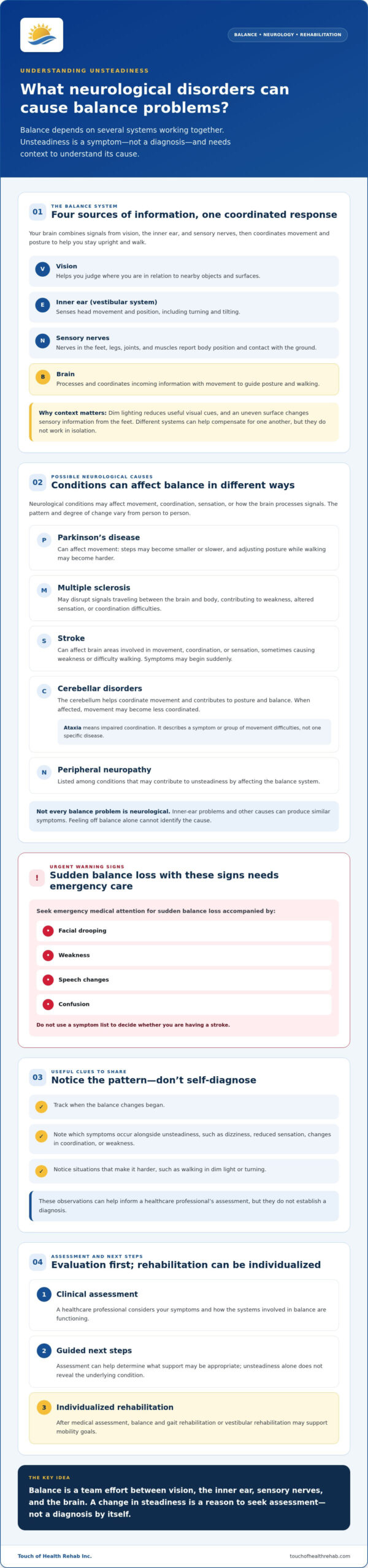
Your visual system helps you judge where you are in relation to nearby objects and surfaces. The vestibular system, located in the inner ear, senses head movement and position, including changes in orientation as you turn or tilt. Sensory nerves in your feet, legs, joints, and muscles send the brain information about body position and contact with the ground. The brain processes and coordinates these signals with movement to guide posture and walking. This interaction is often described as postural control.
These systems can help compensate for one another, but they don’t work in isolation. Dim lighting reduces useful visual cues, for example, while an uneven surface changes the sensory information coming from your feet. Your brain has to interpret the signals available and adjust your body’s response.
Why does a neurological problem affect steadiness?
A neurological condition may affect how the brain processes sensory information or coordinates movement. If signals from the feet are less reliable, it may be harder to sense where your body is positioned. If coordination or movement is affected, adjusting your steps or posture may become more difficult. Changes in strength can also make it harder to respond to a loss of stability.
The effects vary. Two people who describe feeling “off balance” may have different symptoms and different underlying causes. Some notice difficulty walking in the dark; others feel unsteady during turns or alongside changes in coordination or sensation. These observations can help a healthcare professional understand what’s happening, but they don’t establish a diagnosis.
Balance changes can also arise from inner-ear problems or other causes, not only neurological disorders. The question “what neurological disorders cause balance problems” is a starting point for learning, not a way to identify your own condition. A clinical assessment can consider your symptoms and how the different systems involved in balance are functioning.
Which Brain and Spinal Cord Disorders Can Cause Balance Problems?
Several conditions affecting the brain or spinal cord can interfere with movement, coordination, or sensation, and each may affect balance differently. If you’re asking what neurological disorders cause balance problems, examples include Parkinson’s disease, multiple sclerosis, stroke, and disorders involving the cerebellum. These are possibilities, not diagnoses based on unsteadiness alone.
How can Parkinson’s disease, multiple sclerosis, and stroke affect balance?
Parkinson’s disease can affect movement, making steps smaller or slower and making it harder to adjust posture while walking. Multiple sclerosis may disrupt signals traveling between the brain and body, which can contribute to weakness, altered sensation, or coordination difficulties. The pattern and degree of change vary from person to person.
A stroke can affect brain areas involved in movement, coordination, or sensation, sometimes causing weakness or difficulty walking. Symptoms may begin suddenly. Sudden balance loss, especially with facial drooping, weakness, speech changes, or confusion, requires emergency medical attention. Don’t use a symptom list to decide whether you’re having a stroke. Seek emergency care if these warning signs appear.
What role can the cerebellum and other brain pathways play?
The cerebellum helps coordinate movement and contributes to posture and balance. If it’s affected by a disorder or injury, movements may become less coordinated. Ataxia is the term for impaired coordination; it describes a symptom or group of movement difficulties, not one specific disease. Some hereditary or acquired conditions can cause ataxia, and a clinician must determine the underlying reason.
Injury to the brain or spinal cord can also affect the pathways that carry sensory information or support controlled movement. The effects depend on the location and nature of the injury, so two people with similar balance concerns may have different findings and care needs. The National Institute on Deafness and Other Communication Disorders explains that balance problems can have varied causes in its overview of Balance Disorders.
Parkinson’s disease, multiple sclerosis, stroke, and cerebellar disorders are examples of neurological conditions that may affect balance, but only a clinician can determine whether one is causing your symptoms. Sudden changes call for prompt attention, while ongoing or worsening unsteadiness also deserves medical assessment. After evaluation, physical therapy may support mobility goals. Individualized balance and gait rehabilitation can be one part of a care plan. You can explore physical therapy and rehabilitation options as you consider next steps with your healthcare professional.
Can Nerve Damage or Inner-Ear Disorders Also Cause Unsteadiness?
Not every balance problem starts in the brain or spinal cord. Peripheral neuropathy affects nerves outside the central nervous system, while vestibular disorders involve the inner ear or its connections with the brain. These can cause sensations that overlap with neurological conditions, so symptoms alone can’t reliably show where the problem begins. The National Institute on Deafness and Other Communication Disorders outlines the range of possible causes in its overview of Balance Disorders.
How can peripheral neuropathy affect balance?
Sensory nerves in your feet help your brain register where your legs are and how they’re contacting the ground. If peripheral neuropathy reduces that sensation, it may be harder to judge foot position, especially while walking or standing. Diabetes is one possible contributor to neuropathy, but it isn’t the only one, and unsteadiness by itself doesn’t reveal the cause.
A clinician can assess sensation, strength, medical history, and walking pattern to understand what may be contributing. Sharing when the changes began and whether numbness, tingling, or weakness occurs can help guide that evaluation.
When might vestibular problems contribute to unsteadiness?
The vestibular system helps you sense head movement and orientation. When it isn’t working as expected, you might experience dizziness, a spinning sensation called vertigo, or difficulty feeling steady during head movements. Imbalance can occur with these symptoms, but dizziness and unsteadiness aren’t interchangeable, and neither points to one diagnosis on its own.
Inner-ear, nerve, and central nervous system causes can sometimes produce similar or overlapping complaints. That’s why a healthcare professional considers the full symptom pattern and relevant medical history rather than relying on one clue. To learn more about a rehabilitation approach used for some vestibular conditions, explore vestibular rehabilitation and vertigo recovery.
When considering what neurological disorders cause balance problems, remember that unsteadiness may also relate to nerve damage or vestibular dysfunction, and more than one factor may be involved. A clinical assessment can help clarify which systems may be contributing and whether further evaluation is needed. After medical assessment, physical therapy may support balance and mobility goals through an individualized plan, but it doesn’t diagnose or cure the underlying disorder.
What Symptoms Matter, and When Is Balance Loss Urgent?
Noticing how balance changes can help a healthcare professional understand the pattern and decide what evaluation may be appropriate. Keep brief notes rather than trying to match symptoms to a diagnosis. The timing and combination of changes matter, but only a clinician can assess their cause.
Which details should you record before an appointment?
Write down when the problem began, whether it started suddenly or gradually, how long each episode lasts, and what you were doing when it occurred. Note whether symptoms are becoming more frequent or affecting specific activities, such as walking, turning, or standing up.
Include any related changes, even if they seem separate from your balance concern:
- Falls, near-falls, or changes in your walking pattern
- Dizziness, a spinning sensation, or difficulty with head movement
- Numbness, tingling, weakness, or changes in vision
- Recent illness or other changes in your health
- Current medications and existing diagnoses
These details can give your healthcare professional a clearer picture. Don’t stop or change prescribed medication without discussing it with the clinician who manages your care.
When should balance problems receive immediate medical attention?
Sudden balance loss with facial drooping, weakness, speech changes, or confusion may signal a stroke. Call 911 immediately. Sudden severe neurological changes warrant emergency evaluation, even if they improve or seem to pass. Don’t wait for a routine appointment or try to determine the cause on your own.
New, worsening, or recurrent balance changes without those emergency signs still deserve prompt medical advice. Contact a healthcare professional to discuss what’s happening and what next steps are appropriate. If symptoms are severe or rapidly changing, seek urgent medical help.
This article can’t assess your symptoms, diagnose a condition, or replace medical care. If a healthcare professional has evaluated your balance concerns and recommends rehabilitation, physical therapy may support your mobility goals through an individualized plan. You can explore physical therapy options as one possible next step after medical assessment.
How Diagnosis and Balance Rehabilitation Can Support Your Next Steps
Understanding what neurological disorders cause balance problems can help you ask informed questions, but identifying the cause takes a clinical assessment. A healthcare professional considers your symptoms alongside your health history and examination findings. This process helps determine whether the next step is medical treatment, additional testing, rehabilitation, or a combination of care.
What may happen during a balance evaluation?
Your clinician may ask when the unsteadiness began, whether it comes and goes, and how it affects activities such as walking, turning, or getting up from a chair. Be ready to discuss falls or near-falls, other symptoms, existing diagnoses, recent health changes, and medications.
An examination may include observing your walking, balance, coordination, strength, and sensation. Which checks are appropriate depends on your symptoms and the suspected cause. A clinician may recommend condition-specific tests, imaging, or referral to a specialist, but these decisions depend on clinical judgment. Testing isn’t the same for everyone, and a balance symptom alone doesn’t determine what investigations you need.
How can balance and gait rehabilitation fit into recovery?
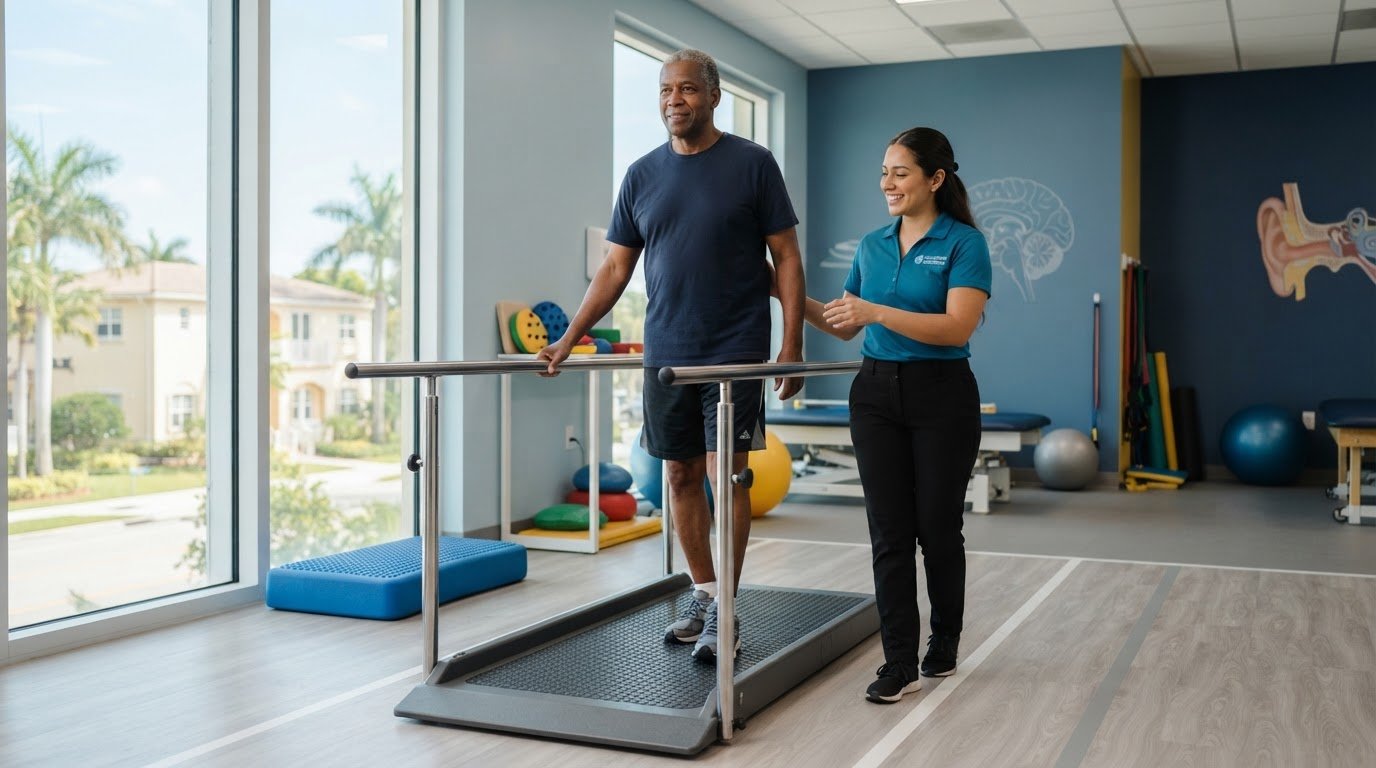
After medical assessment, physical therapy may support balance, walking, and everyday movement goals when clinically appropriate. A plan can be individualized to your abilities and the challenges you want to address. Depending on your needs, sessions may focus on steady movement, gait practice, or strategies for navigating daily activities more safely. Rehabilitation can support function, but it doesn’t diagnose or cure the neurological condition causing symptoms.
Touch of Health Rehab Inc. offers balance and gait rehabilitation, including physical therapy that supports balance. Whether rehabilitation is suitable, and what it should involve, depends on your assessment and care plan. For readers in Sunny Isles Beach, Aventura, Bal Harbour, North Miami Beach, and Miami Beach, learning about local options can be one step in planning care. Confirm current service availability and any referral requirements directly with the clinic.
Take the next step at a pace that feels manageable: Explore physical therapy and balance care.
Take Your Next Step Toward Safer, Steadier Movement
Balance depends on several systems working together, so the same feeling of unsteadiness can have different causes. Parkinson’s disease, multiple sclerosis, stroke, cerebellar disorders, peripheral neuropathy, and vestibular problems are among the conditions that may affect stability, but symptoms alone can’t tell you which one is responsible. A healthcare professional can assess your history and symptoms and determine whether further testing or rehabilitation may be appropriate.
Act quickly if balance loss begins suddenly with facial drooping, weakness, speech changes, or confusion. Call 911 for these possible stroke symptoms. For ongoing balance concerns, medical assessment can help guide a personalized plan. After assessment, physical therapy may support balance, gait, and mobility goals. Touch of Health Rehab Inc. offers vestibular rehabilitation and balance and gait rehabilitation in Sunny Isles Beach, Aventura, Bal Harbour, North Miami Beach, and Miami Beach.
If you’re ready to explore care options, Explore personalized physical therapy and balance care. Asking what neurological disorders cause balance problems is a helpful first step; with professional guidance, you can move forward with greater clarity and support.
Frequently Asked Questions
What neurological disorders cause balance problems?
Parkinson’s disease, multiple sclerosis, stroke, cerebellar disorders, and peripheral neuropathy can affect balance by changing movement, coordination, or sensation. Some vestibular disorders can also cause unsteadiness, although they involve the inner ear and its connections rather than being neurological disorders themselves. If you’re asking what neurological disorders cause balance problems, remember that symptoms can overlap. A healthcare professional evaluates your history and symptoms to identify possible causes.
Can a neurological disorder cause sudden loss of balance?
Yes. A neurological event such as a stroke can cause sudden balance loss, sometimes alongside weakness, facial drooping, speech changes, or confusion. These symptoms require emergency evaluation. Call 911 if they occur, even if they improve. Sudden imbalance can have other causes too, so don’t try to determine the cause yourself or wait for a routine appointment when severe neurological symptoms appear.
Can peripheral neuropathy make you feel unsteady?
Yes. Peripheral neuropathy may reduce sensation in the feet, making it harder to sense where your feet are or how they contact the ground. Numbness or tingling may occur, but these symptoms don’t establish neuropathy or reveal its cause. A clinician may assess sensation, strength, walking, and medical history. Diabetes is one possible cause of neuropathy, but many factors can contribute, so professional evaluation matters.
Can Parkinson’s disease affect balance?
Yes. Parkinson’s disease can affect movement and posture, which may make walking or adjusting to changes in direction more challenging. The way balance is affected varies between individuals and may change over time. Unsteadiness alone doesn’t confirm Parkinson’s disease, since other conditions can cause similar difficulties. If you notice new or worsening balance changes, discuss them with a healthcare professional for an appropriate assessment.
How do doctors find the cause of balance problems?
Clinicians begin by asking about your symptoms, when they started, how they affect daily activities, and your medical history and medications. An examination may include checking walking, coordination, strength, sensation, or balance. Depending on the findings and suspected cause, they may recommend condition-specific testing, imaging, or referral to a specialist. The evaluation is tailored to the person; not everyone needs the same tests.
Can physical therapy help with balance problems caused by neurological conditions?
Physical therapy may support balance, walking, and mobility goals after medical assessment. A clinician can help determine whether rehabilitation is appropriate and what activities suit your needs. It doesn’t diagnose or cure the underlying neurological condition. Touch of Health Rehab Inc. offers balance and gait rehabilitation and vestibular rehabilitation for people in Sunny Isles Beach, Aventura, Bal Harbour, North Miami Beach, and Miami Beach. Confirm current availability and referral requirements with the clinic.
When should I seek emergency care for balance problems?
Call 911 for sudden balance loss with facial drooping, weakness, speech changes, or confusion, as these may be signs of stroke. Sudden severe neurological changes need emergency evaluation, even if they begin to improve. For new, worsening, or recurring balance problems without these warning signs, seek prompt medical advice. This FAQ can’t assess your symptoms or replace care from a healthcare professional.