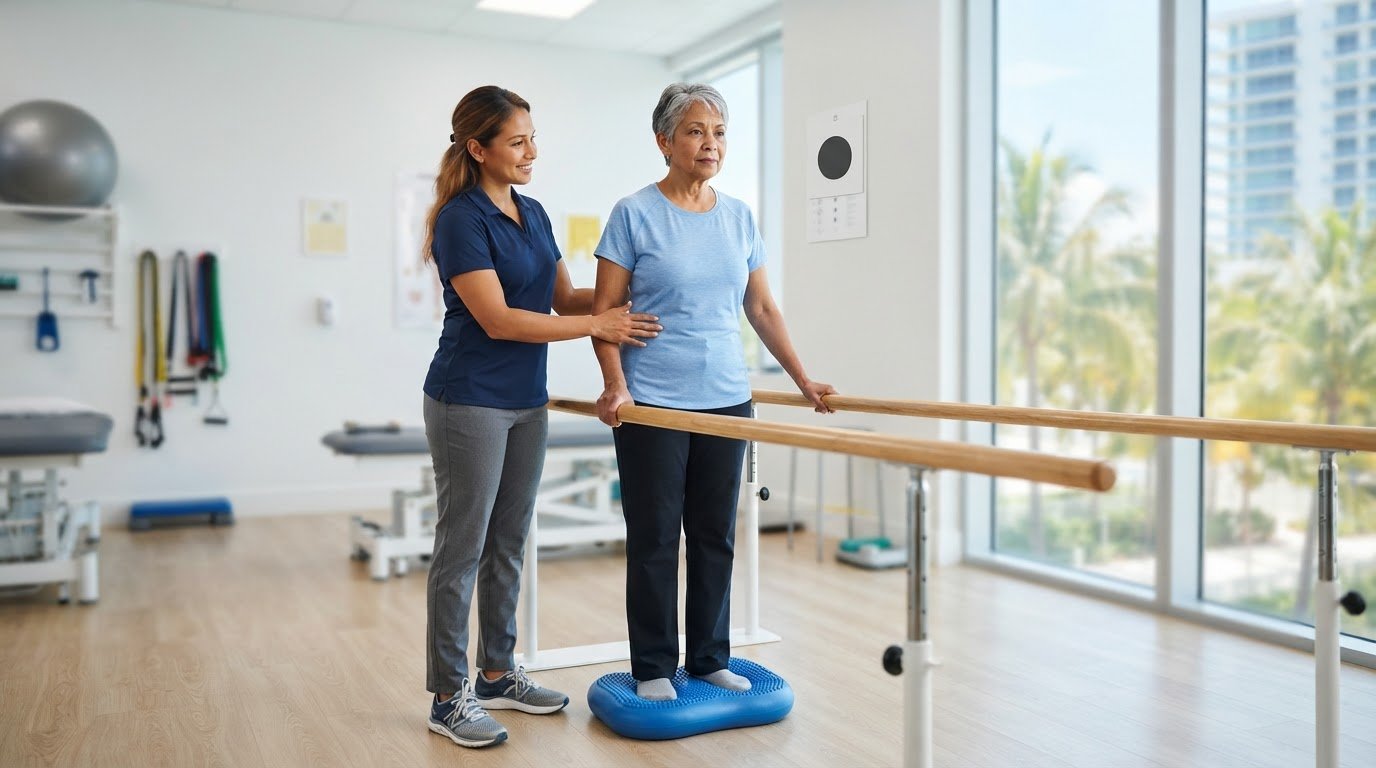
Could the movements that make you dizzy also help you feel steadier? If dizziness or unsteadiness is disrupting everyday activities, it’s understandable to worry that exercise might make symptoms worse. Inner ear balance rehabilitation uses carefully selected movements to help your brain and body respond to balance challenges. Because dizziness can have different causes, the right approach starts with understanding your symptoms.
You don’t have to guess which exercises are appropriate or push through symptoms on your own. With an individualized assessment, a therapist can consider your balance, gaze stability, movement sensitivity, and daily goals, then shape a plan around what you need and can safely manage.
This article explains the purpose of vestibular rehabilitation and the exercise categories a therapist may consider, including gaze-stabilization, balance, and habituation exercises. You’ll also learn what an assessment may involve, how exercises can be adjusted if they provoke symptoms, and what to expect as your plan progresses. The goal is a clearer, safer next step toward steadier movement.
Key Takeaways
- Learn how the vestibular system works with vision and body-position signals to support balance and orientation.
- See why inner ear balance rehabilitation exercises are selected for your symptoms and goals, rather than used as a one-size-fits-all routine.
- Understand what to do if a prescribed movement brings on dizziness, including when to pause and contact a clinician.
- Prepare for an assessment by noting your symptoms, possible triggers, relevant health information, and questions.
- Explore how an individualized evaluation can guide a safe next step for persistent balance concerns near Sunny Isles Beach.
What Is Inner Ear Balance Rehabilitation, and Who May Benefit?
Inner ear balance rehabilitation is individualized physical therapy that uses assessment-guided activities to address dizziness, gaze stability, balance, or mobility. It isn’t a generic exercise routine. A therapist considers your symptoms and functional goals to select and adjust activities that fit your needs.
The vestibular system, located in the inner ear, senses head movement and helps your brain understand how you’re oriented. Your brain combines this information with what you see and signals from your muscles and joints about your body’s position. Together, these systems help you stay steady as you move through your day.
How the vestibular system contributes to balance
Consider turning your head to check for traffic while walking. Your inner ear detects the head movement, your eyes help keep the surroundings in view, and body-position signals tell your brain where your feet and limbs are. Your brain brings these cues together to support movement and stability. If one source of information is disrupted or doesn’t match the others, you may feel dizzy, disoriented, or unsteady.
Vestibular rehabilitation (VR) is an exercise-based approach tailored to a person’s needs. Exercises are chosen for a clinical purpose, rather than followed as a one-size-fits-all sequence.
Symptoms that may prompt a rehabilitation assessment
You might consider an assessment if you feel dizzy, unsteady while standing or walking, notice visual blurring as your head moves, or have less confidence moving around. These symptoms can affect ordinary tasks, such as walking through a busy space or turning to look behind you.
Symptoms alone can’t confirm an inner-ear problem. Dizziness and balance changes can have different causes, so an evaluation helps clarify what may be contributing and whether vestibular rehabilitation is suitable. A clinician can consider your symptom history and responses to movement before recommending exercises. Avoid assuming that a routine found online is right for you.
If you’re exploring vestibular rehabilitation services, Touch of Health Rehab Inc. offers vestibular rehabilitation alongside balance and gait rehabilitation. An individualized physical therapy plan can guide exercise selection and progression based on your assessment and goals.
How Inner Ear Balance Rehabilitation Exercises Address Different Symptoms
Vestibular exercises are selected for particular symptoms, not used as interchangeable routines or guaranteed cures. A movement that supports one person’s gaze stability may be unsuitable for someone with a different cause of dizziness or balance difficulty. Exercise choice depends on assessment findings and the functional goals you and your clinician identify together.
That distinction matters because balance problems can have different underlying causes. The National Institute on Deafness and Other Communication Disorders outlines conditions associated with balance disorders, reinforcing why a clinician considers your history and symptoms before recommending an approach. The aim of inner ear balance rehabilitation is to select and progress activities thoughtfully, not to push through a preset routine.
Gaze-stabilization exercises and visual focus
If your vision seems blurred while your head moves, a clinician may consider gaze-stabilization work. In general, this involves keeping your eyes on a visual target while making prescribed head movements, with the goal of maintaining clear visual focus during motion. Whether it’s appropriate depends on your assessment, symptoms, and possible cause. Your clinician should guide the movement and progression. There’s no universal speed, repetition count, or schedule that fits everyone.
Habituation and balance-training exercises
For some people, a clinician may select carefully graded movements or situations related to their symptoms, an approach known as habituation. Balance training may involve tasks chosen for your current ability and safety, then adjusted as you progress. The activities should connect to real functional needs, rather than simply becoming harder for the sake of difficulty. A supervised plan gives your clinician a way to respond to your symptoms and modify the challenge.
For example, if a particular head movement or visual environment is associated with symptoms, your clinician can decide whether a modified version belongs in your plan. If standing or walking feels unsteady, balance tasks may be selected to match your present abilities and daily goals. These examples aren’t instructions to try on your own. Copying a generic online sequence may expose you to movements that don’t suit your symptoms or safety needs.
At Touch of Health Rehab Inc., an individualized physical therapy plan can guide exercise selection and progression as part of vestibular rehabilitation. To learn more about the clinic, explore its physical therapy services as you consider a next step with a clinician.
Will Inner Ear Balance Exercises Make Dizziness Worse? Safety and Expectations
Some prescribed movements may briefly bring on or increase dizziness, but people respond differently. A temporary symptom response doesn’t prove an exercise is effective, and you shouldn’t feel you have to push through severe discomfort. In inner ear balance rehabilitation, your clinician can help interpret your response in light of your symptoms, assessment, and treatment goals.
What symptom response may mean during a prescribed exercise
Follow your clinician’s directions for each activity, including its pace, when to take breaks, and how to monitor symptoms. If a movement causes a strong reaction, symptoms linger, or the response feels unusual for you, pause the exercise and contact your clinician for guidance. They may change the movement or its level of challenge. Don’t increase the speed or amount on your own to try to make progress faster.
Some people experience a temporary increase in symptoms when they begin prescribed movement, while others don’t. There’s no single response that applies to everyone. Your therapist can use what you report to decide whether to adjust the activity, review its technique, or reassess what may be contributing to your symptoms. Progress should follow your plan, not the idea that more dizziness means better results.
When to seek medical advice before exercising
Arrange an appropriate clinical assessment if dizziness is new, unexplained, worsening, or persistent, especially before starting exercises you found online. A therapist or other clinician can consider your health history and symptoms and help determine a suitable next step. Don’t assume dizziness comes from the inner ear or that vestibular exercises are right for every cause.
Sudden severe symptoms or concerning neurological changes need prompt medical evaluation. Seek emergency medical care for signs such as sudden weakness or numbness, trouble speaking, new difficulty coordinating movement, or a sudden severe headache. Don’t try to manage these symptoms by continuing an exercise routine.
This article offers general information, not a diagnosis or substitute for individualized medical advice. If you’re uncertain whether a movement is safe for you, pause and ask a qualified clinician before resuming. Discussing your symptoms can help guide a safer, more appropriate plan.
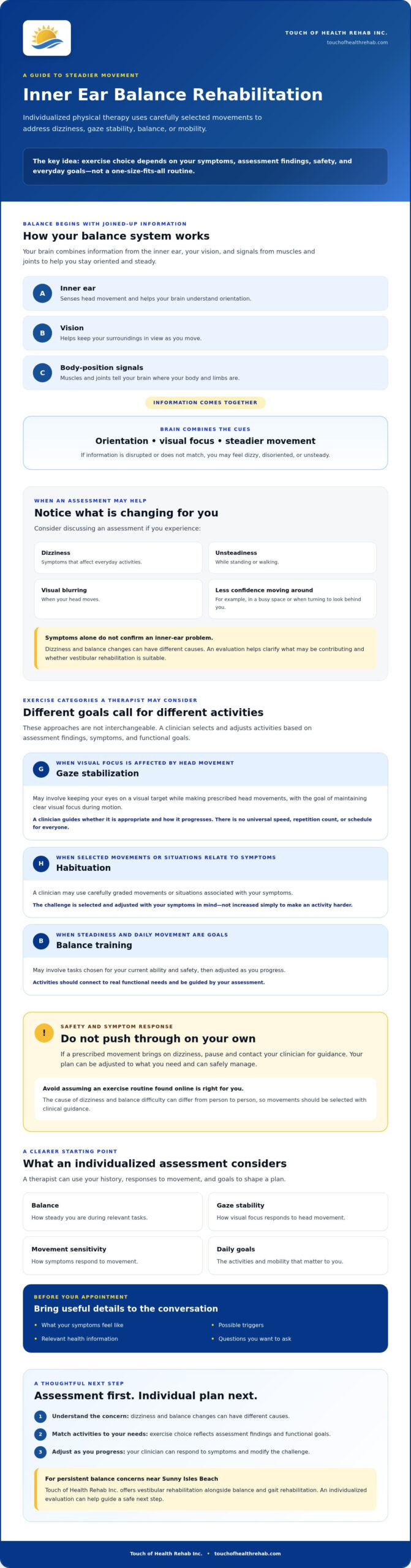
How to Prepare for an Inner Ear Balance Rehabilitation Assessment
A little preparation can help you explain what’s happening and make better use of your appointment. For an inner ear balance rehabilitation assessment, focus on clear observations rather than trying to identify the cause yourself. Your notes can help the clinician understand how symptoms affect daily movement and what may need closer evaluation.
What details to track before your appointment
Write down when symptoms began, how often they occur, and what you were doing when they started or changed. Note whether they arise with head movement, standing, walking, or particular visual environments. Include any falls or near-falls, changes in walking confidence, and visual blurring during movement.
Bring a symptom timeline, possible triggers, relevant health information, and your questions so the clinician can understand what affects your everyday movement.
- List relevant diagnoses, medications, and previous evaluations or treatments.
- Describe activities that have become difficult, such as turning while walking or moving through busy spaces.
- Write down questions about exercise safety, possible next steps, and how progress will be reviewed.
You don’t need to arrive with a perfect record. Even a few specific examples can make the conversation more useful.
What an individualized rehabilitation plan may include
An assessment may include a discussion of your symptom history and observations of balance, walking, gaze, or responses to relevant movements. The clinician decides which components are appropriate based on your presentation; not everyone needs the same tests or activities. Share any concerns during the visit, especially if a movement feels unsafe or brings on an unexpected response.
Goals can reflect activities you want to manage more comfortably, such as walking with greater steadiness or feeling more confident during everyday movement. If rehabilitation is appropriate, exercise selection and progression depend on assessment findings and how you respond. Your plan can be adjusted as your needs become clearer; it isn’t a fixed sequence for everyone.
Touch of Health Rehab Inc. provides vestibular rehabilitation and balance and gait rehabilitation. You can review information about balance and gait rehabilitation to learn about related care. To discuss whether an individualized physical therapy plan may fit your needs, contact Touch of Health Rehab Inc..
Finding Inner Ear Balance Rehabilitation Near Sunny Isles Beach
If dizziness or unsteadiness continues to interfere with walking, everyday tasks, or confidence moving around, a physical therapy evaluation may be a useful next step. It gives you an opportunity to discuss what you’re experiencing and whether an individualized rehabilitation assessment is appropriate. You don’t need to know the cause before asking questions; an evaluation can help guide what to consider next.
Choosing a provider is also a chance to understand how care will be tailored to you. Before beginning inner ear balance rehabilitation, consider asking:
- How will the assessment consider my symptoms, balance, walking, and movements that may trigger discomfort?
- How will exercises be selected for my needs, and what happens if my symptoms change?
- How will we review progress and connect the plan to my everyday goals?
These questions can clarify how your concerns will shape the process. Share which activities matter most to you, whether that’s walking with more confidence, turning your head while moving, or managing daily routines with less worry. A thoughtful conversation helps you understand the proposed approach and raise concerns before you begin.
A personalized next step with Touch of Health Rehab Inc.
Touch of Health Rehab Inc. provides vestibular rehabilitation, vertigo recovery, and balance and gait rehabilitation, with personalized physical therapy plans. The clinic serves Sunny Isles Beach and nearby communities, including Aventura, Bal Harbor, North Miami Beach, and Miami Beach. Exercise choice and progression depend on an individual assessment, so care can be discussed in relation to your symptoms and functional goals rather than assumed in advance.
Explore details about the clinic’s Sunny Isles Beach vestibular rehabilitation service to learn more about this area of care. If you’d like to discuss your symptoms and ask whether an individualized assessment may be appropriate, explore care options with Touch of Health Rehab Inc..
Take a Thoughtful Next Step Toward Steadier Movement
Inner ear balance rehabilitation works best when the approach reflects your symptoms, assessment findings, and everyday goals. Exercises aren’t one-size-fits-all, and a brief increase in symptoms doesn’t mean you should push through or assume an exercise is working. Tracking what you experience and sharing it with a clinician can help guide safer, more relevant care.
If dizziness or unsteadiness continues to affect your daily life, an individualized assessment can help you discuss possible next steps. Touch of Health Rehab offers vestibular rehabilitation, vertigo recovery, and balance and gait rehabilitation in Sunny Isles Beach and nearby communities, including Aventura, Bal Harbor, North Miami Beach, and Miami Beach.
Explore vestibular and balance rehabilitation options at Touch of Health Rehab Inc. to discuss your concerns and ask about an individualized assessment. A conversation can be a practical first step toward a plan shaped around your needs, with progression guided by your clinician.
Frequently Asked Questions
What is inner ear balance rehabilitation?
Inner ear balance rehabilitation, also called vestibular rehabilitation, is individualized physical therapy designed to address concerns such as dizziness, visual stability, balance, or mobility. A clinician considers your symptoms, assessment findings, and daily activities when deciding whether rehabilitation may be appropriate. It isn’t a standard exercise routine for everyone, and dizziness alone doesn’t confirm an inner-ear condition. Assessment helps guide a plan suited to your needs.
Can exercises help with inner ear dizziness?
Some exercises may help manage dizziness associated with vestibular conditions, but the right approach depends on the cause and your individual symptoms. After assessing you, a clinician may consider gaze-stabilization, carefully graded movements, or balance activities. These exercises aren’t interchangeable or guaranteed to resolve symptoms. If dizziness is new, unexplained, persistent, or worsening, seek appropriate clinical advice rather than assuming exercises are the answer.
Can vestibular exercises make dizziness worse at first?
Some prescribed movements may briefly provoke dizziness, while other people experience little or no increase in symptoms. A temporary response doesn’t prove that an exercise is effective, so follow your clinician’s instructions for pace, breaks, and monitoring. Pause and contact the clinician if symptoms are intense, persistent, or unusual for you. They can review your response and adjust the exercise or plan as needed.
How long does inner ear balance rehabilitation take?
The duration varies with the underlying cause, your symptoms, functional goals, and how you respond to the plan. Some people need a short course, while others may benefit from a longer period of guided care. Your clinician can discuss a reasonable plan after assessing you and review progress over time. Rather than relying on a fixed timeline, ask how your goals and response will guide progression.
What happens during a vestibular rehabilitation assessment?
A vestibular rehabilitation assessment may include discussion of your symptom history and observations of balance, walking, gaze, or responses to relevant movements. The clinician chooses examination components based on your individual needs; not everyone has the same assessment. Bring notes about symptom timing, triggers, falls, medications, and prior evaluations. Touch of Health Rehab provides vestibular and balance rehabilitation in Sunny Isles Beach and nearby Aventura, Bal Harbor, North Miami Beach, and Miami Beach.
Is it safe to try inner ear balance exercises at home?
Home exercises may be part of a plan, but it’s best to have a clinician determine which movements are appropriate and explain how to do them safely. An exercise found online may not match your symptoms, cause, balance ability, or surroundings. Ask how to manage breaks and what symptoms should prompt you to stop. Don’t continue a movement that feels unsafe or causes a strong, unusual response without guidance.
When should I seek medical care for dizziness instead of exercising?
Seek clinical advice for new, unexplained, worsening, or persistent dizziness before starting exercises on your own. Sudden severe symptoms or concerning neurological changes, such as sudden weakness, trouble speaking, or new difficulty coordinating movement, need prompt medical evaluation. Don’t try to treat urgent symptoms by continuing an exercise routine. This FAQ can’t diagnose the cause of dizziness or replace individualized medical advice.