
What if walking more confidently depends on training not just your legs, but how your body balances and moves as a whole? Balance and gait rehabilitation works on these connected skills, helping you practice steadier, more coordinated movement for everyday activities.
If your steps feel less steady than they used to, it’s understandable to wonder what’s causing the change, worry about falling, or feel unsure whether it’s safe to try exercises on your own. A physical therapist can assess how you move and balance, then tailor rehabilitation to your abilities, symptoms, and mobility goals.
This guide explains how balance and walking work together, what an assessment and common rehabilitation activities may involve, and when balance care may overlap with vestibular rehabilitation. You’ll also learn how to support safe practice and choose a practical next step. Touch of Health Rehab Inc. is based in Sunny Isles Beach, Florida, and offers balance and gait rehabilitation as part of its physical therapy services.
Key Takeaways
- Notice which everyday movements feel less steady. Those details can help guide a conversation about mobility.
- Balance and gait rehabilitation may combine strength, coordination, posture, and walking practice, with activities adjusted to your needs.
- A therapist can connect movement observations with your history and personal goals to shape a relevant plan.
- Keep home practice within the instructions you’ve been given: use agreed support, clear hazards, and report changes in how you feel.
- Touch of Health Rehab Inc. in Sunny Isles Beach offers balance and gait rehabilitation and individualized physical therapy. Ask the clinic whether its location and services suit your needs.
What Balance and Gait Rehabilitation Addresses in Everyday Movement
When your steps feel uncertain, familiar activities such as getting up from a chair, crossing a room, or turning toward someone can become less predictable. Balance and gait rehabilitation is individualized physical therapy that addresses stability and walking function. It connects movement practice with the tasks that matter in your daily life.
Balance and walking are closely linked, but they aren’t identical. Standing balance is your ability to stay upright while your body is relatively still. Moving balance is the control needed to shift your weight, take steps, turn, and adjust as you move. You might feel steady while standing but less secure when walking, or find that changing position is more difficult than walking along a straight path.
How balance and walking work together
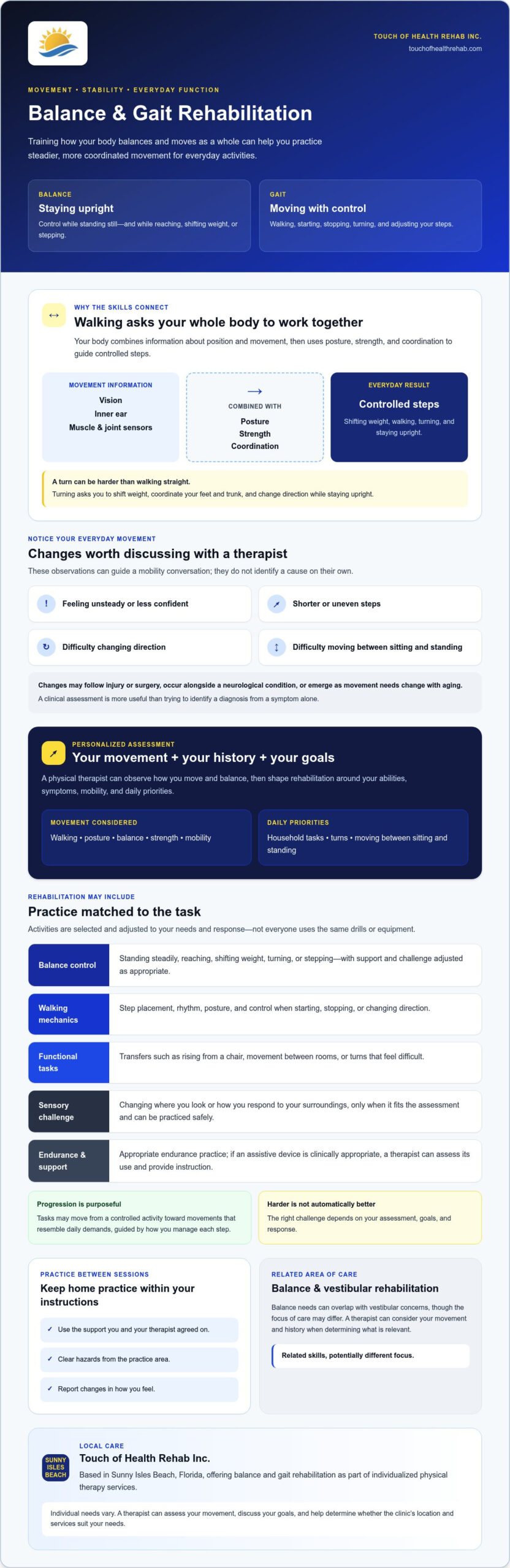
Your body combines information from vision, the inner ear, and sensors in your muscles and joints to understand position and movement. Posture, strength, and coordination help turn that information into controlled steps. If one part of this system is affected, walking may take more effort or feel less predictable.
Consider turning while walking. You need to shift your weight, coordinate your feet and trunk, and adjust your direction while staying upright. A change in balance, strength, or coordination can make that turn harder, even if walking straight ahead feels manageable. Practicing movement as a whole can help a therapist identify which skills need attention.
When walking or stability changes deserve attention
Notice patterns such as unsteadiness, shorter or uneven steps, reduced confidence, or difficulty changing direction. These changes can follow an injury or surgery, occur alongside a neurological condition, or emerge as movement needs change with aging. They don’t point to one specific cause on their own. A clinical assessment is a more useful next step than trying to identify a diagnosis from a symptom.
A physical therapist can consider your walking, posture, balance, strength, mobility, health history, and daily priorities when shaping care. Your goals might include feeling more secure during household tasks, managing turns, or moving between sitting and standing. General strategies for fall prevention include attention to risk factors and appropriate interventions, but the right approach depends on the individual.
Balance and gait needs can also overlap with vestibular concerns, though the focus of care may differ. Touch of Health Rehab Inc. offers balance and gait rehabilitation in Sunny Isles Beach as part of its individualized physical therapy services.
How Balance and Gait Rehabilitation Retrains Movement
Effective practice connects the skills needed to stay steady with the movements you want to manage in daily life. In balance and gait rehabilitation, a physical therapist may select activities that address strength, coordination, posture, and walking mechanics, then adjust them to your response and goals. Not everyone needs the same drills, equipment, or level of challenge.
Training balance during stillness and movement
Maintaining an upright position while standing is different from staying controlled as you reach, turn, or step. A therapist may begin with a manageable task and change the amount of support, the surface, or the movement demands as appropriate. Sensory challenges, such as changing where you look or how you respond to your surroundings, are used only when they fit your assessment and can be practiced safely.
Progression is purposeful, not a race. A controlled activity may help you focus on one element of movement; a more functional task asks you to coordinate several elements at once. Your therapist can observe how you manage each step and adapt the challenge. A harder exercise is not automatically a better one.
Practicing walking mechanics and functional tasks
Walking practice can focus on step placement, rhythm, posture, and control when starting, stopping, or changing direction. Depending on your needs, sessions may also include transfers, such as rising from a chair, and appropriate endurance practice. If an assistive device is clinically appropriate, a therapist can assess its use and provide instruction rather than assuming everyone needs one.
Tasks become more meaningful when they reflect your routine. For one person, that could mean practicing movement between rooms; for another, it could mean working on turns or transitions that feel difficult. Activities may begin in a more controlled setting and gradually resemble the demands of everyday movement, guided by your abilities and the therapist’s assessment.
Common training components may include:
- Strength and coordination activities selected for your movement needs.
- Standing balance and balance challenges during reaching, stepping, or turning.
- Walking practice addressing steps, direction changes, and movement control.
- Functional tasks and endurance practice matched to personal goals.
This overview describes possible components, not a self-directed exercise plan. Your therapist can help determine which activities are suitable and how to progress them. If you’re considering individualized physical therapy, learn more about Touch of Health Rehab Inc. and its rehabilitation services.
How Therapists Match Rehabilitation to Your Balance and Gait Needs
A useful rehabilitation plan starts with understanding how movement affects your life, not simply assigning exercises based on a diagnosis. During an evaluation, a physical therapist may consider how you walk, stand, turn, and move between positions, then connect those observations with your health history and priorities. This helps shape balance and gait rehabilitation around your current abilities and meaningful functional goals.
What a physical therapist may assess
A therapist may observe your walking pattern, turns, transfers, and stability, while considering relevant limits in strength or mobility. They’ll also ask about your health history and what feels difficult or important to you, such as moving around your home with greater confidence. The assessment is guided by your circumstances; it doesn’t follow one fixed sequence for everyone.
Sharing specific details can make the discussion more useful. Note when you first noticed a change, which activities feel challenging, and whether symptoms vary with movement or position. These observations don’t establish a diagnosis, but they can help the therapist understand your experience and decide what to explore further.
Different needs can lead to different therapy priorities
After an injury or surgery, therapy may account for changes in strength, mobility, or comfort as you resume movement. With a neurological condition, the therapist may consider how it affects coordination and walking function. The goal is not to rank one situation against another, but to select priorities that fit your circumstances and daily activities.
Dizziness or a sense of motion may bring the vestibular system into consideration. Balance and walking concerns can overlap with vestibular symptoms, but they aren’t interchangeable. A therapist can help determine whether vestibular rehabilitation is also relevant. For more information, see the clinic’s vestibular rehabilitation information.
The same broad concern, such as feeling unsteady, can have different implications for each person. One person may want to focus on turning safely, while another may prioritize standing from a chair or walking farther during everyday tasks. Those priorities help guide the type and level of practice, with the plan adjusted as the therapist learns more about your needs.
For details about the clinic’s local service, visit Touch of Health Rehab’s balance and gait rehabilitation page. An individualized conversation can help connect assessment findings with practical mobility goals without assuming that the same approach suits everyone.
How to Support Safe Progress Between Balance and Gait Sessions
Home practice can help carry therapist-guided work into daily routines, but it should extend an approved plan, not replace an assessment. In balance and gait rehabilitation, the right activity and level of challenge depend on your symptoms, stability, and health needs. Before trying a new or more difficult movement, ask your therapist what to practice, where to do it, and what support to use.
Making practice more manageable at home
Your surroundings matter. Clutter in a walkway, footwear that feels insecure, or worry about losing your balance can make practice harder to manage. Tell your therapist about these barriers so you can discuss practical adjustments. If reducing hazards is a priority, learn more about the clinic’s fall prevention therapy.
Use this simple safety framework for activities your therapist has approved:
- Follow your instructions. Practice only the movements and level of difficulty discussed with your therapist. Don’t add extra repetitions or progress an activity on your own.
- Use agreed support. Follow your therapist’s guidance about support or assistive devices, and practice only in the setting you’ve discussed.
- Clear the space. Make sure the planned area is free of obstacles and has enough room for the activity. Ask whether your usual footwear and surroundings are suitable.
- Report changes. Share whether practice felt manageable, difficult, or different from expected, and mention any changes in your balance or walking.
There isn’t a universal schedule for making exercises harder. Your therapist can help judge progression based on how stable you feel, how you tolerate the activity, and what they observe during care. Exercises that involve reducing support or changing sensory conditions aren’t right for everyone. Don’t try challenging drills, such as standing on one leg or closing your eyes, unless your therapist has specifically approved and explained them.
Knowing when to pause and ask for guidance
Stop an activity if it feels unsafe or brings on concerning changes in your symptoms. Contact your clinician for guidance if walking or balance difficulties are new, worsening, or interfering more with daily activities. If symptoms are sudden or severe, seek urgent medical advice rather than waiting for your next rehabilitation session.
Clear communication helps your therapist adjust the plan with you. Contact Touch of Health Rehab to ask about its physical therapy services and discuss whether balance and gait rehabilitation may fit your mobility needs.
Finding Balance and Gait Rehabilitation in Sunny Isles Beach
Choosing rehabilitation is a practical step toward understanding what may be affecting your mobility and which goals deserve attention first. An individual assessment helps connect your symptoms and movement needs with a personalized plan, while therapist-guided progression keeps activities aligned with your abilities and clinical circumstances. Treatment approaches and progress vary from person to person.
What to ask when exploring therapy
A clear conversation can help you understand what care may involve. Consider asking how the evaluation will relate your concerns to walking and balance goals, and how those findings will inform a plan. Share relevant details, including a diagnosis, falls, dizziness, recent surgery, injury, or any assistive device you use. This information helps the therapist consider your circumstances without assuming one approach fits everyone.
You might also ask how progress will be discussed and what to do if an activity feels difficult or your symptoms change. If you’re comparing local care options, this Sunny Isles Beach physical therapy guide offers broader local context. For a closer look at balance-focused care, read about physical therapy for balance. This article focuses on how walking practice and balance training can work together.
A local next step for personalized mobility support
Touch of Health Rehab Inc. is a physical therapy center based in Sunny Isles Beach, Florida, offering balance and gait rehabilitation and individualized physical therapy. If you live in Sunny Isles Beach, Aventura, Bal Harbor, North Miami Beach, or Miami Beach, contact the clinic to confirm whether its location and services suit your needs. Its stated location is in Sunny Isles Beach, so don’t assume that services are offered at other locations.
As you consider your next step, look for a conversation that connects your concerns with functional goals and explains how rehabilitation may be tailored to you. Explore balance and gait rehabilitation at Touch of Health Rehab to learn more about the clinic’s services.
Take a Thoughtful Next Step Toward Steadier Mobility
Balance and walking work together, so rehabilitation considers how you stay stable and move through everyday tasks. An individualized assessment helps connect your symptoms, health history, and personal priorities with suitable practice. Progress is guided by your response, not a one-size-fits-all exercise schedule.
Home activities are safest when they follow your therapist’s instructions. Use agreed support, keep practice areas clear, and speak up if a movement feels unsafe or your balance or walking changes. Small, informed steps can help you move forward with greater understanding.
Touch of Health Rehab offers balance and gait rehabilitation, vestibular rehabilitation, and individualized physical therapy. If you’re ready to learn more, contact Touch of Health Rehab to explore balance and gait rehabilitation.
Your mobility goals are personal, and the path toward them can be guided one step at a time.
Frequently Asked Questions
What is balance and gait rehabilitation?
Balance and gait rehabilitation is individualized physical therapy focused on stability and walking function. A therapist may consider how you stand, walk, turn, and manage everyday movements, then tailor activities to your needs and goals. Treatment may address strength, posture, coordination, and walking practice. The specific plan varies with your symptoms, health history, and functional priorities rather than following a standard exercise routine for everyone.
Who can benefit from balance and gait rehabilitation?
People who feel unsteady, walk differently than before, or have difficulty with turns or everyday movement may benefit from an assessment. Walking and balance concerns can arise in different circumstances, including after an injury or surgery, alongside a neurological condition, or with vestibular symptoms. These experiences don’t identify a specific diagnosis by themselves. A physical therapist can assess your movement and help determine whether rehabilitation may be appropriate for your needs.
Can physical therapy improve walking and balance?
Physical therapy can address walking and balance challenges through activities selected for your individual needs. A therapist may work on strength, coordination, posture, standing stability, turns, or walking tasks, then adjust practice based on your response. The aim is to support functional movement, such as getting around your home more comfortably. Results and progress differ between people, so a therapist can discuss appropriate goals without promising a particular outcome.
What happens during a balance and gait assessment?
A balance and gait assessment may include observing how you walk, turn, stand, and move between positions. The therapist may also consider your posture, strength, mobility, health history, symptoms, and personal goals. For example, you can explain whether turning, rising from a chair, or walking around your home feels difficult. The evaluation is guided by your circumstances; there isn’t one fixed process that applies to every person.
How long does gait rehabilitation usually take?
There isn’t a standard timeline for gait rehabilitation. The length and pace of care depend on factors such as your symptoms, health history, functional goals, and how you respond to therapy. A therapist can discuss a plan after learning more about your needs and observing your movement. Progression should be guided by clinical judgment and your tolerance, rather than a generic schedule or a promise of a specific result.
Are balance exercises safe to do at home?
Home balance exercises are safest when a physical therapist has assessed your needs and approved the activities. Follow the instructions you’ve been given, use agreed support, and clear the practice area of hazards. Don’t add challenging movements or change the difficulty on your own. Ask your therapist whether your footwear, surroundings, and any assistive device are appropriate, and let them know if an exercise feels unsafe or changes your symptoms.
When should I seek help for new walking or balance problems?
Contact a healthcare professional if new or worsening unsteadiness, changed walking patterns, or difficulty turning begins to affect daily activities. A clinical assessment can help explore possible factors without assuming a symptom points to one diagnosis. Touch of Health Rehab Inc. is based in Sunny Isles Beach and has a stated local focus that includes Aventura, Bal Harbor, North Miami Beach, and Miami Beach. For sudden or severe symptoms, seek urgent medical advice.