
If you feel unsteady on stairs, hesitate when turning, or worry that a fall could disrupt your independence, those concerns deserve thoughtful attention. Fall prevention physical therapy can help identify movement factors affecting your balance and build practical skills for everyday activities.
Your balance and mobility are shaped by factors such as strength, posture, walking habits, and how you move between positions. A physical therapist can assess how these factors work together and use the findings to develop an individualized plan. The goal is not to promise that falls can be eliminated, but to support steadier, more confident movement in daily life.
In this article, you’ll learn what can affect balance, what to expect from fall-prevention care, and how exercise and balance and gait rehabilitation may support your goals. You’ll also see how postural education and practice with everyday movements can fit into therapy. Touch of Health Rehab Inc. provides personalized care in Sunny Isles Beach, Aventura, Bal Harbour, North Miami Beach, and Miami Beach, helping you take progress one step at a time.
Key Takeaways
- Fall prevention physical therapy focuses on your mobility, balance, strength, and everyday movement needs. It cannot guarantee that falls will never happen.
- A physical therapist can assess how you walk, balance, stand, and move between positions to shape a plan around your goals.
- Exercises are selected for your abilities and may address leg strength, balance reactions, transfers, and walking confidence.
- Between visits, follow your therapist’s plan and share changes. Discuss footwear, medications, vision, and home hazards with the appropriate healthcare professionals.
- Touch of Health Rehab Inc. provides personalized fall-prevention, geriatric, and balance and gait rehabilitation care in Sunny Isles Beach, Aventura, Bal Harbour, North Miami Beach, and Miami Beach.
What Fall Prevention Physical Therapy Can, and Cannot, Do
Feeling less steady doesn’t mean you have to stop doing the things that matter to you. Fall prevention physical therapy addresses movement factors such as balance, strength, walking, posture, and the ability to manage everyday tasks. A physical therapist considers how these areas work together, then tailors care to your abilities and functional goals. For a broad overview of approaches to reducing fall risks, see Fall prevention.
The aim is to work on movement factors that can be addressed and help you move with greater control and confidence. Therapy can’t guarantee that you’ll never fall: falls may have more than one cause, and not every factor is within your control. Touch of Health Rehab Inc. provides fall prevention therapy as part of personalized care focused on mobility and daily function.
Which changes in movement may prompt a fall-risk evaluation?
Consider discussing a movement evaluation if turning feels difficult, standing up from a chair takes more effort, or uneven ground makes walking feel less secure. You might find yourself holding onto furniture more often or avoiding an activity because you feel uncertain on your feet. These changes can help guide a conversation, but no single symptom proves that a fall will happen.
Tell your clinician about previous falls or near-falls, including what you were doing and whether your movement has changed since. New or sudden symptoms warrant medical evaluation. Physical therapy can address movement and balance goals, but it isn’t emergency care or a substitute for prompt assessment of an abrupt change in your health.
Does fall-prevention therapy mean giving up independence?
No. The purpose is to support your participation in meaningful activities, not to take those choices away. You and your therapist can identify what you want to keep doing, whether that’s walking through your neighborhood, getting up from a favorite chair, or moving around more comfortably at home. Exercises and goals should reflect your current abilities and comfort level.
Progress is collaborative and gradual. Your therapist can adjust activities as your movement, confidence, or needs change, while keeping your priorities in view. At Touch of Health Rehab Inc., personalized fall-prevention care can include balance and gait rehabilitation and postural education. In Aventura, Sunny Isles Beach, Bal Harbour, North Miami Beach, and Miami Beach, this care can help you work toward steadier movement while staying engaged in daily routines that matter to you.
How Physical Therapists Assess Fall Risk and Plan Care
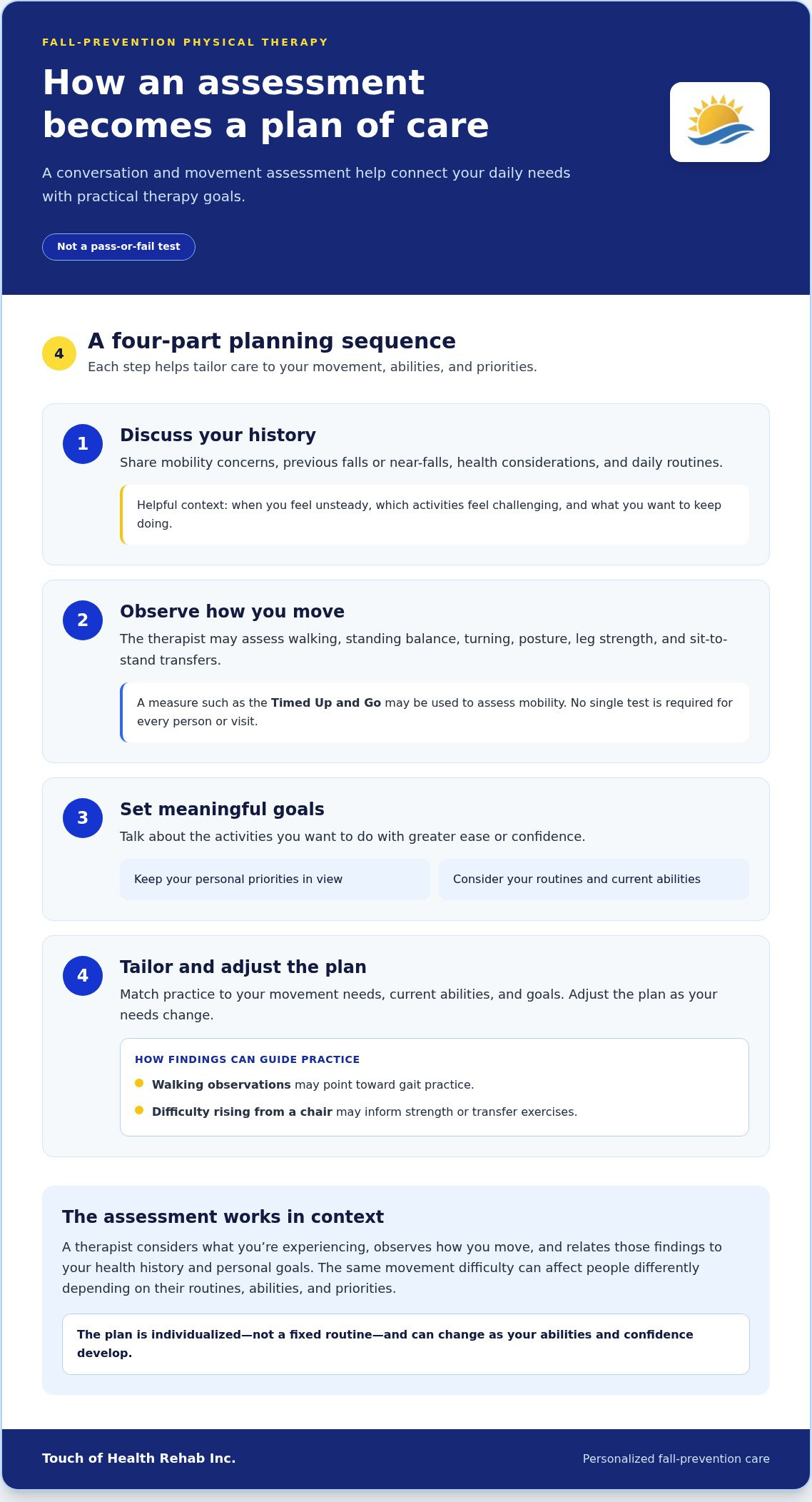
A fall-risk evaluation combines a conversation with a movement assessment. It isn’t a pass-or-fail test. The therapist considers what you’re experiencing, observes how you move, and relates those findings to your health history and personal goals. That context matters: the same movement difficulty can affect people differently depending on their routines, abilities, and priorities.
A typical planning sequence includes:
- Discuss your history: Share mobility concerns, previous falls or near-falls, health considerations, and daily routines.
- Observe movement: The therapist may assess walking, standing balance, turning, posture, leg strength, and sit-to-stand transfers.
- Identify meaningful goals: Talk about activities you want to do with greater ease or confidence.
- Tailor the plan: Match practice to your movement needs, current abilities, and goals, then adjust it as your needs change.
The National Institute on Aging also offers guidance on fall prevention for older adults, including common causes and prevention approaches. A physical therapy assessment adds an individual perspective by connecting general risk factors with how you move in daily life.
What happens during a fall-risk physical therapy assessment?
You may be asked when you feel unsteady, whether you’ve fallen or nearly fallen, which activities feel challenging, and what you’d like to keep doing. The therapist may observe how you walk, turn, stand, maintain balance, or rise from a chair. A measure such as the Timed Up and Go may be used to assess mobility, but no single test is required for every person or visit.
How do assessment findings shape an individual plan?
Assessment findings help the therapist choose what to work on and how to begin. For example, observations about walking may point toward gait practice, while difficulty rising from a chair may inform strength or transfer exercises. The plan can progress or change as your abilities and confidence develop; it isn’t a fixed routine. Balance and gait rehabilitation can also support mobility goals.
At Touch of Health Rehab Inc., personalized fall prevention physical therapy connects assessment findings with your priorities in a supportive plan. Explore Touch of Health Rehab Inc.’s physical therapy care to learn about movement support in Sunny Isles Beach, Aventura, Bal Harbour, North Miami Beach, and Miami Beach.
Which Fall-Prevention Exercises Are Safe and Useful?
There isn’t one exercise routine that suits everyone. In fall prevention physical therapy, exercise choices are guided by your assessment findings, health history, current abilities, and the movements you want to manage more comfortably. A therapist considers how much support you need and how an activity feels before deciding how to begin or progress it.
This individualized approach also helps address exercise-safety concerns. Challenging balance drills aren’t appropriate for everyone, especially without guidance. A physical therapist can adapt an activity, provide suitable support, and adjust its difficulty as your steadiness and confidence develop. The goal is purposeful practice, not pushing through discomfort or attempting movements that feel unsafe.
How can strength and balance practice support steadier movement?
Lower-body strengthening may target movements used to stand from a chair or stay upright while walking. Balance practice can help you work on controlling your body as you shift position or respond to a change in movement. These are examples of therapy goals, not a universal exercise list or a prescription to try on your own.
Your therapist can choose a starting level that fits your abilities and progress it thoughtfully. For one person, that may mean practicing a familiar transfer with appropriate support. For another, it may involve a different strength or balance challenge. The exercise and its difficulty should be based on your needs.
How does gait training relate to everyday fall prevention?
Walking involves more than moving straight ahead. Turning, changing direction, and adjusting your pace are all part of everyday mobility. In a suitable clinical setting, a therapist may use gait practice to work on these movement skills in a way that reflects your current ability. The focus is on building control and confidence for meaningful tasks, rather than treating every walking pattern the same.
For example, if changing direction feels uncertain, that concern can guide which walking movements to practice and how much support to use. As your needs change, the therapist can adapt the practice instead of relying on a fixed routine. This is one way fall-prevention therapy connects targeted exercise with everyday movement goals.
With personalized fall-prevention care, strength, balance, and gait activities can work together to support functional progress. Share what feels manageable and what still feels difficult so your therapist can shape practice around your comfort and priorities.
How to Support Fall-Risk Reduction Between Therapy Visits
Progress can carry into everyday life when you follow the plan developed with your physical therapist. Use this simple sequence between visits:
- Follow your therapist’s instructions. Practice only the activities and movement strategies you’ve agreed on together.
- Notice how daily movement feels. Keep track of tasks that feel difficult, easier, or different from before.
- Share updates at follow-up. Tell your therapist about changes, questions, or challenges so your plan can be adjusted appropriately.
Reducing fall risk also involves factors that exercise alone may not address. Discuss footwear, vision concerns, medication questions, and possible home hazards with the appropriate healthcare professional. Note environmental concerns, such as a walkway that feels cluttered or poorly lit, and discuss suitable ways to make everyday movement safer.
Supervised therapy builds movement skills through guided practice, while home-safety measures address hazards in your surroundings. Both can contribute to a broader fall-risk reduction plan.
How can daily routines reinforce therapy goals?
With your therapist’s guidance, you may be able to apply an agreed movement strategy during an appropriate daily activity, such as standing up from a familiar chair. Don’t add challenging balance exercises or change your program on your own. Pace activities according to your plan, allow time to rest, and use the safe surroundings and supports you’ve discussed with your therapist. Brief notes about what feels easier or harder can make follow-up conversations more useful.
When should someone seek additional medical guidance?
Seek prompt medical evaluation for a sudden or unexplained change in balance or walking. Recurrent falls, dizziness, and concerns about medication are also worth discussing with a healthcare professional, who can help determine appropriate next steps. If symptoms feel urgent, seek appropriate medical care rather than waiting for a routine physical therapy session. Fall prevention physical therapy can support movement goals, but it doesn’t replace medical evaluation when health changes need attention.
Touch of Health Rehab provides personalized care around your mobility needs and goals. Explore physical therapy care at Touch of Health Rehab to learn about support for steadier movement.
Fall Prevention Physical Therapy in Aventura and Sunny Isles Beach
If unsteadiness is making everyday movement feel less certain, care can start with your individual needs rather than a standard exercise routine. Touch of Health Rehab provides fall-prevention care, geriatric physical therapy, and balance and gait rehabilitation for people in Sunny Isles Beach, Aventura, Bal Harbour, North Miami Beach, and Miami Beach. The focus is on understanding how you move and shaping therapy around the activities you want to continue doing.
A personalized approach can make therapy more manageable. Your goals and current abilities help guide the plan, and movement practice can progress gradually as your needs change. The purpose is to support mobility and confidence, not to pressure you into activities that don’t feel appropriate.
What can a personalized fall-prevention plan focus on?
Depending on your needs, a plan may address balance, walking, strength, posture, or functional movements such as standing and changing direction. Goals can be practical: feeling more confident moving around familiar places or participating more comfortably in daily routines. For older adults, geriatric physical therapy can provide care tailored to age-related mobility needs and personal goals.
Fall prevention physical therapy isn’t a promise that falls will never happen. It offers a supportive way to work on movement factors that can be addressed through individualized care.
How can therapy support a more confident next step?
Progress begins with collaboration. You can share what matters most to you, and your physical therapist can help shape goals and adapt activities to your comfort and abilities. A gradual approach gives you space to build familiarity with movement while adjusting the plan as your functional needs evolve.
If you’re in Aventura, Sunny Isles Beach, Bal Harbour, North Miami Beach, or Miami Beach and would like support with mobility and fall prevention, explore physical therapy at Touch of Health Rehab. Learn about care that supports steadier movement and participation in everyday life.
Take a Steadier Step Toward Everyday Confidence
Feeling unsteady doesn’t mean you have to give up the routines and activities that matter to you. Fall prevention physical therapy can help identify movement needs and build a personalized plan around your abilities, priorities, and daily goals. Assessment, appropriately selected exercises, and sharing changes with your therapist all help guide care over time.
At Touch of Health Rehab, fall-prevention and geriatric physical therapy can work alongside balance and gait rehabilitation to support functional movement. Personalized plans may also include postural education, with activities adjusted to your needs and progress. Therapy can address modifiable risks, though it can’t guarantee that falls will never happen.
Take the next step toward steadier movement in Sunny Isles Beach, Aventura, Bal Harbour, North Miami Beach, or Miami Beach. Explore personalized physical therapy at Touch of Health Rehab and learn about care shaped around your daily goals.
Frequently Asked Questions
Can physical therapy help prevent falls?
Yes, physical therapy can help address movement factors that may be improved, though it can’t guarantee falls won’t happen. Fall prevention physical therapy may focus on balance, leg strength, walking, posture, and functional movements that matter in your routine. A therapist tailors the plan to your abilities and goals, then adjusts activities as your needs change. Therapy can be one part of a broader approach to reducing fall risk.
Which physical therapy exercises help with balance and fall prevention?
Exercises are selected based on your assessment, health history, and current abilities. A plan might include lower-body strengthening, supported balance practice, controlled sit-to-stand movements, or walking and turning activities. These are examples, not a routine for everyone to try independently. A physical therapist can match each activity to your goals and adjust the challenge as your abilities and confidence change.
Is fall-prevention physical therapy safe for older adults?
Fall-prevention therapy can be adapted to an older adult’s abilities, health considerations, and comfort. A physical therapist guides movement practice and can adjust an exercise’s support or difficulty to suit your needs. Share any concerns, symptoms, or changes in your health before or during therapy. If balance or walking changes suddenly, seek medical evaluation rather than treating the change as a routine exercise concern.
How often should someone attend physical therapy for fall prevention?
There isn’t one schedule that suits everyone. Visit frequency depends on your mobility needs, goals, response to therapy, and the plan developed with your physical therapist. Your therapist can explain how supervised sessions and agreed-upon practice between visits fit together, then review progress and adjust the plan as needed. Follow the activities and frequency recommended for you rather than adding sessions or exercises based on a general rule.
When should I seek physical therapy for balance or walking problems?
Consider discussing physical therapy if unsteadiness, changes in walking, or reduced confidence are affecting daily activities. A therapist can assess movement and help identify goals for balance, gait, and mobility care. Seek prompt medical evaluation for sudden or unexplained changes, and discuss recurrent falls, dizziness, or medication concerns with a healthcare professional. Touch of Health Rehab serves Sunny Isles Beach, Aventura, Bal Harbour, North Miami Beach, and Miami Beach.
Can physical therapy help after a fall?
Yes, physical therapy may support mobility and functional progress after a fall, once any immediate medical concerns have been addressed. A therapist can assess how the fall has affected your movement and guide an individualized plan based on your needs and goals. Touch of Health Rehab offers fall-prevention care and balance and gait rehabilitation in Sunny Isles Beach, Aventura, Bal Harbour, North Miami Beach, and Miami Beach.