
What if a sudden loss of balance is more than a brief spell of dizziness? If you’re asking what causes sudden balance problems, possible explanations include an inner-ear issue, a medication effect, a change in blood pressure, or a more urgent health concern. The sensation may feel like spinning, faintness, or unsteadiness. Those differences can offer useful clues, but they can’t confirm the cause.
An unexpected change in balance can be worrying, especially when you’re unsure whether to wait, call a healthcare professional, or seek emergency help. The timing of the symptoms and what happens alongside them matter. Sudden severe dizziness with weakness, facial numbness, trouble speaking, or chest pain needs immediate medical evaluation. A balance problem after a head injury also warrants prompt assessment.
This guide covers common causes, warning signs, and useful details to share with a healthcare professional, such as when symptoms began and what makes them better or worse. It also explains how vestibular rehabilitation and balance and gait therapy may support stability and recovery when appropriate after assessment.
Key Takeaways
- Learn what causes sudden balance problems, from inner-ear changes to medication effects, and why symptoms alone can’t identify the cause.
- Watch for warning signs such as sudden weakness, facial drooping, numbness, speech difficulty, or severe vision changes that call for emergency evaluation.
- If symptoms begin, reduce your risk of falling by sitting or lying somewhere safe and avoiding stairs or unsupported walking.
- Track when symptoms started and what you experienced so you can give a healthcare professional clear, useful details.
- After appropriate assessment, vestibular or balance rehabilitation may help support steadiness, walking, and confidence with daily activities.
What Causes Sudden Balance Problems, and What Does the Sensation Mean?
A sudden balance problem is a new or abrupt change in how steady, oriented, or secure you feel while standing or walking. It might begin during an everyday movement, such as turning your head or getting up, or appear without an obvious trigger. Describing exactly what changed is a practical first step in helping a healthcare professional understand what’s happening.
Balance problems are symptoms, not a diagnosis, and the same sensation can have different underlying causes. That’s why the question of what causes sudden balance problems can’t be answered from the feeling alone. The pattern, timing, and other symptoms all matter.
How the body keeps you steady
Your balance depends on several sources of information working together. The vestibular system in your inner ear senses head movement and position, helping your brain register whether you’re turning, tilting, or moving forward. Your eyes provide visual reference points, while sensors in your muscles and joints tell your brain where your body and limbs are in space.
The brain combines these signals and adjusts posture and movement so you can stay upright and coordinate your steps. For example, when you turn your head while walking, your eyes and inner ears help you keep track of your surroundings while your legs and trunk respond to the movement. If these signals are disrupted or don’t align, you may feel disoriented or less steady. A Balance disorder can involve different parts of this system, which is one reason a careful assessment matters.
What sudden imbalance can feel like
People use “dizziness” to describe several different experiences. Room-spinning vertigo can feel as if you or the environment is moving, even when you’re still. Faintness or lightheadedness may feel more like you could pass out, while wooziness is a vague sense of being off. Unsteadiness is different again: you may feel pulled to one side or unsure on your feet without any spinning sensation.
Some people also notice nausea, blurred vision, or difficulty walking. Describe what you feel rather than relying on “dizzy” alone. Does the room seem to spin, or do you feel faint? Does it happen at rest, when you stand, or when you move your head? Is walking difficult, and did the change begin suddenly or build over time? These details don’t establish a diagnosis, but they can help a healthcare professional understand your experience. If balance changes continue to affect your movement, balance and gait rehabilitation may be considered after the cause has been assessed.
Common Causes of Sudden Balance Problems, From Inner-Ear Changes to Medication
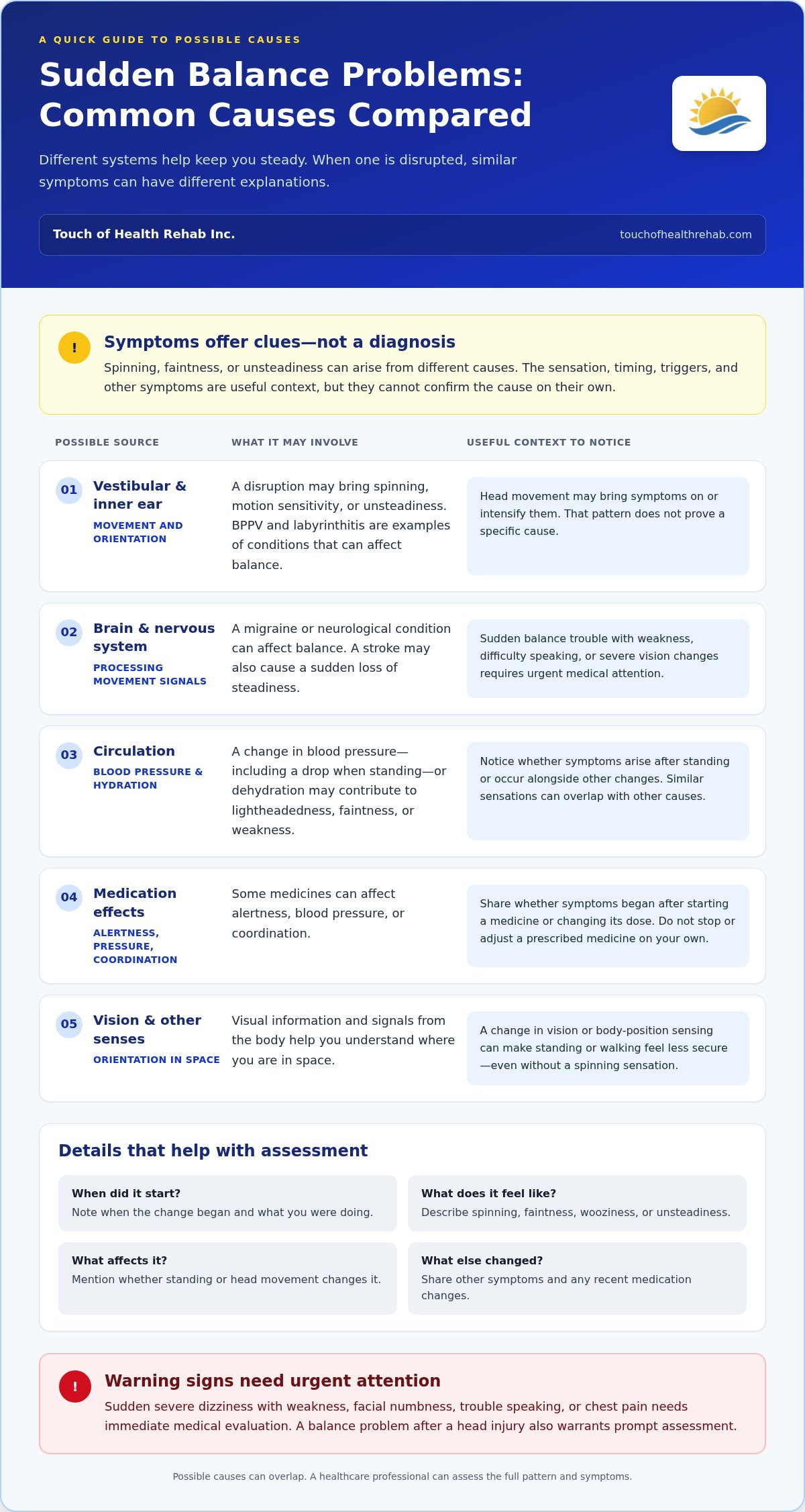
There isn’t one explanation for a sudden change in balance. If you’re wondering what causes sudden balance problems, possible sources include the inner ear, brain and nerves, circulation, medications, or changes in vision and other sensory information. These causes can feel similar, so a sensation or trigger may be useful context, but it can’t establish a diagnosis.
Because the inner ear, brain, circulation, vision, and sensory nerves all help guide posture and movement, problems in different systems can produce similar symptoms.
- Vestibular and inner-ear changes: A disruption in the vestibular system may cause spinning, motion sensitivity, or unsteadiness. Benign paroxysmal positional vertigo (BPPV) and labyrinthitis are examples of conditions that can affect balance, but symptoms alone can’t tell you whether either is responsible. Head movement may bring on or intensify some vestibular symptoms, but that pattern doesn’t prove a specific cause.
- Neurological conditions: The brain and nervous system process movement and sensory information. A migraine or neurological condition can affect balance, and a stroke may also cause a sudden loss of steadiness. Sudden balance trouble with warning signs such as weakness, difficulty speaking, or severe vision changes requires urgent medical attention.
- Cardiovascular changes: A change in blood pressure, including a drop when standing, can cause lightheadedness or a faint feeling. Dehydration may also contribute to feeling faint or weak. Note whether symptoms arise after standing or alongside other changes, while keeping in mind that these sensations can overlap with other causes.
- Medication effects: Some medicines can affect alertness, blood pressure, or coordination. If symptoms begin after starting a medication or changing its dose, share that timing with the prescribing healthcare professional. Don’t stop or adjust a prescribed medicine on your own. A clinician can help assess whether it may be contributing.
- Vision and other sensory changes: Clear visual information and signals from the body help you orient yourself in space. A change in vision or in the way your body senses position can make walking or standing feel less secure, even without a spinning sensation.
These categories can overlap, and similar symptoms don’t necessarily point to the same cause. The Mayo Clinic also describes balance problems in connection with inner-ear issues, medications, and other health conditions. When discussing a new episode with a healthcare professional, share when it started, what you were doing, whether movement affected it, any recent medication changes, and other symptoms you noticed. That context can support a more complete assessment without requiring you to guess at the cause.
After a healthcare professional assesses the cause, individualized physical therapy may support balance and function when rehabilitation is appropriate. Explore physical therapy support as one possible part of your recovery journey.
When Is a Sudden Balance Problem an Emergency?
A sudden balance change needs emergency help when it appears with signs that could indicate a stroke or another immediate threat. Other new or ongoing balance problems also deserve medical assessment, even without obvious emergency warning signs. You can’t reliably determine the cause by how long symptoms last or whether they ease temporarily.
If sudden loss of balance occurs with possible stroke signs, call 911 now, and don’t drive yourself. Getting emergency help promptly is safer than waiting to see whether symptoms pass.
Warning signs that call for emergency help
- Facial drooping, or weakness or numbness, particularly on one side of the body
- Difficulty speaking, understanding speech, or sudden confusion
- Severe or sudden changes in vision
- A severe headache, fainting, or chest pain
- Inability to stand or walk safely, particularly when the change is sudden or severe
Don’t wait for these symptoms to improve before seeking help. If someone else is with you, ask them to call and stay nearby. Note the time symptoms began, if you can, and tell emergency responders what changed. Avoid walking without support, and don’t attempt to drive to care. Sudden balance loss with stroke signs is an emergency even if you’re unsure what caused it.
When to arrange prompt medical assessment
A new balance change without the warning signs above may still need timely assessment. Arrange medical guidance if it persists, returns, worsens, or makes ordinary activities difficult. A fall or recent head injury also calls for prompt attention. New hearing symptoms are useful to report, particularly if they begin around the same time as the balance change.
Share relevant context: when the problem began, whether it came on suddenly, what you were doing, and whether you fell or hit your head. Mention any recent medication start or dose change, along with other symptoms you noticed. These details can help a healthcare professional assess your situation, but they can’t confirm a cause on their own.
It’s natural to wonder what causes sudden balance problems and whether a symptom that has eased is less concerning. Improvement or the absence of a particular warning sign doesn’t rule out a serious cause. If you’re worried about a sudden change, seek medical advice rather than relying on symptom duration to decide it’s safe to wait. Emergency signs call for 911; other new, persistent, recurring, or worsening changes still merit assessment.
What to Do After Sudden Balance Problems Start
A sudden change in balance can make it hard to think clearly. Take the next steps in order: get somewhere safe, check for emergency signs, note what happened, and seek appropriate medical assessment. If you’re trying to understand what causes sudden balance problems, clear details about the episode can help a healthcare professional assess possible explanations without relying on guesswork.
Make the immediate environment safer
Sit or lie down in a stable, safe place as soon as you feel unsteady. Avoid stairs, ladders, driving, and walking without support while symptoms are present. If standing feels unsafe, ask someone nearby to stay with you and help reduce the risk of a fall.
If sudden balance trouble occurs with facial drooping, weakness, numbness, trouble speaking, severe vision changes, chest pain, fainting, or another severe symptom, call 911. Don’t drive yourself or wait to see if emergency warning signs pass.
Prepare useful details for a healthcare assessment
Once you’re safe, write down what you noticed while the episode is fresh. A brief timeline can be more useful than trying to remember every detail later. Include:
- When symptoms began and how long they lasted, if they’ve stopped
- Whether they came on abruptly, gradually, or after a movement such as turning your head or standing up
- What the sensation felt like, such as spinning, faintness, or unsteadiness
- Other changes, including nausea, hearing changes, headache, weakness, numbness, vision changes, or a fall
- Recent illness, medication starts or dose changes, and relevant health history
Be specific about what you could and couldn’t do. For example, note whether you needed support to stand or whether walking felt different from usual. Don’t stop or adjust prescribed medication on your own. Share concerns about a new medicine or dose change with a healthcare professional.
Understand what an assessment may involve
A healthcare professional may ask about your symptoms, health history, and medicines, then assess balance or other relevant functions. The examination and any tests depend on your individual presentation and clinical judgment. Your notes can help guide that conversation, but they don’t replace an assessment or establish a cause.
If a healthcare professional has assessed the cause and recommends rehabilitation, vestibular rehabilitation may be one option to support function and stability. Touch of Health Rehab Inc. provides vestibular rehabilitation as supportive therapy, not as a substitute for emergency or medical evaluation. Explore physical therapy support as part of an appropriate recovery plan.
How Vestibular and Balance Rehabilitation Can Support Recovery
Rehabilitation may be part of recovery when an appropriate healthcare assessment indicates it suits your needs. It doesn’t diagnose the cause of a sudden balance change or replace emergency or medical evaluation. If symptoms are new or unexplained, seek assessment first. When clinically appropriate, rehabilitation can then focus on restoring function safely and progressively.
What vestibular rehabilitation may address
For some vestibular-related conditions, vestibular rehabilitation may help you work on steadiness, tolerance for movement, and confidence with everyday activities. A physical therapist can tailor supervised activities to your symptoms, abilities, and response, adjusting the approach as needed. Exercises aren’t one-size-fits-all, so don’t try to treat an undiagnosed sudden episode with exercises you find online.
How balance and gait therapy supports daily function
Balance and gait rehabilitation focuses on practical movement, such as standing, walking, turning, or changing direction with greater control. Therapy goals may include building safer mobility and developing balance strategies that fit daily routines. A physical therapist can adapt activities and their progression to your current function and response, helping you work toward meaningful tasks rather than a generic exercise target.
For example, if walking or turning feels difficult, therapy may address those movement demands in a structured way after the cause has been assessed. Progress is individualized: what feels manageable for one person may need adjustment for another. The goal is to support function and stability while respecting your clinical needs, not to push through symptoms that require medical attention.
Taking a supported next step in South Florida
Touch of Health Rehab Inc. provides vestibular rehabilitation, vertigo recovery, and balance and gait rehabilitation in Sunny Isles Beach and nearby South Florida communities, including Aventura, Bal Harbor, North Miami Beach, and Miami Beach. Care is guided by your assessed needs and functional goals, with physical therapy supporting recovery rather than replacing medical care.
Understanding what causes sudden balance problems is only one part of moving forward. Once a healthcare professional has assessed your symptoms and rehabilitation is appropriate, you can work with a physical therapist on a plan shaped around your abilities and daily life. If you’re ready to explore local physical therapy support, learn about services at Touch of Health Rehab.
Take the Next Step Toward Steadier Days
After a sudden change in balance, you don’t have to work out what causes sudden balance problems on your own. A useful next step is to speak with a healthcare professional who can consider your individual symptoms and advise you on what’s appropriate. If rehabilitation is part of your plan, your progress can focus on the movements and daily activities that matter to you, one supported step at a time.
With appropriate guidance, uncertainty can give way to a clearer path forward. Touch of Health Rehab offers physical therapy to support recovery after assessment, with care shaped around your needs and functional goals. Explore personalized physical therapy and balance rehabilitation and take a confident step toward feeling more secure in daily life.
Frequently Asked Questions
Can dehydration cause sudden balance problems?
Yes, dehydration can contribute to lightheadedness or feeling unsteady, especially after fluid loss from heat, sweating, vomiting, or diarrhea. If you’re wondering what causes sudden balance problems, dehydration is one possibility, but it isn’t the only one. Note whether you’ve had less fluid than usual or been ill, and share that context with a healthcare professional. If you can’t keep fluids down or feel severely unwell, seek medical advice promptly.
Can low blood pressure make you feel off balance when you stand up?
Yes. A drop in blood pressure after standing can cause lightheadedness, weakness, or a faint feeling, sometimes making you feel unsteady. If it happens, sit or lie down to reduce the chance of falling, and note whether the sensation follows standing or happens at other times too. Repeated episodes, fainting, or symptoms that don’t settle deserve medical assessment, since blood pressure changes are only one possible explanation.
Can an ear infection cause sudden balance problems?
It can, depending on which part of the ear is affected. Some infections or inflammation involving the inner ear can affect balance and may come with spinning, nausea, or hearing changes. A middle-ear infection may also cause pressure or hearing symptoms, but balance changes have other possible causes too. Seek medical advice for new balance symptoms with ear pain, fever, or hearing changes rather than assuming an infection is responsible.
Can you have a balance problem without feeling dizzy?
Yes. You might feel unsteady while walking, veer to one side, or need to hold onto furniture without experiencing spinning or lightheadedness. For example, someone may notice difficulty walking across a dim room but describe no dizziness. Explain which movement feels different and whether you’ve stumbled or fallen. A clear description helps distinguish the problem you’re experiencing, but it can’t identify the cause by itself.
How long can sudden balance problems last?
Duration varies with the underlying cause: a brief episode and symptoms that continue or recur can both need attention. How long it lasts doesn’t reliably show whether the cause is minor or serious. Note when it began, whether it has eased or returned, and what you were doing at the time. Arrange medical assessment for a new or recurring change, and seek emergency help if serious warning signs appear.
Can a new medication cause balance problems?
Yes, some medicines can contribute to dizziness, unsteadiness, or changes in coordination, and symptoms may begin after starting one or changing its dose. Keep a record of the medication name, dose, and when the balance change began, then discuss it with the prescribing healthcare professional or pharmacist. Don’t stop or adjust a prescribed medicine without professional advice, since changing treatment on your own may carry risks.
Does sudden loss of balance always mean a stroke?
No. Sudden loss of balance can have several possible causes, but stroke is one urgent possibility that needs to be taken seriously. Call 911 if it occurs with facial drooping, sudden weakness or numbness, trouble speaking, confusion, or severe vision changes, and don’t drive yourself. The absence of these signs doesn’t rule out every serious cause. Whether you’re in Sunny Isles Beach, Aventura, Bal Harbor, North Miami Beach, or Miami Beach, seek prompt medical guidance for a sudden, unexplained change.