
Could anxiety be causing your dizziness, or is dizziness making you anxious? When symptoms keep returning, it’s understandable to search for one clear explanation. But managing chronic dizziness and anxiety often starts with recognizing that each can intensify the other while assessing possible causes separately. Feeling worried doesn’t mean your symptoms are “just anxiety,” and dizziness alone doesn’t identify its cause.
This guide explains how the cycle can develop, which changes and warning signs deserve medical attention, and how to take safe, informed next steps. You’ll learn why movement or busy environments may feel difficult, how to track symptoms in a useful way, and what to discuss with a healthcare professional. If an assessment identifies a vestibular or balance-related need, personalized physical therapy may support stability and mobility. Anxiety concerns may also call for appropriate healthcare support. A careful, step-by-step approach can help you move toward answers without guessing at a diagnosis.
Key Takeaways
- Persistent dizziness can affect your confidence, routines, and sense of safety without pointing to one diagnosis.
- Vestibular, medication-related, cardiovascular, and other health factors may contribute. Discuss recurring or worsening symptoms with a healthcare professional.
- During an episode, pause somewhere safe, sit or lie down if needed, notice what’s happening, and record the pattern when you can.
- Make managing chronic dizziness and anxiety a step-by-step process by following an agreed care plan and seeking support for physical symptoms and emotional distress.
- Individualized vestibular rehabilitation may help address balance and mobility goals as part of care.
How chronic dizziness and anxiety can affect each other
Persistent dizziness can make ordinary routines feel less predictable. You might hesitate before walking through a busy store, avoid turning your head quickly, or feel less confident doing activities that once seemed automatic. That disruption can affect your independence and sense of safety, especially when symptoms come and go without an obvious pattern.
“Chronic dizziness” is a plain-language way to describe dizziness that keeps recurring or continues over time. It isn’t one specific diagnosis, and there’s no single duration that defines everyone’s experience. Dizziness can have different causes, so the way it feels is useful information, but it can’t identify the cause by itself.
What does chronic dizziness feel like?
Dizziness can mean different things to different people. You might feel lightheaded, as if you could faint; unsteady, as if the ground is shifting; woozy or disoriented; or as though you or your surroundings are spinning. Some people experience more than one sensation, or find that the feeling changes from one episode to the next.
Describe what you notice in your own words rather than trying to match it to a diagnosis. You might say, “I feel pulled to one side when I walk,” or “The room seems to move when I turn my head.” Also note when it happens and how it affects walking, concentration, or confidence. These details help a healthcare professional understand your experience, even if the symptoms fluctuate.
How can dizziness and anxiety reinforce one another?
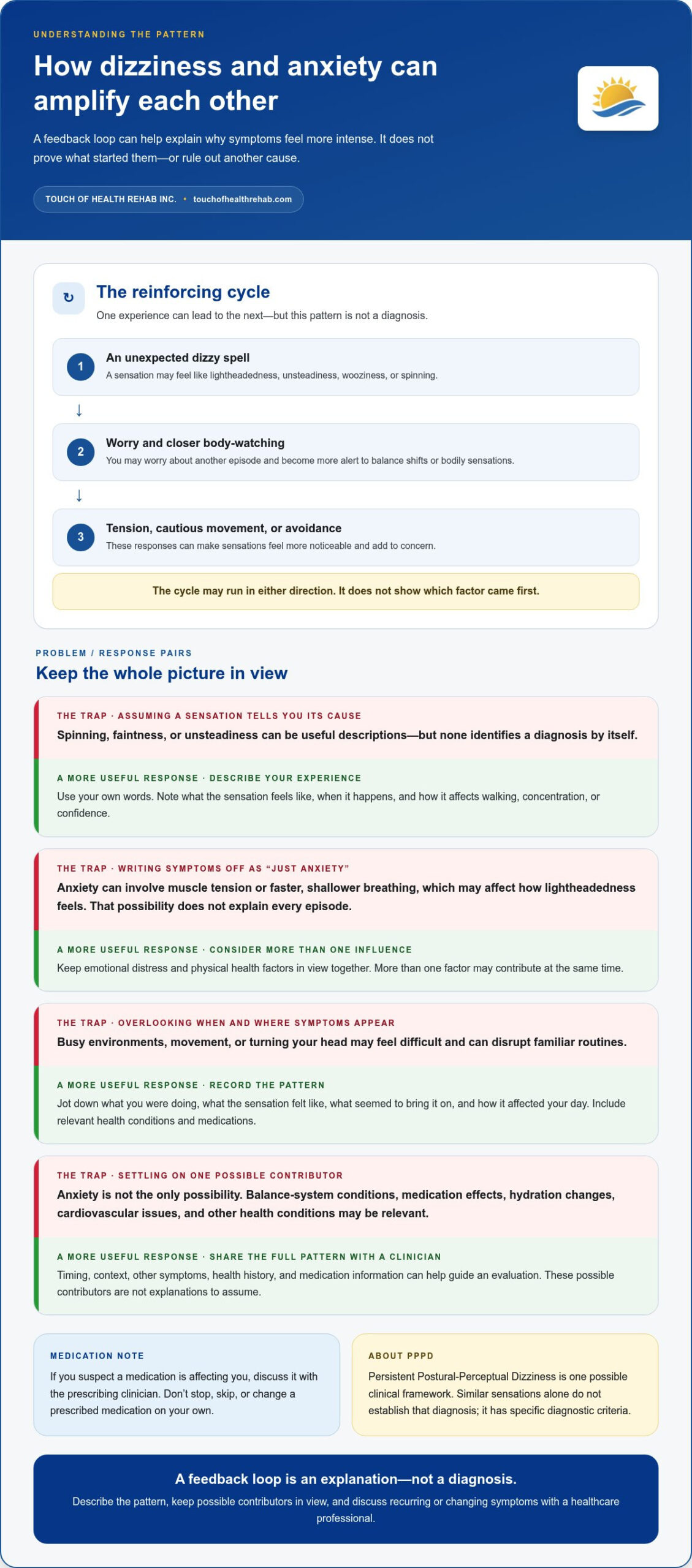
An unexpected dizzy spell can make you watch your body closely and worry about when it might happen again. You may tense up, move cautiously, or avoid situations where you fear an episode would be difficult to manage. That understandable vigilance can make normal shifts in balance or bodily sensations feel more noticeable, adding to your concern.
Anxiety can also bring physical changes, such as muscle tension or faster, shallower breathing. For some people, these changes can affect how bodily sensations feel, including feelings of lightheadedness. This possibility doesn’t mean anxiety explains every episode. Dizziness can have vestibular, medication-related, cardiovascular, or other health contributors, and more than one factor may be involved.
Some people with ongoing dizziness encounter information about Persistent Postural-Perceptual Dizziness (PPPD), a condition associated with persistent balance-related symptoms. A general description can help you learn the terminology, but it cannot determine whether you have PPPD or another condition.
A feedback loop can explain how dizziness and anxiety may intensify each other; it doesn’t prove which one started the symptoms or rule out another cause. Keeping both possibilities in view is more useful for managing chronic dizziness and anxiety than assuming the sensations are “just nerves” or that worry has no role.
Why dizziness can persist: anxiety is only one possible contributor
Dizziness describes a sensation, not a diagnosis. Anxiety may influence how strongly you notice or respond to it, but it isn’t the only possible contributor, and it doesn’t rule out a physical health issue. Symptoms can have more than one influence at once, so trying to identify a cause from a symptom description alone can lead to the wrong conclusion.
Possible contributors include the inner ear and other parts of the balance system, medication effects, changes in hydration, cardiovascular issues, and other health conditions. These are possibilities for a clinician to consider, not explanations to assume. Sharing your full experience and health history can help guide an evaluation and clarify whether different factors may be interacting.
What other factors can a clinician consider?
Inner-ear or balance-system conditions can affect how you sense movement and orientation. Medication effects or other medical issues may also be relevant, and reduced fluid intake can sometimes contribute to feeling faint or lightheaded. Don’t stop, skip, or change a prescribed medication on your own. If you suspect a medication is affecting you, discuss it with the clinician who prescribed it.
One clinical concept a clinician may consider is Persistent Postural-Perceptual Dizziness (PPPD). It involves persistent dizziness or unsteadiness that can become more noticeable while standing, moving, or being in visually busy environments. PPPD has specific diagnostic criteria; recognizing a few similar sensations doesn’t establish that diagnosis. It’s one possible framework, not a default explanation for everyone whose dizziness lasts.
Keeping this broader view is central to managing chronic dizziness and anxiety. It makes room for anxiety as one possible influence while preserving attention to other health factors that may need assessment. A careful evaluation doesn’t dismiss emotional distress; it considers it alongside the rest of the picture.
Why does identifying the pattern matter?
Timing and context can offer useful clues. Note whether a sensation starts with a change in position, appears during movement, follows a medication change, or comes with other symptoms. Spinning may feel different from faintness or unsteadiness, but none of these descriptions is a diagnosis. Dizziness can have overlapping contributors, so assessment should consider the whole pattern.
Before an appointment, jot down what you were doing, how the sensation felt, what seemed to bring it on, and how it affected your day. Include relevant health conditions and medications. Your record doesn’t need to be technical or perfect; clear everyday language is useful. A clinician can use these details to decide what to explore rather than relying on one symptom in isolation.
If an assessment identifies a balance-system or movement-related need, vestibular rehabilitation may be part of individualized care focused on balance and mobility. Touch of Health Rehab provides vestibular rehabilitation and balance and gait rehabilitation in Sunny Isles Beach. You can also learn about physical therapy at Touch of Health Rehab.
When chronic dizziness needs medical assessment
Dizziness can be real and distressing whether or not anxiety is also present. Anxiety and a physical condition can coexist, and noticing worry alongside dizziness doesn’t show which came first or explain every symptom. You deserve an assessment that takes both your physical experience and emotional concerns seriously, rather than assuming the symptoms are “just anxiety.”
Arrange a healthcare evaluation if dizziness persists, keeps returning, worsens, or interferes with walking, work, daily activities, or your confidence moving around. An appointment can help clarify what should be considered and what kind of support may be appropriate. Physical therapy may help with balance or movement needs identified through an assessment, but it doesn’t replace medical evaluation or determine the cause of dizziness on its own.
What information should you bring to an appointment?
A brief symptom record can make it easier to describe what’s happening. Note when the dizziness began, how often it occurs, how long episodes last, and what you were doing when they started. Include what seems to change the sensation, any symptoms that occur at the same time, and whether episodes affect sleep, concentration, walking, or everyday tasks.
Also mention recent illness or injury, health conditions, and any medication changes. If anxiety rises before, during, or after an episode, share that as relevant context, not as proof of the cause. You don’t need medical terms; clear descriptions in your own words are valuable.
Which symptoms call for urgent attention?
Some symptoms need urgent assessment rather than a routine appointment. Seek emergency help for sudden dizziness with signs such as facial drooping, weakness or numbness on one side, trouble speaking, or sudden vision changes. The U.S. Centers for Disease Control and Prevention lists these among possible stroke warning signs. Review the CDC’s stroke warning signs, and call your local emergency number if they appear.
Also seek emergency help for sudden severe symptoms such as chest pain, trouble breathing, fainting, or a new severe headache, especially when these occur with dizziness. Don’t drive yourself if you may be experiencing an emergency. If you’re unsure whether symptoms are urgent, contact local emergency services or a healthcare professional for immediate guidance.
For non-emergency symptoms, keep your appointment notes simple and specific: what happened, when, what else you noticed, and how your daily function changed. This information can support a more useful conversation and help separate patterns that might otherwise feel confusing. A careful assessment is a constructive step in managing chronic dizziness and anxiety, not a judgment about whether your symptoms are physical or emotional.
Practical ways to manage dizziness and anxiety safely
A dizzy episode can make it hard to decide what to do next. A simple sequence can help you prioritize safety, notice useful details, and stay connected to the care plan developed with your healthcare professional. Adjust these steps to your situation, and seek urgent help if symptoms suggest an emergency.
What can you do during a dizzy episode?
Stop what you’re doing and move carefully to a stable place. If you feel unsteady or faint, sit or lie down to lower the risk of falling. Don’t drive, climb, or use equipment while actively dizzy. Give yourself time before standing or resuming an activity, and avoid rushing to test whether the sensation has passed.
Try this sequence:
- Pause safely. Stop walking or other activity. Hold a stable support if you need it to reach a seat, and ask someone nearby for help if moving feels unsafe.
- Observe the episode. Notice what the sensation feels like and what was happening just before it began. You don’t need to interpret it or identify a cause in the moment.
- Note the pattern. When it’s safe, record the time, activity, duration, and any other symptoms. A short note can be more useful than trying to remember details later.
- Follow your agreed care plan. Use the steps your healthcare professional has recommended. If you don’t yet have a plan, avoid adding exercises or changing medication on your own.
If it feels comfortable, you might try a gentle grounding technique, such as noticing the support beneath you or naming a few things you can see. Calm, unforced breathing may also help you settle if worry rises. These are optional coping tools, not treatments for the cause of dizziness. Stop if they make you feel worse, and don’t use them instead of medical evaluation.
How can you build a steadier longer-term plan?
Keep a consistent symptom record and bring it to follow-up appointments. Include changes in daily function, what you’ve tried, and whether anxiety tends to rise before or after an episode. This can help your healthcare professional review the pattern and adjust next steps with you. Support for anxiety may also be appropriate alongside medical care or rehabilitation; addressing emotional distress doesn’t mean dismissing physical symptoms.
Balance or head-movement exercises aren’t suitable for everyone or every cause of dizziness. Their selection and progression should follow an individual assessment. If an evaluation identifies balance-system or movement-related needs, vestibular rehabilitation may be one part of a personalized plan focused on balance and mobility.
Touch of Health Rehab provides physical therapy for balance and movement goals, including vestibular rehabilitation and balance and gait rehabilitation. To learn about these services, visit Touch of Health Rehab. A measured plan can make managing chronic dizziness and anxiety feel more structured while keeping safety and appropriate clinical guidance at the center.
How individualized vestibular rehabilitation may support recovery
Vestibular rehabilitation may be appropriate when a healthcare assessment identifies a balance-system or movement-related need. It isn’t a universal treatment for dizziness, and it doesn’t replace medical evaluation or address every possible cause. When it fits your situation, individualized physical therapy can focus on practical goals, such as feeling steadier while walking, moving more confidently through daily routines, or improving balance during activities that matter to you.
What might an individualized rehabilitation plan address?
A plan starts with your symptoms and functional needs. A physical therapist may consider how balance, gait, and everyday movement are affecting you, then tailor activities and progression to your abilities. The aim is to work toward useful functional goals, not to follow a generic exercise list.
For example, if walking feels less steady, therapy goals may relate to safer, more confident mobility. If certain daily movements feel difficult, those needs can help shape the approach. Activities should be selected and adjusted according to individual assessment and response. Avoid copying balance or head-movement exercises from online sources without guidance, since the right activities depend on your circumstances.
For people whose assessment points to stability or walking goals, balance and gait rehabilitation may be relevant to the functional side of care. Touch of Health Rehab offers vestibular rehabilitation and balance and gait rehabilitation to address balance and mobility goals. Anxiety concerns may need separate support from an appropriate healthcare or mental health professional. Addressing both concerns with suitable support can help ensure neither is overlooked.
What is a sensible next step in the local area?
If dizziness persists or affects your daily life, discuss it with an appropriate healthcare professional. They can help evaluate possible causes and whether vestibular rehabilitation fits your needs. You can also use the guide Vestibular Rehabilitation in Sunny Isles Beach: Your Guide to Vertigo Recovery for local context, while remembering that a general guide cannot determine what is causing your symptoms or which care is right for you.
For people in Sunny Isles Beach, Aventura, Bal Harbor, North Miami Beach, and Miami Beach, an individualized physical therapy discussion may be useful when an assessment has identified balance or mobility goals. It can help you understand how those goals may be addressed as part of your broader care, without assuming therapy will resolve every symptom. Managing chronic dizziness and anxiety is a personal process, and physical rehabilitation can be one component when clinically appropriate.
Explore personalized physical therapy support for balance and mobility needs.
Take one steady step toward feeling more confident
You don’t have to solve every part of this experience at once. Choose one useful next step, such as writing down a question for your healthcare professional or identifying a daily movement you’d like to approach with more confidence. Small, considered actions can help turn uncertainty into a plan that reflects your needs.
Managing chronic dizziness and anxiety may involve more than one kind of support. If balance or mobility goals are part of your care, individualized physical therapy can be a practical area to explore alongside appropriate medical and emotional support. The right next step is guided by your assessment and personal priorities.
Touch of Health Rehab provides physical therapy, vestibular rehabilitation, and balance and gait rehabilitation in Sunny Isles Beach. Contact Touch of Health Rehab to explore personalized support for balance and mobility in Sunny Isles Beach, Aventura, Bal Harbor, North Miami Beach, and Miami Beach.
Frequently Asked Questions
Can anxiety cause dizziness every day?
Yes, anxiety can be associated with frequent or even daily dizziness for some people, but that doesn’t establish it as the cause. Ongoing symptoms deserve attention, especially if they’re new, changing, or affecting your routine. Note whether they occur during periods of worry, after poor sleep, or in particular situations, and share that pattern with a healthcare professional. Don’t assume anxiety is the only factor without an appropriate assessment.
Can chronic dizziness make anxiety worse?
Yes, recurring dizziness can increase anxiety, particularly if you start worrying about symptoms interrupting an activity or happening somewhere you feel unsafe. That concern may lead you to limit outings or rely on others more than you’d like. If fear is narrowing your routine, mention the specific activities you’ve changed to a healthcare professional. That gives them practical context about how symptoms affect your life and what support might be useful.
How can I tell whether dizziness is anxiety or an inner-ear problem?
You usually can’t reliably tell from the sensation alone. Spinning, swaying, or feeling faint can occur in different circumstances, and symptoms may overlap. Rather than using a self-test, record whether the sensation follows a head turn, standing up, a stressful moment, or another event. Share the timing and any accompanying changes in hearing, vision, or overall health with a clinician, who can decide what evaluation is appropriate.
Can breathing exercises stop dizziness caused by anxiety?
Breathing exercises may help you feel calmer when anxiety is rising, but they can’t be relied on to stop dizziness or treat its underlying cause. If you try one, keep the breath gentle and comfortable rather than forcing deep or rapid breaths. Stop if you feel worse. If dizziness keeps happening, don’t use breathing practice as a substitute for an evaluation or a care plan tailored to your symptoms.
Should I avoid exercise if I have chronic dizziness and anxiety?
Not necessarily, but the safest activity depends on your symptoms, balance, and health. Avoid pushing through active dizziness or doing activities where a loss of balance could cause injury. Ask your healthcare professional what level of movement is appropriate and how to progress. For example, they may help you distinguish a manageable walk on a familiar, level route from an activity that currently feels unsafe.
Can vestibular rehabilitation help if anxiety is also present?
It may help address balance or movement-related needs when an assessment indicates they’re relevant, but it isn’t a treatment for anxiety and can’t be expected to resolve every cause of dizziness. Anxiety concerns may need support from an appropriate healthcare or mental health professional as part of broader care. If you’re in Sunny Isles Beach, Aventura, Bal Harbor, North Miami Beach, or Miami Beach, Touch of Health Rehab provides vestibular rehabilitation and balance and gait rehabilitation for balance and mobility needs.
How long does chronic dizziness from anxiety last?
There’s no set timeline, and it’s not possible to estimate duration without knowing what’s contributing to your symptoms. The pattern may depend on the underlying cause, your overall health, and the support that fits your needs. If dizziness continues, returns, worsens, or limits daily activities, arrange an assessment rather than waiting for it to pass. A clinician can help identify reasonable next steps and when to follow up.