
What if preparing for knee surgery meant rehearsing for recovery, not pushing through pain? If you’re unsure what to do before surgery, it’s understandable to worry that exercise might make your knee feel worse or conflict with your surgeon’s instructions. Pre-hab for knee surgery Sunny Isles Beach can be a guided, individualized part of your rehabilitation journey, with your medical team’s plan at the center.
Prehab doesn’t mean trying to fix your knee or guarantee a particular outcome. It may involve physical therapy and conditioning shaped around your needs, comfort, and planned procedure. The goal is to help you prepare safely, with activities based on your surgeon’s guidance rather than a one-size-fits-all routine.
This article explains what knee surgery prehab can involve, how a physical therapist’s plan can fit alongside your surgeon’s instructions, and what to discuss if you’re concerned about movement or discomfort. Touch of Health Rehab in Sunny Isles Beach provides personalized physical therapy and post-surgical rehabilitation, supporting patients through preparation and the next steps of recovery.
Key Takeaways
- Prehab is physical therapy before surgery, shaped around your needs and medical guidance.
- An initial assessment can establish a starting picture of movement, strength, balance, and everyday activities.
- With pre-hab for knee surgery Sunny Isles Beach, preparation should be guided and adapted, not pushed through worsening symptoms.
- Discuss prehab with your surgical team, share their instructions, and let the surgery schedule guide the next steps.
- Personalized physical therapy can connect preparation before surgery with post-surgical rehabilitation.
What prehab for knee surgery means before your Sunny Isles Beach procedure
An upcoming knee operation can bring practical questions alongside understandable uncertainty: What can you do before the procedure? Is movement helpful, or could it aggravate your symptoms? Prehabilitation, often called prehab, means physical therapy before surgery that is tailored to your needs and clinical guidance. For people exploring pre-hab for knee surgery Sunny Isles Beach, it offers a structured way to prepare without treating every knee or procedure the same.
Prehab and rehabilitation after surgery have different purposes. Before the procedure, the focus is on preparing within your current abilities and medical instructions. Afterward, rehabilitation addresses the needs of recovery from the operation and follows the care plan for that stage. These are connected parts of a broader rehabilitation journey, but one doesn’t replace the other. Prehab also doesn’t replace standard medical care or your surgeon’s instructions. It should complement them, with your surgical team’s guidance helping shape what is appropriate.
What does knee surgery prehab aim to prepare?
Preparation may focus on movement, strength, balance, or everyday activities that matter to you, such as standing from a chair or moving around your home. These are examples of areas a physical therapist may discuss, not a standard exercise list or a promise that each will be addressed. Your starting point depends on your symptoms, general health, current mobility, and planned procedure. Someone who can manage daily tasks comfortably may have different priorities from someone whose knee symptoms already limit those activities.
An individualized approach to orthopedic physical therapy considers the person, not just the joint. A physical therapist can use your current function and relevant medical guidance to help identify suitable areas of preparation. The aim is purposeful participation that fits your circumstances, not achieving a particular fitness level or pushing through discomfort.
Who may consider pre-surgical physical therapy?
Pre-surgical physical therapy may be worth discussing if you have a planned knee procedure and want guided preparation that takes your current function into account. It can also give you an opportunity to explain which daily activities feel difficult and what you hope to manage before surgery. Whether therapy is suitable, what it may involve, and when to begin depend on your medical circumstances and surgical plan.
Start with your surgeon’s advice about whether and when physical therapy is appropriate. Share relevant instructions with your physical therapist, including any activity limits or precautions your care team has provided. If your symptoms change or an activity feels worse, don’t assume you should push through. Raise the concern with your treating team so the plan can reflect your circumstances.
Touch of Health Rehab provides physical therapy and personalized therapy plans in Sunny Isles Beach, with post-surgical rehabilitation as part of the wider care journey. Prehab is preparation within that journey, shaped by your needs and coordinated with the medical guidance for your planned procedure. Patients in nearby Aventura, Bal Harbor, North Miami Beach, and Miami Beach can also explore physical therapy support in Sunny Isles Beach.
How knee prehab physical therapy can prepare you for recovery
A useful prehab plan starts by understanding how your knee functions now, not by handing you a standard set of exercises. An initial assessment can establish a baseline for movement, strength, balance, and daily activities. That picture helps guide preparation around your current abilities and the instructions for your procedure. For people considering pre-hab for knee surgery Sunny Isles Beach, the assessment is an opportunity to make the process specific to their needs.
Prehab is individualized physical therapy before surgery that helps you prepare for recovery within the guidance of your medical team. It isn’t a promise of a particular result. Instead, it gives you a chance to understand your starting point, raise practical concerns, and consider appropriate ways to prepare.
What may happen during an initial prehab assessment?
The first conversation may cover your symptoms, relevant health and treatment history, goals, and the procedure you’re planning. A physical therapist may also observe movement and everyday function, such as how you stand, walk, or manage a transfer, within appropriate limits. The purpose is to understand what feels manageable and what needs attention, not to measure you against a fixed standard.
Assessment findings can inform an individualized plan. If a movement is difficult, the plan can take that into account. If your surgeon has set activity limits, those instructions matter too. This is why a generic exercise list may not suit everyone. Two people preparing for similar procedures can have different symptoms, mobility, health considerations, and priorities.
How can preparation relate to daily activities after surgery?
Some preparation may involve discussing functional movements relevant to your situation. A therapist might talk with you about transfers, such as getting up from a chair, or ways to manage everyday mobility. These are examples for discussion, not instructions to practice independently. Your physical therapist should adapt any activity to your abilities and medical guidance.
Education can also help you think through pacing: breaking a task into manageable parts, recognizing when you need a pause, and following any activity modifications your care team recommends. The aim is to build familiarity with practical strategies, not rehearse movements that aren’t suitable for you. If a movement causes worsening symptoms, share that information with your treating team instead of assuming you should push through.
Timing and content should reflect your surgery schedule, current function, and clinical instructions. A fixed lead-in period or session frequency may not fit every person, so don’t treat another patient’s plan as a template. Preparation can be adjusted as your needs and guidance become clearer. Touch of Health Rehab creates personalized therapy plans, and its post-surgical rehabilitation supports the next stage of care without assuming a particular outcome.
If you’re exploring guided preparation in the area, physical therapy in Sunny Isles Beach can be a starting point for discussing your needs and medical guidance.
Is knee surgery prehab safe, and what can it realistically do?
It’s reasonable to wonder whether exercise before knee surgery could make symptoms worse. Prehab should be guided and adapted to your current function and medical instructions, not treated as a challenge to push through worsening symptoms. Whether an activity is appropriate depends on your health, knee symptoms, planned procedure, and the guidance of your treating team. There isn’t one routine that suits every patient.
A prehab plan should respect your medical guidance, current abilities, and individual response to activity. This matters more than following a generic schedule. Your surgeon’s instructions and standard medical care remain central. Physical therapy preparation should fit alongside them.
How are activity and symptoms handled?
A physical therapist can adapt activities to your current function and the clinical plan agreed with your care team. That may mean changing the type or level of a movement, or focusing on a different functional goal. Share any activity limits or precautions before starting so they can inform the plan.
Pay attention to how you respond and communicate concerns. If symptoms worsen, change, or make an activity feel unsuitable, tell your physical therapist and surgical team rather than assuming you should continue. They can help determine an appropriate next step in light of your circumstances. This isn’t a substitute for medical assessment, and an article can’t determine which activity is safe for you personally.
What should you expect from prehab results?
Set expectations around preparation, not guarantees. A useful plan may help you understand your current abilities, work toward individualized functional goals, and become more familiar with movement strategies relevant to your care. Progress looks different from person to person, and it may not mean every goal is reached before surgery.
Research findings describe groups, not a promise about what will happen for any one patient. They can’t guarantee a particular pain level, prevent complications, ensure a faster recovery, or predict how long your rehabilitation will take. Your health, symptoms, procedure, and care plan all matter. Keep expectations grounded in the goals you and your clinicians identify, and revisit them if your circumstances or instructions change.
For pre-hab for knee surgery Sunny Isles Beach, a practical measure of value is whether the preparation is relevant to you, appropriate to your medical guidance, and responsive to your needs. It’s reasonable to ask why an activity is included and how it relates to your goals.
If you’re considering guided preparation, physical therapy in Sunny Isles Beach can help you discuss an individualized approach that respects your care team’s instructions.
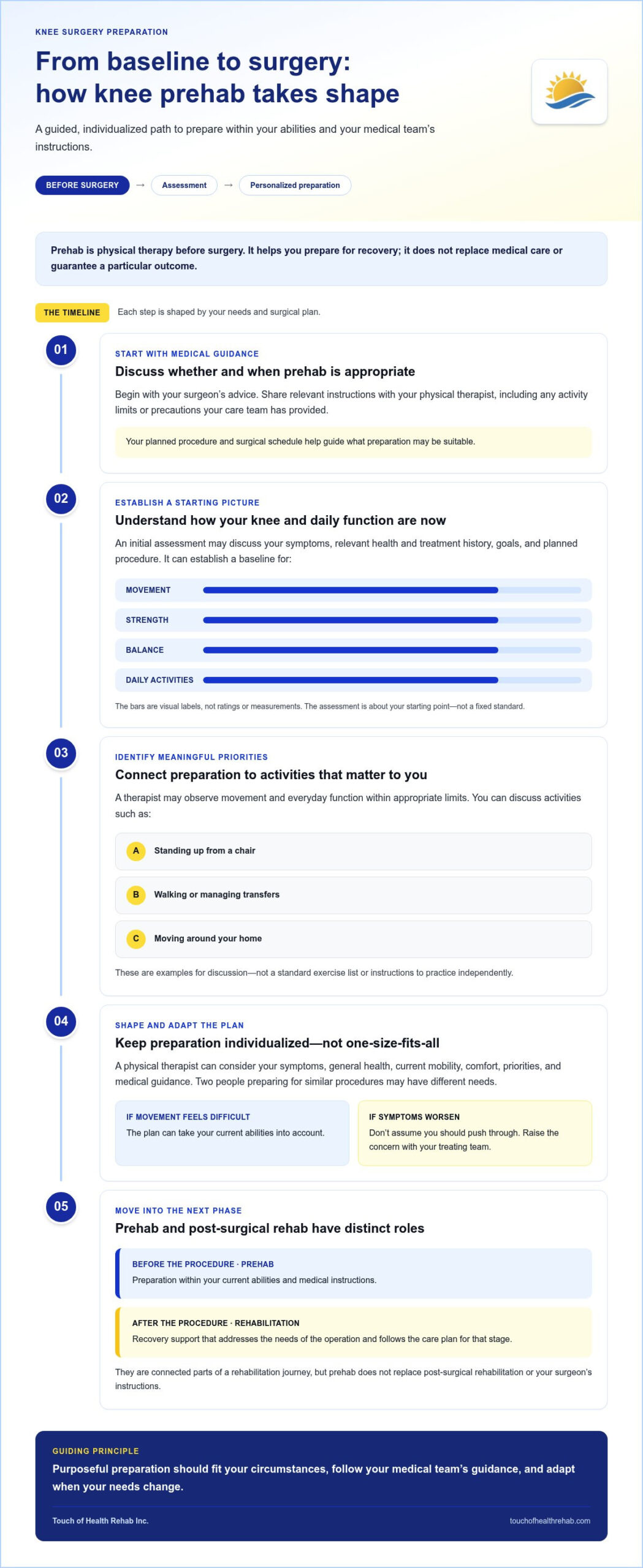
How to prepare for knee surgery prehab in Sunny Isles Beach
A few clear steps can make starting prehab feel more manageable. Begin with your surgical team’s guidance, then share relevant instructions with your physical therapist so preparation fits your procedure and needs. Follow the timing recommended by your care team rather than a schedule borrowed from someone else.
Use this sequence to get organized:
- Discuss prehab with your surgical team. Ask whether physical therapy before surgery is appropriate for your circumstances and when to begin.
- Gather the guidance you’ve received. Note activity limits, precautions, and details about the planned procedure to share with your therapist.
- Describe your current needs. Make a note of movements or daily tasks that feel difficult, along with any changes in symptoms you want to discuss.
- Agree on goals and follow the tailored plan. Tell your therapist which daily activities matter to you, then follow the plan in line with your clinicians’ instructions.
What information helps shape an individual plan?
Bring relevant medical instructions and information about the planned knee procedure. Before your visit, consider how you manage everyday mobility, which symptoms affect you, and what you’d like to prepare for, such as moving around your home or getting up from a chair. These details help make the conversation practical and personal.
Share your goals with the treating therapist, and be clear about any restrictions your surgeon has given you. Your therapist can use this context to shape preparation around your current function without overriding medical guidance. If instructions change, pass along the update so your plan reflects the latest direction from your care team.
How can local planning make the process feel manageable?
If you’re traveling to therapy in Sunny Isles Beach from Aventura, Bal Harbor, North Miami Beach, or Miami Beach, consider how travel and your usual routine fit around the planned procedure. Think through practical details, such as how you’ll get to sessions and which daily tasks you want to discuss. Keep your schedule aligned with the timing recommended by your surgical team.
Planning can also include thinking ahead to the next stage of care. Touch of Health Rehab provides physical therapy and post-surgical rehabilitation, connecting preparation with rehabilitation after the procedure as part of an individualized journey. Your plan should remain specific to your needs and clinical guidance, not a promise of a particular outcome.
For pre-hab for knee surgery Sunny Isles Beach, your care team’s instructions are a sound starting point. Explore personalized physical therapy in Sunny Isles Beach as you consider your next step.
Prehab and post-surgical knee rehabilitation with a Sunny Isles Beach physical therapy team
Preparing for surgery and rehabilitating afterward are different phases, each with its own priorities. Prehab focuses on preparation before the procedure; post-surgical rehabilitation responds to your needs after it. Together, they can form part of a broader care journey guided by your medical instructions and individual goals. For people considering pre-hab for knee surgery Sunny Isles Beach, viewing these phases as connected can help you plan ahead without assuming the same approach applies throughout.
Touch of Health Rehab provides physical therapy and post-surgical rehabilitation in Sunny Isles Beach. Personalized therapy plans shape care around your clinical context and needs, rather than relying on a one-size-fits-all routine. Orthopedic physical therapy can be relevant to a knee-related rehabilitation journey, while the specific focus of your care should reflect your circumstances and your medical team’s guidance. The clinic serves patients in Sunny Isles Beach and nearby Aventura, Bal Harbor, North Miami Beach, and Miami Beach.
How can care connect preparation with rehabilitation?
The goals before surgery and after surgery aren’t interchangeable. Before the procedure, preparation may focus on what is appropriate for your current function and the instructions you’ve received. Afterward, rehabilitation follows the needs of the post-surgical stage and your recovery plan. Your priorities may change between these phases, so goals should be considered in context rather than treated as one fixed program.
Clear communication supports that transition. Keep your surgical team’s instructions central, and share relevant updates with the professionals involved in your physical therapy. You can also discuss which daily activities matter most to you, so the care conversation reflects real-life priorities as well as clinical guidance. If you’re exploring how this journey can look after joint replacement, information about physical therapy after joint replacement can offer additional context without replacing advice tailored to your procedure.
What can a local physical therapy conversation help clarify?
A conversation with a physical therapy team can help you explain what you hope to prepare for, what feels challenging in daily life, and which questions you have about rehabilitation. You might discuss how your current mobility affects routine activities or how your surgeon’s instructions shape what you can do before the procedure. These details keep the discussion grounded in your situation.
At Touch of Health Rehab, personalized therapy plans and post-surgical rehabilitation support distinct stages of care. The plan is guided by your needs and medical context, not by a promised result or assumed knee protocol. You don’t need every detail figured out before starting a conversation. Bringing your questions and the guidance you’ve received is a practical first step.
If you’re ready to discuss your physical therapy needs in Sunny Isles Beach, connect with Touch of Health Rehab. You can begin with a clearer sense of your goals and the medical guidance that matters to your care.
Take the next step with a plan that feels right for you
Preparing for knee surgery can feel more manageable when your next step is clear and grounded in your priorities. Before speaking with a physical therapy team, write down the movements or routines you hope to manage, along with questions you want answered. That preparation can turn uncertainty into a focused conversation.
For pre-hab for knee surgery Sunny Isles Beach, you don’t need to arrive with a complete plan. Your questions, goals, and the guidance you’ve received from your medical team are a helpful starting point for discussing what preparation could look like. Take it one step at a time, with your care team’s direction guiding the way.
Start a conversation with Touch of Health Rehab about personalized physical therapy and your next step in the rehabilitation journey.
Frequently Asked Questions
Is prehab for knee surgery worth considering?
It may be worth discussing if you’re preparing for a planned knee procedure and want guidance before surgery. A practical reason to explore it is to get help thinking through a specific concern, such as managing a daily task within your medical instructions. Prehab isn’t a guarantee of faster recovery or a particular result. Your surgeon and physical therapist can help determine whether it fits your health, procedure, and preparation goals.
Can I do knee prehab if my knee already hurts?
Having knee pain doesn’t automatically rule out every form of activity, but it should be part of the conversation before you begin. Describe what tends to aggravate your symptoms, what feels manageable, and whether anything has changed. A physical therapist can use that information alongside your medical guidance when discussing preparation. Don’t push through worsening or concerning symptoms. Contact your care team and follow any restrictions provided before surgery.
How long before knee surgery should I start prehab?
There’s no single start date that applies to everyone. Your available time may depend on the scheduled procedure, your health, and the instructions from your surgeon and physical therapist. Bring your surgery date into the conversation and ask what is appropriate for your circumstances, rather than using another person’s timeline as a rule. Don’t delay or change medical plans to fit a general recommendation about when prehab should begin.
What happens at a knee prehab physical therapy appointment?
A visit may begin with questions about what you want help preparing for, such as a movement or routine that has become difficult. The therapist may ask about your symptoms and medical instructions, then assess movement or daily function within appropriate limits. Those details can help shape the guidance you receive. The focus of a session varies with your situation, and prehab should complement, not replace, your surgeon’s care plan.
Does prehab guarantee an easier recovery after knee surgery?
No. Prehab can’t guarantee a particular recovery experience, pain level, or recovery duration. It may offer individualized preparation and help you clarify activity goals, but outcomes differ among patients. Your health, the procedure, and post-operative care all play a role. Research describes findings in groups and can’t predict exactly what will happen for you. Use your care team’s guidance to set realistic expectations and understand what your plan is intended to address.
Can I start prehab before my surgeon recommends it?
Discuss physical therapy with your surgeon or treating medical team before starting, especially if you have activity restrictions, changing symptoms, or a procedure scheduled. Their guidance helps establish what is appropriate for your situation. A physical therapist can use those instructions to shape preparation. Avoid following a generic online exercise list if it conflicts with your medical advice or feels unsuitable for your current symptoms.
Is prehab only for people having a knee replacement?
No. Knee replacement isn’t the only planned procedure for which someone might discuss prehab. Whether preparation is relevant depends on the specific operation, your health, and your individual goals. A plan designed for one procedure shouldn’t automatically be applied to another. If you’re considering physical therapy before knee surgery in Sunny Isles Beach, Aventura, Bal Harbor, North Miami Beach, or Miami Beach, discuss suitability with your surgeon and therapist.