
What if the path to feeling steadier isn’t avoiding movement, but practising it at a pace that feels safe? If you searched “fear of falling rehabilitation Sunny Isles,” you may already know how worry can make walks, errands, or social plans feel less manageable. It’s understandable to hesitate, especially when dizziness, weakness, or unsteadiness leaves you unsure what your body can handle.
Fear and reduced activity can reinforce each other. Moving less may affect strength and balance over time, making everyday movement feel even less familiar. Rehabilitation can help you work on confidence through personalized, measured practice. At Touch of Health Rehab Inc., physical therapy can include balance and gait rehabilitation, vestibular rehabilitation, and fall prevention, shaped around your mobility concerns and goals. Exercises can progress step by step, so practice feels supportive rather than overwhelming.
In this article, you’ll learn how fear and activity levels may influence each other, what individualized balance and gait rehabilitation may involve, and how local support in Sunny Isles Beach can help you work toward safer, more confident movement in daily life.
Key Takeaways
- Fear of falling can influence your choices and confidence, but feeling afraid doesn’t mean a fall is inevitable.
- Learn how rehabilitation can move from discussing concerns to assessing movement, setting goals, practising, and reviewing progress.
- Unsteadiness, gait difficulty, dizziness, and fear can overlap, but they’re not the same concern.
- Noticing when and where you avoid activities or feel unsteady can help guide a useful therapy conversation.
- Explore how fear of falling rehabilitation Sunny Isles can connect you with personalized balance, gait, vestibular, and fall-prevention support.
Fear of Falling: How Worry Can Change Everyday Movement
Fear of falling is concern that you might lose your balance or fall. It can influence how you move, what you choose to do, and how confident you feel. You might grip a railing more tightly, pause before stepping off a curb, or turn down an outing because the route feels uncertain. That concern is worth taking seriously, but it isn’t proof that a fall will happen. Fear describes how movement feels; a fall-risk assessment considers your movement and other relevant factors.
This distinction matters. You may feel worried while moving steadily, while someone else may feel unsteady without strong fear. Neither experience should be dismissed or used alone to decide what support is needed. A physical therapist can discuss your concerns and observe movement to better understand what may be affecting your confidence.
How fear and activity avoidance can reinforce each other
Worry can make everyday activities feel like decisions to weigh carefully. You might shorten a walk, ask someone else to run an errand, or skip a social visit because standing, walking, or getting around an unfamiliar place feels daunting. Avoiding an activity may bring temporary relief, but it also means fewer opportunities to practise that movement in daily life. Over time, a task you once did routinely can feel less familiar or take more thought. This pattern differs from person to person, and avoiding an activity doesn’t automatically mean your mobility will decline. A useful starting point is to identify what you’re avoiding and why, then discuss safe next steps with a clinician.
When a change in confidence deserves attention
Notice whether you’ve changed how you walk, stand, use stairs, or manage familiar routines. Have you started reaching for furniture, moving more cautiously, or avoiding a particular place? Near-falls, unsteadiness, and dizziness are also worth discussing with a clinician, especially if they affect your usual activities. These experiences can have different causes, and this article can’t diagnose what’s behind your symptoms. Sharing what happens and in which situations gives a clinician useful context for deciding what to assess.
A few observations can make that conversation more specific:
- Note the activity or setting that brings on worry or unsteadiness.
- Describe whether you feel spinning, lightheadedness, or a sense of instability.
- Record what you’ve begun avoiding and what would feel meaningful to resume.
Fear of falling rehabilitation Sunny Isles can start with understanding your experience, not assuming that fear alone explains what’s happening. At Touch of Health Rehab Inc., personalized physical therapy can connect your mobility goals with balance and gait rehabilitation, fall prevention, or vestibular rehabilitation when relevant. For example, dizziness may call for a different discussion than avoiding a walk because you feel unsure on uneven ground. Learn about the clinic’s vestibular rehabilitation in Sunny Isles Beach, and explore Fear of Falling (FoF) on Wikipedia for additional background on the experience and related approaches.
How Fear of Falling Rehabilitation Builds Confidence Step by Step
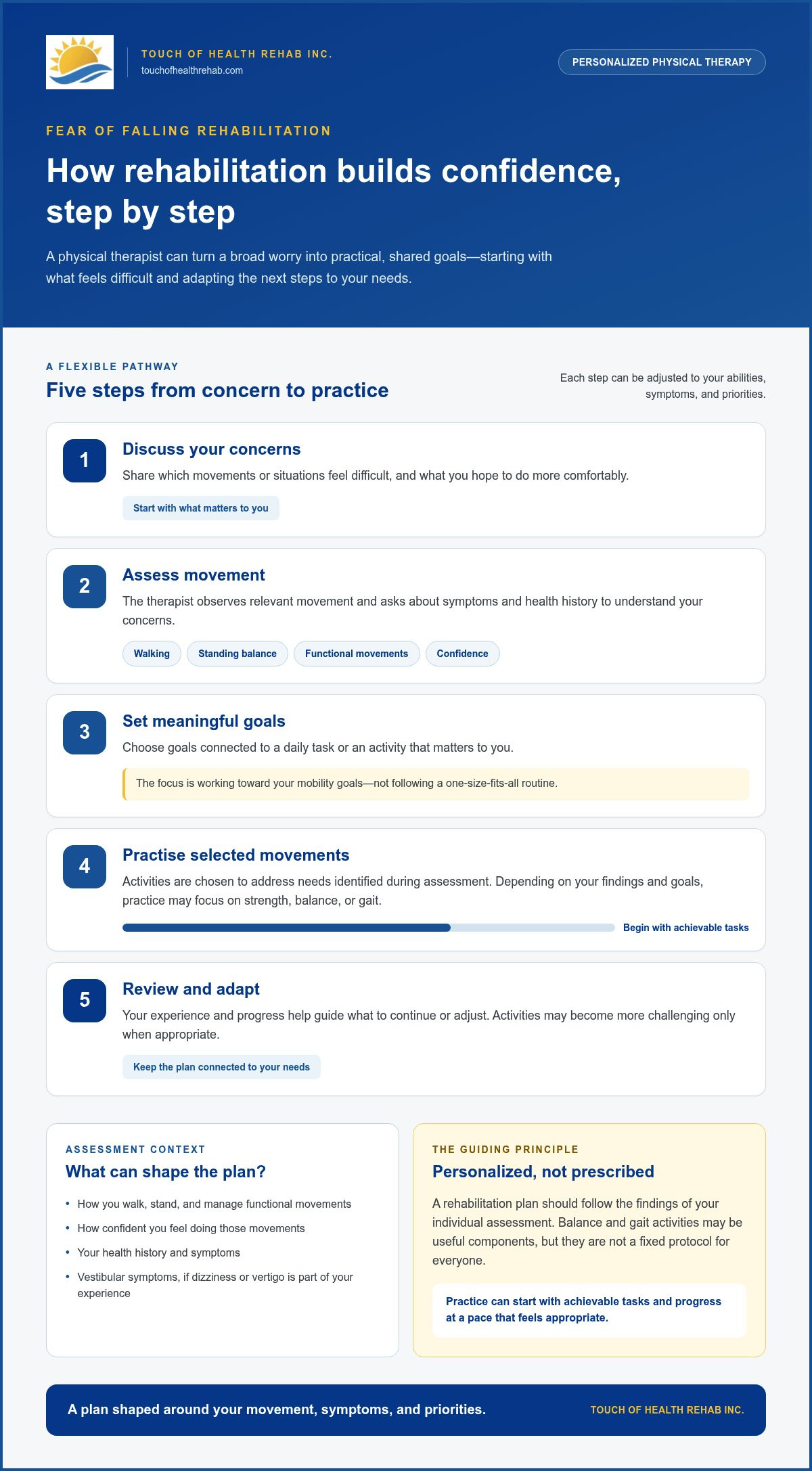
Rehabilitation can make rebuilding confidence feel more manageable by turning a broad worry into practical, shared goals. Rather than beginning with challenging exercises, a physical therapist can first learn what feels difficult, assess how you move, and shape the next steps around your needs. At Touch of Health Rehab Inc., personalized physical therapy can address relevant concerns through balance and gait rehabilitation or vestibular rehabilitation.
A plan may follow a sequence like this, with each step adjusted to your abilities, symptoms, and priorities:
- Discuss your concerns. Share which movements or situations feel difficult and what you hope to do more comfortably.
- Assess movement. The therapist observes relevant movement and asks about symptoms and health history.
- Set meaningful goals. Goals might relate to a daily task or activity that matters to you.
- Practise selected movements. Activities are chosen to address the needs identified during assessment.
- Review and adapt. Your experience and progress help guide what to continue or adjust.
A rehabilitation plan should follow the findings of your individual assessment, not a one-size-fits-all routine. Balance and gait activities may be useful components, but they aren’t a fixed protocol for everyone. The focus is finding an appropriate way to work toward your mobility goals.
What a physical therapist may assess
An assessment may include how you walk, maintain standing balance, and manage functional movements, along with how confident you feel doing them. Your health history and symptoms provide context. If dizziness or vertigo is part of your experience, vestibular symptoms may also warrant attention. Findings guide the plan; age alone doesn’t determine which activities are appropriate. This helps keep care connected to your current abilities and concerns.
How movement practice can progress at a comfortable pace
Practice can begin with achievable tasks and become more challenging only when appropriate. Depending on assessment findings and goals, activities may address strength, balance, or gait, with the aim of supporting movements that matter in everyday life. For one person, that may mean building comfort with a basic movement; for another, it may involve practising a specific functional task under a therapist’s guidance.
Progress is not a race. The therapist can adjust an activity based on your response, symptoms, and comfort, then review how it relates to your goals. There’s no single timeline that applies to everyone, and unsupervised exercises aren’t a substitute for an individualized assessment. Balance and gait rehabilitation may be one part of personalized care.
For fear of falling rehabilitation Sunny Isles, a collaborative plan can help translate assessment findings into supported, purposeful practice. Learn about Touch of Health Rehab Inc. and its personalized physical therapy.
Is Fear of Falling a Balance Problem, Dizziness, or Both?
Feeling afraid, feeling unsteady, having difficulty walking, and experiencing dizziness can all affect confidence in movement, but they describe different experiences. Fear may lead you to avoid an activity even when you don’t feel physically unsteady. Unsteadiness describes a sensation or difficulty maintaining stability. Gait difficulty refers to challenges with walking, while dizziness can involve sensations such as spinning or motion. These concerns may occur together, but one doesn’t automatically explain the others.
That distinction can make a clinical conversation more useful. For example, you might feel steady while standing still but become unsure while turning or walking across an uneven surface. Someone else may describe a spinning sensation when changing position, alongside concern about moving. These examples offer context, not a diagnosis. A single symptom can’t establish its cause, and experiences that sound similar may need different questions and assessment.
Clues that point to different movement concerns
Notice what you experience and what you’re doing at the time. Do you feel unsteady while standing, walking, or changing direction? Does dizziness feel like spinning or motion, and does it occur during a particular movement? Or is the main difficulty worry that makes you hold back, even without dizziness? Sharing these details with a clinician can help clarify which concerns to explore without assuming one symptom tells the whole story.
Describe the situation in everyday terms rather than trying to identify a cause. For instance, explain that you feel unstable when walking through a busy space, or that the room seems to spin when you move your head. Mention whether the sensation affects a specific task, changes how you walk, or leads you to avoid an activity. These observations give a clinician a clearer starting point for assessment.
Why the right rehabilitation focus depends on the person
Rehabilitation is guided by assessment findings, symptoms, and what you want to do more comfortably. If concerns relate to walking or stability during movement, balance and gait rehabilitation may be relevant. If dizziness or vertigo is part of the picture, vestibular rehabilitation may be considered. These approaches aren’t interchangeable, and not everyone needs the same combination.
A therapist can consider how your symptoms show up during movement and connect with daily goals, rather than treating a label in isolation. For one person, the priority may be walking with greater confidence; for another, understanding motion-related dizziness may be central to planning care. Sometimes more than one concern deserves attention. The plan can reflect that, with its focus shaped by your individual assessment instead of a standard routine.
If you’re exploring fear of falling rehabilitation Sunny Isles, describing what you feel, when it happens, and which activities it affects can help guide the next conversation. The aim is to understand the movement concern more clearly and identify a rehabilitation focus that fits your needs.
What to Do When Fear Is Limiting Walking or Daily Activities
If you’ve started avoiding a walk, an errand, or a social activity, identify what makes that situation feel difficult. Is it standing for a long time, turning, walking on an uneven surface, or worrying that dizziness might occur? Specific examples can help a clinician understand how your concern affects daily life and what kind of assessment may be useful.
You don’t need to interpret the symptoms yourself. Keep a brief record of when unsteadiness, dizziness, or fear occurs, what you were doing, and how it affected your movement. Share new or worsening symptoms with an appropriate healthcare professional. Avoid starting generic home exercises as a substitute for individualized guidance, since an activity that suits one person may not be right for another.
How to prepare for a rehabilitation conversation
A little preparation can help you explain what has changed and what you’d like to work toward. Write down recent near-falls, activities you’ve stopped or modified, symptoms you notice, and a mobility goal that matters to you. Bring relevant health information and a current medication list if available. These details help make the discussion specific to your experience.
- Describe the activity and setting where concern or symptoms occur.
- Note whether you feel unsteady, dizzy, fearful, or a combination.
- Share what you hope to resume or manage with greater confidence.
- Tell the therapist openly if you’re worried that exercises may feel unsafe or overwhelming.
Your concerns are useful information, not a barrier to care. A therapist can take them into account when discussing assessment and possible movement practice. For fear of falling rehabilitation Sunny Isles, individualized physical therapy can connect your concerns with goals that reflect your daily routines.
When symptoms may need prompt medical attention
Some symptoms call for urgent medical evaluation rather than a routine rehabilitation appointment. Seek emergency care for sudden severe symptoms, a significant injury after a fall, sudden weakness, fainting, chest pain, or new neurological symptoms. If you’re unsure whether an event is an emergency, err on the side of seeking urgent medical help. Rehabilitation can address mobility concerns, but it isn’t a substitute for emergency care.
For concerns that aren’t emergencies, share changes in symptoms with a healthcare professional, especially if they’re new or worsening. Clear notes about what happened, when it began, and how it affects walking or daily activities can support a more informed conversation about next steps.
Taking the first step can be as simple as describing what feels difficult and asking for guidance. Explore personalized physical therapy at Touch of Health Rehab Inc.
Find Support for Fear of Falling Rehabilitation in Sunny Isles
Feeling uncertain about walking or everyday movement can make it harder to stay connected to routines that matter. Touch of Health Rehab is a physical therapy center in Sunny Isles Beach serving nearby communities, with personalized care shaped around each person’s mobility concerns and goals. For people seeking fear of falling rehabilitation Sunny Isles, care can begin with a conversation about what feels difficult and what you would like to do with greater confidence.
Rehabilitation isn’t a promise that falls can be prevented or a fixed set of exercises for everyone. The appropriate focus depends on your symptoms and assessment. Fall prevention therapy may be relevant for some people; for others, concerns about walking and stability may connect with balance and gait rehabilitation. Vestibular rehabilitation may also be considered when dizziness or vertigo is part of the concern.
What personalized care can focus on
Your priorities help shape the discussion. You might want to feel more comfortable walking outdoors, standing during a daily task, or returning to an activity you’ve been avoiding. A therapist can consider these goals alongside assessment findings and relevant symptoms, then identify a rehabilitation focus suited to your needs. The aim is to make care meaningful to your life, rather than follow a routine that doesn’t reflect your concerns.
As you take part in rehabilitation, your experience can help guide adjustments. If a movement feels difficult or symptoms change, share that openly so it can inform the next conversation. The treatment focus may evolve with assessment findings and progress. This individualized approach supports purposeful movement practice without promising an outcome or a timeline that may not fit your situation.
Taking a first step in Sunny Isles Beach
It can help to begin with a clear description of what’s changed: which activities feel less comfortable, what symptoms you notice, and what you hope to work toward. You don’t need to arrive with a diagnosis or know which rehabilitation approach is right. Sharing your experience gives the therapist a starting point for understanding your mobility needs and discussing relevant care.
Touch of Health Rehab serves Sunny Isles Beach and nearby communities, including Aventura, Bal Harbor, North Miami Beach, and Miami Beach. Its physical therapy can address balance, gait, vestibular concerns, and fall prevention. Whether your first question is about feeling unsteady or rebuilding confidence in a specific daily activity, the conversation can focus on your priorities and assessment findings.
When you’re ready, explore personalized physical therapy at Touch of Health Rehab.
Take a Thoughtful Next Step Toward Steadier Movement
Feeling more confident doesn’t require you to ignore worry or push through movement that feels unsafe. A constructive first step is to name one activity you miss or one daily task you’d like to approach with greater ease. That goal can help shape a conversation about what matters to you and what support may fit, even if you don’t yet know why the activity feels difficult. Your priorities belong in that conversation.
With fear of falling rehabilitation Sunny Isles, the path forward can be personal and collaborative. Your concerns, preferences, and pace can help guide care as you work toward meaningful routines. You deserve to have your experience heard, without pressure to take on more than feels appropriate.
Touch of Health Rehab offers a place to explore a next step with a physical therapy team. Contact Touch of Health Rehab to explore rehabilitation support and begin a conversation centered on your goals. Progress can start with one manageable step toward feeling more at ease in daily life.
Frequently Asked Questions
Can physical therapy help with fear of falling?
Yes, physical therapy may help address movement concerns that affect your confidence. A therapist can consider how balance, walking, or strength-related challenges relate to a specific task, such as stepping off a curb or getting up from a chair. You can also discuss what feels intimidating and what you’d like to do more comfortably. Care is individualized, and therapy can’t guarantee that falls will never occur.
Is fear of falling normal after a fall?
Feeling worried after a fall or near-fall is understandable, especially if you find yourself changing how you move afterward. For example, you may hesitate before using stairs or stop going somewhere you used to visit. If that worry is interfering with activities you value, tell a healthcare professional. Describing what has changed can help guide a discussion about your concerns and possible next steps.
What happens during rehabilitation for fear of falling?
A rehabilitation visit may begin with questions about your movement, symptoms, and daily routines, followed by an assessment relevant to your concerns. Mention practical details, such as whether you feel less secure turning in a narrow space or carrying something while walking. A therapist can use that information to discuss appropriate movement practice and revisit the plan as your needs or comfort change.
Can dizziness cause fear of falling?
Dizziness can make movement feel uncertain and may contribute to worry, but it doesn’t point to one cause by itself. Describe the sensation in your own words, such as spinning, lightheadedness, or feeling off balance, and note what you were doing when it began. A healthcare professional can discuss those details with you. If vestibular symptoms are relevant, vestibular rehabilitation may be considered.
Should I stop walking if I am afraid of falling?
Don’t assume you need to stop all walking, but don’t force yourself through symptoms that feel unsafe. Consider what specifically concerns you, such as walking outdoors alone or turning quickly, and share that with a healthcare professional. Avoid adding exercises or increasing activity without considering your symptoms and health needs. A clinician can help discuss an approach that takes your circumstances and everyday goals into account.
When should I seek urgent care after a fall?
Seek urgent medical evaluation after a significant injury or sudden severe symptoms. Sudden weakness, fainting, chest pain, or new neurological symptoms also need urgent attention, not a routine therapy appointment. If you fall and experience a new, severe problem afterward, prioritize emergency medical care. If symptoms are persistent but not urgent, discuss them with a healthcare professional to determine an appropriate next step.
Is fear of falling rehabilitation available in Sunny Isles Beach?
Yes. If you’re exploring fear of falling rehabilitation Sunny Isles options, Touch of Health Rehab provides physical therapy in Sunny Isles Beach, including balance and gait rehabilitation, vestibular rehabilitation, and fall prevention. Care can be shaped around individual movement goals. The clinic also serves nearby communities, including Aventura, Bal Harbor, North Miami Beach, and Miami Beach. Explore the clinic’s services to learn more about local rehabilitation support.