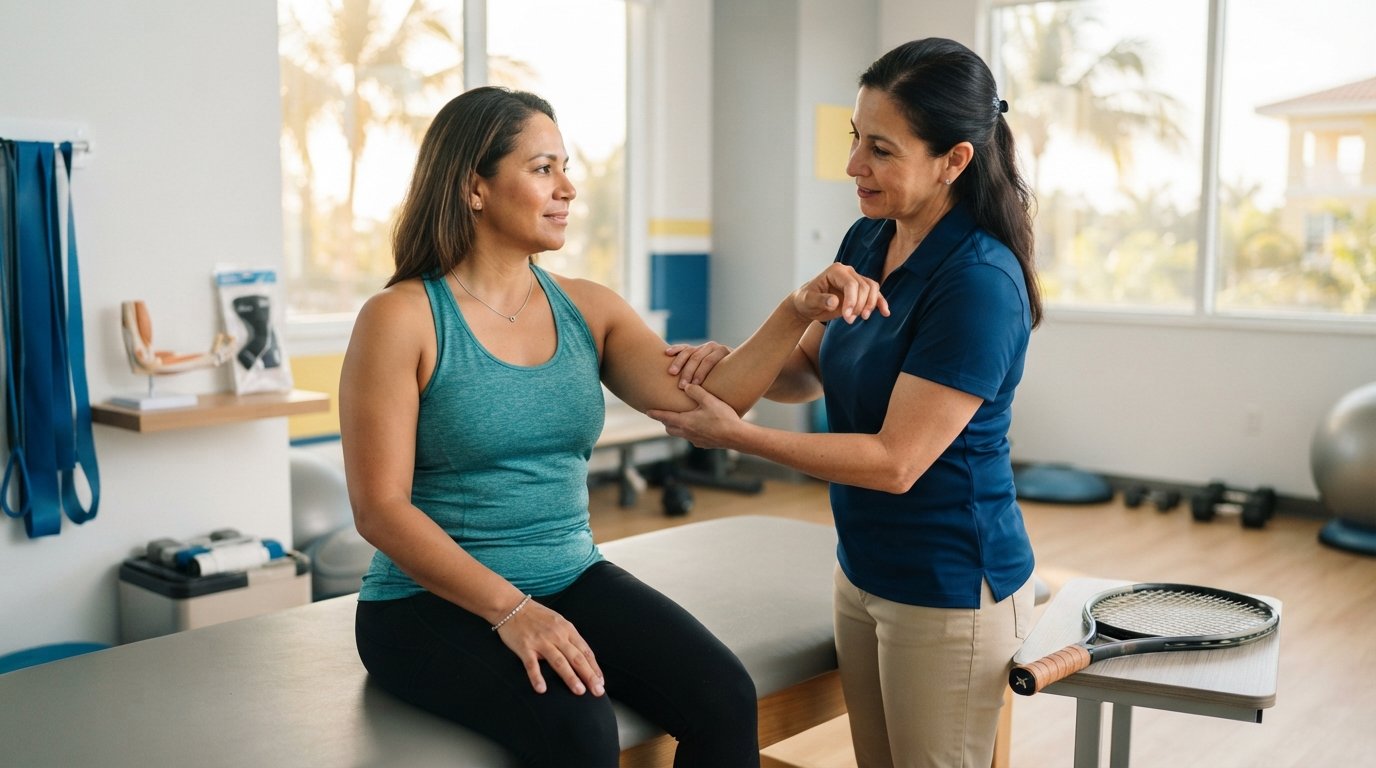
Tennis elbow treatment in Sunny Isles Beach usually begins with reducing activities that strain the arm and a conservative care plan, which may include physical therapy, bracing, and activity changes. The goal is to ease irritation while gradually restoring strength, flexibility, and comfortable movement. Surgery may be considered when symptoms persist despite conservative care.
Elbow pain can make familiar tasks, from gripping a racquet to lifting a kettle, unexpectedly difficult. It’s natural to want relief while keeping sight of the activities you hope to return to.
This guide explains tennis elbow, its common symptoms and triggers, and how treatment options work. You’ll also learn what a physical therapy assessment may involve and how an individualized rehabilitation plan can support a gradual return to daily activities.
Key Takeaways
- Pain location and the movements that bring it on can help distinguish tennis elbow from golfer’s elbow and other causes of elbow discomfort.
- An assessment may consider your work tasks, sports, training volume, and hands-on findings; imaging can help rule out other injuries when needed.
- For an acute injury, the National Institute of Arthritis and Musculoskeletal and Skin Diseases (NIAMS) says to apply an ice pack for 15-20 minutes every 4-6 hours for 3-5 days.
- Physical therapy can guide a gradual return to movement and strength, rather than relying on rest alone.
- Learn why cortisone may offer short-term relief while not providing long-term benefits for elbow tendonitis.
What Causes Elbow Pain & How Do I Treat It?
Elbow pain can stem from irritated tendons, repeated loading, or conditions affecting nearby joints and nerves. Where the pain occurs and which movements trigger it can help guide next steps.
Elbow Pain Causes and Tennis Elbow Risk Factors
Tennis elbow, or lateral epicondylitis, involves irritation of tendons where forearm muscles attach outside the elbow. Repeated gripping and wrist movements can overload these tissues during racquet sports, painting, carpentry, or keyboard use. People between 30 and 50 years old are most often affected. Golfer’s elbow causes pain on the inner elbow, rather than the outer side. Joint problems and nerve compression can also cause elbow pain, so location alone doesn’t establish the cause.
Tennis Elbow Symptoms and Signs
Symptoms often include gradually worsening pain or burning on the outside of the elbow, sometimes extending down the forearm toward the wrist. Grip weakness can make turning a key, shaking hands, or lifting a kettle painful. Swelling or morning stiffness may follow a long match or workout. Arrange an assessment if pain interferes with everyday tasks, persists, or repeatedly returns with activity.
Treatment Options Compared
Physical therapy uses assessment, activity adjustments, and progressive exercises to rebuild strength and flexibility. Injections may be considered for persistent symptoms, while surgery is generally considered when other treatments haven’t helped; surgery may be recommended after symptoms persist for 6-12 months despite conservative care. These options differ in invasiveness and recovery demands, so the choice depends on symptoms and response to earlier care.
In Florida, insurance coverage for tennis elbow treatment depends on your policy, plan requirements, and the care recommended. Review your benefits or ask your insurer about coverage, referrals, and any authorization requirements. To find sports medicine or orthopedic care near Sunny Isles Beach, look for an assessment that considers your work, sports, symptoms, and activity goals. Learn about sports injury treatment in Sunny Isles Beach.
Recovery Time and Home Care
Recovery time varies with tendon irritation, daily demands, and how consistently you adjust aggravating activities and follow rehabilitation. For home care, reduce painful gripping or repetitive wrist work, and use gentle strengthening drills as tolerated. Ice may ease symptoms; for tennis or golfer’s elbow, apply it for 15-20 minutes at a time, several times daily, until pain subsides. Rest may mean avoiding aggravating sports or heavy work for several weeks. After surgery, one patient returned to modified-duty work four months later, according to the United States Department of Labor Employees’ Compensation Appeals Board.
Physical therapy
Physical therapy for tennis elbow combines a focused assessment with a rehabilitation plan to build strength and restore flexibility. It can also help you adapt repetitive activities that continue to irritate the tendon, such as gripping tools or practicing a racquet swing.
Assessment and a tailored rehabilitation plan
An assessment may cover your sport, work tasks, and training volume, followed by hands-on tests. This helps connect your symptoms with movements that load the forearm. A tailored program can then guide activity progression while rebuilding elbow strength and flexibility. Exercises should reflect your goals, whether you want to lift household items, manage work tasks, or return to sport. Progress depends on how your arm responds to movement and load, not simply on completing a set routine.
Exercise and activity adjustments
Rehabilitation exercises target the forearm muscles and the movements used for gripping and wrist control. Your plan can progress from manageable motions to tasks that resemble your usual activities. Reducing or adapting painful repetitive actions gives irritated tissue a chance to settle while you maintain appropriate movement. Your therapist can help identify how work technique, training volume, or equipment use may contribute to strain. This practical focus connects clinic exercises with the demands of daily life.
Shockwave, laser, and ultrasound
Shockwave therapy applies acoustic waves to a sore area and requires no downtime. It is one option discussed for tennis elbow, but it does not replace rehabilitation to restore strength and guide activity progression. Class IV deep tissue laser therapy is another modality you may encounter. Consider how any modality fits into an overall plan, and track progress with practical measures, such as grip-related tasks and comfortable wrist movement.
Ultrasound can mean imaging used to assess elbow pain or help rule out other injuries, depending on the case. This diagnostic use differs from therapeutic ultrasound, which is a treatment modality. The name alone does not explain its role in your rehabilitation. Ask how a proposed approach relates to your symptoms, functional goals, and active exercise plan.
Cold therapy for an acute injury
For an acute injury, an ice pack can be applied for 15-20 minutes every 4-6 hours for 3-5 days, according to the National Institute of Arthritis and Musculoskeletal and Skin Diseases (NIAMS). Cold therapy can be one part of managing an injury, alongside activity adjustments and a structured return to movement. Follow the stated application period, and avoid treating ice as a substitute for assessment when elbow symptoms persist.
For a plan centered on progressive movement and function, explore physical therapy guidance and consider how rehabilitation can support your return to everyday tasks.
Common symptoms and activities that trigger pain
Tennis elbow symptoms often develop gradually as repeated arm and wrist motions strain the forearm tendons. Notice where the pain begins and which specific activities bring it on.
Tennis Elbow Symptoms and Pain Location
Lateral epicondylitis causes pain around the bony area on the outer elbow, where forearm muscle tendons attach. Discomfort may spread down the forearm toward the wrist, with burning or aching that worsens during gripping or wrist movement. Track whether symptoms appear during a task or afterward, such as after a long tennis match or workout. That pattern can help describe how the elbow responds to activity.
Grip weakness may make routine tasks harder, such as holding a coffee cup or lifting a kettle. Some people notice swelling or stiffness the morning after a demanding match. These symptoms do not identify the cause on their own, but their location and triggers are useful details to share during an assessment. Golfer’s elbow, by comparison, is associated with pain on the inner elbow rather than the outer attachment.
Repeated motions can load the tendon in different ways. Racquet backhands, painting, carpentry, and keyboard use may involve repeated wrist or gripping actions. Tennis players can review their grip pressure and string pattern, since backhands may contribute to elbow trouble. Padel players can use a controlled follow-through and regular rest days, as fast overhead shots place stress on the wrist.
Signs That Indicate Treatment
Pay attention if pain returns during the same activity, spreads down the forearm, or changes how you grip and lift. Discomfort that makes holding a coffee cup difficult, for example, can affect daily function as well as sport. Gradually worsening aches or pain that returns after matches also deserve attention, particularly if modifying activity has not eased the strain. These patterns can help guide a discussion about next steps.
Keep a simple record of which movements trigger symptoms, when they occur, and how they affect your grip. Note whether pain follows a long match, repeated tool use, or a particular wrist position. Golfers can monitor their lead-arm wrist position and use clubs suited to their build. For prevention, light wrist circles and gentle forearm stretches can be part of a warm-up; swimming or core work can distribute physical load across the body.
Ongoing elbow pain can have causes beyond tendon irritation. A clinical assessment considers your symptoms and physical findings to identify possible contributors; ultrasound or MRI may help rule out other injuries when needed. Arrange an assessment if symptoms persist, limit work or sport, or keep returning despite changes to aggravating activities. Understanding the pain pattern helps shape a suitable path toward recovery and restored function.
What Is Tennis Elbow?
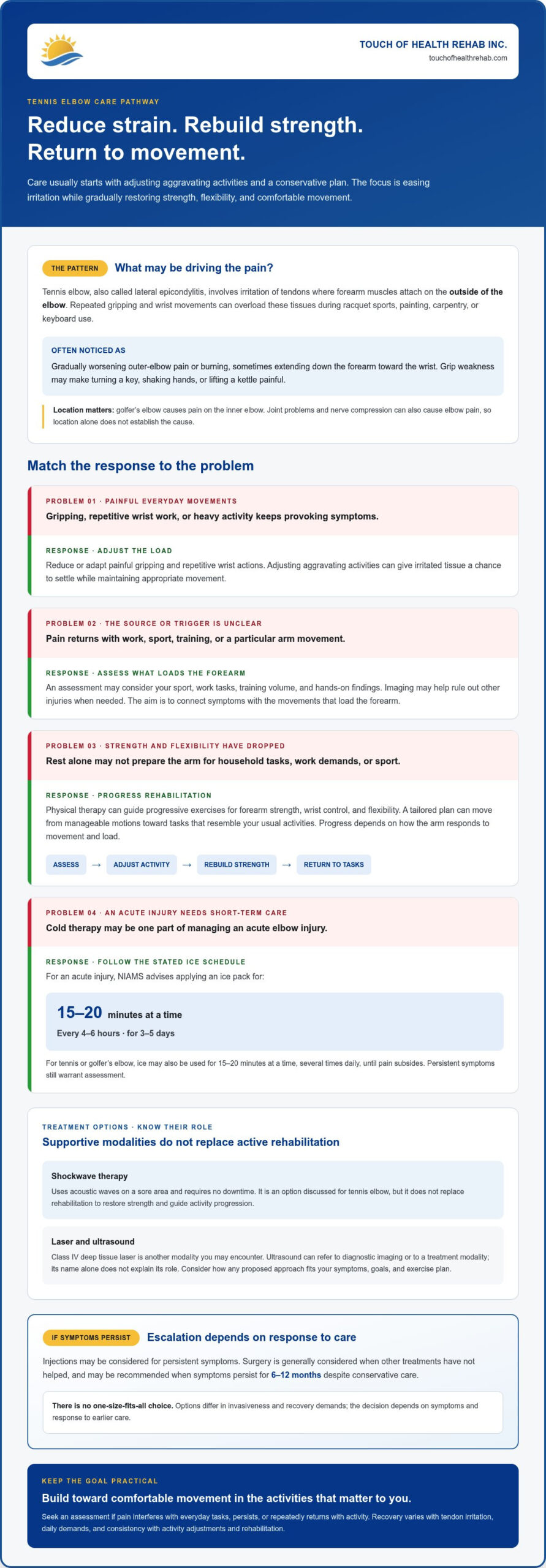
Tennis elbow, also called lateral epicondylitis, is an overuse condition affecting tendons on the outer side of the elbow. Forearm muscles attach there, and repeated wrist or gripping motions can irritate the tendon. The elbow contains three bones: the humerus, radius, and ulna. Pain may extend from the outer elbow into the forearm or wrist, but an assessment can help distinguish tendon irritation from other causes.
A clinical assessment begins with your medical history and a physical examination. Describe when symptoms started and which tasks aggravate them, such as a tennis backhand, painting, or lifting at work. The clinician may ask about your sport, work demands, and training volume, then use hands-on tests to examine the elbow. These steps connect the pain pattern with your activities and guide decisions about diagnosis, rehabilitation, and activity changes.
Imaging is not a substitute for the clinical picture. Depending on the case, ultrasound, X-rays, or MRI may help assess elbow pain. Ultrasound or MRI may also be used when needed to rule out other injuries. The choice depends on the examination and suspected cause. For example, imaging may help investigate whether symptoms relate to an injury other than tendon irritation at the lateral epicondyle.
Nerve compression can also contribute to symptoms around the elbow. Reviewing your medical history and conducting a physical examination can reveal signs that warrant further investigation. Imaging or electromyography may be used to check for nerve compression. Ultrasound or MRI can help assess other possible injuries, while X-rays may be another option depending on the case. Each test answers a different clinical question, so results are considered alongside your symptoms and examination findings.
A clear diagnosis helps match treatment to the problem. If findings point to tendon irritation, conservative care can focus on reducing aggravating loads and progressively restoring strength and flexibility. If the assessment suggests another injury or nerve compression, the next steps may differ. Surgery may be considered when conservative treatment fails and symptoms persist for 6-12 months. After tennis elbow surgery, rehabilitation helps improve joint range of motion and strength, supporting recovery and a gradual return to activities such as sports.
The assessment is more than simply naming pain on the outer elbow. Reviewing your medical history and conducting a physical examination provide context for deciding whether further checks are appropriate. Diagnosis may also involve imaging or electromyography to check for nerve compression. These investigations complement, rather than replace, the history and examination, helping the clinician consider whether symptoms fit tendon irritation or another possible cause.
This combined approach can make the next step more specific: findings consistent with tendon irritation can inform a plan directed at the tendon, while signs of possible nerve compression may prompt further evaluation. Describing which movements trigger symptoms and how they have changed gives the clinician useful context for interpreting the examination and any tests. The aim is to base decisions on the overall pattern, not on a single symptom or test.
Cortisone injections for elbow tendonitis
Cortisone injections may provide short-term relief for elbow tendonitis, but they do not offer long-term benefits. The American Academy of Orthopaedic Surgeons advises against cortisone injections for elbow tendonitis. Temporary symptom relief does not address the repeated loading that irritates the forearm tendons. A doctor’s examination considers where pain occurs, which movements provoke it, and how symptoms affect work or sport. These details help guide a treatment plan focused on restoring function rather than relying on an injection alone.
Tennis elbow involves tendons attached at the lateral, or outer, elbow. The extensor carpi radialis brevis, or ECRB, is a tendon often discussed in relation to the condition. Repetitive wrist and gripping motions can overload forearm tissues and contribute to tendon irritation. If an examination suggests persistent tendon damage, a doctor may discuss options beyond conservative care, including specialized injections or minimally invasive procedures. The approach depends on symptoms and response to earlier treatment.
Prolotherapy and platelet-rich plasma (PRP) differ from cortisone. Prolotherapy uses dextrose injections intended to stimulate healing in ligaments, tendons, and joints. PRP uses concentrated platelets from the patient’s own blood to reduce inflammation and accelerate tissue repair. These descriptions explain the treatments’ intended roles, not a guaranteed outcome. Discuss how an injection fits alongside activity modification and exercises, and which functional changes will be used to assess progress.
Surgery may enter the discussion when other treatments haven’t worked and symptoms persist for 6-12 months. Traditional open lateral epicondyle release uses a single incision. The procedure elevates the muscle and tendon origin, then scrapes the bone and tendon. Recovery from open surgery can take several weeks to several months. After surgery, elbow-stretching exercises begin about 1 week after surgery, when the splint is removed. Light, gradual strengthening begins about 2 months after surgery, while return to athletic activity is usually 4 to 6 months after surgery.
These timelines show why treatment choices should account for both symptom relief and rehabilitation needs. A stepwise plan may begin with conservative care, then consider procedures if symptoms persist. For guidance on elbow injury recovery and movement goals, explore physical therapy support.
Touch of Health Rehab: Physical Therapy
Touch of Health Rehab provides physical therapy to help you address tennis elbow and work toward more comfortable daily movement. If gripping, wrist motions, or sports continue to aggravate your elbow, an individualized rehabilitation plan can guide activity adjustments and progressive exercises to rebuild strength and flexibility.
Physical therapy can also support recovery after elbow surgery, with exercises focused on joint movement and gradual strengthening. Your plan can reflect the demands you want to resume, such as work tasks, household activities, or sport. This step-by-step approach complements the assessment and treatment options discussed above.
If you’re ready to explore physical therapy for elbow symptoms, contact Touch of Health Rehab or visit touchofhealthrehab.com.
Take the Next Step Toward Comfortable Movement
Choose a practical goal to guide your next conversation, such as returning to a racquet swing, completing work tasks comfortably, or lifting everyday items with confidence. A clear goal keeps care focused on the movements that matter in your life. For tennis elbow treatment in Sunny Isles Beach, Touch of Health Rehab offers physical therapy to support a personalized path toward improved function. The practice also offers postural education and vestibular rehabilitation for people with those distinct needs.
Recovery is a process, and steady progress can begin with a thoughtful plan built around your activities and priorities. Share what you hope to return to and what movements currently feel difficult. Contact Touch of Health Rehab to discuss a next step that supports your goals. You can move forward with care, clarity, and a plan shaped around the life you want to reclaim.
Frequently Asked Questions
Who Needs Treatment?
Consider an assessment if elbow symptoms continue to disrupt work, sport, or activities you want to resume. Treatment can also help if you have adjusted a painful task but still struggle to use your arm normally. Bring examples of movements that cause trouble, such as handling tools during a work shift or practicing a tennis stroke. These details help shape care around the demands of your daily life.
What treatments are available for tennis elbow in Sunny Isles Beach?
Options can include activity modification, bracing, pain-relief measures, and physical therapy with progressive exercises. A practical starting point is to identify the movements that aggravate your elbow, then build a plan around your work and activity goals. If symptoms persist despite conservative care, a doctor may discuss injections or a procedure. The choice depends on your symptoms and response to earlier treatment.
Which Sunny Isles Beach clinics treat tennis elbow?
Touch of Health Rehab in Sunny Isles Beach provides physical therapy and sports injury treatment relevant to tennis elbow care. For tennis elbow treatment in Sunny Isles Beach, physical therapy can help you work toward functional goals with a tailored rehabilitation approach. When choosing care locally in Sunny Isles Beach, Aventura, Bal Harbour, North Miami Beach, or Miami Beach, focus on whether the assessment considers your symptoms, work or sport demands, and the activities you hope to resume.
What are the risks and side effects of cortisone or PRP injections for tennis elbow?
Cortisone may provide short-term relief, but it does not offer long-term benefits for elbow tendonitis, and the American Academy of Orthopaedic Surgeons advises against it for this condition. PRP uses concentrated platelets from your own blood and is intended to support tissue repair. Before choosing an injection, discuss its expected benefits and limitations, alternatives, and how exercises fit into the plan with your doctor.
When should someone see a doctor for tennis elbow?
Arrange an assessment if elbow pain persists, repeatedly returns, or limits work, sport, or everyday routines. A doctor can review your medical history, examine your elbow, and consider whether another injury or nerve compression may explain your symptoms. Before the appointment, note which movements bring on pain and how it affects your activities. This information can help make the evaluation more focused.