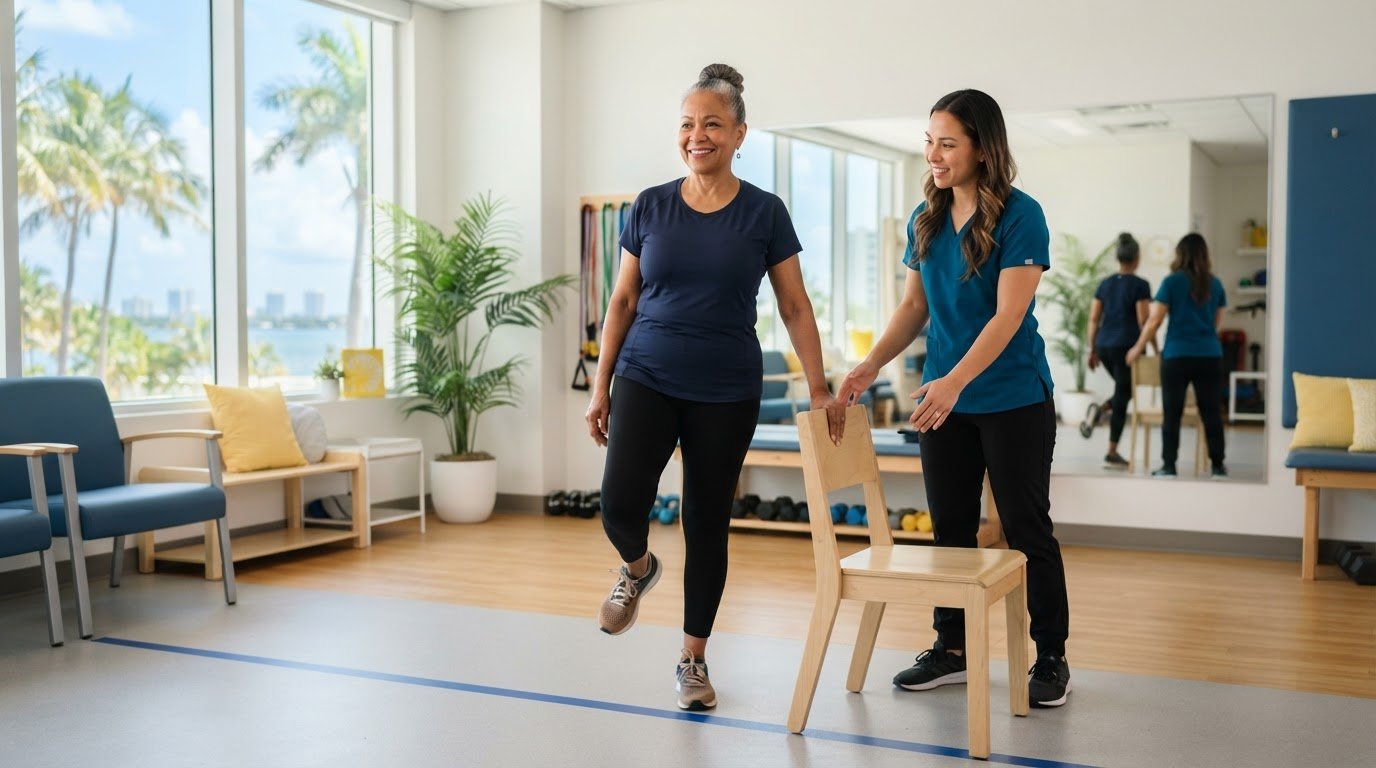
Support isn’t a setback; it’s a practical part of balance training. To build steadier walking, practice exercises to improve walking stability beside a wall or stable chair, combining single-leg balance, lower-body and core strengthening, and heel-to-toe walking. Begin with manageable movements, keep support within reach, and gradually increase the challenge as your control improves.
Feeling unsteady can make familiar routes feel unpredictable. Trying to push through without support may add stress rather than confidence. A safe space, gradual progression, and movements that strengthen your legs and core are all important. This guide explains how to set up safely, build steadiness with simple standing and strengthening exercises, and use heel-to-toe walking to refine each step. You’ll also learn how a wall or chair can support you and how to make walking drills more challenging as your balance allows. The goal is a calm, practical routine that supports more confident movement in daily life.
Key Takeaways
- Balance relies on your inner-ear, visual, and body-position signals working together, so practice can include more than standing still.
- Use a stable chair or wall for support while building single-leg control and strengthening your core and legs.
- Calf raises and controlled step-ups help train the muscles you use to lift, place, and steady each step.
- Practice heel-to-toe walking along a clear, straight path, looking ahead and keeping support nearby as needed.
- Reduce fall risk by creating a safe practice space and increasing exercise difficulty gradually as your balance improves.
Are there other ways to improve your balance?
Keep a stable chair, wall, countertop, or cane within reach for support. After a stroke or injury, supported weight shifts, marching, and sit-to-stands are examples of exercises to discuss with a healthcare provider before starting. Do the same if pain continues for several days or weeks.
-
Understand the systems that support balance
Notice how your senses respond while standing and which cues help you feel steady. Balance relies on three systems: vestibular input from the inner ear, vision, and proprioception, your sense of body position. Each ear has five vestibular balance organs, including semicircular canals and otolithic organs. Together, these systems help orient your body and coordinate movement.
Try a gentle weight shift beside a chair. Your eyes track the room, inner-ear signals register head movement, and proprioception tells your body where your feet and joints are. If one cue changes, the others help you adjust. Keep your gaze forward and avoid closing your eyes during early practice.
-
Set up a safe exercise space
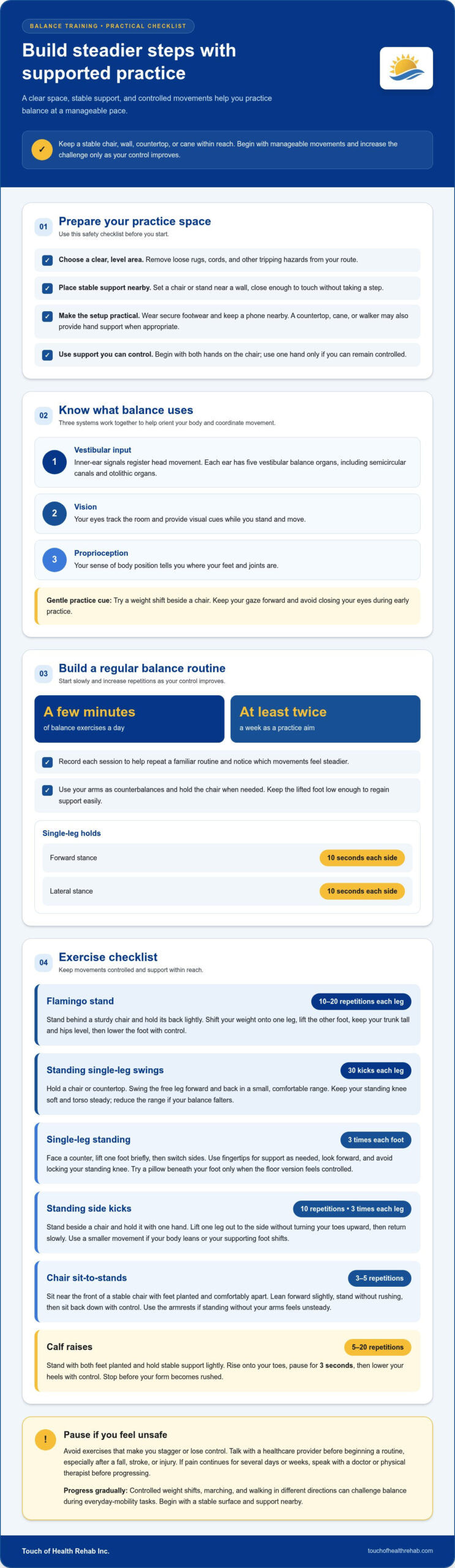
Choose a clear, level area and place a stable chair or stand near a wall before you begin. Keep support close enough to touch without taking a step, and remove loose rugs, cords, and other tripping hazards from your route. Wear secure footwear and keep a phone nearby.
A countertop, cane, or walker can also provide hand support when appropriate. For home balance exercises, begin with both hands on the chair. Use one hand only if you can remain controlled. After a stroke or injury, discuss supported weight shifts or sit-to-stands with a healthcare professional.
-
Set an exercise frequency
Build a regular routine with a few minutes of balance exercises a day, aiming to practice at least twice a week. Start slowly and gradually increase repetitions as your control improves. Record each session to help you repeat a familiar routine and notice which movements feel steadier.
Include single-leg variations beside your chair. Hold a forward single-leg stance for 10 seconds on each side, then try a lateral stance for 10 seconds on each side. Use your arms as counterbalances, and hold the chair when needed. Keep the lifted foot low enough to regain support easily.
-
Recognize fall risks and warning signs
Practice dynamic balance with controlled weight shifts, marching, or walking in different directions. These movements challenge stability during tasks similar to everyday mobility. Exercise programs that include balance exercises can reduce fall risk among older adults. Begin with a stable surface and support nearby, then increase the challenge gradually.
Stop if you feel unsafe, and avoid exercises that make you stagger or lose control. Talk with a healthcare provider before beginning a routine, especially after a fall, stroke, or injury. If pain continues for several days or weeks, speak with a doctor or physical therapist before progressing.
Flamingo stand and core stability
Practice controlled single-leg movements beside stable support. These drills challenge your core and legs while training the balance needed for everyday steps.
-
Practice the flamingo stand
Stand behind a sturdy chair and hold its back lightly. Shift your weight onto one leg, then lift the other foot. Keep your trunk tall and your hips level, using your arms as counterbalances if needed. Lower the foot with control, then repeat 10-20 times on each leg. This flamingo stand asks your core to steady your body as your support base narrows.
-
Add standing single-leg swings
Hold a chair or countertop, stand upright, and shift your weight onto one leg. Swing the free leg forward and back in a small, comfortable range, keeping your standing knee soft. Complete 30 kicks on each leg, moving slowly enough to control your position. Keep your torso steady rather than leaning with each swing. Reduce the range if your balance falters.
-
Practice single-leg standing
Face a counter and stand tall, with both feet on the floor. Lift one foot and hold the position briefly, then switch sides. Repeat three times on each foot, using fingertips for support as needed. Keep your gaze forward and avoid locking your standing knee. To progress, try a pillow beneath your foot only when the floor version feels controlled.
-
Add standing side kicks
Stand beside a chair and hold it with one hand. Keep your back straight, then lift one leg out to the side without turning your toes upward. Return it slowly, maintaining a stable trunk and pelvis. Perform 10 repetitions, three times on each leg. Use a smaller movement if your body leans or your supporting foot shifts.
-
Include chair sit-to-stands
Sit near the front of a stable chair, with your feet planted and comfortably apart. Lean forward slightly, press through your feet, and stand without rushing. Sit back down with control, keeping your knees aligned over your feet. Repeat three to five times. If standing without your arms feels unsteady, use the armrests and focus on a smooth movement.
If you’d like individualized guidance for balance practice, explore support for steadier movement.
Calf raises and step-ups
Calf raises and step-ups strengthen muscles used to lift and place your feet. Start beside a wall or railing, move slowly, and keep support within reach throughout your balance training.
-
Build strength with calf raises
Stand with both feet planted and hold a stable support lightly. Rise onto your toes, pause for three seconds, then lower your heels with control. Repeat five to 20 times, stopping before your form becomes rushed. This movement works your calf muscles, which help raise your heels as you step forward.
-
Practice step-ups
Choose a low step near a railing or wall. Place one foot fully on the step, press through it, and bring the opposite foot up. Step down slowly, leading with the same foot. Repeat 10 times, then start with the other foot. Controlled stepping practices balance while strengthening the legs.
- Keep your heel raises steady. If standing on the floor feels comfortable, try the stair calf raise while holding a railing. Place the balls of your feet on the step, with your heels extending past its edge. Raise and lower your heels through a comfortable range, then repeat 10-12 times. Keep both hands close to support, and avoid bouncing or dropping your heels quickly.
- Adjust step-up practice to your control. Begin with a low step and use the railing or wall for support. Place your whole foot on the step before transferring your weight; don’t rush or let your knee collapse inward. Step up and down slowly, keeping each movement controlled. Practice controlled step-ups with each leg, then rest or switch sides.
- Notice how each side responds. If one leg feels less steady, keep your hand on the support and reduce the step height or repetitions. When 10 repetitions feel controlled, repeat the sequence starting with the opposite foot. Focus on placing your foot securely, shifting your weight, and returning to the floor without a sudden drop.
Before you begin, position the step so you can easily reach the railing, or place it near a wall for support. Keep support close as you practice rather than moving away to make the exercise harder. Place your foot securely on the step, then shift your weight in a measured way. Pay as much attention to returning to the floor as you do to stepping up. Moving slowly and with control helps build balance and lets you focus on steady movement.
For the step-up exercise, perform 10-12 repetitions before switching sides. After changing sides, continue to use the same support and measured pace rather than trying to match the other leg’s speed. Consistent, controlled foot placement matters more than rushing through the sequence. If the movement becomes difficult to control, pause and reset your position before continuing. Keep your attention on placing your foot securely and lowering yourself with care each time.
Heel-to-toe walking
Heel-to-toe walking trains coordination by narrowing the space between each step. Practice on a clear, straight path, with a wall or stable support nearby.
See a physical therapist if walking instability persists, changes your usual mobility, or follows an injury, surgery, or stroke. If pain lasts several days or weeks, talk with a doctor or physical therapist before progressing.
- Set up a straight, flat walking route beside a wall or countertop. Clear away loose rugs, cords, and other obstacles before starting. Stand tall, look forward, and keep one hand near the support. Take steps small enough to stay in control. A clear path lets you focus on foot placement instead of scanning for hazards.
- Begin with a short heel-to-toe walk. Place one foot directly in front of the other, aiming to touch the front heel to the back toes. If your feet cannot meet comfortably, bring them as close together as you can. Hold each step for a second or two, then continue for five or more steps with each foot.
- Keep your gaze forward throughout each pass. Looking down can change your posture and interrupt the rhythm of your steps. Choose a fixed point ahead, such as a doorway, and move toward it as you place each heel carefully. If you sway or need to grab support, pause and reset your stance before continuing.
- Use a 10-foot straight, flat area for tandem walking. Walk heel to toe along its length, then repeat the route four times. Keep the front heel close to the back toes, or place your feet as close together as you can manage. Take your time; accurate placement matters more than covering the distance quickly.
- Build the challenge gradually as control improves. First, repeat the short supported walk, then practice 20-30 steps in a straight line. As you progress, move slightly farther from the wall while keeping it within reach. Don’t add distance and remove support at the same time. Change one part of the drill, then notice whether your steps remain steady.
- Make each pass deliberate rather than rushed. Heel-to-toe walking asks your feet to follow a narrow line while your eyes stay forward and your body adjusts with each weight shift. If the straight path feels difficult, use a shorter route or move closer to your support. A physical therapist can assess your gait and adapt walking practice to your balance and mobility needs.
Fall prevention and safety support
In 2024, emergency departments recorded about 4.5 million visits per year for older adult falls, according to the Centers for Disease Control and Prevention. The Centers for Disease Control and Prevention says falls are the leading cause of injury and injury-related death among adults aged 65 and older.
Yes. Exercise programs that include balance exercises can reduce fall risk among older adults. A useful plan combines balance practice, leg and core strengthening, and safe walking drills.
- Make your practice area safer before you start. Choose a clear, flat route, remove loose rugs and cords, and place a stable chair or countertop within reach. Wear secure shoes and keep a phone nearby. To practice changing walking speed, begin on flat ground in an open space. Change pace for three to five steps at a time, then return to your comfortable speed.
- Practice sideways walking beside a counter. Take 10 steps in one direction, then 10 steps back, keeping your body facing forward. Use the counter for support if needed. You can also try five grapevine cross-steps on each side. Make the steps small; a shorter crossing step gives you more control while coordinating your feet.
- Add backward walking only with support close by. Use a wall, countertop, walker, or cane as needed, and move along a straight path using a toe-to-heel pattern. Keep each step deliberate. If you’re practicing head turns, turn slowly and only as far as you can while walking steadily. Staggering or bumping into walls means the turns are too fast or wide.
- Build walking challenges one at a time. Practice overreaching steps by stepping farther than usual, then returning to your normal stride; repeat each overreaching step 20 times. Try a tightrope walk along a straight line for several feet, counting five seconds between steps. For obstacle step-overs, use small objects and lift each leg high enough to clear them without tripping.
- Choose a stable surface before practicing on uneven terrain. Grass, gravel, or textured mats can challenge balance, so begin with support available and take small steps. Keep your arms out only if it helps you stay controlled. If balance feels less secure on your left leg, shorten the practice or hold the support while gently shifting your weight onto that side.
For guidance tailored to your walking and fall-prevention needs, explore physical therapy support.
Touch of Health Rehab: Physical Therapy
Touch of Health Rehab Inc. provides Physical Therapy to help address walking instability with guidance tailored to your movement needs. Consider professional support if unsteadiness persists, affects everyday mobility, or begins after surgery, injury, or a change in balance.
Care may include Balance and Gait Rehabilitation, Vestibular Rehabilitation, or Postural Education, depending on the factors affecting your steadiness. A physical therapist can assess your walking and shape a practice plan around your goals. If you’re recovering after surgery, Post Surgery Physical Rehabilitation can support your return to movement.
Contact Touch of Health Rehab Inc. to discuss support for steadier walking and balance.
Make steadier movement your next goal
Progress is easier to recognize when you notice changes in daily life: whether you feel more composed turning, stepping onto a curb, or walking across a familiar room. Let those moments guide how you build a routine with exercises to improve walking stability. If unsteadiness continues or makes everyday movement feel uncertain, professional guidance can connect your practice to the challenges you want to manage.
Touch of Health Rehab Inc. provides Physical Therapy, Postural Education, and Vestibular Rehabilitation to support movement and balance. These services address different factors that may affect steadiness, including posture and vestibular function. Your next step can be a conversation about what you’re experiencing and the support that may fit your needs.
Contact Touch of Health Rehab Inc. to discuss your path toward steadier movement. Keep building confidence one purposeful step at a time.
Frequently Asked Questions
What are the best balance exercises?
Choose exercises that challenge control without making you feel unsafe. A bird dog adds trunk control: from hands and knees, extend your opposite arm and leg, then switch sides, completing 10-15 repetitions on each side. You can pair it with standing marches beside a counter. The most useful routine is one you can perform with steady form and gradually adapt as your coordination improves.
Why is balance important?
Balance helps you stay oriented while standing, turning, and moving between surfaces. For example, stepping off a curb requires your legs and trunk to adjust as your weight shifts. Better control can make everyday movements more manageable and support mobility. Balance practice also matters for fall prevention: exercise programs that include balance exercises can reduce fall risk among older adults.
What exercises improve walking stability and balance?
Exercises to improve walking stability can combine walking drills with strength and control work. Try reverse lunges, lowering into a comfortable step and returning upright, for 10 repetitions on each side. Single-leg dead lifts train control as you hinge forward from the hips; perform 8-10 repetitions on each leg with support nearby. Focus on steady form as your weight shifts.
How often and how long should you do balance exercises?
Build a consistent routine by practicing for a few minutes a day and aiming for at least twice a week. For instance, pair a short standing drill with a core exercise, then record what you completed. Start with fewer repetitions if your form changes, and increase gradually as your control improves. Regular practice matters more than fitting every exercise into one session.
What are beginner balance exercises for older adults?
Begin with supported weight shifts: stand near a counter and gently move your weight from one foot to the other. If that feels controlled, add marching in place while holding the counter. Keep the movement small and return both feet to the floor between marches. Stable support lets you focus on posture and foot placement while learning how your body responds.
How can you safely practice walking stability exercises at home?
Choose a clear hallway, secure loose rugs, and place a sturdy counter within reach. Keep your route short enough to turn without rushing, and stop if you feel unsteady. A physical therapist can tailor exercises to improve walking stability when difficulty follows injury, surgery, or dizziness.