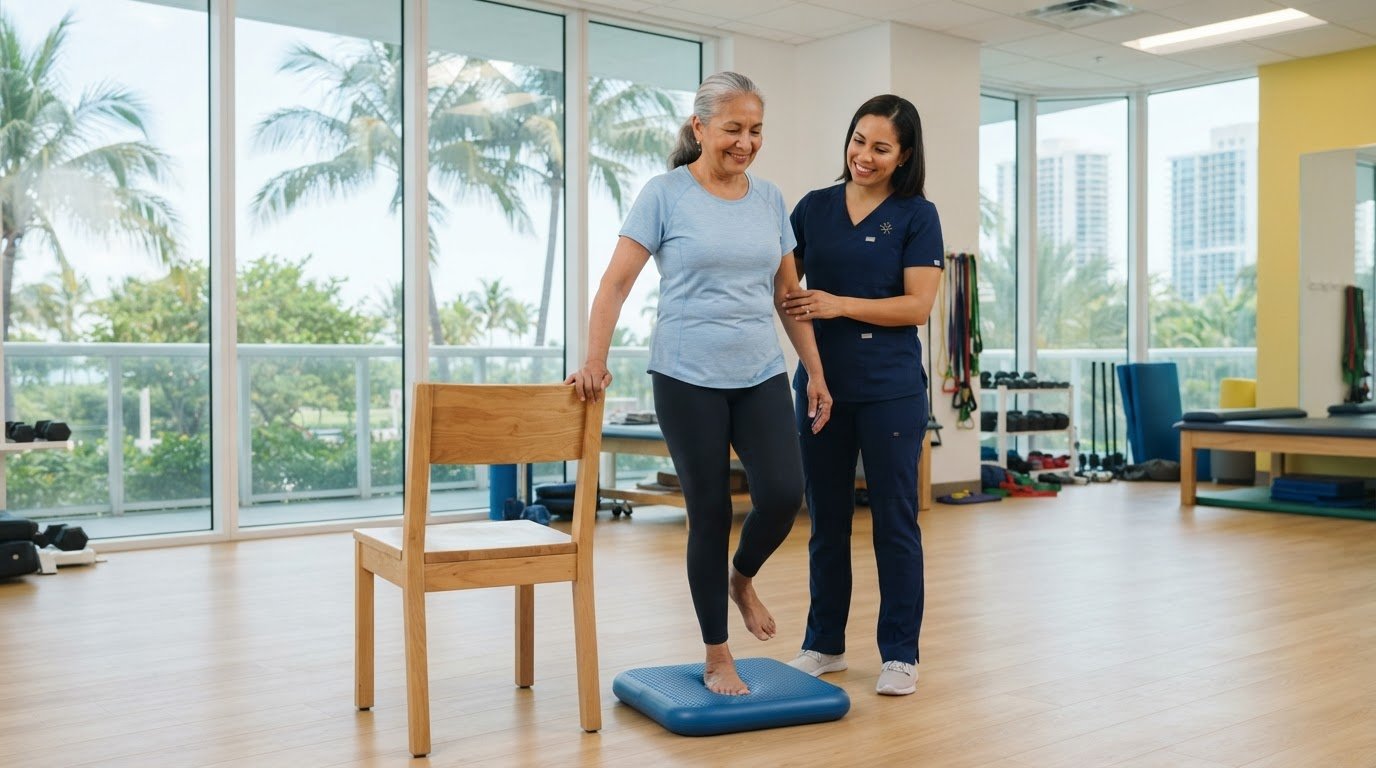
Consistency matters more than pushing through a long session. For balance exercises for seniors in Sunny Isles Beach, practise in brief, controlled sessions, with duration and weekly frequency guided by your steadiness, strength, health, and recovery. Stop if you can’t maintain safe control.
It’s understandable to want a clear schedule, especially when you’re aiming to feel steadier in everyday movement. The right routine gives you enough practice to work on balance without making each session overwhelming. This article explains what can shape session length and frequency, how simple movements support strength, mobility, and postural control, and how an individualized approach can help you progress with confidence.
Key Takeaways
- Build a balance routine around your current steadiness, strength, mobility, and recovery rather than following a one-size-fits-all schedule.
- Use safe, controlled practice and adapt movements to your needs so you can develop stability with confidence.
- Combine balance work with strength and mobility exercises to support more capable movement in daily activities.
- Explore how ankle and hip strength, coordination, and posture each contribute to steadier movement.
- Learn when individualized physical therapy may help you work toward improved balance and postural control.
Safety and individualized exercise programs
Sunny Isles Beach senior programs serve adults ages 55 and older. Start by choosing movements that match your current balance, mobility, and confidence. For example, practice standing exercises beside a sturdy chair or counter. Keep the support within reach, and move slowly enough to stay controlled. If a movement causes pain, dizziness, or unusual discomfort, stop and reassess it.
Adjust the starting position, range of motion, and support to make a program more suitable for you. A seated march may be a better first step than standing leg lifts. Progress by standing with both hands supported, then using one hand as your control improves. Clear loose rugs, cords, and clutter from the practice area. Keep the floor dry and wear secure footwear before you begin.
Sunny Isles Beach senior program registration is available in person at the Government Center, 18070 Collins Avenue, or Gateway Center, 151 Sunny Isles Blvd. These locations give residents a direct way to register for local programs. Ask which scheduled activity fits your goals, then choose a class whose movements feel manageable. A suitable pace and setup make participation more practical.
Adults ages 55 and older can also find senior activities and programs in the City of Miami Beach. Its free senior fitness center use is available at North Shore Park and the Scott Rakow Youth Center. These are Miami Beach programs, distinct from Sunny Isles Beach offerings. Local park and recreation departments may offer low-cost activity classes, according to the National Heart, Lung, and Blood Institute.
Free and low-cost options are available to explore near Sunny Isles Beach. The City of Miami Beach offers free senior fitness center use, while local park and recreation departments may offer low-cost classes. Compare each activity’s format with your balance needs. For example, a seated class may suit someone who needs more support than a standing group class provides.
Sunny Isles Beach’s free City Bus operates seven days a week, offering a local transportation option. For accessibility, match the class format and movements to your mobility. Chair-based exercises, such as seated marching, provide a different starting point from standing practice. The bus information describes service frequency, while choosing a suitable exercise format helps address your individual movement needs.
Intergenerational programming can create opportunities beyond fitness. The City of Miami Beach’s after-school volunteer program serves students in grades K-3, Monday through Friday, from 3PM to 4PM. Its senior volunteer program is open to people ages 55 and older. These are volunteer activities, not balance classes, but they illustrate ways older adults can take part in community programs.
Before joining a group activity, consider how you manage turning, reaching, and standing from a chair. Try a supported version first, such as holding a counter during side steps. Notice whether you can keep your posture steady and breathe comfortably. This practical check helps you choose a program that supports safe participation and gradual balance practice.
Strength, mobility, and balance training for adults over 50
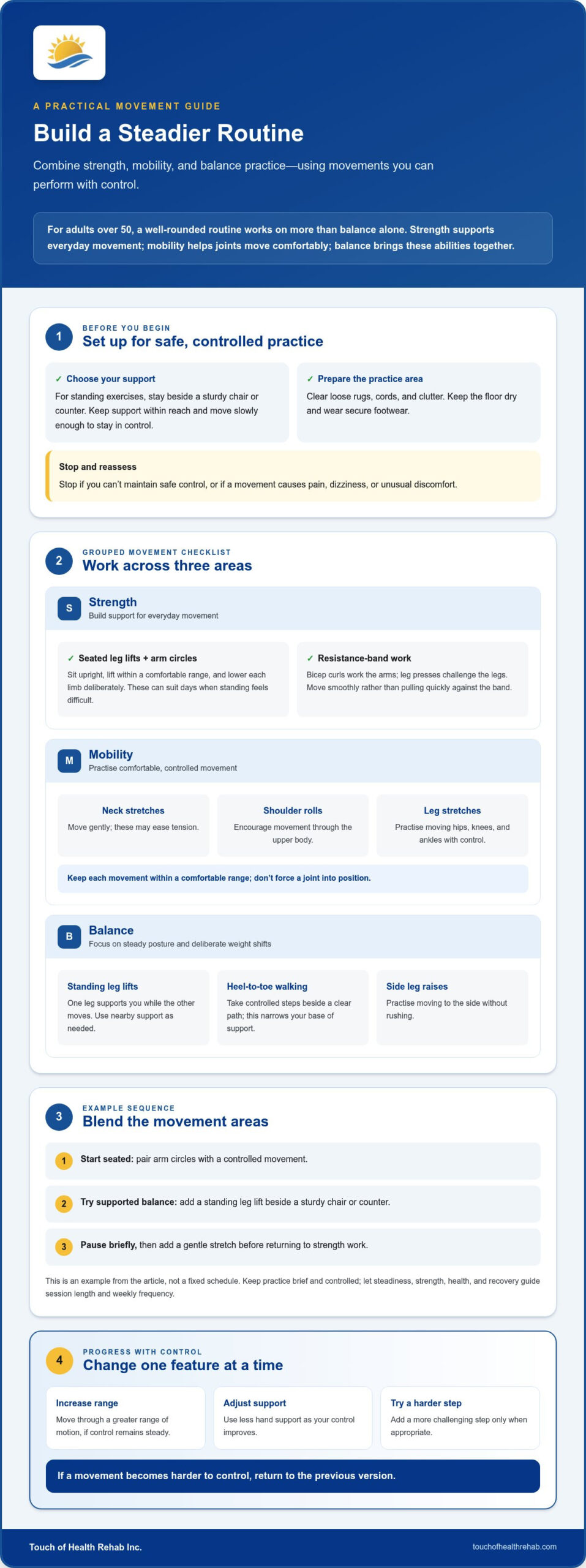
A well-rounded fitness routine works on more than balance alone. Strength helps your legs support everyday movement, while mobility helps your joints move comfortably through useful ranges. Balance practice brings those abilities together as you stand, turn, and reach. For adults over 50, combining these elements can make exercise more relevant to daily tasks.
Begin with a movement you can perform with control. Seated leg lifts and arm circles let you practise strength and movement while seated. Sit upright, lift within a comfortable range, and lower each limb deliberately. These exercises may suit days when standing feels difficult. Pause between movements and notice whether your position remains steady.
Resistance bands offer another way to train strength. Bicep curls work the arms, while leg presses challenge the legs. Move smoothly instead of pulling quickly against the band. Resistance-band exercises may help strengthen muscles while allowing you to work within a comfortable range of movement. Since muscle loss occurs naturally with age, regular strength work can help address changes in muscle capacity.
Mobility practice can fit into a simple daily sequence. Try gentle neck stretches, shoulder rolls, and leg stretches. Move within a comfortable range, without forcing a joint into position. Neck stretches may ease tension, while shoulder rolls encourage movement through the upper body. Leg stretches let you practise moving your hips, knees, and ankles with control.
Balance exercises add a different challenge. Standing leg lifts ask one leg to support you while the other moves. Heel-to-toe walking narrows your base of support, so take controlled steps beside a clear path. Side leg raises train movement to the side. Choose a version you can complete without rushing, and focus on steady posture and deliberate weight shifts.
A practical routine of balance exercises for seniors in Sunny Isles Beach can combine strength, mobility, and steady movement. For example, pair arm circles with a supported standing leg lift, then rest briefly. Add a gentle stretch before returning to strength work. Consistent practice can support confidence and mobility, while regular exercise can benefit physical health and mental well-being.
Progress by changing one feature at a time. Increase your range of motion, reduce hand support, or add a more challenging step, but don’t do all three at once. If a movement becomes harder to control, return to the previous version. For balance exercises for seniors in Sunny Isles Beach, individualized balance and gait rehabilitation can help tailor practice to your movement goals.
Ankle, hip, and coordination strengthening
Your ankles and hips help manage small shifts while standing and walking. Ankle movement lets your feet adjust against the floor. Hip movement helps shift your body’s center over each supporting leg. Practising these actions separately can make balance training easier to follow. Start with a stable counter nearby and use movements you can control.
For ankle control, try a supported heel raise. Stand tall, hold the counter, and slowly lift both heels. Lower them without dropping your weight. Then lift your toes while keeping your heels down. These movements take your ankles through different directions. Keep your knees relaxed and notice whether your weight stays evenly placed across both feet.
Hip practice can focus on moving one leg while the other supports you. Hold the counter and gently slide one foot backward, keeping your trunk upright. Return to the starting position, then switch sides. You can also move one leg slightly out to the side. Avoid leaning your shoulders to increase your range. The goal is controlled hip movement, not a higher lift.
Gentle standing leg lifts and side leg raises can help improve stability and support fall prevention. Begin with a small lift, then set your foot down quietly. For a side raise, keep your toes facing forward and your torso centered. If your body sways, reduce the movement or add hand support. Smooth control matters more than height.
Coordination practice connects foot placement with posture. Try shifting your weight from one foot toward the other while holding support. Keep both feet on the floor and pause when your weight feels centered. Then practise stepping forward and returning to your starting position. A clear path gives you room to focus on where each foot lands.
- Ankle focus: Alternate slow heel raises with toe lifts while standing supported.
- Hip focus: Move one leg backward or sideways without tilting your trunk.
- Coordination focus: Shift weight, pause, then take a controlled step.
Heel-to-toe walking offers another coordination challenge. Place one foot ahead of the other along a clear path, then carefully bring the next foot forward. Keep a hand near support as needed. If the narrow stance feels difficult, widen the space between your feet. Gentle heel-to-toe walks are among the movements that can support stability.
Combine ankle, hip, and coordination work by alternating one movement from each group. For example, practise heel raises, followed by a backward leg slide, then a supported weight shift. Rest if your movement becomes rushed or uneven. This approach helps you notice which action feels less steady and adjust it before progressing.
Balance exercises and postural control
Postural control is how you keep your body aligned as you move. Practise it with a simple sit-to-stand from a sturdy chair. Place both feet beneath your knees, lean slightly forward, and rise with control. Pause upright, then sit slowly. This movement connects posture, leg strength, and balance in one familiar task.
Your center of gravity shifts whenever you reach, turn, or step. A supported weight shift helps you notice the change. Stand near a counter with your feet comfortably apart, and gently move your weight toward one foot. Return to center, then shift toward the other. Keep your shoulders level and eyes facing forward as you move.
Controlled reaching adds a useful challenge. Stand beside a counter and reach one hand toward an object within easy range. Bring your hand back, then reach slightly to the side. Keep both feet planted at first. This teaches your trunk to stay organized as your arm changes position, much like reaching for a shelf at home.
Step taps connect posture with foot placement. Stand near stable support and tap one foot forward, then bring it back beside the other. Repeat to the side, keeping your chest lifted and steps small. If your trunk leans or your feet feel rushed, shorten the reach. Clear floor space makes it easier to focus on alignment.
Turning practice can prepare you for everyday changes in direction. Begin facing a counter, then turn your head and shoulders slightly to one side. Let your feet follow with small steps instead of twisting sharply. Return to face forward, then repeat on the other side. Use the counter for support, and turn smoothly rather than quickly.
Progress one detail at a time. You might reach a little farther, pause longer after standing, or use lighter hand support. Avoid changing several challenges at once. For example, keep the same step-tap pattern while reducing support only if your posture remains steady. In Miami Beach or at home, practise in a clear area with a stable surface nearby.
Look for signs of control during each movement: even breathing, level shoulders, and deliberate foot placement. If a task becomes unsteady, return to a wider stance or shorter reach. A simple practice sequence could include sit-to-stands, weight shifts, and step taps. These movements train posture through everyday actions, not just standing still.
Balance training offered by a local trainer
Sunny Isles Beach senior programs are open to adults ages 55 and older. Local park and recreation departments may offer low-cost physical activity classes, according to the National Heart, Lung, and Blood Institute. A class may include general movement rather than balance-only instruction, so look for activities that practise controlled stepping, weight shifts, or supported standing.
Personal trainers serving Sunny Isles Beach offer another route to structured exercise. Among trainers with a known start date, the average experience is 11 years. Experience alone doesn’t tell you whether a session suits your needs. The training approach matters too: clear demonstrations, manageable movements, and adjustments when your posture or steps become difficult to control.
What balance exercise classes for seniors are available in Sunny Isles Beach? Senior programs for people ages 55 and older and local physical activity classes are options to explore. The available class format depends on the program, so consider whether it includes supported standing, controlled stepping, or other balance practice.
A trainer can organize practice around a specific movement goal. For example, if turning feels uncertain, a session could focus on small turns with steady foot placement. If you need more control while walking, heel-to-toe steps or side steps offer practical movement patterns. Begin with stable support nearby, and progress only when you can maintain control.
Training specialties can help describe a trainer’s focus. In the local trainer data, 98 trainers list Strength Training, while 94 list General Wellness/Fitness. These specialties don’t establish that a trainer runs a balance-specific class. They do show why it helps to ask what movements a session includes and how the trainer adapts activities to your balance goals.
When reviewing a group class or trainer-led session, consider these practical details:
- Movement options: Check whether exercises can be done seated or with hand support.
- Practice focus: Look for examples such as stepping, turning, or standing weight shifts.
- Progression: Notice whether the trainer changes one challenge at a time.
- Experience: Thirty-eight of 91 trainers with a known start date have at least 10 years of experience.
Those figures describe experience, not a guaranteed training outcome. Use a first session to see whether instructions are clear and movements feel controlled. A trainer should explain each exercise, demonstrate the starting position, and offer a simpler variation when needed. For example, shorten a step before trying a faster pace.
For a more individualized plan, bring a specific goal, such as steadier turns or confidence stepping onto a curb. Explain which movements feel challenging, then use that information to shape your practice. In Florida, a structured trainer-led routine can complement community fitness activities by focusing your sessions on specific movement skills.
Options include senior programs for adults ages 55 and older, local physical activity classes, and trainer-led sessions. Their formats vary, so ask whether they include balance practice such as supported standing, stepping, or weight shifts.
Touch of Health Rehab: Physical Therapy
Touch of Health Rehab Inc. offers physical therapy for older adults seeking guided support with stability and mobility. If unsteadiness affects walking, turning, or daily activities, physical therapy can help you work toward movement goals through an individualized approach, incorporating targeted balance exercises for seniors in Sunny Isles Beach. Postural education can help you become more aware of how you position your body while standing and moving.
Vestibular rehabilitation may be relevant when balance concerns involve dizziness or inner-ear-related symptoms. If you’re rebuilding movement after an operation, post-surgery physical rehabilitation supports the recovery process. The right focus depends on your needs and the activities you want to manage more comfortably.
Contact Touch of Health Rehab Inc. to discuss physical therapy and balance support.
Make your next step a steady one
Choose a balance goal that matters in daily life, such as feeling more secure while turning or walking across a room. A routine is more meaningful when practice connects to the movements you want to manage with greater control. Notice which actions feel comfortable and where expert guidance could help. That awareness can help shape a focused conversation about your next steps.
For balance exercises for seniors in Sunny Isles Beach, individualized support can connect practice with your movement needs. Touch of Health Rehab Inc. offers Physical Therapy, Postural Education, and Vestibular Rehabilitation. These services can support people working toward steadier movement, improved posture, or help with balance concerns involving dizziness. The right focus depends on your goals and needs.
Contact Touch of Health Rehab Inc. to discuss a thoughtful next step. With a clear goal and supportive guidance, you can keep building confidence in the movements that matter to you.
Frequently Asked Questions
Is it safe for me?
Choose balance exercises that match your current mobility, symptoms, and ability to follow instructions. Start with a supported or seated version, such as lifting one foot while seated, and stop if you feel pain, dizziness, or unusual discomfort. If a recent operation, ongoing condition, or recurring dizziness affects how you move, a physical therapist can help tailor the starting movements and support level to your needs.
Where are senior balance exercise classes held in Sunny Isles Beach?
Sunny Isles Beach senior program registration is available in person at the Government Center, 18070 Collins Avenue, or Gateway Center, 151 Sunny Isles Blvd. These are registration locations, not a guarantee that every class takes place there. Senior programs serve adults ages 55 and older. Ask about the activity’s venue and format during registration, especially if you need seated options or a particular level of support.
Which local physical therapy clinics offer senior balance training in Sunny Isles Beach?
Touch of Health Rehab in Sunny Isles Beach offers Physical Therapy and Balance and Gait Rehabilitation. Its services can help if unsteadiness affects walking, turning, or daily movement, or if you want guided balance practice tailored to your needs. The clinic also offers Vestibular Rehabilitation for balance concerns involving dizziness. Contact Touch of Health Rehab to discuss physical therapy support for your movement goals.
What balance exercises are safe for seniors to do at home?
Seated knee extensions are a gentle place to begin: sit upright, straighten one knee, lower your foot, then switch sides. For standing practice, try slow toe taps while holding a sturdy counter. Keep the tap close to your body and maintain a comfortable stance. Use a clear, well-lit area and choose a movement you can complete without rushing or losing control.
What precautions should seniors take before starting balance exercises?
Before exercising, wear stable footwear and check that the floor is dry and free of objects. Keep solid support within reach, and avoid practising near stairs or on uneven surfaces. Start with a familiar movement and focus on control rather than speed. New dizziness, pain, or difficulty standing are reasons to get individualized guidance before practising balance exercises alone.