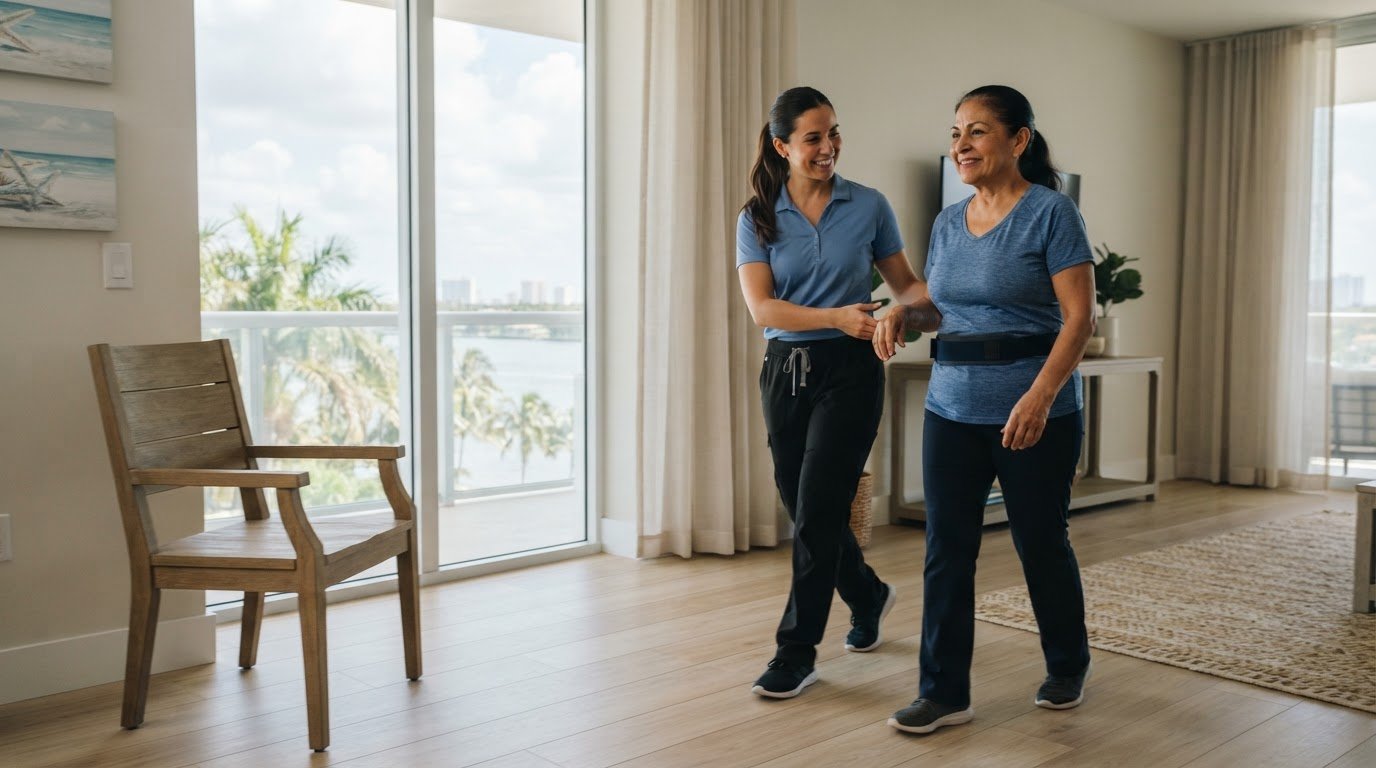
A change in walking is more than a slower pace. Gait difficulty means trouble moving with a steady, coordinated pattern. Gait training for seniors in Aventura can focus on challenging walking skills, from balance and stepping to turning safely. The right exercises depend on how each person moves and what they want to do more comfortably.
When walking feels less steady, it’s natural to wonder whether balance exercises alone are enough. A personalized approach looks at the whole movement pattern and builds practice around a person’s abilities, goals, and daily routines.
This guide explains what gait difficulty can look like and how balance work, individualized gait practice, and pre-gait exercises may fit into therapy. It also covers adapting exercises to familiar surroundings, factors that shape a training plan, and when a physical therapy assessment can clarify next steps.
Key Takeaways
- Notice how steadiness, coordination, and stepping affect everyday walking to identify which skills may need attention.
- Personalized practice can target the walking patterns and daily activities that matter most to each person.
- Pre-gait exercises may build foundational movement skills before progressing to full walking practice.
- Therapy activities and equipment can be selected around a person’s mobility needs, environment, and goals.
- Insurance coverage depends on plan terms and the therapy services involved, so understand those factors when planning care.
Balance and coordination deficits
Balance and coordination challenges can make familiar walking tasks feel less predictable. In Aventura, someone might pause before stepping off a curb, hold a wall while turning, or shorten their steps across a room. These examples describe changes in movement, not a diagnosis. Noticing when they happen helps a therapist understand which parts of walking need attention.
Balance is the ability to maintain or regain a stable position during movement. Coordination describes how body movements work together. Someone may stand steadily but lose rhythm when starting to walk, or walk steadily but struggle to turn. A physical therapist can observe each task separately and relate the findings to everyday activities, such as moving between rooms or approaching a chair.
Useful observations include the task, the surroundings, and the movement that feels difficult. A family member can share examples like these during an assessment:
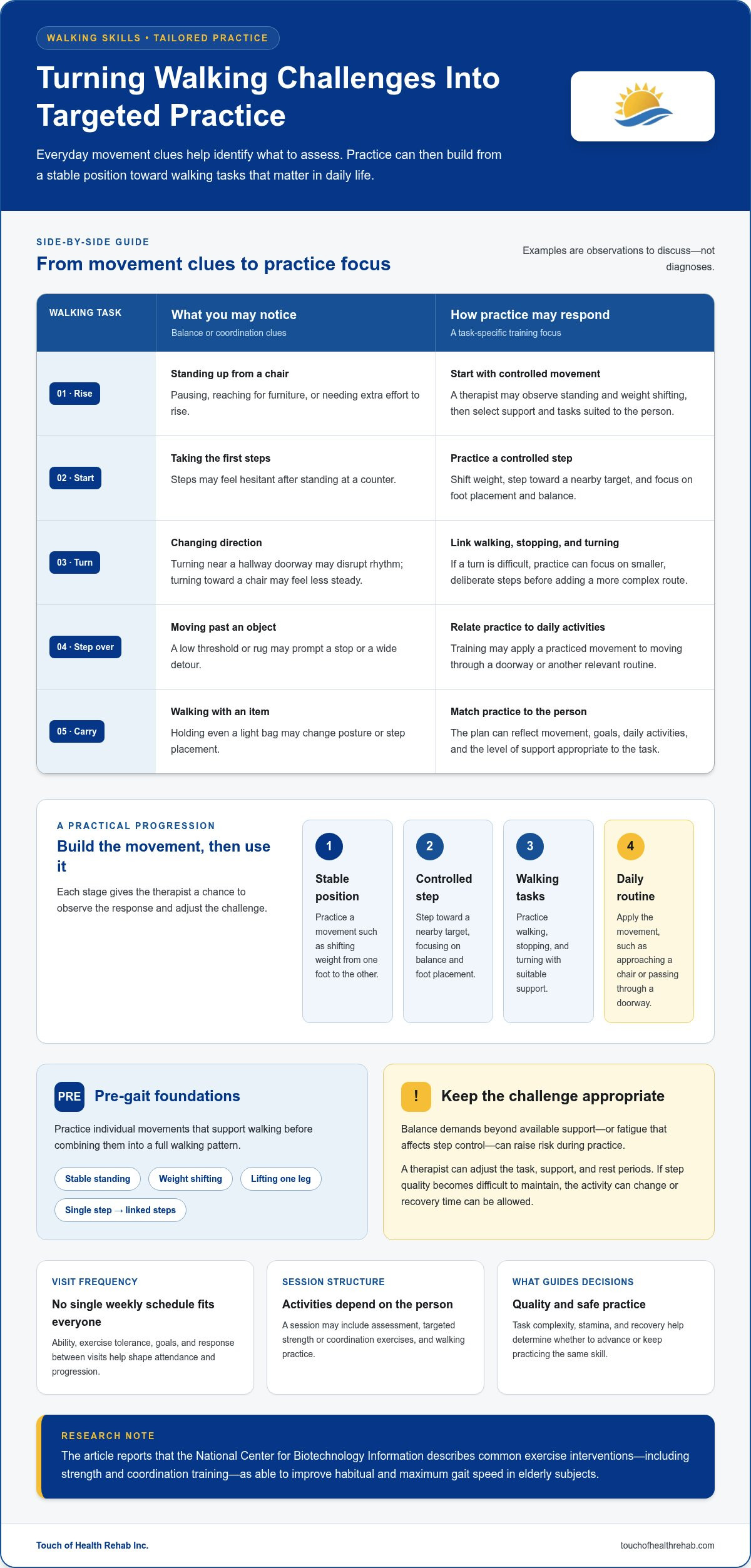
- Standing up: Does the person pause, reach for furniture, or need extra effort to rise from a dining chair?
- Starting to walk: Do the first steps feel hesitant after standing at the kitchen counter?
- Turning: Does changing direction near a hallway doorway disrupt the person’s rhythm?
- Stepping over objects: Does a low threshold or rug prompt a wide detour or a stop?
- Walking while carrying an item: Does holding a light bag change posture or step placement?
These examples can help distinguish a balance challenge from one involving movement timing, or both. A therapist may observe standing, weight shifting, starting a step, and turning in a controlled setting. The assessment can also consider whether a task changes with a walking aid or on a different surface. Each observation adds context; one movement alone doesn’t explain every difficulty.
Training can then focus on the movements that matter in daily life. For instance, practice may progress from controlled weight shifts to stepping toward a marked target, when appropriate for the person. A therapist can adjust the task, support, and environment as needed. The balance and walking support page describes a closely related area of rehabilitation.
Share clear examples, such as “turning toward the bathroom feels unsteady,” rather than only saying walking feels difficult. Note the activity and surroundings, such as a doorway, curb, or chair. These details give gait training for seniors in Aventura a practical starting point: identifying the movement to assess and the everyday task the person hopes to manage more comfortably.
Personalized gait training
Personalized gait training matches walking practice to your movement, goals, and daily activities. A therapist uses your starting point to choose exercises and adjust their level of challenge.
An assessment may look at step length, pace, posture, turning, and how you move between tasks. For example, walking across a room may feel manageable, while stopping and turning toward a chair feels less steady. The plan can target that specific transition instead of repeating drills without a clear purpose.
Progress can follow a practical sequence:
- Practice the movement in a stable position, such as shifting weight from one foot to the other.
- Add a controlled step toward a nearby target, focusing on foot placement and balance.
- Practice walking, stopping, and turning, using the level of support appropriate to the task.
- Apply the movement to a daily activity, such as approaching a chair or moving through a doorway.
Each step gives the therapist a chance to observe how your body responds. If a turn becomes difficult, practice can focus on smaller, deliberate steps before adding a more complex route. The National Center for Biotechnology Information reports that common exercise interventions, including strength and coordination training, can improve habitual and maximum gait speed in elderly subjects.
Training Benefits and Risks
Gait training can develop walking speed, strength, coordination, and confidence with specific tasks. Risks arise when an exercise challenges balance beyond the available support or fatigue affects step control. For example, repeated turning may become less precise as a person tires. A therapist can adjust the task, support, and rest periods to keep practice appropriate.
Typical Attendance Frequency
There isn’t one weekly schedule that suits every senior. Attendance depends on current walking ability, exercise tolerance, goals, and how the person responds between visits. Someone practicing a difficult turn may need a different rhythm from someone building walking endurance. Progress and recovery between sessions help determine whether to advance training or keep working on the same skill.
Typical Session Length
Session length depends on the number and complexity of activities, the person’s stamina, and the time needed to practice safely. A session might include assessment, targeted strength or coordination exercises, and walking practice. If step quality becomes difficult to maintain, the therapist can change the activity or allow recovery time. Purposeful practice matters more than filling a set period.
For a personalized approach, explore physical therapy and rehabilitation support as a next step.
Pre-gait exercises
Pre-gait exercises practice individual movements that support walking before combining them into a full walking pattern. A therapist might begin with lifting one leg or taking a single step, then build toward linking steps together. This allows practice to focus on a specific movement, such as shifting weight onto one foot before moving the other.
Preparation can begin with movements performed while standing in a stable position. For example, someone may practice shifting weight from side to side, lifting a heel, or raising one foot slightly. These activities help the therapist observe posture, control, and weight shifting. The movement should relate to a walking task, such as clearing a foot during a step.
A therapist may organize practice around a sequence like this:
- Shift weight: Move gently toward one foot, then return to a balanced standing position.
- Lift a leg: Raise one foot enough to rehearse the action used to begin a step.
- Place a step: Move one foot toward a nearby target, then bring it back under the body.
- Link movements: Practice alternating steps before adding a turn or a change of direction.
Each stage offers a chance to notice how movement changes. If lifting the right foot causes the body to lean, practice can emphasize controlled weight transfer before stepping. If the foot reaches its target but placement feels uncertain, the therapist can simplify the task by changing the target’s position. These adjustments keep the exercise focused on the movement being developed.
Pre-gait work can also address starting and stopping. Practice might focus on bringing the feet into a comfortable standing position, initiating one step, and pausing before the next. This pattern can prepare someone for transitions such as rising from a chair and beginning to walk. The therapist can then observe how the movements work together during walking practice.
Progression depends on movement quality, not simply completing more repetitions. A therapist can adjust support, target placement, or task complexity as the person practices. For example, a stable step toward a clear marker can come before a more demanding turn. This gradual approach connects a small movement to a meaningful activity, such as moving from a chair toward a doorway.
For gait training for seniors in Aventura, pre-gait exercises offer a practical starting point when a full walking task needs to be broken into manageable parts. Sharing which transition feels hardest, such as taking the first step after standing, helps focus practice on a relevant goal.
What gait training services and equipment are available for seniors in Aventura?
Gait training can combine movement assessment, balance practice, strengthening, and walking tasks. For a senior in Aventura, the plan might address standing from a chair, stepping through a doorway, or walking with an assistive device. The therapist chooses activities based on mobility, goals, and responses during practice. Equipment supports a task; it doesn’t replace skilled observation of movement.
A physical therapy assessment can examine posture, step placement, walking rhythm, and changes in direction. The therapist may observe someone walking across a clear space, stopping, then turning toward a chair. That sequence can reveal which part feels challenging and guide exercise selection. A session might include balance and gait rehabilitation, strength work, or coordination practice linked to a meaningful daily activity.
Equipment varies according to the task and the person’s needs. Common examples used in gait practice may include:
- A cane or walker: A therapist can observe how the person holds and moves with an existing aid during walking practice.
- A chair or rail: A stable support can help with sit-to-stand practice or controlled weight shifting.
- Floor markers: A visible target can guide step placement and help structure a walking path.
- A step or low obstacle: A therapist may use it to practice lifting a foot and clearing an object.
- A treadmill or parallel bars: These may support structured walking practice in some therapy settings.
These examples aren’t a checklist for everyone. Someone who walks comfortably on level ground but struggles to turn, for instance, may benefit more from turning practice than a treadmill task. A cane or walker also needs to suit the person’s movement and environment. A therapist can assess how an aid affects posture, step rhythm, and control instead of assuming one device works for everyone.
Useful questions about a training plan include: Which daily movement will practice address? What support or equipment will be used? How will the therapist progress the task? If the goal is walking from the living room to the kitchen, practice can reflect the route’s turns and transitions. A senior can also describe difficult activities, such as stepping onto a curb or carrying a light item.
Equipment and services should connect to clear movement goals. In Aventura, gait training may combine guided exercises and walking practice, with tools selected for the task. Sharing details about an existing cane or walker, including when it feels helpful, gives the therapist useful information for planning movement assessment and training.
Does Medicare or insurance cover gait training physical therapy in Florida?
Medicare or private insurance may cover physical therapy that includes gait training, depending on the plan’s benefits and the reason care is needed. Being in Florida alone doesn’t determine coverage. Relevant details include the person’s policy, therapy setting, clinical documentation, and any applicable plan requirements.
For example, a senior working on walking after surgery may have different coverage considerations from someone seeking therapy for ongoing balance or mobility problems. The treatment plan and records should explain the movement difficulty, goals, and skilled therapy activities. Coverage depends on individual benefits and how care is documented, not just the label “gait training.”
Review these plan details to understand how coverage may apply:
- Covered rehabilitation benefits: Identify how the plan describes outpatient physical therapy and what conditions or services it includes.
- Network rules: Note whether the plan distinguishes between in-network and out-of-network providers.
- Referral or authorization: Look for requirements that could apply before treatment begins or continues.
- Cost sharing: Review deductibles, copayments, or coinsurance that may apply to covered visits.
- Visit limits or review: Check whether the plan uses a visit allowance or requires progress updates for ongoing therapy.
These terms can affect what a person pays and which steps are required. A plan may, for example, treat outpatient therapy differently from care connected with surgery. A supplemental or Medicare Advantage plan may also have its own benefit terms. Policy documents, not the state name alone, explain these distinctions.
Keep a short record of information relevant to the walking concern. Include why therapy is being considered, such as difficulty walking after a procedure, and the daily task affected, such as getting from a bedroom to the kitchen. This context connects proposed therapy to a functional need and makes the plan’s coverage language easier to interpret.
Before starting gait training, understand the plan’s requirements for the therapy setting, documentation, and any prior approval. Coverage decisions and personal expenses depend on plan-specific factors, so don’t assume every walking program receives the same treatment. A clear therapy plan can describe the skills being addressed and how progress relates to daily mobility.
For support with mobility goals, explore physical therapy options and how therapy can address movement needs.
For support in discussing a therapy plan, patients may also want to understand the clinicians’ backgrounds, while remembering that credentials do not determine insurance benefits. Matvey Gorzhevsky moved to Florida in 2013 to pursue a career in physical therapy. Physical therapist Arif Salla earned his Doctorate in Physical Therapy from Wheeling Jesuit University in 2018. Physical therapist Ieva Sciukauskaite has been licensed since 2012.
Physical therapist assistant Karla Sanabria graduated from Miami Dade College on July 27, 2011. Physical therapist Melissa Duran graduated from the University of St. Augustine for Health Sciences in 2022. Physical therapist Melissa Duran obtained certification in dry needling in 2024. Patients can ask the treating provider how recommended services relate to their mobility goals and what documentation will be available for a coverage inquiry; the insurer remains the source for plan-specific determinations.
Touch of Health Rehab: Physical Therapy
Touch of Health Rehab Inc. provides physical therapy and balance and gait rehabilitation for people working to improve walking and mobility. If uneven steps, difficulty turning, or reduced confidence affect daily activities, a physical therapy assessment can help identify relevant movement goals and guide appropriate practice. Care may also include postural education, vestibular rehabilitation, or post-surgery physical rehabilitation when these services suit the person’s needs.
For seniors in Aventura, start by describing the walking tasks that feel challenging, such as standing and taking the first step or moving through a doorway. This helps focus a therapy discussion on practical goals. To learn more about physical therapy for mobility needs, contact Touch of Health Rehab Inc. or visit touchofhealthrehab.com.
Take the Next Step Toward Steadier Walking
Everyday mobility goals offer a useful starting point for planning what comes next. Consider which activity you’d like to approach more easily, such as walking through a busy room, standing and getting underway, or moving confidently between familiar places. A clear goal helps make gait training for seniors in Aventura a focused conversation about meaningful movement.
Touch of Health Rehab Inc. offers physical therapy, including support for balance and walking needs. Postural education and vestibular rehabilitation can also address movement factors relevant to an individual’s therapy goals. Share the activities that feel challenging and discuss how physical therapy may support your mobility.
Contact Touch of Health Rehab Inc. to begin a conversation about your physical therapy needs. Each step toward a clear, personal goal can help you move forward with greater confidence.
Frequently Asked Questions
What is difficulty with gait?
Difficulty with gait means a change in the way someone walks that makes movement less smooth, steady, or coordinated. It might show up as dragging one foot, taking uneven steps, or needing extra time to begin walking. For example, someone may walk comfortably on a clear path but struggle to move through a crowded room. Describing what changes during a specific activity can help clarify the concern.
Where can seniors get gait training in Aventura, Florida?
Seniors in Aventura can access gait-focused physical therapy at Touch of Health Rehab Inc. in nearby Sunny Isles Beach. The practice offers balance and gait rehabilitation as part of its physical therapy services. Discussing walking goals, such as moving more comfortably around a familiar neighborhood, can help identify whether this therapy suits the person’s needs.
Which Aventura clinics offer gait training or physical therapy for older adults?
Touch of Health Rehab Inc. is a nearby option for older adults seeking physical therapy for walking and balance. Its offerings include geriatric physical therapy and balance and gait rehabilitation. Seniors can discuss the movement issue they want to address, such as feeling less steady while walking outdoors, and explore how therapy may support their mobility goals.
What should seniors look for when choosing a gait training provider?
Look for physical therapy that connects movement assessment with practical goals, such as walking comfortably through a doorway or getting around a familiar store. A helpful plan considers balance, coordination, posture, and relevant recovery needs. For example, dizziness while walking may make vestibular rehabilitation relevant alongside gait work. Clear explanations of exercises and progress can also help seniors participate confidently.