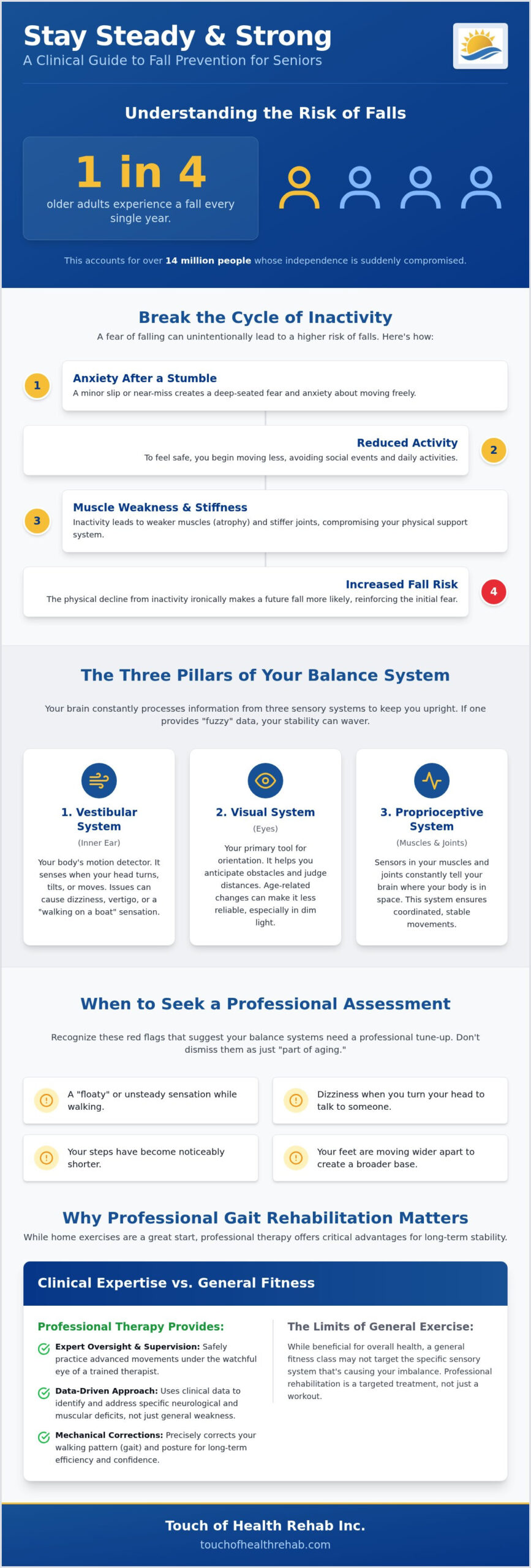
Did you know that more than 1 in 4 older adults experience a fall every single year? This accounts for over 14 million people facing a moment that can suddenly compromise their autonomy. It’s completely natural to feel a sense of hesitation when you stand up from a chair or experience a wave of dizziness when turning your head to greet a neighbor. You likely value your independence above all else, and the thought of a single misstep changing your lifestyle is understandably heavy.
The good news is that falling isn’t an inevitable part of aging; it’s a treatable condition that we can address together. By integrating specific balance exercises for seniors to prevent falls into your routine, you can retrain your sensory systems and regain your steady footing. This guide explores how targeted clinical movements and professional gait rehabilitation can reduce your risks and restore your spirit. You’ll learn exactly why you feel off-balance and how our specialized sanctuary in Sunny Isles Beach provides the professional support you need to walk through your community with absolute confidence.
Key Takeaways
- Break the cycle of inactivity by understanding how the fear of falling impacts your muscle strength and overall mobility.
- Explore the three sensory pillars of balance—vestibular, visual, and proprioceptive health—and how they work together to keep you upright.
- Master seven targeted balance exercises for seniors to prevent falls, designed to safely transition you from supported movements to independent walking.
- Learn how to set up a clinical-grade “safety zone” at home to ensure your stability training is always performed in a secure, risk-free environment.
- Discover why professional gait rehabilitation provides the expert oversight and mechanical corrections necessary for long-term confidence in the community.
Understanding the Risks: Why Fall Prevention is Critical for Seniors
Fall prevention is far more than a set of safety rules; it’s a proactive commitment to your future independence. It’s about protecting your ability to walk along the Sunny Isles coastline or visit your favorite shops in Aventura without the constant worry of a misstep. When we view stability through a clinical lens, we see it as a manageable aspect of your health rather than an inevitable decline. By implementing evidence-based fall prevention strategies, you’re not just avoiding an accident; you’re actively preserving your lifestyle.
Many seniors find themselves trapped in the “Fear of Falling” cycle. This happens when a near-miss or a minor stumble creates a deep sense of anxiety. To stay safe, you might naturally start moving less and avoiding social outings. Unfortunately, this inactivity leads to muscle weakness and stiff joints, which actually increases your risk of a future incident. Breaking this cycle is essential for your long-term vitality. In South Florida, environmental factors like slippery pool decks or sudden afternoon rain showers can combine with biological risks like vision changes, making a professional approach to stability vital.
The Hidden Impact of Gait and Balance Changes
Subtle shifts in your walking pattern, or gait, are often the first indicators that your stability is changing. You might notice your steps becoming shorter or your feet moving wider apart to create a broader base. These changes are frequently linked to muscle atrophy in the lower extremities, where the power needed to stabilize your frame begins to diminish. While searching for balance exercises for seniors to prevent falls is a great first step, understanding the “why” behind these changes is just as important. We prioritize postural education to help you realign your body, ensuring that your muscles work efficiently to support every step you take.
When to Seek Professional Stability Assessment
It’s important to recognize the red flags that suggest your balance systems need a professional tune-up. If you experience a “floaty” sensation while walking or feel a wave of dizziness when turning your head to speak to a friend, your vestibular system may be struggling. Specialized geriatric physical therapy is distinct from a general fitness class because it uses clinical data to address these specific neurological and muscular deficits. A professional assessment provides a safe environment to practice balance exercises for seniors to prevent falls, allowing you to build strength under expert supervision before you take those skills back into the community.
The Three Pillars of Balance: Vestibular, Visual, and Proprioceptive Health
Think of your balance as a sophisticated conversation between three distinct systems and your brain. To keep you upright and moving confidently, your brain must constantly integrate data from your eyes, your inner ears, and the sensors in your muscles and joints. When these three pillars work in harmony, you can navigate your home or the sidewalks of Sunny Isles Beach without a second thought. However, if even one system provides “fuzzy” or conflicting information, your stability begins to waver. Understanding these systems is the first step toward choosing the right balance exercises for seniors to prevent falls.
Your vision acts as a primary tool for orientation, helping you anticipate obstacles and judge distances. As you age, changes in depth perception or light sensitivity can make visual data less reliable, especially in dim lighting. This is why many people feel more wobbly at night. Your brain then has to rely more heavily on the other two pillars to maintain your center of gravity. If you feel your stability is shifting, connecting with a specialist can help identify which of these pillars needs the most attention to keep you moving safely.
Vestibular Health and Vertigo Recovery
The vestibular system, located deep within your inner ear, is your body’s motion detector. It senses when your head turns, tilts, or moves through space. Inner ear disorders can lead to significant unsteadiness, making you feel as though the room is spinning or that you’re walking on a boat. Fortunately, “dizziness” is often a treatable mechanical issue rather than a permanent condition. Through a clinical approach to vertigo recovery, we use precise head movements to reset the system and restore your sense of orientation.
Proprioception and Postural Alignment
Proprioception is the body’s internal GPS for movement. This system relies on thousands of tiny sensors in your feet and joints that “talk” to your brain about the ground beneath you. When these nerves are sharp, your body can make micro-adjustments to stay balanced on uneven grass or sandy paths. We use postural education to retrain these sensors, ensuring your body stays aligned over its base of support. These specialized movements are more effective than generic balance exercises for seniors to prevent falls because they address the specific way your nerves communicate with your muscles.
7 Essential Balance Exercises for Seniors to Perform Safely
Implementing a routine of balance exercises for seniors to prevent falls is most effective when the movements mimic your actual daily activities. Whether you’re reaching for a jar on a high shelf at the grocery store or stepping off a curb to get the mail, your body relies on specific muscle groups to keep you steady. We focus on progressive loading, which means you’ll start with the security of a sturdy chair or countertop and gradually move toward independent movement as your confidence grows. Performing these movements for just 10 minutes every day creates lasting neurological changes that a single, intense weekly session cannot match. Consistency is the bridge to restoration.
Static Balance: Building a Solid Foundation
Static exercises train your body to maintain its center of gravity while you’re standing still. These foundation-building moves sharpen the communication between your brain and your joints. Start with these three movements to improve your spatial awareness:
- Tandem Stance: Stand with one foot directly in front of the other, heel touching toe. This narrow base of support retrains your brain to manage a smaller “safety zone,” which is vital for walking through tight spaces at home.
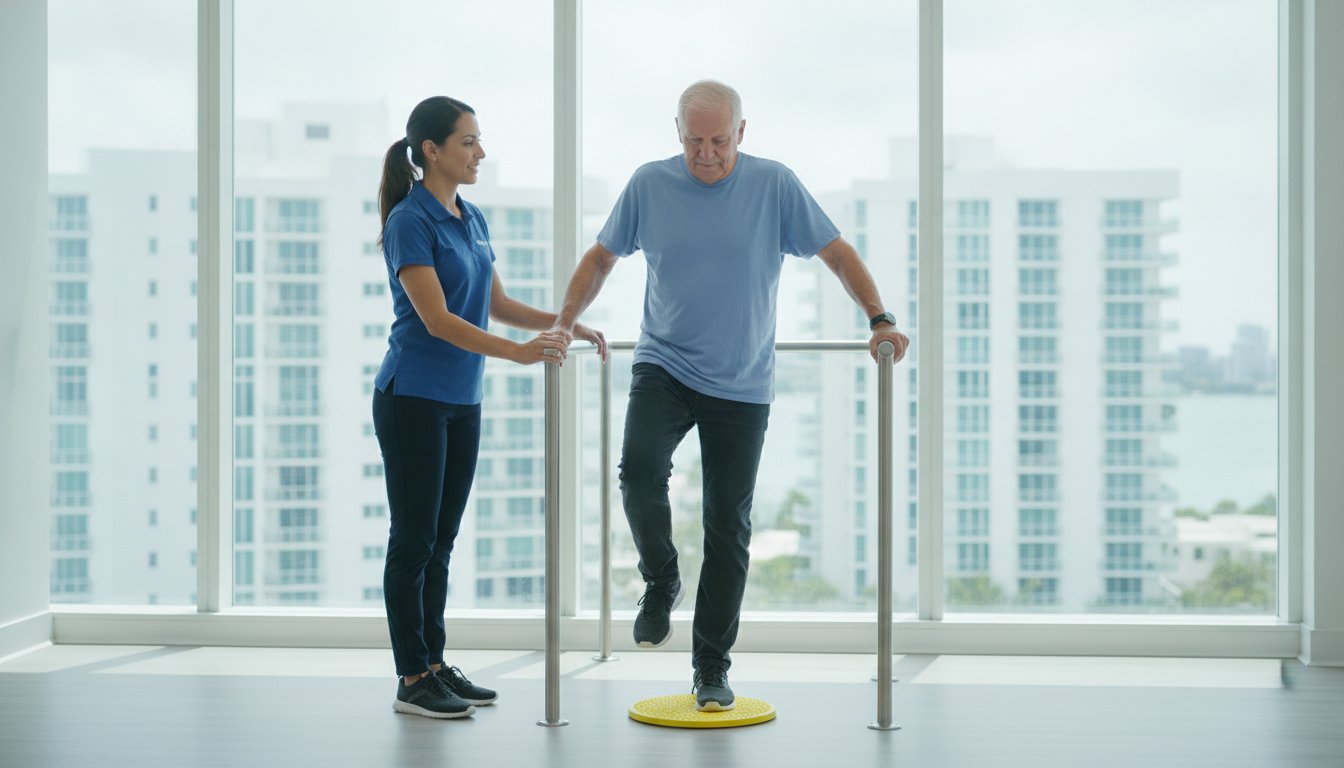
- Single-Leg Balance: Lift one foot slightly off the floor while holding onto a support. This strengthens the stabilizing muscles in your hips and ankles, providing the power you need for stair climbing and stepping over obstacles.
- Weight Shifting: Stand with feet hip-width apart and slowly shift your weight from side to side and front to back. This prepares your body for the natural transitions and turns you make throughout the day.
Dynamic Balance and Strength
Once you’ve mastered standing still, dynamic exercises help you maintain stability while your body is in motion. These movements are designed to build leg power and coordination for real-world scenarios. We often include walking with head turns, a critical vestibular rehabilitation exercise that reduces dizziness by training your brain to ignore conflicting visual signals while you move.
The sit-to-stand is perhaps the most important functional move you can practice. It builds the explosive strength in your quads and glutes required to rise from a chair without using your arms. To improve gait coordination, try the heel-to-toe walk, moving in a straight line for ten steps. Finally, marching in place builds hip flexor strength and cardiovascular endurance. These exercises transform your physical capabilities, ensuring you can navigate your community in Sunny Isles or Aventura with renewed poise and safety.
Safety First: Creating a Secure Environment for Stability Training
Safety isn’t just a precaution; it’s the foundation of your recovery. Before starting any balance exercises for seniors to prevent falls, you must establish a dedicated “safety zone.” This space should be clear of clutter and located near a sturdy, immovable surface like a kitchen countertop or a heavy dining chair. Avoid using light furniture or rolling chairs that might shift when you apply weight. A secure environment allows you to push your boundaries slightly without the fear of an unprotected fall.
Your choice of footwear is equally critical. Walking barefoot or in loose slippers increases the risk of sliding, especially on the tile or hardwood floors common in South Florida. We recommend firm, nonslip shoes that provide adequate arch support and grip. Additionally, always keep a communication device within reach or have a partner nearby during your sessions. This ensures that help is available if you feel unsteady, allowing you to focus entirely on your movement and form. Proper lighting is also essential. Bright, even light helps your visual system compensate for any deficits in your inner ear or joint sensors.
Identifying Household Hazards
Many falls occur in small, high-traffic areas like the bathroom, where wet surfaces and tight turns create a perfect storm for instability. In many Aventura and Sunny Isles condos, decorative “throw rugs” are common but dangerous trip hazards that catch on the edges of shoes or walkers. We advise removing these entirely from your primary pathways. To enhance nighttime safety, install motion-sensor lighting along the route from your bedroom to the restroom. This simple adjustment compensates for age-related vision changes and provides clear visual cues when you’re most vulnerable.
Listening to Your Body: When to Stop
It’s essential to distinguish between productive muscle fatigue and dangerous dizziness. If your legs feel heavy or tired, you’re building strength. However, if you feel “floaty,” nauseous, or lightheaded, stop immediately. Many seniors unconsciously hold their breath during difficult movements, which can cause sudden blood pressure drops and fainting. Focus on steady, rhythmic breathing as you work. As you progress, use the “Two-Finger Rule”: try to stabilize yourself with just two fingers on the counter rather than a full grip. If you’re unsure how to safely advance your routine, schedule a clinical consultation to ensure your home program is optimized for your specific needs.
Beyond Home Workouts: The Role of Professional Balance and Gait Rehabilitation
While practicing balance exercises for seniors to prevent falls at home is a commendable step toward recovery, it’s only one component of a truly robust fall prevention therapy plan. In a clinical setting, we provide real-time corrections to your walking mechanics that are impossible to observe on your own. This professional oversight ensures you aren’t inadvertently reinforcing movement patterns that could lead to future injury. By working within our clinical sanctuary, you gain access to specialized equipment that safely pushes your physical limits. This allows you to reach a level of stability that unsupervised home training simply cannot match. There is also a profound psychological benefit to this environment. Working alongside a Compassionate Expert provides the reassurance you need to overcome the anxiety of moving, turning your hesitation into a sense of empowerment.
Personalized Therapy Plans at Touch of Health Rehab
Our Lead Physical Therapist, Berlin, understands that every path to restoration is unique. We don’t believe in one-size-fits-all solutions. Instead, we integrate balance and gait rehabilitation with comprehensive physical conditioning to address the root causes of your unsteadiness. This holistic approach has empowered countless neighbors in Sunny Isles Beach and Aventura to return to their favorite activities with absolute poise. Whether your goal is walking the shoreline or moving through a busy supermarket, we create a custom roadmap that focuses on your specific functional needs. Our success stories throughout the North Miami Beach area prove that with the right guidance, regaining your independence is entirely possible.
Taking the First Step Toward Confidence
Your journey begins with a comprehensive clinical balance assessment. During this first visit, we evaluate your gait, check your vestibular function, and identify the specific sensory gaps holding you back. This evaluation helps us determine the exact combination of clinical gait training and balance exercises for seniors to prevent falls that will work best for your body. You aren’t just a patient here; you’re a vital partner in your own recovery. We act as your dedicated guides, providing the encouragement and expertise needed to bridge the gap between fear and function. The process is methodical and reassuring, ensuring you never feel rushed or overwhelmed. Schedule your balance assessment at Touch of Health Rehab today and start your collaborative journey toward a more confident, active life.
Reclaim Your Independence and Walk with Confidence
Restoring your stability is a journey that starts with understanding how your body maintains its center of gravity. By addressing the three pillars of balance and consistently practicing targeted movements, you can break the cycle of fear and inactivity. While home practice is valuable, incorporating professional balance exercises for seniors to prevent falls ensures that your recovery is safe, effective, and tailored to your unique neurological needs.
At Touch of Health Rehab, we’ve served the Sunny Isles Beach and Aventura communities since 2026, providing a sanctuary for healing and physical restoration. Lead Physical Therapist Berlin specializes in creating personalized care plans within our dedicated vestibular and gait rehabilitation clinic. We’re here to act as your guides, helping you transition from hesitation to absolute poise in every step you take. Restore your confidence and prevent falls; book your consultation at Touch of Health Rehab today. Your path to peak physical health is a collaborative effort, and we’re honored to partner with you in achieving long-term vitality.
Frequently Asked Questions
Can balance really be improved after age 70?
Yes, balance can absolutely be improved at any age due to the brain’s remarkable ability to adapt, known as neuroplasticity. By performing targeted balance exercises for seniors to prevent falls, you retrain your vestibular and proprioceptive systems to process information more accurately. Clinical studies show that consistent training significantly reduces fall rates even in community-dwelling adults over 80. Your age is not a barrier to restoration; it is simply the starting point for your personalized recovery journey.
How often should seniors perform balance exercises?
We recommend performing short sessions of balance exercises daily for optimal results. Engaging in 10 to 15 minutes of stability training every day is far more effective than a single one-hour session once a week. This frequency keeps your neural pathways sharp and helps your body maintain a steady center of gravity. Consistency allows your muscles and brain to work in partnership, turning these movements into natural, automatic responses during your daily activities in Sunny Isles.
What is the best exercise to prevent falls at home?
The sit-to-stand exercise is widely considered the most effective functional movement for home safety. This move builds the essential lower-body power required to rise from a chair or toilet without relying on your arms. To perform it safely:
- Sit on a sturdy, armless chair with your feet flat on the floor.
- Lean your torso slightly forward.
- Use your leg muscles to stand up slowly and steadily.
- Lower yourself back down with control.
Mastering this move provides the foundation for total body stability and independence.
Are there specific shoes that help with balance for seniors?
Yes, footwear designed for stability can significantly enhance your safety. For 2026, models like the New Balance 928v3, Fresh Foam X 860v15, and Fresh Foam X More v6 are highly recommended for their supportive soles and nonslip grip. These shoes provide a firm base that helps your feet “talk” to your brain more clearly. Choosing a shoe with a low heel and a wide toe box ensures your weight is distributed evenly across your footprint.
How do I know if my dizziness is related to my inner ear?
Dizziness related to the inner ear, or vestibular system, often feels like a spinning sensation called vertigo. It is frequently triggered by specific head movements, such as rolling over in bed or looking up at a high shelf. If you feel “floaty” or experience a loss of orientation when you turn quickly, it’s a strong indicator that your inner ear sensors need recalibration. Professional vestibular rehabilitation can address these mechanical issues and restore your sense of calm.
What should I do immediately after a fall if I am alone?
If you fall while alone, stay still for a few moments to catch your breath and check for pain or injury. Do not try to get up immediately. If you feel capable, crawl on your hands and knees toward a piece of sturdy furniture, like a heavy sofa or bed. Use the furniture to pull yourself up to a kneeling position, then slowly transition to a seated state. Always keep a communication device nearby to call for assistance.
Does Medicare cover balance and gait rehabilitation?
Medicare often covers balance and gait rehabilitation when it is deemed medically necessary to treat a condition like vertigo or gait instability. While specific fall risk assessments aren’t yet covered as part of a standard annual wellness visit, the SAFE Act (H.R. 7618) introduced in 2026 aims to expand these preventive services. Most professional physical therapy programs are eligible for coverage when they focus on restoring function and preventing future injuries for high-risk seniors.
Can physical therapy help if I have a fear of falling but haven’t fallen yet?
Yes, physical therapy is an excellent proactive tool for those experiencing a fear of falling. You don’t need to have suffered an injury to benefit from balance exercises for seniors to prevent falls. We focus on wellness and preventative care to address subtle unsteadiness before it leads to an accident. By building strength and confidence now, you protect your independence and ensure you can continue walking through your community with absolute peace of mind.