
You check your blind spot while driving or roll over in bed, and the entire room suddenly tilts into a disorienting spin. It’s a deeply unsettling sensation, and if you’ve started restricting your daily activities out of fear of sudden falls or nausea, you’re certainly not alone. Many people feel caught between inner ear dysfunction and neck stiffness, often attempting arbitrary motions that only trigger worse vertigo. In truth, practicing targeted dizziness when turning head exercises provides a structured, clinically sound way to recalibrate your vestibular system and stop the spinning at its root source.
You don’t have to accept constant instability as your normal. This guide outlines safe, clinically proven vestibular exercises designed to relieve positional spinning sensations and restore your balance. We’ll walk you through proper exercise form, exact repetitions, and the key distinctions between cervical stiffness and inner ear crystals, giving you the confidence to drive, walk, and turn your head without disorientation.
Key Takeaways
- Pinpoint the underlying mechanical cause of your vertigo by distinguishing between inner ear crystal displacement and cervical spine tension.
- Establish an essential safety checklist to screen for neurological red flags and prevent fall hazards before performing home drills.
- Master targeted dizziness when turning head exercises, including gaze stabilization protocols, to recalibrate your visual-vestibular reflexes and clear false motion signals.
- Avoid common self-treatment mistakes that inadvertently push displaced crystals into horizontal canals or provoke overwhelming autonomic nausea.
- Discover how personalized vestibular physical therapy delivers precise mechanical repositioning to restore lasting balance and movement confidence.
Why Turning Your Head Causes Dizziness: Root Causes Explained
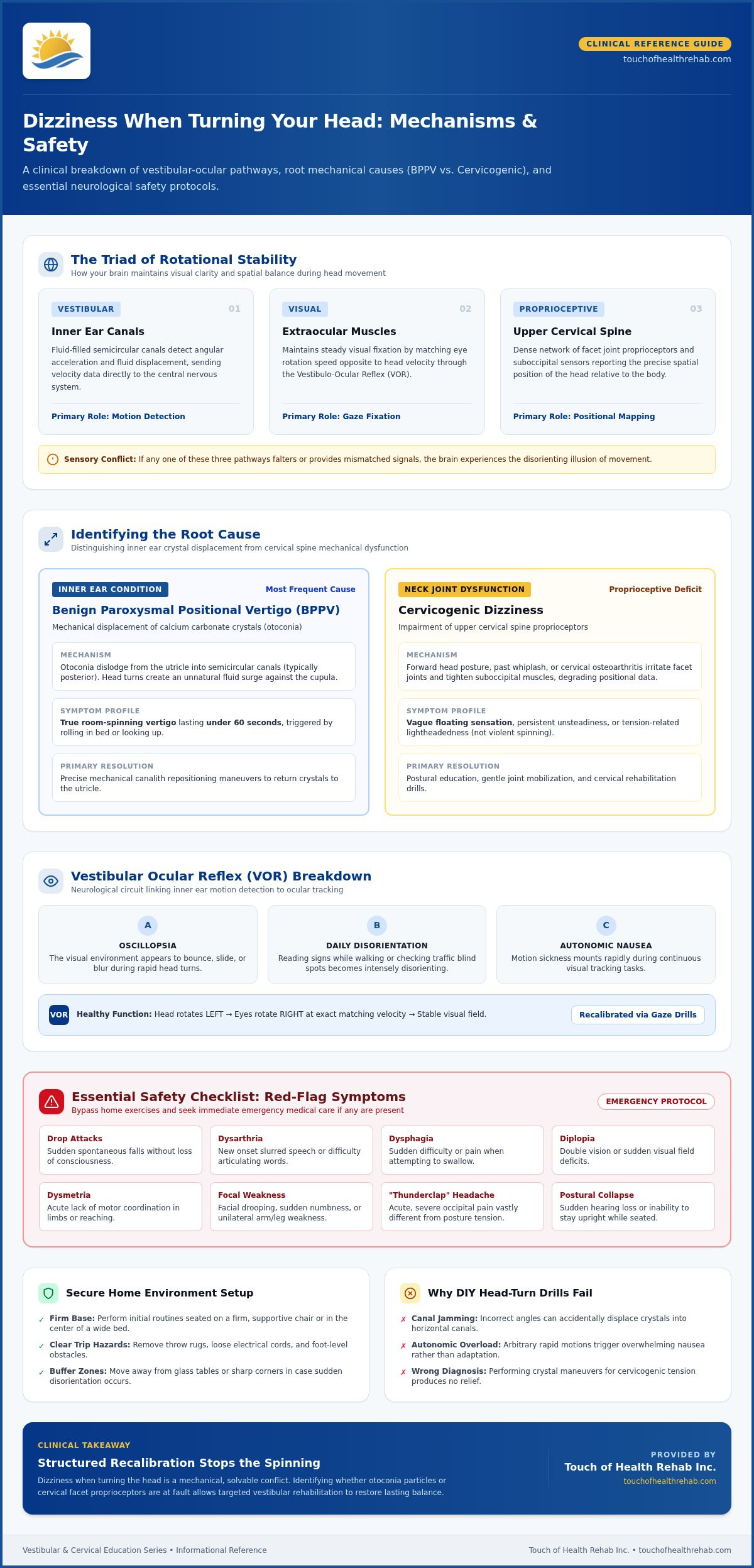
Rotational stability relies on an intricate conversation between your inner ears, eyes, and cervical spine. When you rotate your head, these three systems instantly cross-reference data to keep your vision steady and your body centered. If even one sensory pathway falters, your brain receives conflicting information. The immediate result is that disorienting illusion of movement. Identifying whether your discomfort originates in the inner ear canals or deep within the cervical joints is the essential first step before choosing dizziness when turning head exercises.
Benign Paroxysmal Positional Vertigo (BPPV) and Inner Ear Crystals
The most frequent driver of head-turn spinning is Benign paroxysmal positional vertigo, a condition where microscopic calcium carbonate crystals (otoconia) become dislodged from their normal position in the utricle. These loose particles drift into the fluid-filled semicircular canals, typically the posterior canal. When you tip your head upward to reach a cabinet or roll onto your side in bed, the crystals shift through gravity, creating an unnatural fluid surge. This surge pushes against the cupula, sending intense, false rotational signals to your central nervous system that provoke sudden vertigo lasting under sixty seconds.
Cervicogenic Dizziness and Neck Joint Dysfunction
Your upper cervical spine contains an exceptionally dense network of proprioceptors, tiny nerve sensors that report your neck’s position in space. When chronic forward head posture, past whiplash injuries, or cervical osteoarthritis irritate the facet joints and tighten the suboccipital muscles, those positional signals degrade. Rather than producing true room-spinning vertigo, cervicogenic issues typically generate a vague floating sensation, persistent unsteadiness, or tension-related lightheadedness. In these cases, targeted postural education and gentle joint mobilization address the root mechanical deficit far better than inner ear maneuvers.
Vestibular Ocular Reflex (VOR) Breakdown
Visual stability hinges on the vestibular-ocular reflex, a lightning-fast neurological circuit linking your inner ears to your extraocular eye muscles. In a healthy system, turning your head to the left causes your eyes to rotate right at the exact same velocity, keeping your visual field locked on target. A breakdown in this reflex produces oscillopsia:
- The visual environment appears to bounce, slide, or blur during quick head turns.
- Reading signs while walking or checking traffic while driving becomes disorienting.
- Nausea mounts quickly during rapid visual tracking tasks.
Clinically targeted dizziness when turning head exercises systematically retrain this reflex loop, restoring smooth communication between the eyes and vestibular organs for lasting stability.
Essential Safety Checklist Before Starting Dizziness Exercises
Before beginning any vestibular movements at home, establishing physical safety is non-negotiable. While targeted drills encourage the central nervous system to adapt, moving through exercises without proper screening or physical safeguards invites unnecessary risks. Taking a few moments to evaluate your symptoms and environment protects your body, ensuring every movement brings you closer to recovery rather than setting you back.
Red-Flag Symptoms Requiring Immediate Emergency Care
Rotational dizziness frequently stems from mechanical inner ear or neck disturbances, but certain symptoms indicate central neurological or vascular emergencies. You should bypass home maneuvers and seek immediate medical evaluation if you experience:
- The classic clinical signs: drop attacks, dysarthria (slurred speech), dysphagia (trouble swallowing), diplopia (double vision), or dysmetria (lack of coordination).
- Sudden numbness, facial drooping, or unilateral weakness in your arms or legs.
- An acute “thunderclap” headache across the occipital region, vastly different from familiar postural tension.
- New neurological symptoms like sudden hearing loss or an inability to stay upright while seated.
Setting Up a Secure Home Exercise Environment
Provoking mild disorientation is an expected part of vestibular retraining, which makes your surroundings critical. Perform your routines seated on a firm, supportive chair or situated safely in the center of a wide bed. Clear away throw rugs, loose electrical cords, and tables with sharp edges to eliminate trip hazards. If your balance feels noticeably compromised, having a partner nearby provides reassurance and physical security during your initial sessions. Practicing structured fall prevention therapy principles keeps your physical environment controlled while your equilibrium recalibrates.
Understanding the Safe Zone of Symptom Reproduction
Effective dizziness when turning head exercises rely on mild symptom provocation. When you experience a minor wave of unsteadiness during a drill, that sensory error signal actually stimulates neuroplastic adaptation in your brain. The goal is manageable exposure, not overwhelming distress.
Your discomfort should remain within a mild to moderate threshold and settle back to baseline within two to five minutes after resting. If a drill triggers severe autonomic distress, projectile vomiting, intense visual aura, or lightheaded fainting sensations, stop right away. Aggressive, forced repetition through high-level nausea leads to autonomic exhaustion rather than therapeutic progress. Gentle, calculated consistency always delivers the most dependable outcomes.
Targeted Exercises for Dizziness When Turning Your Head
Recalibrating your balance requires systematic, repetitive movement rather than sporadic head turns. Performing targeted dizziness when turning head exercises retrains your central nervous system to process rotational signals accurately, eliminating the sensory mismatch between your eyes, neck, and inner ear. The following clinical protocols stabilize your gaze, clear lingering sensitivity, and ease cervical restriction.
VOR Gaze Stabilization (VOR x1 Horizontal Drill)
This drill sharpens the reflex linking your eyes and inner ears so your visual field stays anchored while your head turns.
- Hold a target with clear text, such as a business card, at eye level about arm’s length away.
- Fix your eyes firmly on the target without blinking excessively.
- Turn your head smoothly side to side across a twenty-degree arc while keeping the letters in sharp focus.
- Continue for thirty to sixty seconds at a steady tempo, making sure the target doesn’t blur or jump.
Start seated in a supportive chair. As your control improves, advance the challenge by standing with your feet together, and eventually perform the drill while standing on a soft foam cushion.
Brandt-Daroff Habituation Protocol
Brandt-Daroff drills help disperse residual debris and desensitize your brain to positional shifts.
- Sit upright on the edge of your bed, then lie down swiftly onto your right side with your head turned forty-five degrees upward.
- Remain in this position for thirty seconds, or until all provoked spinning settles completely.
- Return to an upright seated position and pause for thirty seconds.
- Lie down swiftly onto your left side, angling your head forty-five degrees upward, and hold for thirty seconds.
- Return upright for thirty seconds to finish one cycle.
Gentle Cervical Spine Rotation and Retraction
When suboccipital stiffness corrupts neck proprioception, slow mobility exercises re-establish accurate joint feedback.
Begin by drawing your chin straight back into a gentle retraction, elongating the suboccipital muscles at the base of your skull. From this neutral posture, slowly rotate your head toward your right shoulder until you feel a mild stretch, avoiding any jerky, fast movements. Hold the posture for five seconds while maintaining calm, rhythmic breathing, then return to center and repeat on the left. Incorporating these controlled ranges into a comprehensive vestibular rehabilitation routine restores smooth mechanics without irritating sensitive cervical nerves.
Why DIY Head-Turn Exercises Fail and Common Mistakes to Avoid
Attempting to resolve rotational vertigo without a clinical diagnosis often backfires. While performing dizziness when turning head exercises is effective when matched to the right pathology, guessing your condition through random online videos can prolong your discomfort or provoke unnecessary suffering. Restoring stability requires an exact match between the mechanical problem and the corrective drill.
Mismatched Maneuvers and Semicircular Canal Misidentification
Your inner ear contains three distinct semicircular canals: posterior, horizontal, and anterior. While posterior canal involvement accounts for the vast majority of cases, performing a standard Epley maneuver for horizontal canal displacement yields zero clinical benefit. Even more concerning is canal conversion, where incorrect head angles accidentally dump loose otoconia into an adjacent canal branch, intensifying your symptoms. A formal assessment confirms the exact ear and canal involved before you begin moving.
Moving Too Fast Versus Total Movement Avoidance
People struggling with balance often swing between two unhelpful extremes: overexertion or rigid immobility. Jerking your head through drills activates acute cervical muscle spasms and spinal guarding, while the resulting autonomic nausea causes many to abandon rehabilitation prematurely. On the other hand, wearing a neck brace or keeping your head perfectly still prevents your central nervous system from adapting. Natural compensation demands steady, graded exposure rather than forceful strain or total avoidance.
Ignoring Posture and Spinal Biomechanics
Vestibular exercises rarely hold if poor cervical biomechanics constantly undermine your progress. Sustained forward head posture strains the deep cervical stabilizers and facet joints, which feed spatial orientation signals directly to your brainstem. When neck mechanics are neglected, inner ear exercises provide only fleeting relief.
- Misaligned cervical joints send faulty positioning cues that scramble your gaze stabilization.
- Chronic upper neck tension perpetuates daily motion intolerance.
- Combining vestibular drills with dedicated postural retraining ensures long-term recovery.
If self-treatment has left you feeling frustrated, dizzy, or uncertain, partnering with a specialist makes all the difference. Explore our dedicated vertigo recovery programs to uncover the exact root cause of your symptoms and safely reclaim your balance.
Professional Vestibular Physical Therapy: Restoring Lasting Stability
While home routines offer initial support, clinical guidance bridges the gap between temporary relief and true mechanical resolution. A licensed physical therapist moves beyond guesswork, isolating whether your symptoms originate in the vestibular canals, cervical spine, or visual pathways. Rather than relying on generic dizziness when turning head exercises, professional intervention tailors corrective maneuvers to your precise physiological presentation.
What to Expect During a Clinical Vestibular Evaluation
A comprehensive examination uses objective diagnostic tools to identify the exact mechanism behind your unsteadiness. During your evaluation, your clinician will perform:
- Infrared video oculography to record involuntary nystagmus eye movements in real time during positional changes.
- Targeted cervical spine mobility tests that distinguish mechanical facet restrictions from vestibular dysfunction.
- Dynamic visual acuity assessments to measure how clearly your eyes track objects during active rotation.
These findings show exactly which semicircular canal or cervical segment needs attention, ensuring your care plan addresses the root mechanical cause.
Advanced Canalith Repositioning and Manual Physical Therapy
When inner ear crystals shift out of place, clinician-assisted maneuvers like the Epley, Semont, or barbecue roll reposition otoconia safely into the utricle for natural reabsorption. If cervical joint dysfunction is the primary driver, your therapist integrates gentle joint mobilization and soft-tissue release to ease suboccipital spasms. From there, customized sensory integration drills challenge visual, vestibular, and somatosensory pathways simultaneously, re-establishing total equilibrium.
Reclaiming Your Active Life in South Florida
You shouldn’t have to fear checking your blind spot along Collins Avenue or strolling the busy boardwalks of Sunny Isles Beach. Lingering motion sensitivity can make simple errands in North Miami or Aventura feel daunting, but targeted clinical care restores the spatial confidence you need to move without hesitation. One-on-one therapy sessions ensure every exercise is executed with exact speed and posture, keeping your rehabilitation safe and comfortable.
If you’re ready to move past rotational imbalance and achieve lasting comfort, discover how targeted vestibular rehabilitation at Touch of Health Rehab can help you regain your vitality and balance.
Take Control of Your Balance and Move with Confidence
Positional spinning doesn’t have to dictate your daily routine or keep you from the activities you love. By identifying whether your symptoms stem from displaced inner ear crystals or cervical joint restrictions, you can finally move away from frustrating trial and error. Practicing targeted dizziness when turning head exercises allows your central nervous system to adapt, restoring visual gaze stability and clearing false rotational signals safely.
Lasting equilibrium begins with precise, root-cause mechanical correction. At Touch of Health Rehab, our specialized vestibular and balance rehabilitation clinical programs provide evidence-based vertigo recovery designed around your specific physiological needs. Working one-on-one with experienced physical therapists in Sunny Isles Beach, you’ll receive the dedicated guidance required to overcome motion sensitivity and eliminate fall risks. Schedule your comprehensive vestibular evaluation today, and take your next steps with steady, effortless confidence.
Frequently Asked Questions
Can turning your head too fast cause permanent inner ear damage?
No, turning your head quickly doesn’t cause permanent inner ear damage. Healthy vestibular organs and semicircular canals are well protected inside dense temporal bone. While sudden head turns can dislodge existing otoconia crystals or irritate strained cervical joints, they don’t tear inner ear structures or create irreversible acoustic trauma. If sharp turns provoke sudden spinning, it reflects a temporary mechanical displacement rather than lasting neurological destruction.
How do I know if my head-turn dizziness is from my neck or my inner ear?
Inner ear issues like BPPV trigger violent, rotational spinning that usually resolves in under a minute once motion stops. Cervicogenic dizziness feels like vague unsteadiness, floating, or postural imbalance that persists alongside neck stiffness, tight muscles, or restricted range of motion. A clinical assessment uses positional testing to isolate whether manual physical therapy for your neck or specific dizziness when turning head exercises for canal clearing will resolve your symptoms.
How long does it take for vestibular exercises to stop dizziness?
Relief often occurs within one to three clinical sessions for uncomplicated BPPV when repositioning maneuvers are performed accurately. For broader vestibular hypofunction or cervicogenic balance disorders, consistent daily practice typically yields noticeable stability within two to six weeks. Your central nervous system requires steady, progressive repetition to adapt. Sticking with prescribed dizziness when turning head exercises ensures your brain recalibrates properly and reduces the chance of future episodes.
What should I do if exercises make me feel intensely nauseous?
Pause your movements immediately, sit upright, and focus your eyes on a stable point across the room while taking slow, diaphragmatic breaths. While mild disorientation is expected during vestibular training, intense nausea signals that the movement intensity was too abrupt for your system. Rest until your baseline settles back to normal. When you resume, reduce your head speed or movement angle to keep symptom reproduction within a tolerable, safe zone.
Can BPPV dizziness go away on its own without any exercises?
Yes, BPPV can sometimes resolve spontaneously over weeks or months as dislodged otoconia gradually dissolve within the canal fluid. Leaving it untreated leaves you vulnerable to sudden falls, persistent nausea, and prolonged motion sensitivity during normal daily routines. Structured canalith repositioning provides rapid mechanical resolution, guiding loose particles back where they belong so you don’t have to wait months for unpredictable self-clearance.
Is it safe to drive if I experience dizziness when checking blind spots?
No, you should avoid driving until your positional symptoms are evaluated and stabilized by a professional. Checking blind spots requires rapid horizontal neck rotation, which can provoke sudden visual blurring or room-spinning illusions right when you need split-second focus. Navigating busy roads across South Florida, from Sunny Isles Beach to North Miami, requires complete visual clarity. Prioritize clinical rehabilitation first so you can return to driving safely and confidently.