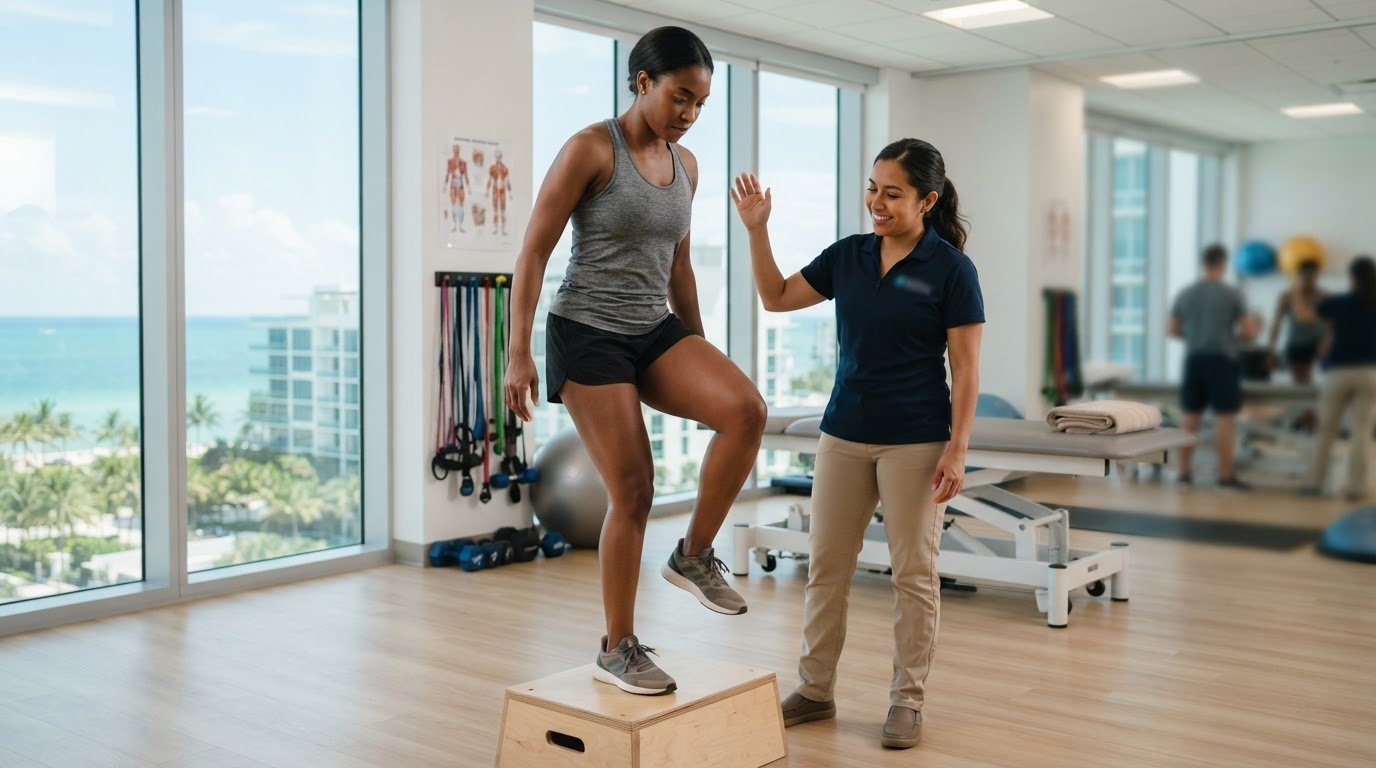
Getting back to sports after ACL surgery commonly means waiting at least nine months before clearance for sport, even though full recovery and unrestricted play generally take six to 12 months. Returning sooner may raise the risk of a second ACL injury by as much as seven times. Your timeline also depends on your sport and how your knee, strength, movement, and confidence progress through rehabilitation.
It’s understandable to focus on the calendar, especially when you’re eager to return to the activities you enjoy. But readiness involves more than reaching a particular month: your knee needs to handle running, jumping, landing, and changing direction. This article explains the recovery timeline, the rehabilitation milestones that can guide your return, and why gradual progression matters. You’ll also learn how structured landing and cutting programs can help prepare you for sport-specific movements and safer play.
Key Takeaways
- Sport clearance commonly uses a minimum benchmark of at least nine months after ACL reconstruction, but readiness also depends on your sport and recovery progress.
- Rehabilitation builds strength and movement control over time; hop tests and strength measures can help assess progress, but no single test proves a safe return.
- Structured landing and cutting practice can help prepare you for the movements that challenge the knee in sport.
- MedlinePlus says returning to your full activity level and sports after ACL surgery often takes 4 to 6 months, while unrestricted sport clearance may follow a different timeline.
- A gradual return, from noncontact drills through controlled practice to competition, helps you rebuild sport-specific demands progressively.
When Can You Play Sports After ACL Surgery?
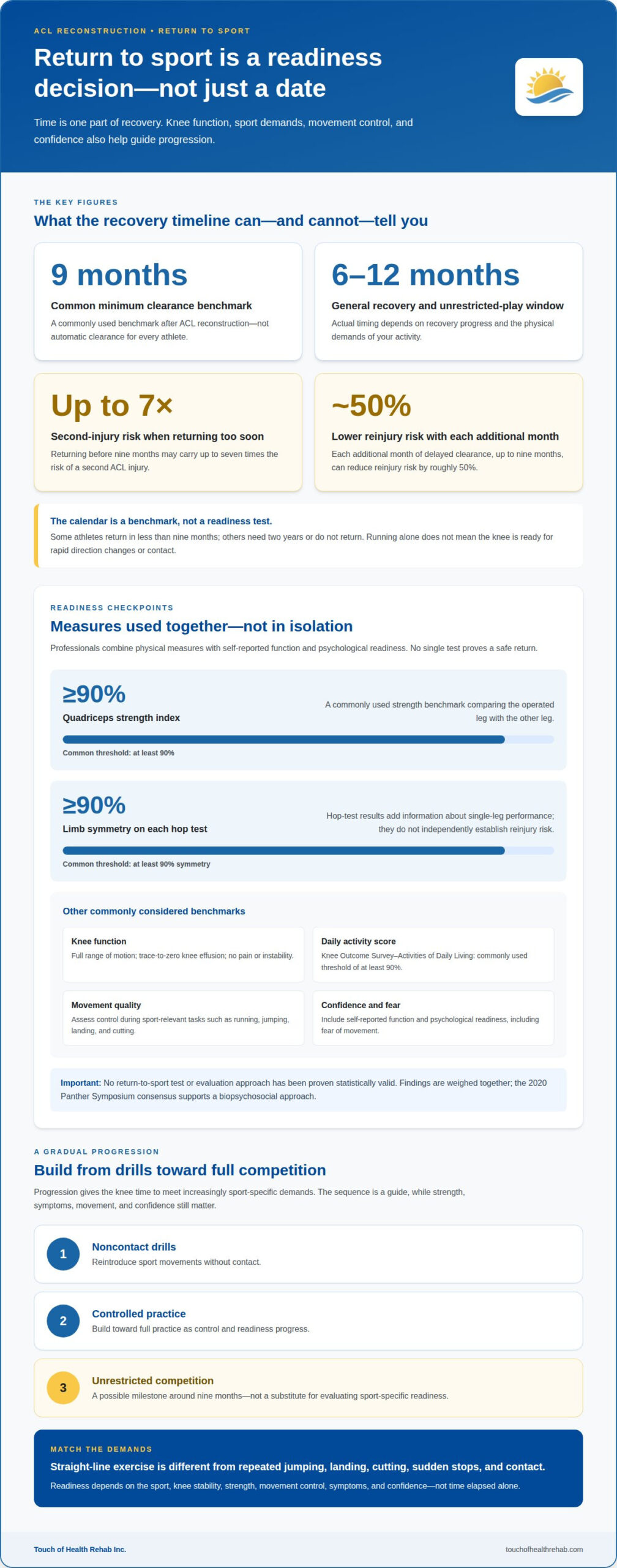
A commonly used clearance benchmark is at least nine months after ACL reconstruction. Your sport and recovery milestones also influence the timing.
Individual Return-to-Sport Outcomes
Return-to-sport outcomes vary: some athletes resume sport in less than nine months, while others need two years or don’t return. That difference matters because a calendar date alone can’t show whether your knee is ready for your sport’s demands.
Full recovery and unrestricted play generally take six to 12 months. Progress depends on factors such as knee stability, strength, movement control, and the physical demands of your activity. A recreational athlete returning to straight-line exercise faces different demands than a competitive player who must repeatedly jump, land, and change direction.
Readiness Assessments and Professional Evaluation
Return-to-sport assessments combine physical measures with self-reported function and psychological readiness. They help identify progress and remaining challenges, rather than treating time elapsed as the only measure of readiness.
Common benchmarks include full range of motion, trace-to-zero knee effusion, and no pain or instability. A quadriceps strength index of at least 90% and at least 90% limb symmetry on each hop test are also used. The Knee Outcome Survey-Activities of Daily Living has a commonly used threshold of at least 90%.
Self-reported scores can offer another perspective on psychological readiness. Evaluation also considers fear of movement. No return-to-sport test or evaluation approach has been proven statistically valid, so professionals weigh findings together. The 2020 Panther Symposium consensus supports a biopsychosocial approach.
Return Timing Across Sports and Activity Levels
Return timing depends on your sport and recovery progress. Running, jumping, and frequent cutting place different demands on the knee than less dynamic exercise, so athletes may progress through rehabilitation at different rates.
A stepwise progression can move from noncontact drills to controlled practice and then unrestricted competition. Athletes may begin noncontact practice and progress toward full practice and sports participation by about nine months after surgery. This timeline is a benchmark, not a substitute for assessing strength, movement, symptoms, and confidence in sport-specific tasks.
For your own activity level, distinguish returning to exercise from resuming full competition. Being able to run doesn’t automatically mean you’re ready for rapid direction changes or contact.
Risks of Returning Too Soon
Returning to sport before nine months after ACL reconstruction may carry up to seven times the risk of a second ACL injury. Young people who return to full play before nine months also face a significantly increased risk of reinjury.
Each additional month of delayed clearance, up to nine months, can reduce reinjury risk by roughly 50%. That makes gradual progression meaningful, especially when training for sports that involve cutting, landing, or sudden stops. Hop-test results can contribute to an assessment, but evidence linking those results to reinjury risk is lacking.
Strength and rehabilitation before and after surgery
Rehabilitation builds the strength and control your knee needs for sport. Before and after surgery, progress is measured through functional tasks and strength assessments, not simply by completing exercises.
Strength and Balance Training
Strength and balance training develop the control needed to manage movement on one leg. This matters because running, jumping, and changing direction each challenge the knee differently.
Before surgery, rehabilitation can focus on preparing the leg and improving movement control. After surgery, exercises progress as knee function returns, with the goal of building capacity for sport-specific demands. A single-leg balance task, for example, challenges control without requiring a jump or rapid direction change.
Progression matters. As knee function returns, patients can work toward sport-specific training, progressing as stability and control improve. That milestone connects foundational strength work with movements that resemble an athlete’s activity. Training should match your current abilities, then advance as control and strength improve.
Quadriceps Strength Testing
Quadriceps strength testing compares how well the muscles straighten the knee and helps show whether strength has returned adequately. This matters because a weaker surgical leg may struggle to produce force during sports movements.
Isokinetic dynamometry is considered the gold standard for measuring torque and side-to-side symmetry after ACL reconstruction. Comparing the operated and uninjured legs can reveal strength differences. Results are considered alongside movement quality and other readiness measures, not used alone.
If dynamometry isn’t available, one alternative is a one-repetition maximum knee extension test through a range from 90 degrees to 45 degrees. The test measures the greatest resistance lifted once through that specified movement. A professional can interpret the result alongside your rehabilitation progress and sport demands.
Assessment can also include functional tasks. The standard hop-test battery includes a 6-meter timed hop, which adds information about single-leg performance. Hop results don’t independently establish reinjury risk, so they’re considered with strength, stability, and movement control.
Consistent post-surgery physical rehabilitation can help you progress through strength and functional training with a clear focus on returning to activity. Use each assessment to understand what is improving and which movement demands still need attention before advancing your training.
Structured cutting and landing injury-prevention programs
Cutting and landing programs rehearse movements that challenge the knee during sports. After ACL reconstruction, controlled studies show that structured practice can lower retear risk by reducing abnormal forces linked with reinjury. The goal is not simply to repeat jumps or turns, but to develop movement control that carries over to sport-specific actions.
Why Landing and Cutting Mechanics Matter
Landing is when your foot meets the ground after a jump; cutting redirects your body while you’re moving. Basketball, soccer, and similar sports combine these demands, often in quick succession. Practicing these patterns in a structured program helps prepare your knee for sports movements.
Landing mechanics are one part of rehabilitation. Training can include practicing proper landing technique alongside strengthening the quadriceps and hamstrings. These muscle groups help support leg movement when stopping after a run or absorbing force after a jump. The emphasis is on controlled execution, not adding speed before movement quality is established.
Cutting practice addresses a different challenge: changing direction while your body is moving. A soccer player, for example, may need to plant a foot and turn toward the ball. Rehearsing this pattern in training helps make direction changes a practiced skill rather than an unpredictable demand during play.
Building Practice Into Rehabilitation
A structured program organizes landing and cutting practice instead of leaving those movements until competition. For example, training can link a controlled landing with a planned direction change. As control improves, practice can reflect the actions and movement patterns required by your sport.
The appropriate ACL injury-prevention program is performed two to three times a week. Participating at that frequency can reduce ACL injury risk by 50%. This prevention figure concerns ACL injury risk; it shouldn’t be treated as a guaranteed outcome or as a personal prediction after reconstruction.
Consistency gives athletes repeated opportunities to practice technique and strengthen the quadriceps and hamstrings. A program can address both landing and cutting, since each movement presents different demands. The schedule matters, but the key is regularly practicing these movements as part of ongoing preparation.
Connecting Training With Return to Sport
Use sport-specific examples to make practice relevant: a planned soccer turn, a basketball landing, or a controlled stop after running. These examples focus training on familiar movement demands without treating a single drill as proof of readiness. Structured movement practice complements, rather than replaces, broader rehabilitation and professional return-to-sport assessment.
As you prepare for competition, progressing from planned drills toward sport practice can connect rehabilitation exercises with real play. Landing and cutting work address how you move; strength work supports those actions. Together, they make prevention training a purposeful part of returning to sport.
ACL surgery recovery time
ACL rehabilitation progresses through early recovery, movement restoration, and later functional training. The milestones below show what each phase can involve and how the phases build toward daily activity.
Overall Recovery Time
ACL surgery recovery time describes the progression from immediate postoperative care to restored knee function. Understanding the phases helps explain why early healing tasks differ from later training demands.
The first weeks focus on basic movement and managing the knee’s response to activity. Later milestones include walking with a normal gait, regaining full range of motion, and beginning sport-specific training. These are distinct steps, not interchangeable signs of recovery. Walking comfortably, for example, doesn’t by itself mean the knee is ready for demanding activity.
Rehabilitation Timeline by Phase
The rehabilitation timeline follows functional milestones across the weeks after surgery. Each phase gives you a clearer picture of what your knee is working toward next.
These time ranges describe common recovery markers, not a prescribed exercise schedule. Your knee’s symptoms and function matter alongside the calendar, so use each milestone to understand the progression rather than to skip ahead.
- Weeks 0 to 2: This is the initial recovery phase. During the first 2 weeks, patients can begin putting weight on the knee if there’s no pain.
- Weeks 3 to 5: Patients are expected to wear a brace at least through this phase. Most adults can return to driving about three weeks after surgery.
- Weeks 6 to 8: By this point, patients should have full range of motion and a normal walking gait. Physical activity should cause no pain or swelling.
- Weeks 9 to 12: By 12 weeks, patients should have full knee stability and be able to work on sport-specific training.
Each marker reflects a different aspect of function. Weight bearing in the first 2 weeks is not the same as walking normally by 6 to 8 weeks. Likewise, full range of motion and an improved gait do not mean the knee has reached the stability expected by 12 weeks.
Use the sequence to put progress in context: early weight bearing, brace use, walking and motion milestones, then sport-specific work. If you haven’t reached a milestone, the next phase may need to wait while rehabilitation addresses the current goal. Tracking pain, swelling, gait, motion, and stability makes the timeline more meaningful than counting weeks alone.
How long does it take to return to sports after ACL surgery?
There isn’t one timeline for every kind of return. MedlinePlus says it often takes 4 to 6 months to return to your full level of activity and take part in sports again after ACL surgery. That milestone differs from unrestricted competition, for which a commonly used clearance benchmark is at least nine months after reconstruction.
Think of recovery as a progression, not a single return date. Running, sport-specific drills, practice, and competition each place different demands on your knee. Most people are ready to start running around three to five months after surgery, while most patients can begin sport-specific training by three months. These milestones are steps toward sport, not automatic approval for full play.
For many athletes, getting back to sports after ACL surgery means progressing through practice stages. Athletes can begin with noncontact practice, advance to full practice, and move toward sports participation by about nine months after surgery. A player might first rehearse planned movements without contact, then join controlled team drills before competing. Each stage introduces demands that the previous one didn’t include.
The right progression depends on your sport and recovery. Repeated cutting, jumping, or contact requires preparation for those specific movements, while less demanding activities involve different movement patterns. Your strength, knee function, and ability to complete sport-specific tasks help distinguish returning to activity from resuming your full competitive role.
Getting back to sports after ACL surgery also means considering your performance goals, not just participation. About 70% of football and soccer players return to play after ACL reconstruction. Some athletes return sooner, while others take longer or don’t return to their former sport. The relevant question is whether you can handle the movements and level of play you’re aiming for.
A retear can extend the process, involving another nine to 12 months of rehabilitation before returning to sport. This reinforces the value of progressing through training stages rather than moving straight from basic activity into competition. A return plan should reflect both your sport’s demands and the progress you demonstrate during rehabilitation.
Use the timeline to focus on your next functional milestone, whether that’s running, sport-specific drills, noncontact practice, full practice, or competition. For support with your rehabilitation progression, connect with a physical therapy team.
Touch of Health Rehab Inc.: Physical Therapy
Touch of Health Rehab Inc. provides Physical Therapy and Post Surgery Physical Rehabilitation to support recovery after ACL surgery. If you’re rebuilding strength, restoring movement, or progressing through rehabilitation milestones, therapy can help you work toward your activity goals with guided care.
Consider physical therapy when you need structured support after surgery or help connecting rehabilitation progress with everyday movement. Your recovery plan can focus on your current function and the demands of returning to sport, rather than relying on time alone.
To discuss physical therapy for your recovery, visit Touch of Health Rehab Inc. online.
Keep Your Next Milestone Within Reach
Your plan for getting back to sports after ACL surgery can move forward when each next step reflects what you’re working toward. Choose a practical goal with your rehabilitation team, such as improving control during a sport-specific movement or building confidence in a training drill. Tracking how that movement feels and how well you perform it can help focus future sessions and make progress easier to discuss.
Touch of Health Rehab Inc. offers Physical Therapy, Postural Education, and Vestibular Rehabilitation. If you’d like support as you continue your recovery, contact Touch of Health Rehab Inc. to explore the next step in your care. Stay patient with the process, keep working toward your goals, and make your return to sport a steady part of your journey.
Frequently Asked Questions
How Long is ACL Recovery?
ACL recovery commonly spans six to 12 months, with the return point depending on your goals and progress. MedlinePlus says returning to full activity and sports often takes four to six months, but unrestricted competition may require a longer progression. For example, being comfortable with everyday walking doesn’t establish readiness for repeated cutting during a game. Consider daily function, training demands, and sport participation as separate recovery milestones.
When to Return to Practice and Play?
Return to practice and competition should be gradual, not a jump from rehabilitation straight into a game. Start with noncontact drills, then progress to controlled practice and unrestricted play as readiness improves. A soccer player might first rehearse planned turns without opponents, then join structured team drills. Each stage adds movement demands, helping you recognize whether your knee tolerates the next level of activity.
What milestones should be met before returning to sports after ACL reconstruction?
Commonly used readiness benchmarks include full knee motion, trace-to-zero swelling, and no pain or instability. Strength should also be assessed, including quadriceps symmetry, alongside sport-specific movement. Consider a basketball player who can jog but struggles to land steadily after a jump: jogging alone doesn’t show readiness for basketball. Psychological readiness matters too, since confidence and fear of movement can affect participation.
What tests assess readiness to return to sports after ACL surgery?
Readiness assessments can include quadriceps strength testing, hop tests, knee function questionnaires, and psychological measures. A standard hop-test battery includes a six-meter timed hop; clinicians may compare performance between legs. Isokinetic dynamometry measures torque and side-to-side symmetry. Interpret these results together, not as a pass-or-fail guarantee. No single return-to-sport evaluation approach has been proven statistically valid.
How can athletes reduce the risk of a second ACL injury?
Athletes can reduce risk by progressing gradually and practicing sport-relevant movements under structured conditions. Training that rehearses landing mechanics and cutting can address movements common in field and court sports. For example, practice a planned turn with control before adding the unpredictability of a game situation. Quadriceps and hamstring strengthening also supports movement preparation. Consistent prevention training complements, but doesn’t replace, readiness assessment.
How do graft type and age affect return to sports after ACL surgery?
Graft type and age can shape rehabilitation planning, but neither alone determines when you’re ready to play. Recovery progress, knee function, strength, psychological readiness, and the demands of your sport also matter. A younger athlete returning to competitive soccer, for example, faces different participation demands than an adult resuming recreational activity. Discuss how your surgical details relate to your training goals and assessment results before progressing to full practice.
What role does physical therapy play in returning to sports after ACL reconstruction?
Physical therapy helps organize rehabilitation around strength, movement control, balance, and sport-specific preparation. Sessions can progress from foundational exercises to tasks that resemble your activity, such as controlled landings or planned direction changes. For athletes in Sunny Isles Beach, Aventura, Bal Harbour, North Miami Beach, and Miami Beach, Touch of Health Rehab Inc. offers Physical Therapy and Post Surgery Physical Rehabilitation. The focus is helping you work toward functional goals through progressive rehabilitation.
When should an athlete consult their surgeon before returning to sports?
Consult your surgeon before resuming full practice or competition so your surgical recovery and functional progress can be considered together. Bring specific examples from training, such as whether cutting drills cause pain, swelling, or instability. Discuss your sport, position, and expected intensity, since these shape the movements you need to handle. If knee symptoms change during rehabilitation, pause progression and raise those changes during your clinical follow-up.