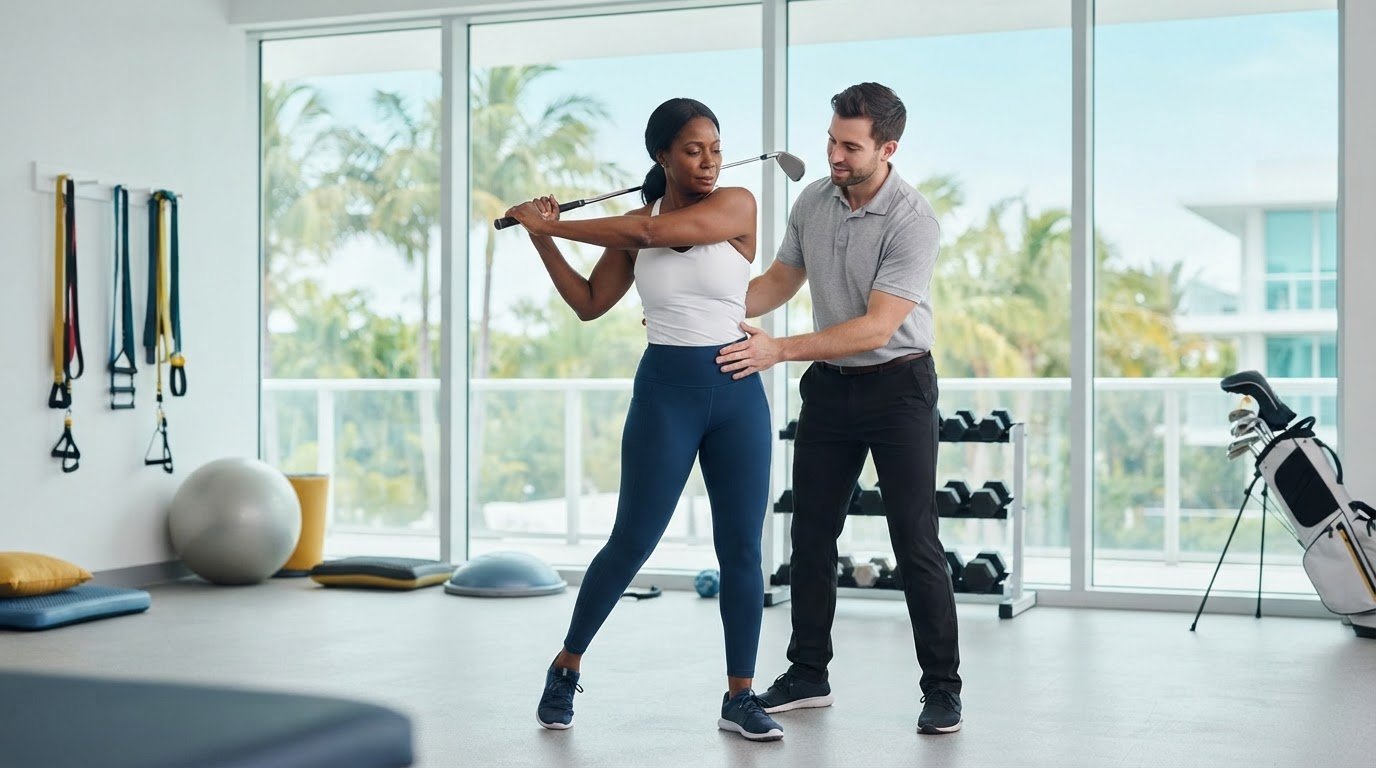
Physical therapy can help you get back to golfing after an injury by rebuilding strength, mobility, and confidence in the movements your swing requires. Many golfers can return to full play in about 8 to 10 weeks, depending on their recovery, but readiness matters more than the calendar.
It’s understandable to want to head straight back to the course once the pain eases. But a golf swing repeatedly asks your hips, spine, shoulders, and core to rotate and stabilize. Getting back to golfing after an injury often means preparing your body and easing into play. Physical therapy can address common golf injuries, while strength and mobility exercises support swing control. A gradual return also helps you monitor how your body responds. The goal is a thoughtful path back to the game that keeps your recovery and long-term movement in view.
Key Takeaways
- Lower-back, shoulder, elbow, and knee problems can affect golfers; identifying what limits your movement helps guide recovery.
- Build core, glute, and stabilizing-muscle strength to support balance and control through your swing.
- Progress from putting and chipping to fuller swings and course play, increasing demands gradually.
- Start with nine holes on your first round back, then pay attention to how your body feels during play and over the next 24 hours.
- A physical therapy plan can target your mobility, strength, and movement needs to support a more comfortable return to golf.
What are some common golf injuries?
Lower-back pain, shoulder impingements, elbow tendinitis, and knee problems are common golf injuries. Repeated swings can irritate elbow tendons and stress the wrist, while forceful or repetitive movement can strain the rotator cuff. A bent-over stance also loads the back. Poor technique, limited flexibility, inadequate strength, or insufficient pre-play stretching can add stress to joints and soft tissues.
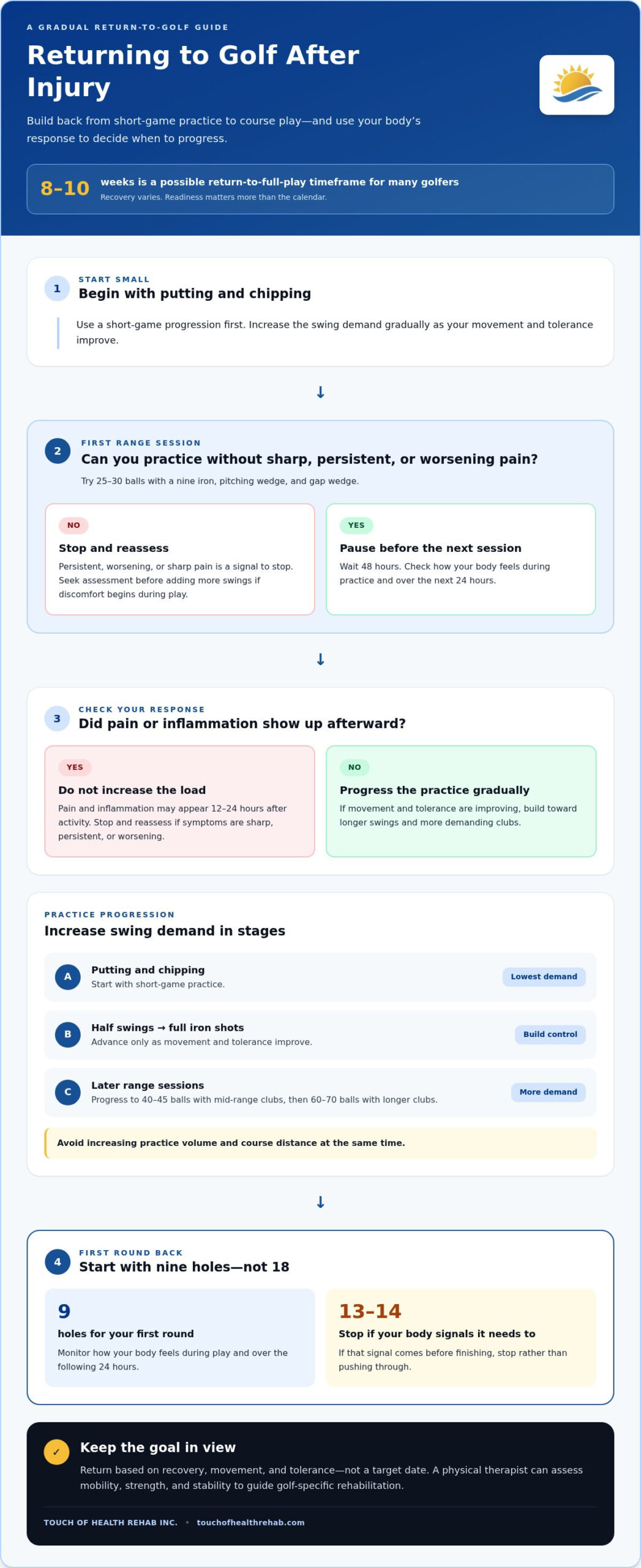
Returning to golf involves more than waiting for discomfort to fade. A full round includes repeated swings, walking several miles, and bending to retrieve the ball. Many golfers can return to full play in about 8 to 10 weeks, depending on recovery. Begin with a short-game progression, then build toward longer swings and course play as your movement and tolerance improve.
- Start with putting and chipping, then progress to half swings and full iron shots.
- For an early range session, try 25 to 30 balls with a nine iron, pitching wedge, and gap wedge.
- Wait 48 hours before the next range session and assess how your body responds.
- A later session can progress to 40-45 balls with mid-range clubs, then 60-70 balls with longer clubs.
These steps let you notice how your body responds to each increase in effort. Pain and inflammation may appear 12-24 hours after activity, so assess your symptoms during practice and over the next 24 hours. Persistent, worsening, or sharp pain is a signal to stop and reassess. On your first round back, play nine holes before attempting 18. If your body signals that it needs to stop after 13 or 14 holes, stop rather than pushing through.
Readiness also depends on whether physical limitations are changing your swing. Restricted hip or thoracic-spine movement may limit rotation and lead you to compensate through your lower back. Limited shoulder mobility can affect your backswing, while weak lower-body stability may alter balance through impact. A physical therapist can assess these movement patterns and use the findings to guide golf-specific rehabilitation.
A TPI movement screen assesses mobility, strength, and stability limitations that may affect swing efficiency or contribute to pain. Some TPI-certified clinics also use indoor golf simulators to observe swing mechanics in real time and guide targeted adjustments. This type of analysis can link a movement restriction, such as limited hip rotation, with a visible swing compensation.
Strengthening exercises can support injury prevention by improving control and tolerance for repeated swings. Golf-focused strengthening may be performed every other day in sets of 10-15 repetitions. Warm up before teeing off, and avoid increasing practice volume and course distance at the same time. If soreness after a round takes longer than usual to settle, or discomfort begins during play, seek assessment before adding more swings.
Core, glute, and stabilizing-muscle strengthening
Core, hip, and shoulder strength help coordinate the rotation and balance a golf swing demands. Training these areas can improve control and help limit compensations that put extra stress on joints.
Building Core Strength and Joint Stability
Core strength is the ability to stabilize your trunk as your arms and legs move. During a golf swing, that control helps transfer power between your upper and lower body while supporting posture. A plank or side plank trains the trunk to resist unwanted movement; holds can last 5-30 seconds or longer. Proper control matters more than rushing through repetitions.
Strengthening the Glutes and Stabilizing Muscles
Your glutes and other stabilizing muscles help keep your pelvis and legs steady as you rotate. That support matters because rotational forces can stress the knees, especially when hip mobility is limited or lower-body stability is weak. Exercises such as bridges and controlled hip hinges can build strength for these movements. Keep the motion smooth and focus on maintaining balance rather than forcing your range.
Developing Single-Leg Stability
Single-leg stability is the ability to control your body while most of your weight rests on one foot. It supports balance during weight shifts and gives your legs a stable base for trunk rotation. A controlled single-leg stance is a simple example: keep your pelvis level and avoid leaning your trunk. If your balance changes as you fatigue, shorten the hold and regain control.
Strength work should match your current ability and the demands of your swing. Golf strengthening exercises can be performed every other day in sets of 10-15 repetitions. Start with body-weight movements, such as a bridge or supported single-leg stance, then add resistance as the exercises become familiar. This gradual loading helps build capacity without making every session a test of maximum effort.
Mobility and strength work together. Hip flexibility allows the pelvis to rotate, while a mobile thoracic spine contributes to a smoother turn. If either area has restricted range of motion, your lower back may compensate. Pairing controlled rotation drills with core and glute exercises addresses both movement and support. The aim is coordinated motion, not simply greater flexibility.
Shoulder strength also contributes to swing control. Repeated swings place demands on the rotator cuff and shoulder joint, so resistance-band exercises can strengthen the rotator cuff muscles. Keep the movement controlled and stay within a comfortable range. A physical therapy assessment can help connect your strength and stability needs with suitable exercises. If you’d like guidance applying these principles to recovery, explore physical therapy support.
What do weight training, stretches, and exercises have to do with improving my swing?
Weight training, stretching, and golf-specific exercises prepare your body for the repeated rotation of a full swing. To reduce stress on an injured back, shoulder, elbow, or wrist, use shorter, controlled movements, avoid forcing your range, and build swing speed gradually.
Progressing from Short Game to Full Swings
Gradual progression means increasing swing range and effort in stages, from putting to full swings. This lets you practice golf movements before adding the demands of a complete round. Start with putting and chipping, then move to half swings and full iron shots. Next, add driving-range practice, including longer clubs, before returning to course play. Notice whether each step changes your comfort or movement quality.
Retraining Movement Mechanics
Movement mechanics are the coordinated actions that produce your swing, including hip and spine rotation, balance, and arm movement. Repetitive swings can reinforce compensations, so focus practice on smooth, controlled motion rather than simply hitting more balls. A movement assessment can identify mobility restrictions or strength deficits that affect your swing. Pairing targeted exercises with technical practice helps prepare your body to repeat improved mechanics.
A swing analysis can connect what you feel with how your body moves. For example, a limited hip turn may lead to extra rotation through the lower back. Observing your swing alongside functional movement can reveal where technique changes may help. The goal is efficient movement, with power generated through coordinated body rotation rather than excess strain on one area.
Improving Posture and Swing Alignment
Posture and alignment position your body to move through the swing with control. A bent-over stance, uneven balance, or restricted trunk movement can encourage compensations during the backswing and follow-through. Use a comfortable setup, keep your balance centered, and check whether your shoulders and hips can rotate without forcing movement. Postural education can help you recognize positions that make repeated swings feel less controlled.
Adjusting Swings to Reduce Injury Stress
Adjusting swing range and effort can reduce unnecessary stress as you rebuild tolerance. For a sensitive back, use a shorter backswing and controlled rotation rather than forcing a full turn. With shoulder discomfort, avoid pushing your arm beyond its comfortable range. For an irritated elbow or wrist, ease your swing effort and keep the motion smooth instead of gripping tightly or snapping through impact.
These adjustments are starting points, not a substitute for assessing the movements behind your symptoms. Track which swing length, club, or practice activity changes how you feel. If a shorter swing remains comfortable but a full swing brings symptoms back, return to the easier stage and build gradually. Matching mechanics to your current mobility and strength supports more consistent practice.
Incorporating exercises into a routine
Physical therapy exercises for golfers can include mobility drills, core and hip strengthening, balance practice, and shoulder stability work. A consistent routine builds the strength and control needed for golf movements while addressing individual limitations.
Using Corrective Exercises and Conditioning
Corrective exercises target movement restrictions or muscle weaknesses that can affect your golf swing. For example, hip mobility drills can address limited rotation, while balance exercises develop control through weight shifts. Conditioning adds strength and endurance for repeated swings and walking the course. Start with 10 minutes of exercise a day, then build a routine around movements you can perform with control.
Match each exercise to a specific need. If shoulder stability is a focus, resistance-band rotations can strengthen the rotator cuff muscles. For trunk control, try a plank or side plank, holding for 5-30 seconds or longer. If your balance changes during a movement, use support and reduce the challenge until your form remains steady.
Tailoring Individual Exercise Programs
An individualized exercise program selects movements according to your injury, function, and golf goals. A physical therapist can assess strength, flexibility, balance, and functional movement, then use those findings to guide rehabilitation. A golfer rebuilding hip mobility may need different exercises from someone working on shoulder stability. The program should also progress as your control and tolerance improve.
Keep a simple record of your routine, including the exercise, resistance, and how the movement felt. Strength exercises can be performed every other day in sets of 10-15 repetitions. Golf stretches should be done daily, with each stretch held for at least 20 seconds. These details help you recognize whether a movement is becoming easier or needs adjustment.
Choosing Exercises for Recovery
Recovery exercises are selected to restore the movement and strength your golf activities require. Hip and thoracic mobility drills can support rotation; core work supports trunk control; and shoulder stability exercises target the muscles used during repeated swings. Balance and neuromuscular control exercises can also improve coordination around joints. Choose exercises that match your current limitations, not just a generic golf workout.
To develop a sustainable routine, pair one mobility exercise with one strengthening or balance exercise. For example, follow a hip mobility drill with controlled bridges, then add a supported single-leg stance. Begin with manageable movements and progress resistance as the exercises become familiar. Consistent physical therapy exercises and regular sessions support progress, while thoughtful adjustments keep the routine aligned with your changing needs.
Lower-back strain and limited hip or thoracic mobility
A golfer’s bent-over stance and repeated swing can strain lower-back muscles and load the spine. Limited hip or thoracic movement may lead to extra rotation through the lower back, making a mobility assessment useful when discomfort returns during a swing.
Improving Hip and Thoracic Mobility
Hip and thoracic mobility means rotating through the hips and mid-back with control. Improving both areas can help you make a smoother turn without asking your lower back to compensate for restricted movement. A physical therapist can assess hip rotation, spinal movement, stability, and flexibility, then identify which limitations matter to your swing.
Notice where rotation feels restricted during a slow practice motion. If your hips turn less freely than your shoulders, your lower back may rotate more to complete the swing. If your mid-back feels stiff, your upper body may struggle to turn smoothly. These observations don’t diagnose the cause, but they provide useful context for assessing your movement pattern.
Lateral lunges can help improve hip flexibility and range of motion. Move into the lunge with control, then return to your starting position without forcing a deeper stretch. A physical therapy mobility plan may also include drills for the hips, thoracic spine, and shoulders. These areas work together during the golf swing, so improving one while overlooking another may leave a movement limitation unaddressed.
Training Mobility and Flexibility
Mobility training develops controlled movement through a joint’s range, while flexibility training focuses on lengthening surrounding tissues. Both can support a more comfortable rotation through the hips, mid-back, and shoulders. Golf stretching exercises should be held for at least 20 seconds, and each exercise can be repeated 2-3 times within a routine.
For a knees-to-chest stretch, lie on your back and bring your knees toward your chest. Hold the position for 20-30 seconds, then repeat several times with both legs. Keep the movement controlled and notice whether one side feels different. That comparison can help describe changes in mobility during an assessment, especially when back strain varies with rotation.
Mobility work should relate to the movement that feels limited. For example, if turning your trunk is difficult, a therapist may assess hip rotation and thoracic movement before selecting drills. If shoulder movement also restricts your backswing, include that area in the assessment rather than focusing only on the lower back. Explore physical therapy support for an assessment and mobility-focused care.
Touch of Health Rehab Inc.: Physical Therapy
Touch of Health Rehab Inc. offers Physical Therapy to help you address movement limits, rebuild strength, and work toward returning to golf. If back, shoulder, hip, or balance concerns are affecting your swing, a physical therapy assessment can help identify which movements and functions need attention. Your recovery may involve progressive exercises that support mobility, stability, and control, with Postural Education helping you understand how alignment affects everyday movement and golf posture.
After surgery, Post Surgery Physical Rehabilitation can support your recovery of strength and function before you increase golf activity. A gradual return lets you observe how your body responds to practice and course play, then adjust your activity accordingly. Contact Touch of Health Rehab Inc. to discuss physical therapy for your recovery and return to golf.
Make Your Next Step a Personal Return Plan
Your next step is to turn general recovery advice into a plan that fits your body and the golf you want to play. Decide what you want to return to first, such as a comfortable practice session, and note which movements still feel difficult. This gives you a clear starting point for discussing your goals.
Physical therapy can support your return to golfing after an injury by addressing movement and function relevant to your needs. At Touch of Health Rehab Inc., physical therapy and postural education can help you work on movement awareness and posture. Vestibular rehabilitation may be relevant when balance or vestibular concerns affect your confidence moving around the course.
Progress is easier to understand when you pay attention to what your body can do, not only how far you have returned. Bring your questions and golf-related goals to your next care conversation, then plan your next steps with support suited to your recovery.
Contact Touch of Health Rehab Inc. to discuss your physical therapy needs and take a thoughtful step toward golf again.
Frequently Asked Questions
How Can Physical Therapy Help With My Golf Game?
Physical therapy can help you get back to golfing after an injury by connecting symptoms with the movements your swing requires. It can also turn assessment findings into exercises for strength, balance, and mobility, then adapt the plan as your function changes. For golfers in Sunny Isles Beach, Aventura, Bal Harbor, North Miami Beach, and Miami Beach, Touch of Health Rehab Inc. offers physical therapy to support injury recovery and movement goals.
Is golf rehabilitation covered by insurance?
Golf rehabilitation may be covered when care meets your health plan’s requirements for physical therapy. Coverage can depend on your benefits, network rules, referral requirements, and whether treatment is considered medically necessary. The fact that exercises support golf does not alone determine coverage. Review your plan’s physical therapy benefits and ask your insurer how they apply to treatment for your injury and rehabilitation goals.
How do you know when it is safe to return to golf after an injury?
Readiness means you can manage the movements golf requires without sharp or worsening pain or a noticeable loss of control. Consider whether you can rotate, maintain balance, and perform practice swings with steady movement. Also notice how ordinary activities feel after practice, not just during it. If symptoms increase or your movement changes to avoid discomfort, reduce the demand rather than forcing a return to full play.
How should you gradually return to golf after physical therapy?
Increase one demand at a time so you can tell how your body responds. For example, keep your club choice and swing effort steady while adding practice time, or maintain practice volume while trying a longer club. Avoid combining a longer session, faster swings, and a full round in one jump. This makes it easier to identify which change brings discomfort and when to pause or scale back.
How do physical therapists assess readiness to play golf after an injury?
A physical therapist can consider your injury history, symptoms, strength, balance, and movement control alongside golf-related tasks. You might be asked to rotate your trunk, shift your weight, or perform a practice swing while the therapist observes your movement. The assessment can reveal whether you’re compensating or avoiding a position. Those findings help guide exercise choices and identify which activities to reintroduce first.
How long does it take to return to golf after common injuries?
Many golfers can return to full play in about 8 to 10 weeks, depending on their recovery. That range is a guide, not a timetable for every injury. A back strain, shoulder problem, or elbow tendon irritation can affect different movements, and recovery also depends on how strength and function return. Surgery may involve a different rehabilitation process. Track progress through activities you can perform comfortably and with control.
What are the risks of playing golf too soon after an injury?
Returning before your body can tolerate repeated swings and course demands can aggravate symptoms or make it harder to move normally. You may compensate by changing your posture, shortening your rotation, or putting extra strain on another area. A full round also combines repeated swings with walking and bending. If pain sharpens, worsens, or changes your mechanics, stop playing and reassess before increasing activity.
How can you prevent reinjury when returning to golf?
Build a sustainable routine around the demands that challenged you, rather than focusing only on swing practice. Keep strength and mobility exercises in your schedule, warm up before playing, and use controlled movements when fatigue affects your form. Avoid increasing practice intensity and course time together. Pay attention to soreness after activity, too. If symptoms recur or linger longer than usual, adjust your routine before returning to heavier demands.