
The best at-home vertigo exercise isn’t the same for everyone. Choosing exercises for vertigo to do at home that actually work starts with identifying the cause: the Epley or Foster maneuver may help with BPPV, while balance retraining focuses on steadiness. A formal diagnosis and guidance from a licensed physical therapist can help match the movement to your vertigo type.
If turning in bed or moving your head triggers dizziness, it’s understandable to want exercises for vertigo to do at home that actually work. The right exercise depends on the cause, though, and the wrong approach may not help.
This guide explains how to try the Epley and Foster maneuvers, when balance retraining may help, and how to choose an approach based on your symptoms. You’ll also learn when to pause and seek professional guidance, so you can take a steadier, more informed next step.
Key Takeaways
- Match the exercise to the cause of your vertigo; repositioning maneuvers are intended for BPPV, not every type of dizziness.
- Learn how the Epley and Foster maneuvers differ, and why identifying the affected ear matters before trying either at home.
- Understand how the Semont maneuver may be used for BPPV and what to consider when comparing repositioning options.
- Explore how balance retraining can help address unsteadiness, even when it isn’t the right approach for brief, position-triggered vertigo.
- Use your symptoms and a professional assessment to guide your next step, especially if dizziness continues or balance remains difficult.
What is the home Epley maneuver?
The home Epley maneuver repositions displaced inner-ear crystals in certain cases of BPPV. First identify the affected ear and confirm that positional vertigo fits your symptoms.
-
Check for BPPV and identify the affected ear
Notice whether turning in bed, looking up, or bending triggers a brief spinning sensation. Benign paroxysmal positional vertigo (BPPV) happens when otoconia move into the wrong part of the inner ear; episodes may last up to 1 minute and can cause nausea or vomiting. To check the right side, lie back with your head turned right and wait one minute for dizziness. This observation does not establish a diagnosis: BPPV can involve one of three inner-ear canals, so a therapist’s evaluation helps identify the correct side and maneuver.
-
Use the Epley maneuver to treat BPPV
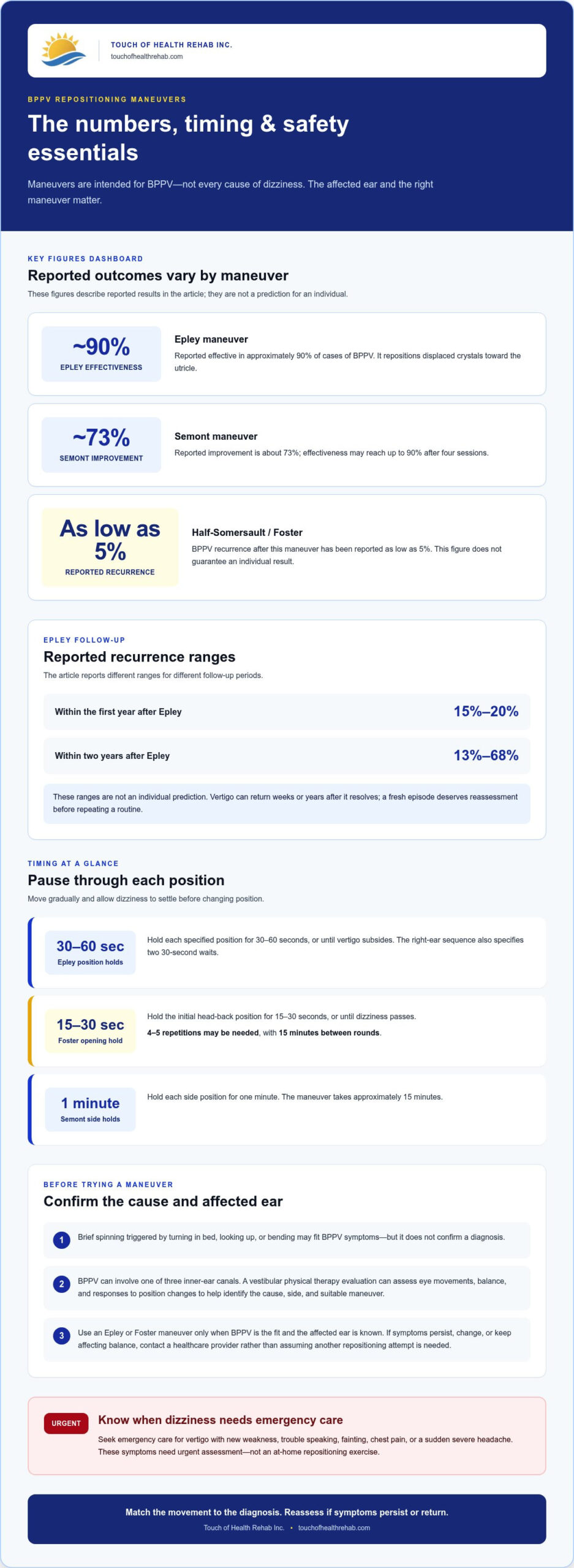
Once the affected ear is identified, follow the matching Epley sequence rather than guessing the side. For right-ear BPPV, begin seated with your head turned 45 degrees right; lie back while keeping that angle, then wait 30 seconds. Turn your head 90 degrees toward the opposite side and wait 30 seconds. Continue by rolling onto your side with your nose angled toward the floor, then sit up carefully. Hold each specified position for 30-60 seconds, or until vertigo subsides. The maneuver guides displaced crystals back toward the utricle.
- Track whether symptoms settle, return, or change after the maneuver. BPPV recurrence has been reported in 15%-20% of cases within the first year after Epley, and in 13%-68% within two years. Those ranges describe different follow-up periods, not a prediction for an individual. BPPV-related vertigo can return weeks or years after it resolves, so a fresh episode deserves reassessment before repeating a routine. If symptoms persist, contact a healthcare provider; the Epley maneuver treats BPPV-related vertigo, not every cause of dizziness.
- Arrange a vestibular physical therapy evaluation before repeating home treatment, especially if you don’t know which ear is affected. A therapist can assess eye movements, balance, and responses to position changes to help distinguish BPPV from other causes. Seek emergency care for vertigo with new weakness, trouble speaking, fainting, chest pain, or a sudden severe headache. These symptoms need urgent assessment, not an at-home repositioning exercise. A brief spinning episode triggered by a particular head position may point to BPPV, but an evaluation is needed to confirm the cause.
What Is the Half-Somersault or Foster Maneuver?
The Foster maneuver, also called the half-somersault, is a repositioning exercise for BPPV. It involves moving through a controlled sequence of head and body positions, with pauses before repeating.
-
Perform the half-somersault maneuver
Begin kneeling on a stable surface, then tilt your head back and look upward. Hold for 15-30 seconds or until dizziness passes. Lower your head toward the floor, bringing your chin toward your knees. Turn your head toward the affected ear and pause in that turned-head position; left-ear instructions call for 30 seconds. Raise your head while keeping it turned, then return to standing slowly. Keep your shoulders steady, and stop if the spinning feels unsafe.
- Rest for 15 minutes before attempting another Foster round. The maneuver may need 4-5 repetitions before symptoms improve, with 15 minutes between each exercise. Don’t rush between positions: moving gradually gives you time to notice whether dizziness settles or intensifies. The Half-Somersault can be performed at home without an assistant, but a formal BPPV diagnosis helps establish whether this maneuver fits your symptoms.
-
Know what to expect afterward
Sit quietly after a round and notice whether head movement still triggers spinning. A temporary sensation of dizziness can occur during position changes; allow it to pass before getting up. If vertigo continues, changes in character, or interferes with standing, arrange a clinical assessment rather than assuming the crystals need another repositioning attempt. After symptoms resolve, a healthcare provider may advise sleeping propped up on 2 pillows for a while.
- Compare the Foster approach with the Semont maneuver only after identifying which ear is affected. For Semont, begin seated, turn your head away from the affected side, and move onto the affected side. Then shift quickly to the opposite side without changing your head position. Hold each side position for 1 minute. The maneuver takes approximately 15 minutes; reported results include about 73% improvement, and up to 90% effectiveness after four sessions.
- Choose the maneuver that matches your diagnosis, not simply the one that seems easiest. Reported BPPV recurrence after the Half-Somersault maneuver has been as low as 5%; that figure doesn’t guarantee an individual result. If you’re unsure about the affected ear, or symptoms persist, guided vertigo recovery support can help you pursue a diagnosis-led approach.
Epley maneuver
The Epley maneuver is a repositioning exercise for vertigo caused by BPPV. The sequence depends on which ear is affected, so professional guidance can help you choose the correct side.
-
Decide whether a home Epley is appropriate
Use this maneuver only when BPPV has been diagnosed and the affected ear identified. It moves displaced calcium crystals from the semicircular canals back to the utricle, where they’re less likely to trigger positional spinning. The maneuver is effective in approximately 90 percent of cases. It doesn’t treat every cause of dizziness, so symptoms that persist after an attempt call for contacting your healthcare provider.
-
Follow the right-ear Epley steps
Sit on a bed and turn your head 45 degrees toward the right ear. Lie back with your head turned, then wait 30 seconds. Turn your head 90 degrees to the left without raising it, and wait another 30 seconds. Roll onto your left side, directing your nose toward the floor. Pause, then sit up slowly. Keep each specified position for 30-60 seconds, or until vertigo subsides.
-
Follow the left-ear Epley steps
For left-ear BPPV, sit and turn your head 45 degrees left. Lie back while keeping that angle, then wait 30 seconds. Turn your head 90 degrees to the right without raising it, and hold for 30 seconds. Roll onto your right side with your nose angled toward the floor. Pause before sitting upright slowly. Move through the positions deliberately, rather than turning your shoulders ahead of your head.
- Make your surroundings safe before starting: use a bed with room to roll, and clear the route to standing. Position changes may trigger spinning or nausea, so pause between movements until the sensation eases. If you have neck or back disease, a vascular condition, or retinal detachment, ask a healthcare provider whether this maneuver is safe for you.
- Follow the frequency recommended for your situation rather than adding extra rounds. A healthcare provider may recommend doing the home Epley maneuver 3 times a day until symptoms have been gone for 24 hours. Stop the exercise and contact your healthcare provider if symptoms persist; the maneuver addresses BPPV-related vertigo only. For help with a diagnosis-led approach, explore vertigo recovery support.
Can balance retraining exercises help with dizziness?
Balance retraining can help you practice balance and movement, but it is different from exercises intended to reposition inner-ear crystals. Practice controlled movements near a stable support, and stop if symptoms become difficult to manage.
-
Practice the Romberg balance exercise
Stand with your feet together beside a counter, then hold the position for 30 seconds. Keep your eyes open and shoulders relaxed while noticing how your balance responds. If steady, repeat with your feet closer together only when safe. The Romberg exercise challenges how your body combines visual, inner-ear, and surface signals. Keep the counter within reach, and don’t close your eyes without guidance.
-
Build tandem-stance balance
Place one foot slightly ahead of the other, leaving a comfortable gap between them. Hold the wide tandem stance for 1-2 sets on each side, resting 30-60 seconds between sets. Practice 1-2 times daily beside a stable support. Switch which foot leads to challenge both sides evenly. If your body sways, widen your stance before progressing; control matters more than making the position difficult.
-
Add balance and turning exercises
Stand near a counter, then slowly turn 180 degrees in a half-circle. After turning, stand motionless for 10-15 seconds before continuing; repeat five times. Let your feet and shoulders move together, and pause if spinning disrupts your footing. A physical therapist can help adjust turning speed and stance, so vestibular signals and balance responses are challenged at a manageable level.
- Practice one balance exercise at a time for a week or longer, and note changes in steadiness. If dizziness settles within 5 minutes, continue at lower intensity or with fewer repetitions. Wait 30 seconds or until dizziness passes before moving to another exercise. This gradual approach helps you distinguish a useful challenge from a movement that overwhelms your balance.
-
Review evidence for balance retraining
Use balance retraining when unsteadiness or motion sensitivity is the target, and discuss persistent symptoms with a physical therapist. In scientific studies cited in the research, 75%-80% of people taught balance retraining reported feeling better within a few months. That finding doesn’t directly compare home practice with clinician treatment. A therapist can assess your balance, select exercises, and adjust their difficulty as your responses change.
The turning-in-place exercise is repeated five times. Try one exercise at a time for a week or longer; make an exercise more difficult if its score is 0 or only 1 for several weeks.
Choosing exercises based on vertigo type
Choose exercises based on your dizziness pattern, not just the word “vertigo.” A diagnosis can help distinguish position-triggered BPPV from balance or motion problems that need different training.
- Track when dizziness starts, how long it lasts, and what movements bring it on. For example, spinning after rolling over in bed or turning your head can fit BPPV, whose episodes may last up to 1 minute. Note the direction that triggers symptoms and whether one side consistently brings them on. These clues help guide evaluation, but a symptom diary alone cannot identify the affected inner-ear canal.
- For diagnosed BPPV, use a repositioning maneuver suited to the affected ear and canal. The Epley maneuver addresses specific BPPV patterns, and a therapist can assess which approach fits. Don’t choose a side based only on which direction feels worse once. BPPV can affect any of the three inner-ear canals, and the appropriate maneuver depends on identifying the source.
- Ask about Brandt-Daroff exercises if your therapist recommends a home routine for BPPV. These side-to-side movements are a different approach from repositioning maneuvers; they don’t replace identifying the cause first. Brandt-Daroff exercises are associated with 50% improvement for BPPV. Follow the schedule your therapist sets, and track whether symptoms change with each side rather than increasing repetitions on your own.
- Choose balance retraining if your main difficulty is unsteadiness while standing, walking, or turning. A supported tandem stance or Romberg practice challenges balance rather than repositioning inner-ear crystals. Start beside a stable support, and note which movements cause dizziness and how long it lasts. If head movements trigger symptoms while walking, tell your physical therapist so they can shape vestibular exercises around that pattern.
- Reassess the plan if dizziness continues beyond brief, position-triggered episodes or returns after symptoms settle. Persistent symptoms can have causes that repositioning exercises don’t address, so avoid repeating the same maneuver without reassessment. A therapist can evaluate eye and balance responses, identify the exercise goal, and adjust the routine as your symptoms change. For individualized vertigo exercise guidance, take the next step toward a diagnosis-led plan.
Touch of Health Rehab Inc.: Physical Therapy
Touch of Health Rehab Inc. provides physical therapy, including vestibular rehabilitation for people with vertigo and balance concerns. If you’re unsure which exercise suits your symptoms, dizziness persists, or unsteadiness affects daily movement, professional guidance can help identify a practical next step. Vestibular rehabilitation addresses balance and motion difficulties through an approach tailored to your needs, while postural education can support steadier movement habits. Home exercises may help, but they don’t replace identifying the cause of vertigo and choosing appropriate movements. For help with vertigo or balance concerns, contact Touch of Health Rehab Inc. or visit touchofhealthrehab.com.
Take Your Next Step Toward Steadier Days
Plan your next step around how dizziness affects daily life. Note which movements are difficult, what you were doing when symptoms began, and whether they affect walking, sleep, or confidence moving around your home. These details can make a conversation with a healthcare professional more focused and help shape a plan for your needs.
Exercises for vertigo to do at home that actually work are those suited to the cause of your symptoms and performed with appropriate guidance. If you’re unsure where to begin or dizziness keeps interfering with daily activities, you don’t have to figure it out alone. An assessment can help turn uncertainty into a practical plan.
Contact Touch of Health Rehab Inc. to discuss a supportive next step. With the right guidance, you can move toward greater confidence and steadiness, one step at a time.
Frequently Asked Questions
What are the best exercises for vertigo?
The best exercises for vertigo to do at home that actually work depend on the cause. For diagnosed BPPV, a correctly matched Epley or Foster maneuver targets the affected inner-ear crystals. For ongoing unsteadiness, balance retraining instead focuses on steadiness and movement. If you live in Sunny Isles Beach, Aventura, Bal Harbor, North Miami Beach, or Miami Beach, vestibular rehabilitation at Touch of Health Rehab Inc. can help clarify which exercises fit your symptoms.
Can these exercises do me any harm?
Vertigo exercises can temporarily trigger dizziness, nausea, or unsteadiness, especially during head-position changes. Practice near a stable support and stop if you feel unsafe or symptoms intensify. If you have neck or back disease, a vascular condition, or retinal detachment, ask a healthcare provider about Epley safety first. Exercises chosen for the wrong cause may not help, so diagnosis and a therapist’s guidance matter.
What Is the Semont Maneuver?
The Semont maneuver is a sequence of quick side-to-side body movements used for BPPV. A therapist identifies the affected ear, then guides you from sitting onto one side and rapidly across to the other while your head stays turned. Each side position is held for 1 minute, and the maneuver takes approximately 15 minutes. Reported results include about 73% improvement, with another report describing up to 90% effectiveness after four sessions.
What is the fastest way to cure vertigo?
There isn’t one fastest treatment for every cause of vertigo; the right approach depends on what’s producing it. For confirmed BPPV, a repositioning maneuver such as Epley can address displaced inner-ear crystals. Other causes need different care, so repeating a maneuver without a diagnosis may waste time. If dizziness persists after an appropriate BPPV maneuver, contact a healthcare provider for reassessment rather than simply doing more repetitions.
What triggers vertigo attacks?
For BPPV, changes in head position can trigger a spinning episode, such as rolling over in bed, looking upward, or bending down. The sensation can occur when displaced inner-ear crystals move during those movements, and an episode may last up to 1 minute. Vertigo from other causes can follow different patterns. Note the movement, direction, and duration of symptoms to share during an assessment.
Which types of vertigo can be treated with exercises at home?
Some cases of diagnosed BPPV can be treated with a home repositioning maneuver when the affected side and proper technique are known. Balance retraining can help with unsteadiness, but it serves a different purpose from repositioning inner-ear crystals. A diagnosis helps distinguish these situations. Follow a licensed physical therapist’s instructions, especially if your symptoms don’t match a brief, position-triggered pattern or continue after an exercise.
How to do the Epley maneuver at home step by step for right-ear BPPV?
For diagnosed right-ear BPPV, sit and turn your head 45 degrees right. Lie back with your head turned, then wait 30 seconds. Turn your head 90 degrees left without lifting it, and wait another 30 seconds. Roll onto your left side, nose angled toward the floor, then sit up slowly. Hold each specified position for 30-60 seconds or until vertigo subsides, following your therapist’s instructions.
How to do the Epley maneuver at home step by step for left-ear BPPV?
For diagnosed left-ear BPPV, sit and turn your head 45 degrees left. Lie back while keeping that angle, then wait 30 seconds. Turn your head 90 degrees right without lifting it, and wait another 30 seconds. Roll onto your right side with your nose angled toward the floor, pause, then sit up slowly. Keep each specified position for 30-60 seconds or until vertigo subsides, following your therapist’s instructions.