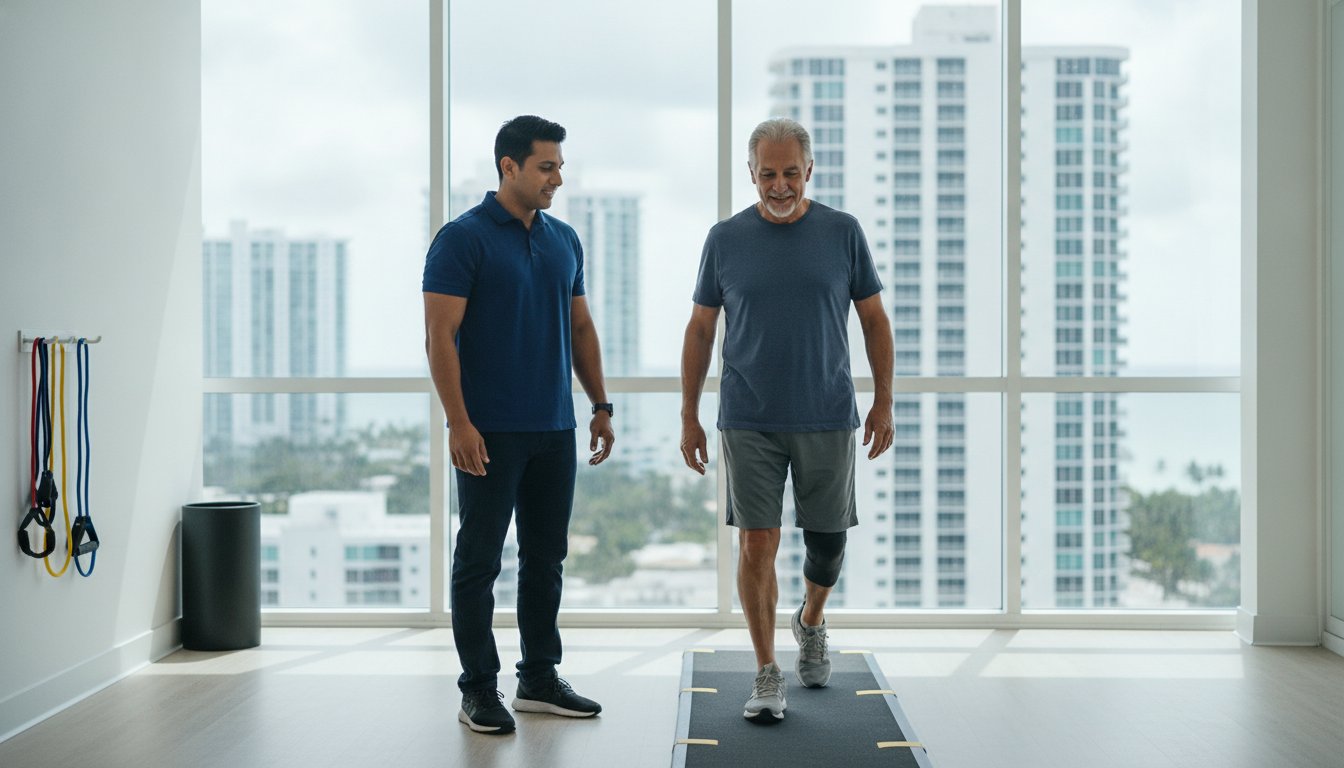
Did you know that North America now commands over 40% of the global knee replacement market? While the surgery is more precise than ever thanks to robotic assistance, the real work of reclaiming your life happens during your knee replacement physical therapy. It’s completely natural to feel a sense of trepidation about the road ahead. You might worry that the exercises will be too intense or that you’ll never quite regain the fluid motion needed to enjoy a round of golf or a morning stroll along Sunny Isles Beach.
We’re here to show you that your recovery doesn’t have to be a source of anxiety. This guide outlines exactly what to expect during your post-surgical journey, incorporating the latest 2026 clinical practice guidelines to ensure your care is evidence-based and effective. We’ll explore how personalized gait analysis and postural education can protect your new joint, helping you move from using a walker to walking pain-free. You’ll also find clear answers on 2026 Medicare thresholds and how our dedicated team in Sunny Isles Beach partners with you to restore your vitality and independence through a steady, reassuring path to health.
Key Takeaways
- Understand the critical milestones of the 12-week recovery timeline, from managing initial swelling to weaning off assistive devices with confidence.
- Learn to differentiate between expected therapeutic soreness and surgical pain so you can progress through your knee replacement physical therapy with peace of mind.
- Discover the foundational exercises that re-engage your hip and thigh muscles to provide the lasting stability your new joint requires.
- Identify how professional gait analysis and postural education help you navigate the “confidence gap” and prevent falls during your transition to independent movement.
- Gain insights into transitioning your recovery into a long-term physical conditioning plan that keeps you active on the beach and the golf course.
What to Expect During Your Knee Replacement Physical Therapy Journey
Your surgery was the first essential step toward a life without chronic pain; now, the restorative work begins. Think of your physical therapist not just as a medical practitioner, but as a dedicated guide who understands the unique landscape of your healing process. During the initial phase of your knee replacement physical therapy, the primary focus is safety and physiological stabilization. We prioritize increasing your circulation and managing inflammation to protect the integrity of your new joint. This collaborative journey is designed to instill confidence, ensuring you never feel alone as you navigate the early days of recovery.
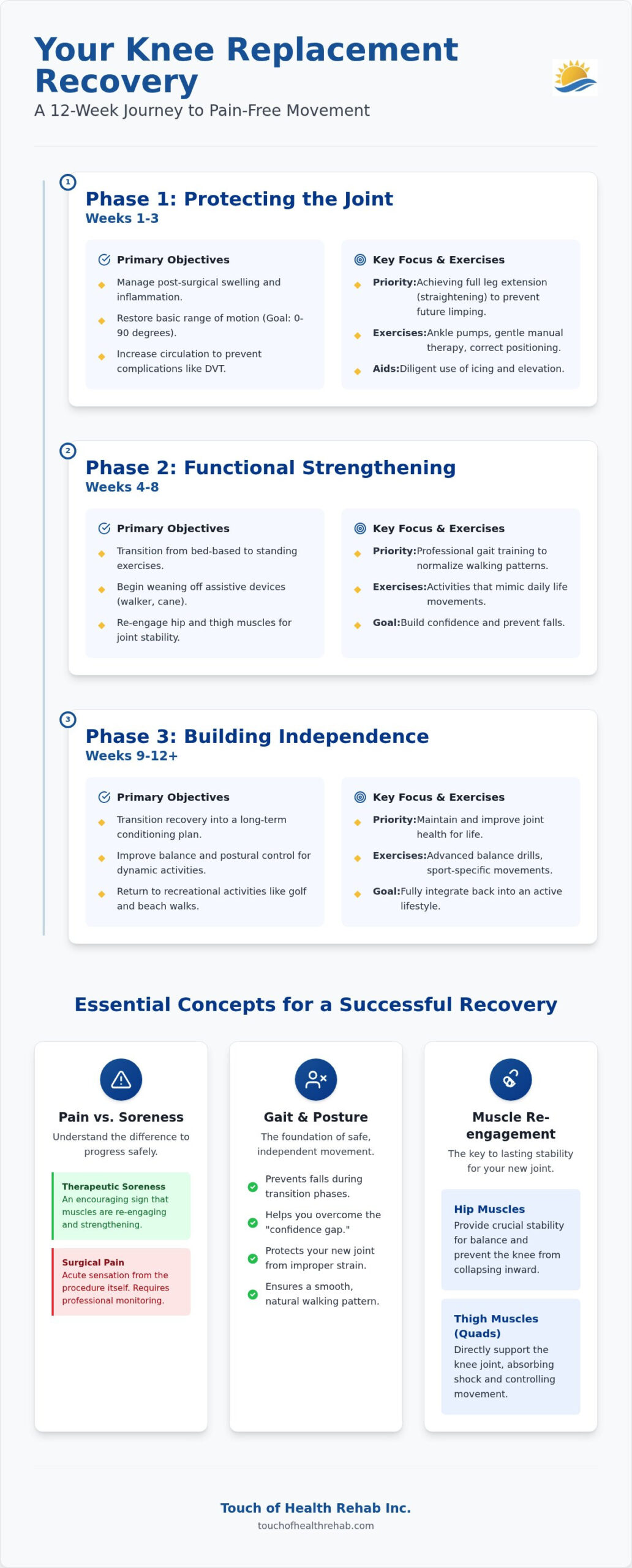
It’s completely natural to feel a sense of trepidation regarding post-operative discomfort. You’ll likely experience a mix of “surgical pain,” which is the acute sensation from the procedure itself, and “therapeutic soreness.” This soreness is actually an encouraging sign; it indicates that your muscles are re-engaging and beginning the hard work of supporting your movements. While unmonitored home exercises might seem convenient, they lack the clinical precision and real-time adjustments that professional support provides. In our Sunny Isles clinic, we monitor your progress closely to ensure every movement serves your long-term vitality without overtaxing your body.
The First 24 Hours: Movement as Medicine
Within hours of your procedure, your rehabilitation starts with simple yet vital movements like ankle pumps. These rhythmic contractions of your calf muscles are essential for preventing Deep Vein Thrombosis (DVT) by keeping your blood flowing steadily. Early mobilization is recognized as the gold standard for 2026 recovery protocols to minimize complications and accelerate the return to function. You’ll likely take your first few steps with a walker under the watchful eye of a professional. This initial movement isn’t a sign of limitation, but a necessary foundation for regaining your balance and independence.
Outpatient vs. Inpatient Rehabilitation
While some patients spend a few days in an inpatient facility, many quickly transition to an outpatient setting to receive specialized, one-on-one attention. Choosing a dedicated clinic allows you to access sophisticated equipment and hands-on manual therapy that you simply can’t replicate at home. For those seeking a deeper understanding of the procedure’s medical context, this Knee Replacement Overview offers a helpful foundation for your recovery knowledge. Our specialized Post Surgery Physical Rehabilitation programs are designed to bridge the gap between hospital discharge and your return to the activities you love, such as walking along the Atlantic coast or enjoying the vibrant lifestyle of South Florida.
The 12-Week Recovery Timeline: Milestones and Goals
Recovery is a methodical progression where every week brings you closer to the activities you love. While every individual’s path is unique, following a structured timeline for your knee replacement physical therapy ensures that you hit critical milestones without overstressing the healing tissue. We view this 12-week period as a collaborative journey where we monitor your progress and adjust your plan in real time. This steady approach builds a foundation of stability, allowing you to transition from the initial post-surgical phase to a life of pain-free movement.
Phase 1: Protecting the Joint (Weeks 1-3)
During these first three weeks, our primary objective is to manage inflammation while restoring your basic range of motion. Many patients focus heavily on bending the knee, but achieving full extension, or straightening the leg, is actually the higher priority. A knee that cannot straighten fully leads to a permanent limp and back pain later on. We utilize gentle manual therapy and specific positioning to help you reach a goal of 0 to 90 degrees of motion. This Knee Replacement Patient Guide provides additional context on why these early goals are so vital for long-term success. By diligently using icing and elevation, you reduce swelling, which in turn makes your exercises more comfortable and effective.
Phase 2: Functional Strengthening (Weeks 4-8)
As you enter the second month, your focus shifts from bed-based movements to standing exercises that mimic daily life. This is the period where most patients begin to wean off walkers or canes. We introduce specialized gait training to ensure you aren’t compensating with your hips or lower back. Our therapists provide professional Balance and Gait Rehabilitation to help you eliminate any lingering limp and restore a natural walking pattern. You’ll start to feel a significant boost in confidence as your quadriceps and hamstrings grow stronger, supporting your new joint during more complex movements like climbing stairs or navigating uneven surfaces.
By weeks 9 through 12, the emphasis moves toward endurance and total-body alignment. We focus on physical conditioning that prepares you for the specific demands of your lifestyle, whether that means returning to the golf course or enjoying long walks along the shore in Sunny Isles Beach. Our team is dedicated to ensuring you don’t just “get by” but truly thrive with your new joint. If you feel ready to take the next step toward peak health, we invite you to start your personalized recovery plan with our compassionate experts today. Beyond the three-month mark, many patients find they can return to low-impact sports with a level of comfort they haven’t felt in years.
Essential Exercises for Knee Replacement Rehabilitation
Consistency is the heartbeat of a successful recovery. While your surgery provides the mechanical fix, your commitment to specific movements during knee replacement physical therapy determines the quality of your long-term mobility. These exercises aren’t just about building muscle; they’re designed to retrain your nervous system and restore the fluid motion required for a vibrant life. By performing these movements correctly, you provide the necessary stimulus for your body to heal and adapt to your new joint, ensuring every step you take is a step toward restoration.
- Quadriceps Sets: These serve as the foundation of knee stability. You simply tighten your thigh muscle and try to push the back of your knee down into the bed or floor. Hold for five seconds, then relax.
- Straight Leg Raises: Once you can activate your quad, you’ll progress to lifting your leg while keeping it perfectly straight. This re-engages the hip and thigh muscles, which is vital for a steady, confident gait.
- Heel Slides: To improve your range of motion, you’ll slowly slide your heel toward your buttocks, bending the knee as far as comfortable. This active flexion helps prevent stiffness and promotes circulation.
- Terminal Knee Extension (TKE): Often performed with a resistance band, this move focuses on those final, difficult degrees of straightening that are essential for standing comfortably and walking naturally.
The Quadriceps Connection
It’s common for the quadriceps muscle to “shut down” immediately following surgery. This phenomenon, known as arthrogenic muscle inhibition, happens because the brain sends signals to deactivate the muscle to protect the joint from perceived trauma. To wake it up, we use targeted activation techniques. The biofeedback process involves consciously visualizing the muscle contraction while feeling the tension beneath your palm to reconnect the brain’s neural pathways to the quadriceps. As you gain control, you’ll move from these isometric holds to active lifting, which is a major milestone in your knee replacement physical therapy journey.
Safety Protocols and Red Flags
Learning to listen to your body is a skill we help you develop throughout your rehabilitation. It’s vital to distinguish between “good pain”—that dull, therapeutic ache from stretching—and “stop pain,” which is sharp, stabbing, or causes you to hold your breath. For a deeper understanding of these sensations, this resource on What to Expect During Physical Therapy provides excellent clinical context. We also watch for red flags like excessive heat around the joint, calf pain, or a sudden fever, which could indicate infection or circulation issues. Our therapists provide hands-on stretching to ensure you avoid arthrofibrosis, a condition where excessive scar tissue limits your movement, keeping your path to health steady and thorough.
The ‘Touch of Health’ Edge: Posture, Balance, and Gait
Most recovery guides treat the knee as an isolated mechanical part, but we understand that your body operates as a single, integrated system. When you receive a new joint, your center of gravity shifts. Your brain must essentially “recalibrate” how it perceives your position in space. This is why knee replacement physical therapy at our clinic goes beyond simple leg lifts; we focus on how your entire body adapts to your improved mobility. By addressing your total-body alignment, we ensure that your new knee doesn’t just function well, but actually improves your overall quality of life.
Postural Education for Joint Longevity
It’s common for patients to develop “compensation patterns” during the years of pain leading up to surgery. You might have developed a slight lean or a habit of “hip hiking” to avoid putting weight on your painful leg. If these habits continue after surgery, they can lead to chronic lower back pain and unnecessary strain on your healthy joints. Through specialized Postural Education, we help you identify and correct these deep-seated patterns. We teach you how proper spine alignment reduces the load on your new knee, which is a vital step in ensuring the long-term success of your procedure.
We pay particularly close attention to the “confidence gap” that often emerges between weeks four and six. During this window, you likely feel strong enough to move more freely, but your stabilizer muscles haven’t fully regained their reactive speed. For our senior patients in Aventura and Sunny Isles, we often integrate vestibular health checks into the plan. Ensuring your inner ear and balance systems are in sync with your new joint is a key part of our collaborative journey toward your total restoration. Patients recovering from other lower-extremity procedures, such as those seeking physical therapy after ankle surgery in Sunny Isles Beach, face similar balance recalibration challenges that our integrated approach is designed to address.
Advanced Gait Training and Fall Prevention
Walking is a complex neurological task that requires perfect timing and muscle coordination. We use clinical gait analysis to ensure you’re developing a natural, fluid walking stride rather than a guarded or “stiff-legged” gait. This training is especially important for navigating the unique environments of South Florida. Whether you’re transitioning from tile floors to the shifting sands of the beach or stepping over uneven sidewalks, our Fall Prevention Therapy gives you the tools to move with certainty. We want you to feel empowered to enjoy your outdoor lifestyle without the constant worry of a stumble.
Your path to a pain-free life deserves the attention of experts who look at the big picture of your health. If you’re ready to reclaim your stride and move with total confidence, contact our Sunny Isles Beach team to begin your personalized gait and posture assessment today.
Long-Term Success: Maintaining Your New Knee in South Florida
Completing your initial 12 weeks of knee replacement physical therapy is a milestone worth celebrating, but it marks the beginning of a new chapter rather than the end of your journey. To ensure the longevity of your new joint, it’s essential to transition from medical rehabilitation to a consistent physical conditioning program. This proactive approach helps you maintain the strength and flexibility you’ve worked so hard to regain. Think of your recovery as an investment in your future vitality; a little regular maintenance goes a long way in preventing future stiffness and protecting your other joints from overcompensation.
Living in the Miami Beach area offers a unique advantage for long-term joint health. We encourage you to take advantage of low-impact activities that are gentle on your knee while providing excellent cardiovascular benefits. Swimming in the Atlantic or cycling along the scenic paths of Sunny Isles provides the rhythmic movement your joint needs to stay lubricated and mobile. We often recommend annual “tune-ups” with your physical therapist. These brief check-ins allow us to catch minor postural shifts or muscle imbalances before they become problematic, ensuring your movement remains fluid and pain-free year after year.
Returning to the Activities You Love
The ultimate goal of your knee replacement physical therapy is to return to the hobbies that define your lifestyle. Whether you’re eager to get back to the golf course, the tennis court, or morning laps in the pool, we provide clear guidelines to ensure your return is safe and sustainable. Reclaiming these activities offers a significant psychological boost, restoring your sense of self and independence. We look for specific physical markers before giving the green light for more strenuous sports. A patient is cleared for a safe return to sport once they demonstrate full range of motion, symmetrical limb strength, and the ability to perform activity-specific movements without compensatory pain.
Why Local Expertise Matters
Choosing a clinic that understands the specific needs of Sunny Isles Beach residents makes a profound difference in your recovery experience. At Touch of Health Rehab, we don’t believe in one-size-fits-all solutions. We create personalized roadmaps that account for your unique anatomy, your surgical history, and your personal goals. Our lead physical therapist, Berlin, and our entire team act as your dedicated guides, providing the one-on-one attention you deserve. This high-end clinical care is delivered in a welcoming sanctuary designed for healing and restoration. You don’t have to take our word for it; we invite you to explore our Success Stories to see how your neighbors have successfully reclaimed their active South Florida lifestyles through our collaborative approach to health.
Reclaiming Your Active Lifestyle with Confidence
Your journey to a pain-free life is a collaborative process that requires patience, expertise, and a clear vision for the future. By following a structured 12-week recovery timeline and focusing on foundational exercises, you’ve already laid the groundwork for success. True mobility comes from more than just moving the joint; it’s about total-body alignment and professional gait analysis that protects your investment. Whether your goal is a morning stroll through Sunny Isles or a return to the golf course, specialized care ensures you navigate the “confidence gap” safely.
Our expert team, led by Berlin, our Lead Physical Therapist, is dedicated to providing the high-end clinical support you need to thrive. We specialize in balance and gait rehabilitation, prioritizing senior safety and long-term joint health for residents in Sunny Isles Beach and Aventura. You don’t have to navigate this path alone. Schedule your personalized post-surgery consultation at Touch of Health Rehab today to start your customized knee replacement physical therapy plan. We’re here to help you move with grace and reclaim the vibrant, active lifestyle you deserve.
Frequently Asked Questions
How painful is physical therapy after a knee replacement?
You should expect some discomfort during your sessions, but the process shouldn’t be excruciating. We distinguish between “therapeutic soreness,” which feels like a deep stretch or muscle ache, and sharp surgical pain that signals you should stop. Our team uses gentle manual techniques to ensure your progress remains steady and manageable without causing unnecessary distress.
How long will I need physical therapy after my surgery?
Most patients require structured knee replacement physical therapy for approximately 12 weeks to reach their primary functional goals. This duration allows us to guide you through the critical phases of reducing swelling, regaining a full range of motion, and rebuilding strength. After these three months, many residents transition to a long-term physical conditioning program to maintain their joint health.
Can I do my knee replacement exercises at home instead of at a clinic?
While a home exercise program is a vital part of your daily routine, it’s not a substitute for clinical care. In our Sunny Isles Beach clinic, we provide specialized equipment and professional gait analysis that you can’t replicate at home. Our therapists offer real-time adjustments to your form, ensuring you don’t develop compensation patterns that could lead to hip or back pain.
What happens if I don’t do physical therapy after a knee replacement?
Skipping professional knee replacement physical therapy significantly increases your risk of developing arthrofibrosis, or excessive scar tissue. This condition can lead to a “frozen” joint, permanently limiting your ability to straighten or bend your leg. Without guided rehabilitation, you’re also more likely to experience chronic instability and a higher risk of falls during your daily activities.
When can I drive again after a knee replacement?
You can typically return to the driver’s seat within four to six weeks, provided you’re no longer taking narcotic pain medications. If your surgery was on the left knee and you drive an automatic vehicle, your surgeon might clear you even sooner. We’ll work on your braking force and reaction time during your sessions to ensure you feel confident and safe behind the wheel.
Is it normal for my knee to feel hot or swollen after PT sessions?
It’s completely normal for your joint to feel warm and appear slightly swollen after you’ve performed your exercises. This is a sign of increased circulation and metabolic activity as your muscles and tissues adapt to new movements. We recommend following a consistent icing and elevation protocol after every session to manage this inflammation and keep your recovery path comfortable.
How many times a week should I attend physical therapy?
A standard recovery plan usually involves two to three in-person sessions per week. This frequency provides the ideal balance between professional monitoring and the rest your body needs to heal. Between your visits to our clinic, you’ll perform a personalized set of home movements to keep your joints mobile and your progress moving forward without interruption.
When can I return to walking on the beach in Sunny Isles?
Most patients are ready to navigate the uneven sands of Sunny Isles Beach between eight and twelve weeks after their procedure. Walking on sand requires advanced balance and strong stabilizer muscles, which we’ll develop during the later stages of your program. Before you reach that milestone, reviewing the essential checklist for physical therapy after knee replacement in Sunny Isles Beach can help you arrive fully prepared and confident. We’ll ensure your gait is steady and your confidence is high before you return to enjoying our beautiful Florida coastline.