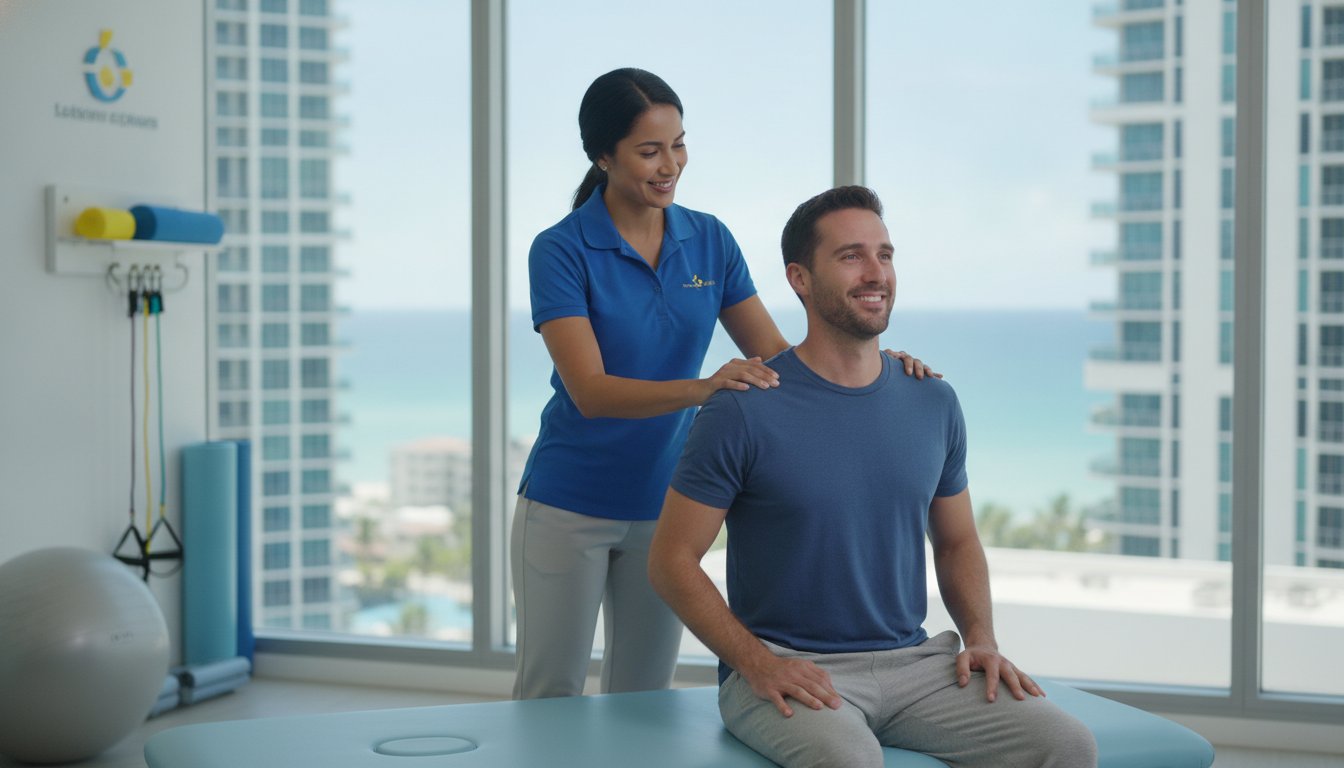
What if the persistent tension in your shoulders and those nagging afternoon headaches aren’t just signs of a long workday, but your body’s “internal GPS” being recalibrated by your digital habits? It’s a common struggle, where hours spent leaning over screens can lead to the “nerd neck” appearance that many fear will become a permanent fixture. You don’t have to live with the discomfort or the self-consciousness that comes with a shifting profile. Specialized physical therapy for forward head posture provides a sophisticated pathway to retrain your nervous system and realign your spine, moving beyond temporary fixes to achieve lasting structural restoration.
We recognize the frustration of feeling stuck in a cycle of upper back pain and the worry that your spinal health is at risk. This comprehensive guide details how professional intervention can eliminate chronic neck pain and restore your natural, confident alignment. You’ll gain a clear roadmap for long-term vitality, featuring evidence-based strategies and postural education that empower you to return to pain-free daily movement. By addressing the biomechanical barriers that hold you back, we can work together to ensure your posture reflects your strength and health.
Key Takeaways
- Learn how the “10-Pound Rule” explains the hidden pressure on your spine and why addressing these biomechanical shifts is essential for your long-term health.
- Discover why professional physical therapy for forward head posture is more effective than generic stretches, specifically by targeting the root causes of Upper Crossed Syndrome.
- Understand the clinical steps of correction, from manual therapy for pain mitigation to specialized joint mobilization that restores your neck’s natural range of motion.
- Identify the risks of self-treating postural issues and how a personalized evaluation ensures you don’t inadvertently aggravate sensitive spinal discs.
- Master practical ergonomic habits, such as the 20-20-20 rule, to protect your spinal alignment while navigating the demands of a modern digital workspace.
Understanding Forward Head Posture: More Than Just a ‘Hunch’
Forward Head Posture (FHP) is more than a minor slouch; it’s a significant biomechanical shift where your head protrudes anteriorly from its vertical axis. Often called “Text Neck” or “Nerd Neck,” this condition reflects the physical toll of our modern, screen-centric lives. Understanding Forward Head Posture is the first step toward reclaiming your health. When your head shifts forward, it disrupts the natural “cascading effect” of your spine, forcing lower vertebrae to compensate for the imbalance. This isn’t just an aesthetic concern; it’s a structural issue that affects your entire nervous system.
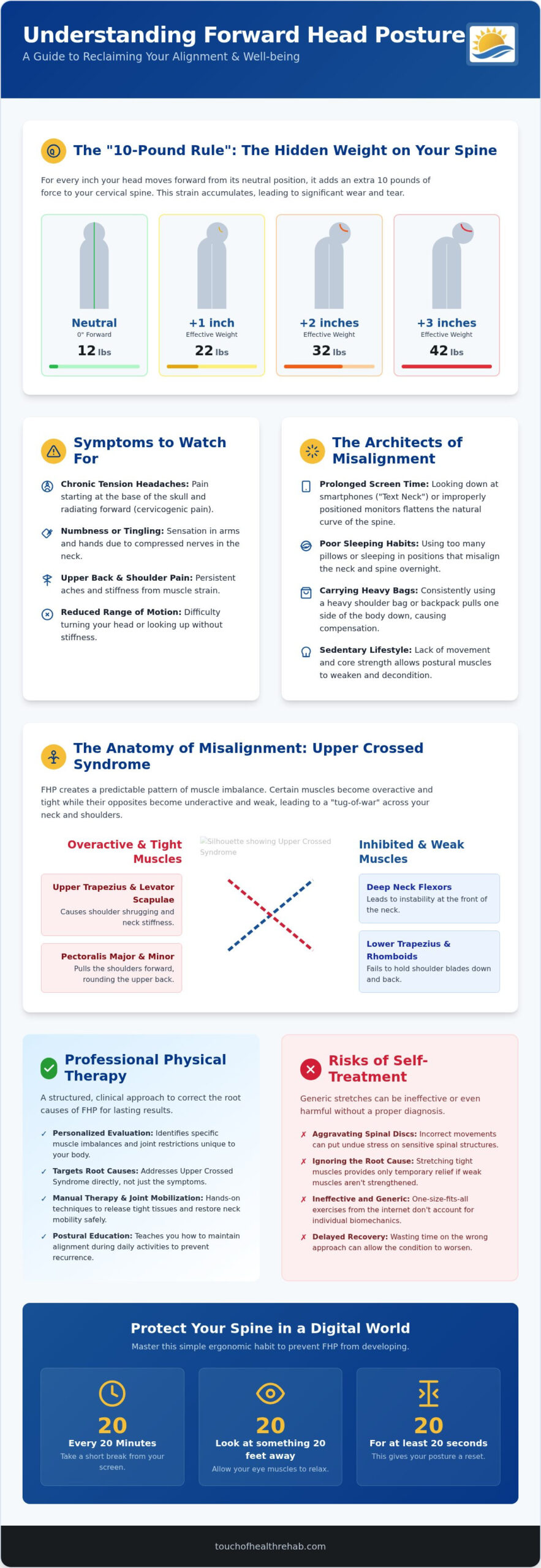
The physical strain is quantifiable through the “10-Pound Rule.” For every inch your head moves forward from its neutral position, it adds an additional 10 pounds of pressure to your cervical spine. If your head weighs 12 pounds and shifts three inches forward, your neck muscles are suddenly tasked with supporting 42 pounds. In the digital-heavy environments of Sunny Isles Beach and Aventura, where professionals spend hours on laptops and tablets, this constant load leads to rapid wear and tear. You can perform a simple “Wall Test” to check your alignment: stand with your heels, glutes, and shoulder blades against a flat wall. If your head doesn’t naturally touch the wall without you tilting it back, you’re likely dealing with FHP.
The Symptoms You Shouldn’t Ignore
FHP doesn’t just change how you look; it changes how you feel. Chronic tension headaches, often called cervicogenic pain, frequently start at the base of the skull and radiate forward. You might also experience numbness or tingling in your arms. This happens when compressed nerves in the neck struggle to send signals to your extremities. Beyond physical pain, poor posture can sap your energy and affect your self-confidence. It’s difficult to feel empowered when your body is physically pulled downward by the weight of misalignment.
Common Causes: From Smartphones to Sleeping Habits
Our daily habits are the primary architects of our posture. Prolonged screen time is a major culprit, as looking down at a smartphone flattens the natural curve of the cervical spine. Improper workstation ergonomics in home offices also play a role; if your monitor isn’t at eye level, your body will adapt to that suboptimal position. Even small factors, like carrying a heavy shoulder bag or sleeping on too many pillows, can contribute to a permanent “hunch.” Seeking professional postural education and physical therapy for forward head posture helps reverse these patterns before they lead to long-term spinal damage. It’s about retraining your body to find its natural center again.
The Anatomy of Misalignment: Why Your Neck Feels Stiff
When your head drifts forward, your body doesn’t just let it happen. It adapts through a specific pattern of muscle compensation known as Upper Crossed Syndrome. This condition describes a predictable imbalance where certain muscle groups become chronically overactive and tight, while their functional opposites become inhibited and weak. This creates a mechanical tug-of-war across your shoulder girdle and neck. Without professional intervention, your spine inevitably loses this battle, leading to the persistent stiffness and restricted movement you feel every day. Utilizing specialized physical therapy for forward head posture is the most effective way to break this cycle and restore your body’s natural equilibrium.
The tight culprits in this scenario are the suboccipitals at the base of your skull, the pectorals in your chest, and the upper trapezius muscles. These muscles work overtime to keep your eyes level with the horizon despite your forward lean. Meanwhile, the weak victims are the deep neck flexors and the lower stabilizers of the shoulder blades. A 2026 systematic review of therapeutic exercises confirms that targeted rehabilitation is essential to correct these specific imbalances and restore structural integrity. By strengthening the weak stabilizers and releasing the overactive ones, you can finally move without the constant sensation of being pulled forward.
The Link Between Posture and Dizziness
Your neck is a primary source of sensory information for your brain. When misalignment occurs, it can interfere with the vestibular system, which manages your sense of balance. This connection is why many individuals with chronic postural issues also report feelings of lightheadedness or instability, particularly in older adults. For those experiencing vertigo alongside neck stiffness, integrating vestibular rehabilitation into your care plan can help stabilize your balance and reduce dizzy spells.
Long-Term Risks of Untreated FHP
Ignoring these signs can lead to permanent bone remodeling, often manifesting as a Dowager’s Hump or kyphosis. Over time, the extra pressure accelerates early-onset osteoarthritis and degenerative disc disease in the cervical spine. Your breathing may even suffer; a collapsed chest cavity limits the expansion of your lungs, reducing your overall oxygen intake and vitality. If you’ve noticed your balance shifting or your neck feeling increasingly rigid, our team can provide the postural education needed to reverse these trends and protect your long-term spinal health. Those dealing with joint degeneration may also benefit from understanding how physical therapy for arthritis pain can address the wear and tear that accelerated spinal stress often causes.
Home Stretches vs. Professional Physical Therapy
It’s tempting to rely on a four-minute “miracle fix” video from social media when you’re dealing with neck tension. While these quick routines offer a temporary sense of relief, they often fail to provide lasting results because they treat the symptom rather than the systemic cause. Self-treating without a clinical diagnosis can actually be counterproductive. If you have an undiagnosed disc herniation or spinal stenosis, certain generic stretches might aggravate your condition rather than heal it. Professional physical therapy for forward head posture ensures that every movement you perform is safe, intentional, and specifically chosen for your unique spinal health.
A physical therapist looks beyond the neck to identify the true root cause of your misalignment. Sometimes, the “hunch” in your upper back is actually a compensation for tight hips or a lack of stability in your lower spine. We also focus heavily on proprioception, which is your brain’s ability to perceive your body’s position in space. After years of slouching, your brain has been trained to accept that “hunch” as your natural center. Clinical interventions recalibrate this internal GPS, retraining your nervous system to recognize what a healthy, neutral alignment actually feels like. This neurological reset is a cornerstone of effective posture-correction interventions, providing a foundation for permanent change that home exercises simply can’t match.
Why ‘Just Standing Up Straighter’ Doesn’t Work
Consciously trying to pull your shoulders back is an exhausting battle against your own muscle memory. Over time, chronic tension creates fascial restrictions, which are physical changes in your connective tissue that lock your body into a forward lean. These restrictions are like a tight suit that’s a size too small; you can’t just wish them away. Integrating professional postural education into your routine helps you understand these physical barriers. It gives you the tools to break through fascial limitations and build a body that naturally defaults to an upright, open position.
What a Clinical Assessment Looks Like
A clinical assessment is a deep dive into your body’s biomechanics. We perform range of motion testing and evaluate strength symmetry to see where your muscles are overcompensating. Through skilled palpation, your therapist identifies specific trigger points and areas of spinal “stuckness” that require manual release. This detailed information allows us to develop a personalized physical therapy plan tailored to your specific needs. This collaborative process ensures that you aren’t just doing exercises, but actively rebuilding your structural integrity for long-term health.
The Clinical Path to Correction: How We Fix FHP
Correcting Forward Head Posture (FHP) requires a methodical, multi-phase approach that moves beyond temporary relief toward functional restoration. It isn’t enough to simply stretch; you must systematically address the pain, the joint restrictions, and the underlying muscle weakness. Our clinical framework follows a logical progression that begins with calming inflamed tissues and ends with retraining your body to maintain its natural alignment effortlessly. By engaging in professional physical therapy for forward head posture, you’re choosing a path that prioritizes long-term spinal health over short-term fixes.
Manual Therapy: The Hands-On Advantage
The first step in your recovery often involves manual therapy to “unlock” the physical restrictions holding you in a slumped position. We use myofascial release to address the chronic tightness in your chest and neck muscles, which allows your shoulders to drop back into their natural state. This hands-on expertise is a core component of orthopedic physiotherapy, where the focus is on restoring the proper “glide” to your cervical and thoracic vertebrae. Professional guidance ensures that we are mobilizing the specific joints that are stuck, rather than overstressing the ones that are already loose, providing a safer and more effective route to alignment.
The Best Exercises for Forward Head Posture
Once the joints are mobile, we transition to targeted strengthening. The “Chin Tuck” is the gold standard for activating the deep cervical flexors, which serve as the core of your neck. To perform this correctly, sit tall and gently draw your chin straight back toward your throat as if making a “double chin” while keeping your eyes level. We complement this with scapular squeezes to open the chest and Wall Angels to retrain the muscles of your upper back. These movements teach your body how to support the weight of your head without straining the delicate structures of your spine. For active individuals and athletes whose postural issues are compounded by sport-related strain, the same active rehabilitation principles used in sports injury physical therapy in Sunny Isles Beach can accelerate recovery and restore optimal biomechanics.
Postural Education: The ‘Secret Sauce’ for Longevity
The final phase of correction is integrating these new habits into your daily life. We teach you how to find a “neutral spine” whether you’re sitting at a desk in Aventura or walking along Sunny Isles Beach. Using biofeedback techniques, you’ll learn to catch yourself slouching before the pain starts, turning your recovery into a proactive habit. Integrating these lessons into a wellness and preventative care routine ensures that your progress isn’t just temporary, but a permanent upgrade to your quality of life. If you’re ready to stop the “hunch” and start living with confidence, you can consult with our expert team to begin your personalized journey.
Living Alignment-First in Sunny Isles Beach
Maintaining the progress you’ve made through physical therapy for forward head posture requires more than just clinical visits; it involves a commitment to how you move throughout your day. In the vibrant professional hubs of Sunny Isles Beach and Aventura, many of us spend hours at desks or on the go. Transitioning to an “alignment-first” lifestyle means making your environment work for you, rather than forcing your body to adapt to your technology. By integrating small, purposeful changes, you can protect your spine and ensure your recovery remains permanent.
Ergonomics for the Home Office
Proper workstation setup is your first line of defense against recurring misalignment. Start by ensuring your monitor or laptop stand is at eye level; this simple adjustment prevents you from tilting your head down and adding unnecessary weight to your spine. Your chair should support the natural lumbar curve of your lower back, which helps stabilize your entire spinal column from the base up. We advocate for “dynamic sitting,” which means changing your position every 30 minutes to prevent muscle stiffness from setting in. Even a small shift in weight can keep your tissues hydrated and resilient.
Our digital habits often extend far beyond the desk. When using your smartphone, remember the golden rule: bring the phone to your eyes, not your eyes to the phone. Lifting your device to chest or eye level immediately reduces the strain on your cervical ligaments and keeps your head in its neutral, healthy position. This habit alone can significantly reduce the daily load on your neck muscles.
To combat digital eye and neck strain, implement the 20-20-20 Rule. Every 20 minutes, take a 20-second break to look at something at least 20 feet away. This brief pause allows your neck muscles to reset and prevents the “frozen” posture that leads to long-term discomfort. It’s a simple tool that fits perfectly into a busy South Florida schedule.
Staying active in South Florida is easy with our beautiful beaches and parks, but protection is key. Whether you’re swimming or walking, focus on keeping your chin tucked and your shoulders relaxed. Regular check-ins with your physical therapist in Sunny Isles Beach serve as vital maintenance. These visits help you catch minor alignment shifts before they become painful relapses, ensuring you stay on the path to peak physical health. For those who have also undergone orthopedic procedures, exploring physical therapy after joint replacement in Sunny Isles Beach can provide the structured gait training and postural education needed to reclaim full mobility alongside your postural recovery.
Your Journey to Better Health Starts Here
You deserve a life that isn’t defined by chronic tension or the self-consciousness of a “nerd neck.” At Touch of Health Rehab, we provide a sanctuary for healing where your unique path to vitality is our priority. Our team is dedicated to bridging the gap between clinical treatment and your long-term wellness, providing the expert guidance you need to thrive.
Take the first step toward a more confident, pain-free version of yourself. Schedule your postural assessment at our Sunny Isles Beach clinic today!
Reclaiming Your Natural Alignment and Vitality
Your path to a pain-free life begins with the realization that your posture is a dynamic reflection of your overall health. We’ve explored how forward head posture is a complex structural challenge that requires more than a simple stretch; it demands a methodical approach to retrain your muscles and nervous system. By choosing specialized physical therapy for forward head posture, you’re investing in a future where chronic headaches and upper back tension no longer dictate your daily experience. You can move beyond the “hunch” and rediscover the strength of a neutral, supported spine.
At Touch of Health Rehab, our team is led by Lead Physical Therapist Berlin. We’re committed to your long-term restoration through specialized Postural Education programs designed for your unique biomechanics. Our clinic is conveniently located in Sunny Isles Beach, proudly serving the Aventura and Miami communities with a blend of clinical expertise and compassionate care. Start your journey to perfect alignment at Touch of Health Rehab. You have the power to transform your health, and we’re here to guide you every step of the way toward lasting comfort and confidence.
Frequently Asked Questions
Can physical therapy really fix forward head posture that I’ve had for years?
Yes, your body remains capable of adaptation even after years of misalignment. Through specialized physical therapy for forward head posture, we address the deep-seated fascial restrictions and muscle memory that keep you stuck. This process involves a collaborative effort to recalibrate your spinal “GPS,” ensuring your recovery is a sustainable journey toward long-term vitality rather than a temporary fix.
How long does it take to see results from physical therapy for neck posture?
You’ll likely experience a reduction in muscle tension within the first few sessions. However, clinical research from July 2026 indicates that significant improvements in spinal angle and functional capacity typically require eight weeks or more of consistent therapeutic exercise. Lasting structural restoration is a methodical process that mirrors the patient nature of physical rehabilitation itself, rewarding your persistence with improved alignment.
Is forward head posture permanent if I already have a small hump?
While a “hump” can indicate bone remodeling, it’s rarely permanent or beyond improvement. Professional intervention can halt the progression of kyphosis and significantly reduce the soft tissue inflammation that makes the hump appear larger. Our focus on postural education helps you regain height and confidence by strengthening the stabilizers that counteract the forward pull on your spine.
Can poor neck posture cause dizziness or vertigo?
Yes, your neck’s alignment is deeply connected to your balance and vestibular system. Misalignment can send conflicting signals to your brain, resulting in lightheadedness or instability. If you’re struggling with these symptoms, integrating vestibular rehabilitation into your care plan can help restore your balance while we simultaneously work on correcting the underlying cervical positioning.
What are the most effective exercises for ‘text neck’?
The most effective routine combines cervical stabilization, stretching, and postural correction. Chin tucks are the gold standard for activating deep flexors, while scapular squeezes and Wall Angels help open the chest and support the head’s weight. A multi-faceted approach, rather than a single exercise, is the most successful way to reverse the effects of prolonged screen use. Athletes looking to return to peak performance after addressing postural imbalances may also find that the structured recovery protocols used in sports injury physical therapy in Sunny Isles Beach offer valuable guidance for rebuilding strength and movement quality.
Does insurance typically cover physical therapy for posture correction?
Most insurance plans cover physical therapy when it’s medically necessary to treat pain or functional limitations caused by posture. As of July 2026, Medicare co-payments typically range from $25 to $60 per session. We recommend checking your specific policy’s KX modifier thresholds to understand your coverage limits for combined physical and speech therapy services.
How often should I see a physical therapist for postural education?
Most patients benefit from seeing a physical therapist one to two times per week during the initial phase of care. This frequency allows for consistent manual therapy and ensures your exercise form is precise. As you gain strength and master your postural education, your sessions may become less frequent, transitioning into a maintenance and wellness routine.
Will I need to wear a posture corrector or brace?
We generally don’t recommend external braces because they can lead to muscle laziness and further weakness over time. Our goal is to empower your body to support itself through internal strength and awareness. By focusing on your own “internal brace,” you’ll achieve a more natural and sustainable alignment that lasts long after a brace would have been removed.