Every 40 seconds, someone in the United States experiences a stroke, a moment that instantly alters the rhythm of daily life. If you’re facing this reality, you likely feel the weight of uncertainty and the fear that permanent disability is inevitable. It’s natural to feel frustrated by slow progress or confused by the different types of treatment available. However, specialized physical therapy for stroke recovery offers a way to reclaim your strength and confidence through the science of neuroplasticity, which allows your brain to rewire itself for movement.
You deserve a recovery process that feels like a partnership, not just a series of clinical appointments. We believe that every survivor has a unique path to healing that requires a dedicated guide and a sophisticated approach to care. This guide explores how a personalized recovery plan, incorporating advanced gait training and postural education, can help you regain your independence and significantly reduce fall risks. We’ll look at the latest 2026 rehabilitation trends and the practical steps needed to help you navigate your journey toward peak physical health right here in the South Florida community.
Key Takeaways
- Understand how neuroplasticity empowers your brain to forge new pathways, making physical therapy for stroke recovery a transformative process for regaining motor control.
- Learn how targeted gait and balance rehabilitation reduces your risk of falls while restoring the confidence you need to walk independently.
- Discover how specialized techniques like vestibular rehabilitation address complex symptoms such as dizziness and spasticity to improve your daily comfort.
- Identify the critical “window of opportunity” in the sub-acute phase of recovery to maximize your functional gains through a structured, personalized timeline.
- See why a one-on-one approach in a sanctuary-like clinical setting provides the steady, compassionate support required for your long-term vitality.
Understanding Physical Therapy for Stroke Recovery
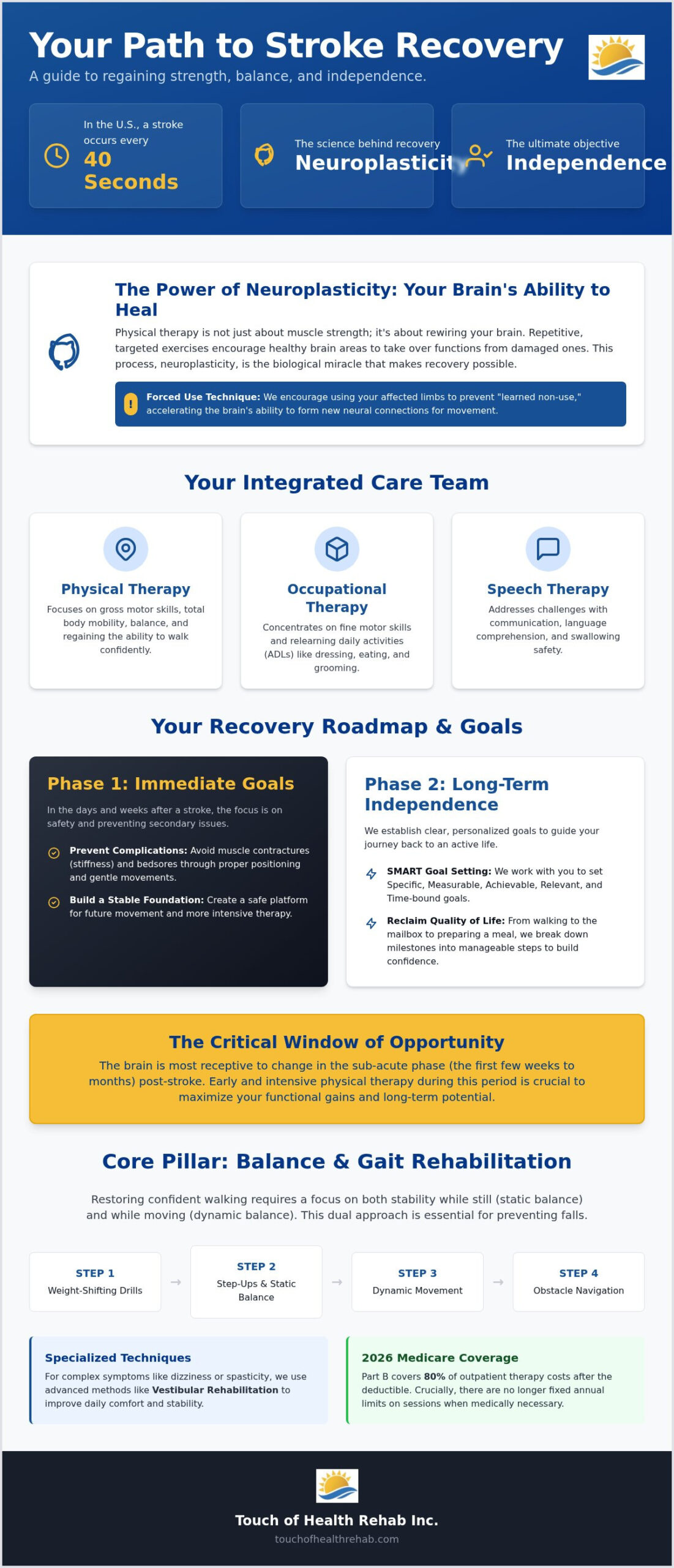
Recovery from a stroke is a profound journey of restoration. It begins the moment you are medically stable. While physicians manage your immediate health, stroke recovery therapy focuses on the neuro-restorative process. This is not simply about muscle strength; it is about teaching your nervous system to function again. Early intervention is vital. Your brain is most receptive to change in the weeks following the event, making this a critical window for progress. As of 2026, Medicare Part B covers 80% of these outpatient costs after your $257 deductible is met, and there are no longer fixed annual limits on sessions based on medical necessity. Understanding the distinct roles of your care team is the first step toward a successful outcome:
- Physical Therapy: Focuses on gross motor skills, total body mobility, and balance and gait rehabilitation.
- Occupational Therapy: Concentrates on fine motor skills and the ability to perform daily tasks like dressing or grooming.
- Speech Therapy: Addresses communication challenges and ensures swallowing safety.
By integrating physical therapy for stroke rehabilitation into your routine early, you set the stage for maximum functional return.
The Role of Neuroplasticity in Healing
Neuroplasticity is the brain’s ability to reorganize itself after injury. This biological miracle allows healthy parts of your brain to take over the functions once handled by damaged areas. When you engage in physical therapy for stroke recovery, repetitive, task-specific exercises stimulate these new neural pathways. We often utilize a technique called “forced use.” This approach encourages you to use your affected limbs rather than relying solely on your stronger side, which prevents a phenomenon known as “learned non-use.” By consistently challenging your body, you empower your brain to build the connections necessary for restoration.
Immediate vs. Long-Term Rehabilitation Goals
Your recovery timeline involves distinct phases, each with specific objectives designed to protect your vitality. In the immediate days following a stroke, our focus is on preventing secondary complications. We work to avoid muscle contractures, where joints become permanently stiff, and ensure proper positioning to prevent bedsores. These foundational steps create a stable platform for your future movement.
Achieving long-term independence requires a clear, personalized roadmap. You’ll work with your Sunny Isles Beach physical therapist to set SMART goals: specific, measurable, achievable, relevant, and time-bound. Whether your goal is walking to the mailbox or standing long enough to prepare a meal, we break these milestones into manageable steps. This methodical approach ensures you see constant progression, fostering the confidence needed to reclaim your quality of life and peak physical health.
Core Pillars of Post-Stroke Mobility and Stability
Restoring mobility requires a structured approach that addresses how your body interacts with gravity. While strength is helpful, the mechanics of movement are what truly restore independence. A comprehensive review of physical therapy interventions highlights how targeted movements can specifically address impairments like hemiparesis or coordination loss. By focusing on the core pillars of stability, physical therapy for stroke recovery transforms tentative steps into confident strides. This process isn’t just about moving; it’s about moving with efficiency and safety.
Balance and Gait Rehabilitation
Walking is a complex cycle involving weight bearing, swing, and foot clearance. We analyze your walking patterns to identify exactly where the cycle breaks down, whether it’s a lack of hip stability or difficulty lifting the toes. Through specialized balance and gait rehabilitation, we work on both static balance, which is staying steady while standing still, and dynamic balance, which is maintaining stability while moving. This dual focus is essential for fall prevention in everyday environments.
Specific exercises tailored to your needs might include:
- Weight-shifting drills: These build the necessary confidence to put weight on your affected side.
- Step-ups and obstacle navigation: These tasks improve foot clearance and help you avoid tripping on uneven surfaces.
- Rhythmic walking: This helps synchronize muscle firing patterns to create a more natural gait.
Postural Education and Alignment
Post-stroke changes often lead to misalignments like “pusher syndrome,” where a patient actively pushes away from their stronger side. This creates a high risk for falls and can lead to chronic discomfort if left unaddressed. Integrating postural education into your recovery plan ensures your body remains symmetrical and well-supported. Proper alignment conserves energy, making every movement feel less exhausting. It also prevents secondary joint pain in the hips and lower back that often results from compensating for weakness.
We teach you techniques for maintaining symmetry whether you’re sitting in a favorite chair or standing at a kitchen counter. This constant awareness of your body’s position in space is a key factor in long-term vitality. Physical conditioning also plays a vital role by managing muscle spasticity and hypertonia. Regular, clinical stretching combined with targeted strengthening combats the weakness that often follows a neurological event. If you’re ready to build a foundation for lasting mobility, you can start your journey with our dedicated team and discover how a personalized plan makes a difference.
Specialized Techniques for Complex Stroke Symptoms
While restoring basic movement is the first priority, many survivors face complex symptoms that require a more nuanced approach. Physical therapy for stroke recovery isn’t just about walking; it’s about fine-tuning how your brain perceives your body and the world around it. We often see patients struggling with limb awareness, known as proprioceptive training, or a lack of endurance. Cardiovascular conditioning is also a vital tool for brain health. It provides the stamina you need for intensive therapy sessions and promotes overall neurological healing. According to the NIH Stroke Rehabilitation Review, these specialized interventions are essential for tailoring recovery to the specific neurological deficits of each individual.
Vestibular Rehabilitation for Dizziness
Dizziness is one of the most overlooked symptoms in stroke rehabilitation. A stroke can disrupt the delicate signals between your inner ear and your brain, leading to a persistent sense of vertigo or nausea. This is not a sign of failure. It’s a sign that your balance system needs recalibration. This is where vestibular rehabilitation becomes essential to your recovery. We use gaze stabilization exercises to retrain your eyes to stay focused while your head is moving. These targeted movements help your brain process balance information correctly again, reducing nausea and helping you feel grounded in your environment.
Physical Conditioning for Muscle Spasticity
Spasticity and hypertonia involve painful muscle tightness that restricts your range of motion. This affects roughly 30% of survivors and can make even simple tasks feel like a struggle. We address this through clinical stretching and precise positioning to keep your muscles long and flexible. We don’t just focus on the side affected by the stroke. Strengthening your “unaffected” side is equally important to provide the total body support required for mobility. For those dealing with chronic discomfort, we often integrate pain management solutions to ensure your therapy remains a positive, restorative experience. By combining these techniques, we help you manage the hypertonia that often limits your daily activities, paving the way for a return to peak physical health.
Designing Your Personalized Stroke Recovery Timeline
Your journey toward restoration begins with a comprehensive initial assessment. We don’t just look at what you can’t do; we evaluate your current strength, sensation, and coordination to see what’s truly possible. This evaluation allows us to craft a roadmap tailored specifically to your neurological needs. Physical therapy for stroke recovery is most effective when it follows a logical, steady progression that respects your body’s healing pace while pushing for maximum functional gain. By setting clear milestones, we turn an overwhelming process into a series of achievable victories.
The First 90 Days: Building the Foundation
The first three months are often the most intensive part of your rehabilitation. During this time, we prioritize high-intensity, repetitive movements that signal your brain to begin the rewiring process. We also establish a safe fall prevention therapy protocol early on to ensure you feel secure as you regain your mobility. The ‘golden period’ of stroke recovery is the first 3-6 months post-event, a window where the brain’s capacity for change is at its highest. Our goal during this phase is to jumpstart neuroplasticity through consistent, guided effort that builds the foundation for all future movement.
Maintenance and Long-Term Functional Independence
As you move into the chronic phase of recovery, the focus shifts toward community reintegration and advanced mobility. We want you to do more than just walk; we want you to thrive in your daily life and navigate your neighborhood with ease. This involves ongoing wellness and preventative care to maintain your hard-won gains and significantly reduce the risk of a second stroke. Transitioning from clinical physical therapy for stroke recovery to a home-based conditioning plan requires a supportive environment. We work closely with your family and caregivers to ensure your home remains a sanctuary for healing, preventing regression and fostering the long-term independence you deserve.
Recovery is a collaborative journey that requires a dedicated guide by your side. If you’re ready to move beyond limitations and start your personalized path to health, contact Touch of Health Rehab today to begin your clinical assessment.
Finding Expert Stroke Rehabilitation in Sunny Isles Beach
Choosing where to receive physical therapy for stroke recovery is a pivotal step in your journey toward independence. While large hospital systems provide essential acute care, a boutique clinical environment offers the one-on-one attention necessary for complex neurological restoration. You aren’t just a patient number; you’re a partner in a collaborative process. This personalized focus allows your therapist to catch small misalignments in real-time, ensuring that every movement contributes to your long-term vitality. By selecting a local provider in the Sunny Isles Beach and Aventura area, you remove the stress of long commutes, making it easier to maintain the consistent schedule that neuroplasticity requires.
What to Look for in a South Florida Physical Therapist
When evaluating a South Florida physical therapist, you should look for a specific blend of clinical precision and holistic wellness. A dedicated guide should have extensive experience in neurological rehabilitation and gait training. Ask potential therapists how they plan to adapt your program as you progress through different stages of recovery. Proximity to Miami Beach, Bal Harbor, and North Miami Beach is also a practical consideration for your recovery timeline. You want a clinic that feels like a sanctuary, where you can focus entirely on your restoration without the distractions of a crowded medical facility.
Consider asking these questions during your initial visit:
- How do you personalize treatment plans for stroke survivors?
- What specific technologies or techniques do you use for balance and gait?
- How do you integrate postural education into daily movements?
- What is your approach to managing long-term muscle spasticity?
The Touch of Health Rehab Approach to Stroke Care
At Touch of Health Rehab, we’ve designed our clinic as a sanctuary for healing near Miami Beach. Our team of dedicated guides prioritizes your unique path to restoration through a compassionate, expert-led approach. We recognize that many survivors are also managing age-related changes, which is why we seamlessly integrate geriatric physical therapy into our stroke care plans to address the specific needs of older adults. You can meet our team to learn more about our commitment to your success and our passion for the craft of healing led by Lead Physical Therapist Berlin.
We believe that physical therapy for stroke recovery is more than just returning to function; it’s about attaining peak physical health and reclaiming your quality of life. Our methodical, steady rhythm of care ensures that your journey is handled with patience and thoroughness. By positioning ourselves as your partners in health, we provide the stability and reassurance you need to move forward through Sunny Isles Beach and the surrounding communities with confidence and strength.
Your Path to Restored Independence
Reclaiming your mobility after a stroke is a journey that requires patience, expertise, and a dedicated partner. We’ve explored how the science of neuroplasticity allows your brain to rewire itself and why the first six months are so critical for functional gains. By focusing on specialized gait training and postural education, you can reduce your risk of falls and move with renewed confidence. Every step you take toward peak physical health is a victory for your long-term vitality.
At Touch of Health Rehab, we offer a sanctuary for healing right in the heart of Sunny Isles Beach, serving our neighbors in Aventura and Miami Beach. Our Lead Physical Therapist, Berlin, provides expert care through customized plans that prioritize your unique recovery timeline. When you choose specialized physical therapy for stroke recovery, you aren’t just attending sessions; you’re investing in your future independence. We’re here to guide you through every milestone with professional authority and compassionate support.
Ready to reclaim your mobility? Schedule your personalized stroke recovery consultation at Touch of Health Rehab today. Your journey to restoration starts with a single, guided step toward the life you deserve.
Frequently Asked Questions
How long does physical therapy for stroke recovery usually take?
The duration of your rehabilitation depends on the severity of the stroke and your specific recovery goals. Most survivors see the most rapid progress during the sub-acute phase, which is the first three to six months after the event. However, physical therapy for stroke recovery is often an ongoing process. We focus on steady, methodical progression to ensure you reach your peak physical health, whether that takes several months or longer-term maintenance.
Can I still improve my mobility years after having a stroke?
Yes, you can absolutely continue to make functional gains years after your initial stroke. Your brain remains capable of neuroplasticity throughout your life, meaning you can still forge new neural pathways through consistent, task-specific exercises. Our team in Sunny Isles Beach works with many survivors in the chronic phase to refine their balance and gait rehabilitation. It’s never too late to start a personalized plan that prioritizes your restoration and independence.
Is physical therapy painful for stroke survivors?
Rehabilitation should be challenging and intensive, but it should not be painful. We prioritize your comfort by using clinical stretching and precise positioning to manage muscle spasticity. If you experience chronic discomfort, we integrate specialized pain management solutions into your sessions. Our goal is to create a sanctuary for healing where you feel supported and encouraged. We always adjust the intensity of your movements to match your body’s current tolerance and healing pace.
How often should I attend physical therapy sessions for the best results?
Most survivors benefit from attending sessions two to three times per week during the early stages of recovery. As of 2026, Medicare no longer imposes a fixed annual limit on the number of therapy sessions you can receive. Instead, coverage is based on the medical necessity documented by your therapist. This allows us to create a consistent rhythm of care that mirrors your body’s needs, helping you maintain the momentum required for lasting mobility gains.
What happens if I stop physical therapy too early in my recovery?
Stopping therapy prematurely can lead to regression, muscle contractures, and a phenomenon known as “learned non-use,” where you stop using your affected side entirely. Ongoing wellness and preventative care are essential to maintain the strength and coordination you’ve worked hard to regain. Consistent attendance at our Sunny Isles Beach clinic helps you stay on track. We ensure you have the necessary tools and home conditioning plans to prevent functional decline and protect your long-term vitality.
Does insurance cover physical therapy for stroke rehabilitation in Florida?
Yes, most insurance plans, including Medicare, provide coverage for outpatient stroke rehabilitation in Florida. For 2026, Medicare Part B covers 80% of the cost once you’ve met your annual deductible of $257. This makes professional care accessible for residents in Aventura and Miami Beach. We recommend verifying your specific plan details with our office during your initial assessment. This ensures you can focus entirely on your recovery journey without financial uncertainty or stress.
What is the difference between physical therapy and occupational therapy for stroke?
Physical therapy focuses on gross motor skills, such as your ability to walk, stand, and maintain your balance. Occupational therapy centers on fine motor skills and your ability to perform activities of daily living like dressing or eating. Both are vital components of a comprehensive recovery plan. In our clinical environment, we often integrate balance and gait rehabilitation with functional movement training. This collaborative approach ensures you regain the total body coordination needed for a high quality of life.
How can I prevent falls at home during my stroke recovery?
Preventing falls requires a combination of home modifications and specialized fall prevention therapy. You should remove loose rugs, install grab bars in bathrooms, and ensure all walkways are well-lit for safety. We also teach you postural education techniques to improve your awareness of your body’s position. By strengthening your core and improving your weight-shifting abilities, we help you navigate your home in North Miami Beach with greater confidence. These practical steps significantly reduce your risk of injury.