Shoulder pain doesn’t always mean you have to give up swimming for good. Swimmer’s shoulder can involve irritation around the rotator cuff, with pain and reduced range of motion that affect your stroke. Physical therapy for swimmer’s shoulder in Aventura can help you build strength and shoulder stability while guiding a gradual return to the water.
If swimming brings on pain, pushing through it may aggravate the problem. You may need to pause or modify certain movements during treatment, but that does not necessarily mean stopping all activity. The right approach depends on your symptoms and how your shoulder responds. This article explains swimmer’s shoulder, how rehabilitation can address strength, flexibility, and movement patterns, and what to consider when deciding whether to swim during recovery.
Key Takeaways
- Swimmer’s shoulder can involve more than one structure, so understanding the pattern of symptoms helps guide the next steps.
- Rehabilitation can build rotator cuff strength and improve the shoulder’s support for swimming movements.
- Whether to pause swimming depends on how your shoulder responds; painful movements may need to be modified or temporarily stopped.
- Training adjustments and cross-training can help maintain activity while reducing repeated shoulder strain.
- Physical therapy appointments in Aventura can support a gradual, individualized approach to rebuilding shoulder function.
Rotator cuff strengthening
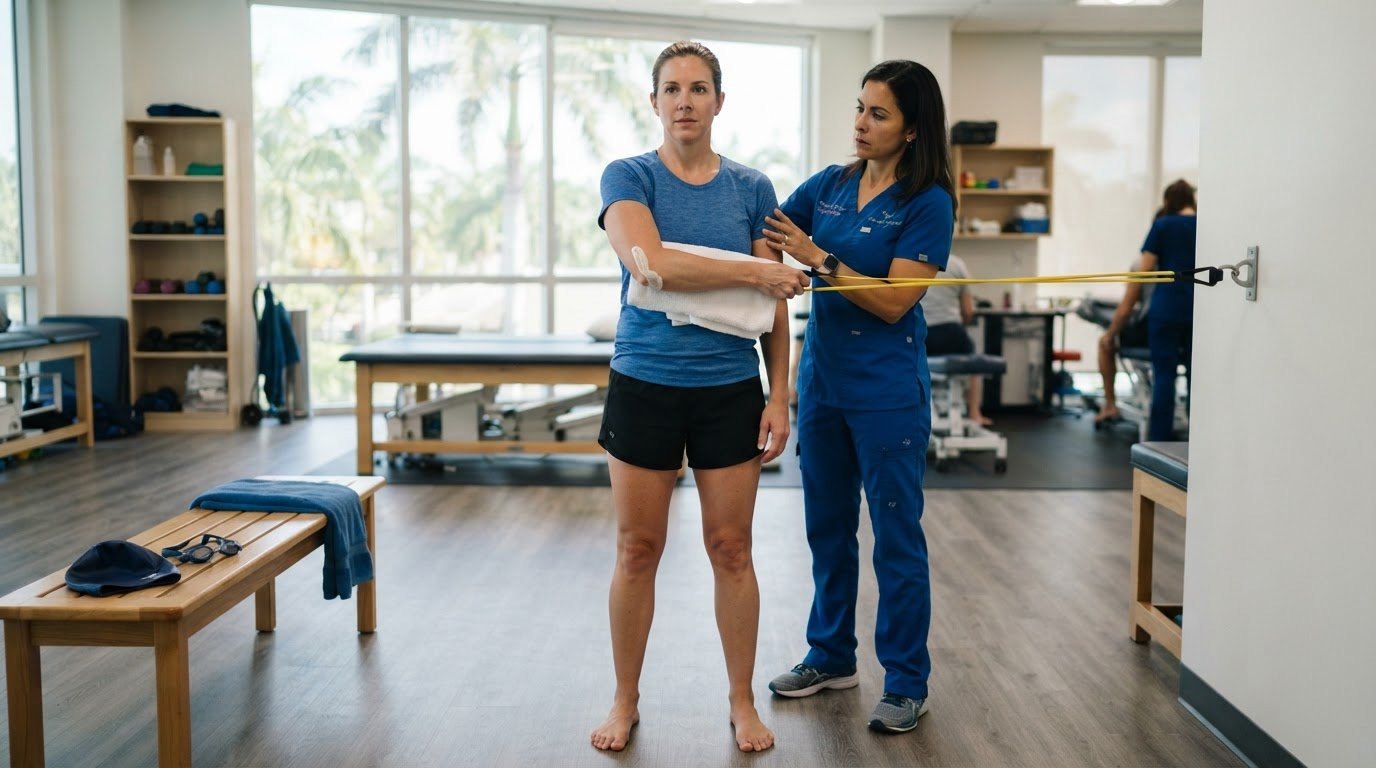
Physical therapy for swimmer’s shoulder can combine therapeutic exercise, stretching, manual therapy, and movement correction. For example, a therapist may use resistance-band rotations to strengthen the rotator cuff, then assess how your shoulder moves during an overhead reach. A plan can address pain and function together, rather than focusing on strength alone.
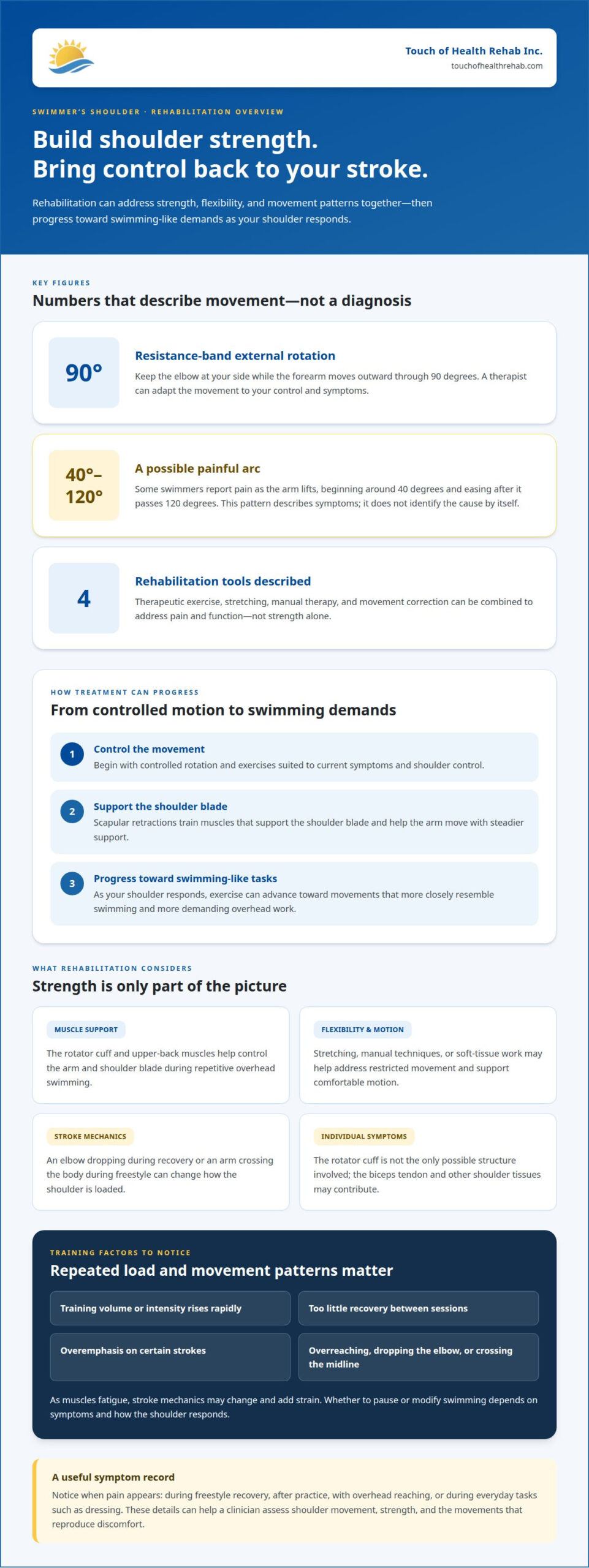
During repetitive overhead swimming, the rotator cuff and upper-back muscles help control the arm and shoulder blade. As these muscles fatigue, stroke mechanics may change and place additional strain on shoulder tissues. You might notice your elbow dropping during recovery or your arm crossing your body during freestyle. These changes can increase irritation, so rehabilitation considers both shoulder strength and the movements that load it.
Targeted exercises can build strength in the muscles that rotate and stabilize the shoulder. One resistance-band external rotation exercise keeps the elbow at your side while the forearm moves outward through 90 degrees. A physical therapist can adapt the movement to your current control and symptoms. Scapular retractions also train the muscles that support the shoulder blade, helping the arm move with steadier support.
When the rotator cuff or upper back is fatigued, a familiar training load can feel harder to manage. Rehabilitation may progress from controlled movements to tasks that more closely resemble swimming, with attention to how your shoulder responds. Flexibility work can address restricted movement, too. A therapist may use manual stretching or massage around the rotator cuff to ease tension and support comfortable motion.
Rotator cuff irritation and inflammation can contribute to shoulder pain and reduced range of motion. Therapeutic exercise and manual techniques may help ease discomfort while restoring movement. Joint mobilization or soft-tissue work can complement active exercises rather than serve as the entire treatment. The approach depends on the tissues and movements involved in your symptoms.
Not every swimmer’s shoulder problem is limited to the rotator cuff. The biceps tendon and other shoulder tissues may also be involved, and pain during an overhead reach can have different contributing factors. Treatment should reflect the specific injury pattern and your ability to move and load the arm. For example, exercises may begin with controlled rotation before progressing to more demanding overhead movements.
Strengthening is most useful when it supports the demands of your stroke without provoking symptoms. A therapist can adjust resistance, range of motion, and exercise selection as your shoulder control changes. Gradual progression connects rotator cuff strength with coordinated shoulder movement, addressing both the muscles and swimming’s repetitive overhead demands.
What is Swimmer’s Shoulder?
Swimmer’s shoulder describes shoulder problems linked to repeated overhead swimming movements, including impingement, tendon irritation, and rotator cuff injuries. A doctor can evaluate pain that persists after swimming, limits arm movement, or occurs with weakness.
Swimmer’s Shoulder Symptoms
Symptoms can include shoulder pain during or after swimming, weakness, fatigue, reduced flexibility, and a feeling of instability. Some swimmers notice a painful arc as they lift an arm, with pain beginning around 40 degrees and easing after the arm passes 120 degrees. This pattern can help describe symptoms, but it doesn’t identify the cause by itself.
Notice which movements bring on symptoms. Pain during freestyle recovery, difficulty reaching overhead, or discomfort when dressing can point to different movement challenges. Symptoms may also vary with training load: you might feel comfortable early in practice, then develop pain as fatigue affects stroke mechanics. These details help a clinician understand what limits your shoulder function.
Causes of Swimmer’s Shoulder
Swimmer’s shoulder can develop when repeated overhead movements place ongoing demands on shoulder tissues. Rapid increases in training volume or intensity, too little recovery between sessions, and overemphasis on certain strokes may contribute. Stroke mechanics matter, too: overreaching, dropping the elbow, or crossing the midline during freestyle can increase shoulder strain.
Several structures may be involved, including the rotator cuff, biceps tendon, labrum, or tissues affected by impingement. Shoulder instability and tendon disease are also possible contributors. The term describes a group of problems, not one specific injury, so similar pain can have different underlying causes.
Posture and movement control can affect how your shoulder handles swimming. For example, repeatedly reaching across your body can load the shoulder differently than following a straighter arm path. Limited flexibility or reduced shoulder-blade control may also affect comfortable movement. An assessment considers these patterns alongside your symptoms and swimming demands.
A clinical evaluation can examine shoulder range of motion, strength, and movements that reproduce discomfort. The clinician may ask whether pain appears during a particular stroke, after practice, or during everyday tasks such as reaching to a shelf. This information helps distinguish a movement-related pattern from other possible sources of shoulder pain and guides appropriate next steps.
If shoulder pain is changing your stroke or daily movement, individualized rehabilitation guidance can help you understand what factors may be contributing and how to approach recovery.
Swimmer’s shoulder is a broad term for shoulder problems associated with repetitive overhead movements. Possible causes include rotator cuff injury, shoulder instability, bone spurs, labral injury, tendon disease, and osteoarthritis. Poor swimming technique or mechanics and overtraining without adequate recovery are also identified as causes. This broad label can therefore describe different shoulder problems.
Studies cited report that shoulder pain or injuries affect between 40% and 91% of swimmers. Up to 90% of competitive swimmers experience shoulder pain at some point in their careers.
Should I stop swimming during treatment?
If swimming hurts your shoulder, stop the painful movement rather than pushing through it. Depending on your symptoms and how the shoulder responds, treatment may involve modifying or temporarily pausing swimming while you recover.
Swimming and Training Modifications
Training modifications change the movements, intensity, or frequency that aggravate your shoulder, helping reduce repeated strain during recovery. For example, if freestyle pull-through causes pain, continuing that motion may keep irritating the shoulder.
Alternate high-intensity training with recovery sessions instead of stacking demanding practices. If you return to swimming, technique matters: maintaining a high elbow during freestyle recovery, avoiding excessive internal rotation during the pull, and using your core and lower body can help distribute workload. A therapist can advise on technique and training changes suited to your symptoms.
Cross-training can help you stay active while giving repetitive overhead movements a break. Cycling or yoga are examples of activities that do not rely on repeated swimming strokes. Choose activities that do not reproduce shoulder pain, and adjust movements involving reaching or lifting if they aggravate your symptoms. The aim is to stay within a comfortable range, not replace swimming with another painful motion.
Pay attention to how your shoulder responds during and after each activity. Pain that appears during a session, worsens afterward, or limits everyday movement suggests the load may need to change. For example, reduce the intensity or pause the stroke that triggers discomfort. Painful overhead motion can aggravate shoulder impingement symptoms, so do not use a demanding swim to test your recovery.
Recovery Time and Activity Changes
Recovery time varies with the severity of the injury, from a few weeks to months. Mild inflammation or early overuse injuries may take 2-4 weeks with rest, physical therapy, and a gradual return; moderate tendinitis or mild rotator cuff strains often need 4-8 weeks. Severe injuries, such as partial rotator cuff tears or prolonged impingement, may take 3-6 months.
These considerations show why activity changes should reflect your injury and symptoms. Stop swimming if it hurts, and wait to return until the pain has stopped or the injury has healed. In the meantime, therapy can help rebuild shoulder function while you modify activities that load the surrounding tissues.
A gradual return focuses on comfortable movement and controlled training, not immediately resuming your full routine. For example, if you have paused painful freestyle, discuss a modified training plan and progress as your symptoms allow. If pain returns during a session, stop that movement and revisit your activity level. A pain-free moment does not necessarily mean your shoulder is ready for every stroke and workload.
Muscle imbalances and shoulder stability
Shoulder stability depends on coordinated muscle support, not strength in one muscle alone. For swimmers, balancing shoulder mobility with control can help the arm move overhead while the shoulder blade stays supported.
Scapular Stabilization
Scapular stabilization trains the muscles that control the shoulder blade as your arm moves. This support matters during overhead strokes, when the shoulder blade needs to move with the arm rather than lag behind.
Scapular retractions and wall slides are examples of exercises used to improve shoulder-blade control. During a retraction, gently draw your shoulder blades back, then relax without forcing your shoulders upward. For a wall slide, move your arms upward along the wall with smooth, controlled motion. These exercises develop coordination as well as strength.
Muscle balance matters, too. Weaker external rotators alongside stronger internal rotators are associated with greater shoulder-pain risk in swimmers. Rehabilitation can address this imbalance with controlled rotation exercises and scapular work, rather than repeatedly loading the strongest movement pattern. Better coordination can help distribute force across the shoulder muscles and tendons.
Shoulder Mobility
Shoulder mobility is the ability to move your arm through a comfortable range while maintaining control. It matters because restricted movement can change how you reach overhead and load the shoulder during a stroke.
Mobility and stability work together. Your arm may reach overhead, for example, but the shoulder blade and surrounding muscles also need to guide the movement. A therapist can assess where motion feels restricted and pair flexibility work with strengthening, helping you develop range without neglecting support.
Posture can influence shoulder position during both training and daily activities. Sitting upright gives the shoulder a position that may support rest and recovery, while a rounded posture can alter how the shoulder moves. Postural education can help you understand how everyday positioning relates to shoulder mechanics, including time spent at a desk between swim sessions.
Progression should connect controlled exercises to the movements your shoulder needs. A therapist might first observe scapular retractions, then assess a wall slide, and later consider how your arm moves overhead. If control changes or discomfort appears, the exercise range or resistance can be adjusted. This approach addresses mobility and stability together.
For swimmers, the goal is coordinated movement: the rotator cuff supports the arm while the shoulder blade provides a stable base. Exercises such as wall slides and scapular retractions can develop that teamwork. Balancing strength, flexibility, and movement control gives your shoulder a considered foundation for swimming demands.
Physical therapy appointments in Aventura, Florida
Appointments for swimmer’s shoulder focus on how pain affects movement, strength, and swimming demands. A useful plan connects each treatment choice to your symptoms and return-to-swimming goals.
Choose a physical therapist who evaluates shoulder movement, strength, and the activities that bring on pain. Explain whether discomfort appears during freestyle recovery, after practice, or when reaching overhead. This helps identify which tasks your shoulder tolerates and which need modification. Look for care that connects assessment findings with exercises and functional goals, rather than treating shoulder pain as one uniform problem.
An appointment may include movement assessment, therapeutic exercises, and manual techniques, depending on your needs. The therapist may observe how you raise your arm, check shoulder rotation, and assess control during a wall slide. If overhead motion brings on impingement symptoms, treatment can address comfortable range and strength before adding more demanding movements. Discuss how symptoms change during swimming, daily activities, and recovery so the plan reflects your routine.
How often should swimmers attend physical therapy sessions? Visit frequency depends on your symptoms, injury severity, goals, and response to treatment. A therapist can use these factors and your progress between visits to set a schedule and adjust it as your shoulder function changes. For instance, improved control during exercises may call for a different next step than pain that continues with everyday reaching.
Each visit should build on the previous one. A session might review your response to an external-rotation exercise, adjust its resistance, then add a controlled overhead movement if appropriate. Manual therapy may complement exercise when stiffness or discomfort affects movement. The treatment should connect clearly to the movement you are working to improve and to your swimming demands. This keeps rehabilitation focused on function, not a list of disconnected techniques.
Do Aventura physical therapy clinics accept insurance for swimmer’s shoulder treatment? Coverage depends on your plan’s benefits, network rules, and requirements for physical therapy. Review your plan’s terms to understand how it applies to visits and treatment, since coverage can differ between plans.
Bring a clear account of the strokes and activities that trigger symptoms, plus any changes you’ve noticed. These details can help shape a practical plan for improving shoulder movement and returning to swimming progressively. If you’re ready to take the next step, explore physical therapy options for shoulder rehabilitation.
Touch of Health Rehab
Touch of Health Rehab Inc. provides physical therapy to support recovery from swimmer’s shoulder. Treatment can focus on the shoulder movement, strength, and activity changes relevant to your swimming goals, with guidance tailored to your needs.
If posture affects how your shoulder moves, postural education can help you understand movement habits that may influence comfort during daily activities and training. Physical therapy can also support a gradual return to swimming, with rehabilitation adjusted as your function changes.
If shoulder pain is limiting your strokes or everyday movement, contact Touch of Health Rehab Inc. to discuss your next steps.
Take the Next Step Toward Swimming Comfortably
Returning to the pool means more than restarting a routine. It is an opportunity to rebuild confidence in your shoulder movement and respond thoughtfully to what your body can manage. Discuss how your symptoms affect swimming and daily activities, and what progress you hope to make.
With physical therapy for swimmer’s shoulder in Aventura, you can work toward a plan that reflects your shoulder needs and swimming goals. Touch of Health Rehab Inc. can provide appropriate rehabilitation and movement support as you decide how to move forward. Recovery takes patience, and steady, informed progress can help you return to the activities you value.
Contact Touch of Health Rehab Inc. to discuss your next step, and take a positive step toward returning to the water with greater confidence.
Frequently Asked Questions
What is swimmer’s shoulder and what causes it?
Swimmer’s shoulder is a broad term for shoulder problems linked to repeated overhead swimming movements. It can involve impingement, tendon irritation, or rotator cuff injury, rather than one specific condition. Training changes, insufficient recovery, and stroke mechanics may contribute. For example, crossing the midline during freestyle can place different demands on the shoulder than keeping the arm’s path more direct.
What exercises help prevent or recover from swimmer’s shoulder?
Examples include banded external rotation, shoulder-blade squeezes, and wall-based abduction. In external rotation, keep your elbow beside your body and rotate your forearm outward through 90 degrees. A shoulder-blade squeeze can be held for 5 seconds before relaxing; the abduction exercise can also be held against a wall for 5 seconds. A therapist can tailor exercise selection to your symptoms and movement control.
How long does physical therapy for swimmer’s shoulder usually take?
Recovery may take a few weeks to months, depending on the condition’s severity. Mild inflammation or early overuse injuries may take 2-4 weeks; moderate tendinitis or mild rotator cuff strains often need 4-8 weeks. Severe injuries, including partial rotator cuff tears or prolonged impingement, may take 3-6 months. Your progress also depends on how symptoms and shoulder function respond as activities resume.
Which Aventura physical therapy clinics treat swimmers and shoulder injuries?
Touch of Health Rehab Inc. provides physical therapy for people in Aventura and nearby communities, including Sunny Isles Beach, Bal Harbour, North Miami Beach, and Miami Beach. If shoulder pain affects your swimming or everyday movement, physical therapy for swimmer’s shoulder in Aventura can focus on restoring function through a rehabilitation plan suited to your needs. Touch of Health Rehab Inc. also offers postural education.
What activities should swimmers avoid during swimmer’s shoulder recovery?
Avoid swimming movements that cause shoulder pain, and do not push through a painful stroke. If freestyle pull-through or overhead reaching provokes symptoms, pause or modify that movement. Recovery may also call for changes to training intensity or a temporary break from certain activities. Cycling or yoga can be alternatives if they do not aggravate your shoulder. Return to swimming gradually, paying attention to pain during activity and afterward.