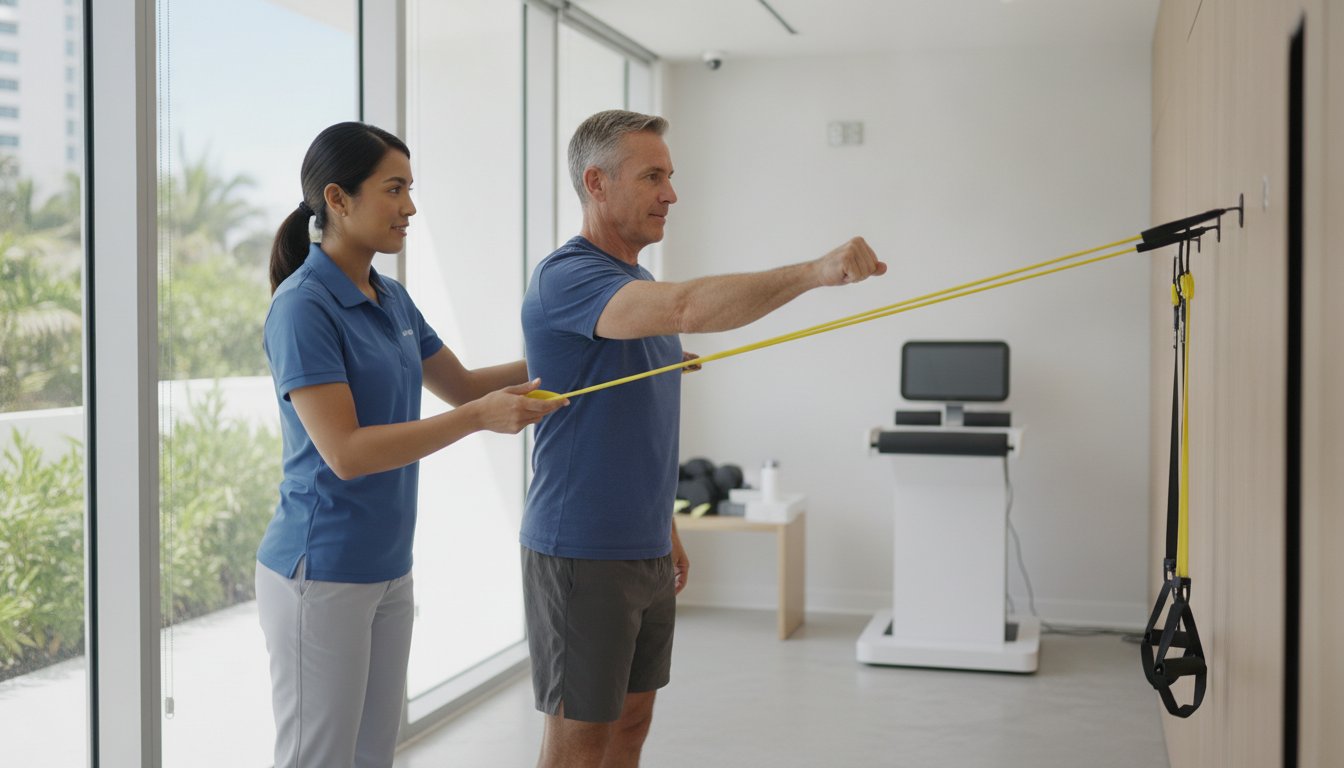
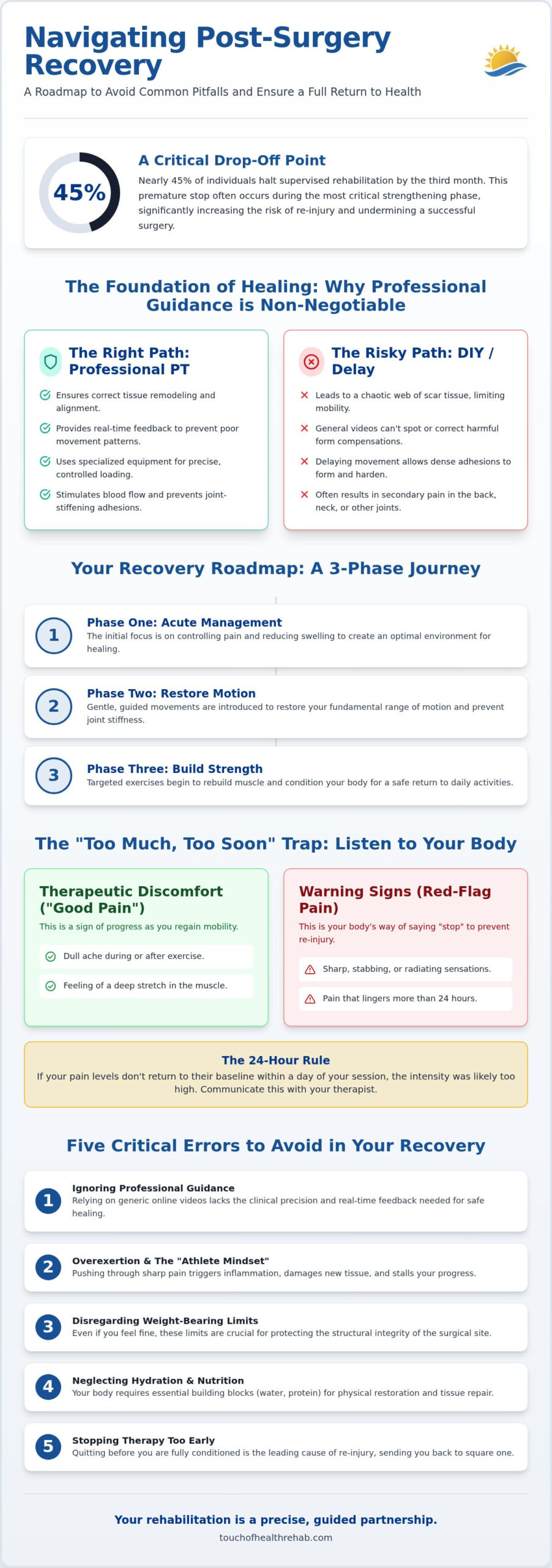
Did you know that nearly 45% of active individuals stop their supervised rehabilitation by the third month, often just as the most critical phase of strengthening begins? It is a startling figure that highlights how easily a successful surgery can be undermined by a fragmented recovery. You likely feel a deep frustration with slow progress or a persistent fear that a single exercise could cause re-injury. These feelings are entirely valid, as the period following a procedure is often filled with uncertainty regarding what is normal and what is a true warning sign.
Understanding the common mistakes to avoid after surgery physical therapy is the first step toward reclaiming your vitality. We believe your rehabilitation should be a precise, guided partnership rather than a solo race against the clock. This article provides a clear roadmap to help you navigate your healing journey with confidence. We will examine the vital difference between healing discomfort and red-flag pain, the risks of premature home-based rehab, and the proven strategies that lead to a faster, safer return to the daily life you deserve. By identifying these pitfalls early, you can move forward with the clarity and precision required for a full restoration of health.
Key Takeaways
- Professional supervision ensures your tissue remodels correctly, protecting you from the risks of unsupervised exercises that lack clinical precision.
- You’ll learn to identify the “too much, too soon” trap where overexertion triggers inflammation instead of the healing you expect.
- Discover the most common mistakes to avoid after surgery physical therapy, including the dangers of ignoring weight-bearing limits even when you feel fine.
- Maintaining hydration and proper nutrition in the South Florida heat provides the essential building blocks for your body’s physical restoration.
- Completing your entire rehabilitation plan prevents the high risk of re-injury that occurs when patients stop therapy before they’re fully conditioned.
The Foundation of Healing: Why Professional Guidance is Non-Negotiable
Surgery is often viewed as the finish line, but biologically, it’s simply the starting block. Your body requires a specific, controlled environment to remodel tissue correctly. Physical therapy isn’t a suggestion; it’s a clinical requirement for ensuring that new fibers align with your original anatomy. Without professional loading, your body may create a chaotic web of scar tissue that limits your future mobility. We view the clinic as a sanctuary for healing where every movement is measured and every milestone is celebrated.
One of the most common mistakes to avoid after surgery physical therapy is the “DIY” trap. While YouTube offers general exercises, it cannot provide the real-time feedback of a licensed clinician. A video won’t notice if your hip is hiking to compensate for a weak knee, nor can it adjust your resistance based on today’s swelling levels. At our Sunny Isles Beach facility, we use specialized clinical equipment to apply precise tension that home tools simply cannot replicate. This expert oversight prevents the development of permanent compensatory movement patterns that often lead to secondary pain in the back or neck.
The Risk of the “Wait and See” Approach
Many patients hesitate to start moving because they fear pain, yet delay is often the greatest enemy of recovery. Within the first 4-6 weeks, your body is aggressively producing collagen to close surgical wounds. If you remain sedentary, this tissue can form dense adhesions that permanently tether your joints. Early mobilization refers to the deliberate, structured movement of a patient shortly after surgery to stimulate blood flow and prevent venous stasis. This early movement is the key to maintaining your range of motion before scar tissue hardens.
Setting Realistic Milestones for Your Recovery
A successful roadmap is never a straight line; it’s a series of intentional shifts in focus. Your journey typically follows a methodical progression:
- Phase One: Acute pain management and swelling reduction.
- Phase Two: Restoration of fundamental range of motion.
- Phase Three: Targeted strength and physical conditioning.
Your speed through these phases depends heavily on your unique health history and the complexity of your procedure. When you Meet Our Team, you’ll see how we tailor these milestones to your specific biology. We act as your dedicated guides, ensuring you don’t rush into heavy lifting before your foundation is secure.
The “Too Much, Too Soon” Trap: Avoiding Overexertion
Many patients approach recovery with an “athlete mindset,” believing that more effort always equals faster results. While this drive is admirable, it is actually one of the most common mistakes to avoid after surgery physical therapy. In the early stages of healing, your body is focused on cellular repair rather than building new muscle mass. If you push too hard, you risk triggering a secondary inflammatory cycle. This doesn’t just cause temporary pain; it can physically damage the delicate new tissue and stall your progress for weeks.
Returning to high-impact activities like running or jumping before your joints are fully stabilized is a significant risk. Proper recovery and rehabilitation requires patience to ensure the structural integrity of the surgical site is maintained. Powering through significant pain often leads to setbacks that require you to regress to earlier, simpler exercises. We want to help you move forward steadily, ensuring each step is a permanent gain in your journey toward long-term vitality.
Distinguishing Between “Good Pain” and Warning Signs
It is essential to understand that not all pain is created equal during your sessions. Therapeutic discomfort often feels like a dull ache or a stretching sensation, which is normal as you regain mobility. However, sharp, stabbing, or radiating sensations are your body’s way of saying “stop.” We recommend using the 24-hour rule: if your pain levels don’t return to baseline within a day of your session, the intensity was likely too high for your current stage of healing. Red-flag signs that require an immediate call to your therapist include sudden calf swelling, a fever, or a significant loss of sensation near the surgical site.
The Science of Gradual Loading and Tissue Repair
Our approach to post-surgical rehabilitation focuses on incremental resistance. This gradual loading allows your tendons and ligaments to adapt to stress without being overwhelmed. Rest days are not a sign of “laziness” or lost time; they are active periods where your body performs the vital work of tissue remodeling. By respecting this biological pace, you ensure a smoother and more predictable path to peak physical health. If you are feeling uncertain about your current pace, we invite you to reach out to our dedicated guides for a personalized assessment of your progress.
Communication and Compliance: The Silent Recovery Saboteurs
Recovery is a collaborative journey that requires more than just showing up; it demands radical transparency. Your physical therapist relies on your feedback to calibrate your care plan with precision. When you withhold information about poor sleep quality or side effects from pain medication, you inadvertently stall your own progress. Sleep is the primary window for cellular repair; without it, your tissues lack the resources to remodel effectively. We view ourselves as your dedicated guides, but we can only navigate the path if we have all the facts about your daily experience. One of the most common mistakes to avoid after surgery physical therapy is treating this dialogue as optional.
Another frequent pitfall is ignoring weight-bearing restrictions because a limb “feels fine.” This is a dangerous metric to follow. While your pain may have subsided, the underlying bone or graft often requires months to achieve full structural integrity. Stepping too heavy too soon can cause micro-fractures or hardware failure that might require a second, more complex procedure. Similarly, reporting new symptoms like dizziness or shifts in your balance is vital. These signs can indicate that your body is struggling to recalibrate its spatial awareness after a long period of immobilization, which is a common occurrence after major orthopedic surgeries.
The Hidden Cost of Inconsistent Attendance
Consistency is the fuel for neurological motor learning. Every time you attend a session, you’re teaching your brain how to communicate with your muscles again. Missing even a few visits disrupts this momentum, forcing your nervous system to “re-learn” patterns it was just starting to master. For our Aventura-area patients, regular attendance allows us to make compounding adjustments to your plan. These small, clinical tweaks ensure your recovery never plateaus and your effort always translates into tangible functional gain.
Navigating Movement Precautions and Bracing
Braces, slings, and walkers are not merely suggestions for comfort; they’re essential tools that protect your surgical investment. A common mistake is adjusting a brace for convenience, which often leads to secondary strain in the neck or back as you overcompensate for the lack of support. Following strict precautions, such as the 90-degree rule for hip replacements, remains a non-negotiable standard for 2026 recovery protocols. Integrating Balance and Gait Rehabilitation into your routine ensures you use these assistive devices correctly, preventing falls and ensuring your new joint settles into its optimal position.
Lifestyle and Environmental Oversights in South Florida
Living in South Florida offers a beautiful backdrop for healing, yet the local environment introduces specific variables that can quietly derail your progress. One of the most frequent common mistakes to avoid after surgery physical therapy is failing to account for the intense heat and humidity. Dehydration significantly reduces muscle elasticity. When your muscles are parched, they become stiff and prone to cramping, which makes your prescribed exercises feel significantly more painful. We encourage you to view hydration as a biological lubricant that allows your tissues to glide and remodel without friction as you regain your strength.
Beyond hydration, the physical layout of your home plays a massive role in your safety. Many residents in Miami Beach and Sunny Isles Beach live in homes with sleek tile or marble floors. While aesthetically pleasing, these surfaces pose a high risk for slips during the early stages of gait training. Surgery-proofing your living space involves more than just clearing clutter; it requires a strategic layout that supports your limited mobility and ensures every step you take is a secure one.
Optimizing Your Home for Safety and Postural Support
This is where Postural Education becomes a cornerstone of your recovery. By learning the correct way to transition from sitting to standing, you prevent the compensatory lean that often causes secondary back or hip pain. Additionally, your resting posture is critical for long-term comfort. Using elevation and specific pillow placement while you sleep facilitates lymphatic drainage, which is your body’s natural way of flushing out the inflammation that lingers after a procedure. We teach you these subtle adjustments so that even your downtime contributes to your restoration.
Hydration and Nutrition for Biological Repair
Biological restoration is an energy-intensive process that requires the right building blocks. Protein is non-negotiable for muscle repair, but micronutrients like Vitamin C and Zinc are the “glue” for collagen synthesis at your incision site. If your diet lacks these essentials, your body may struggle to close wounds or build resilient new fibers. Dehydration also has a psychological component; a lack of fluids can actually heighten your sensitivity to pain, making the rehabilitation process feel more daunting than necessary. For post-surgical patients, an anti-inflammatory plate should feature a balance of lean proteins, omega-3 fatty acids, and antioxidant-rich greens to minimize systemic stress. If you’re ready to master these lifestyle factors for a superior recovery, connect with our specialized team in Sunny Isles Beach to refine your personal roadmap.
The Long Game: Why Stopping Therapy Early is a Critical Error
One of the most persistent common mistakes to avoid after surgery physical therapy is the decision to discontinue treatment as soon as the acute pain vanishes. This stage, often called the “False Sense of Security,” occurs when you feel approximately 80% recovered. While you may be able to navigate your home in Sunny Isles Beach without a limp, your internal tissues haven’t yet regained the tensile strength required for the unpredictable stresses of daily life or sports. Returning to a full workload or an active hobby without complete physiological preparation is a gamble that often leads to a preventable and painful re-injury.
Transitioning from basic healing to total resilience requires a shift in focus. Traditional rehabilitation aims to get you “to zero,” meaning the absence of symptoms. However, we believe in a more ambitious standard. Utilizing Physical Conditioning bridges the gap to peak performance, ensuring your muscles and joints can handle the specific demands of your lifestyle. Stopping early leaves your recovery unfinished and your body vulnerable to the very imbalances that may have necessitated surgery in the first place.
From Basic Healing to Peak Physical Conditioning
The difference between “rehab” and “conditioning” is the difference between surviving and thriving. Our Sunny Isles Beach team specializes in moving patients beyond simple range of motion and into advanced mobility programs. This progression is essential for all ages. For example, Geriatric Physical Therapy focuses on maintaining long-term independence by building the functional reserve necessary to prevent future falls. By committing to the full duration of your plan, you’re not just recovering from a past event; you’re actively fortifying your body against future limitations.
Your Personalized Path at Touch of Health Rehab Inc.
We tailor every recovery roadmap to the specific nuances of your surgical procedure and your unique lifestyle goals. Our role as a “Compassionate Expert” means we guide you through the final, most rewarding stages of your journey where you regain your true power. We remain dedicated to your success, providing the professional oversight needed to ensure every milestone is met with precision. Don’t leave your long-term wellness to chance by stopping at the first sign of comfort. Schedule your post-surgical evaluation today and let us help you reach the finish line with confidence.
Reclaiming Your Vitality Through Precision Recovery
Your path from the operating room to a state of peak physical health is a series of intentional, clinical choices. By understanding the common mistakes to avoid after surgery physical therapy, you’ve gained the clarity needed to protect your surgical investment and prevent avoidable setbacks. True restoration requires more than just the passage of time; it demands a synergy of professional oversight, biological patience, and a commitment to total physical conditioning. We’ve explored how everything from the South Florida environment to your internal communication influences your success, emphasizing that your effort is most effective when guided by expert hands.
At Touch of Health Rehab Inc., we are honored to serve as a sanctuary for healing within the Sunny Isles Beach and Aventura communities. Led by Lead Physical Therapist Berlin, our specialized programs for vestibular and orthopedic recovery are designed to meet the unique needs of every individual. We invite you to move beyond basic healing and embrace a future where you move with confidence and strength. Begin your personalized recovery journey at Touch of Health Rehab Inc. today. Your path to long-term vitality and empowerment starts with a single, precise step forward.
Frequently Asked Questions
How soon after surgery should I start physical therapy?
You should typically begin therapy within 24 to 48 hours after your procedure, depending on your surgeon’s specific protocol. Early movement is vital for stimulating circulation and preventing the formation of blood clots. While the initial sessions focus on gentle range of motion, starting early ensures that scar tissue doesn’t have the chance to harden and limit your future mobility. We coordinate closely with your surgical team to ensure the timing is perfectly aligned with your biological healing.
Is it a mistake to take pain medication before my PT session?
Taking prescribed pain medication before a session is often beneficial as it allows you to participate more fully in your exercises. However, you must inform your therapist about what you’ve taken and when. One of the common mistakes to avoid after surgery physical therapy is masking your pain so completely that you can’t feel your body’s natural boundaries. We want to ensure you’re working within a safe therapeutic window without overstressing the surgical site.
What happens if I accidentally skip my home exercises for a few days?
Skipping a few days of your home exercise program disrupts the momentum of your neurological motor learning, but it isn’t a reason to panic. The most important step is to resume your routine as soon as possible without trying to “double up” on exercises to make up for lost time. Overloading your tissues in a single day can lead to inflammation. Simply be honest with your therapist so they can adjust your in-clinic plan to keep you on track.
Can I do too much physical therapy and hurt my recovery?
Yes, it’s entirely possible to overwork your body during the rehabilitation process. More effort doesn’t always lead to faster results; in fact, excessive loading can trigger a secondary inflammatory cycle that stalls your progress. Your tissues need dedicated rest periods to perform the cellular work of remodeling and repair. We monitor your response to each session to ensure we’re providing enough stimulus for growth without crossing the threshold into cumulative damage.
Why does my joint feel stiffer in the morning after a therapy session?
Morning stiffness is a natural byproduct of the inflammatory response and fluid settling around the joint while you’re inactive during sleep. During a therapy session, we create micro-stimuli that your body must then heal. This process often involves a temporary increase in localized swelling as your body sends repair cells to the area. Gentle movement and proper hydration usually alleviate this stiffness within the first hour of waking, helping you transition into your daily routine.
Is dizziness normal after surgery, and can physical therapy help?
Dizziness and balance shifts are frequent occurrences after major orthopedic procedures, often due to anesthesia or changes in sensory input. We offer specialized vestibular rehabilitation to help your brain and inner ear recalibrate after these disruptions. Addressing these symptoms early is crucial for preventing falls and ensuring you feel confident while walking. If you’re experiencing a spinning sensation or lightheadedness, our team can incorporate targeted balance exercises into your personalized recovery roadmap.
How do I know if my physical therapist is the right fit for my specific surgery?
The right therapist should demonstrate a deep understanding of your specific procedure and offer a personalized, one-on-one approach. You should feel that they are a dedicated guide who listens to your concerns and adjusts your plan based on your daily feedback. Ask about their experience with similar cases and ensure they utilize clinical equipment that supports optimal loading. A strong partnership is built on clear communication and a shared commitment to your long-term physical health.
What are the signs that I am pushing myself too hard during rehab?
Pushing too hard often manifests as sharp, stabbing pain or swelling that doesn’t subside within 24 hours of your session. If you find that your range of motion is actually decreasing or your pain levels are preventing sleep, it’s a clear sign your current intensity is too high. Identifying these common mistakes to avoid after surgery physical therapy helps you stay within the productive healing zone. Always prioritize quality of movement over the quantity of repetitions or the amount of weight used.