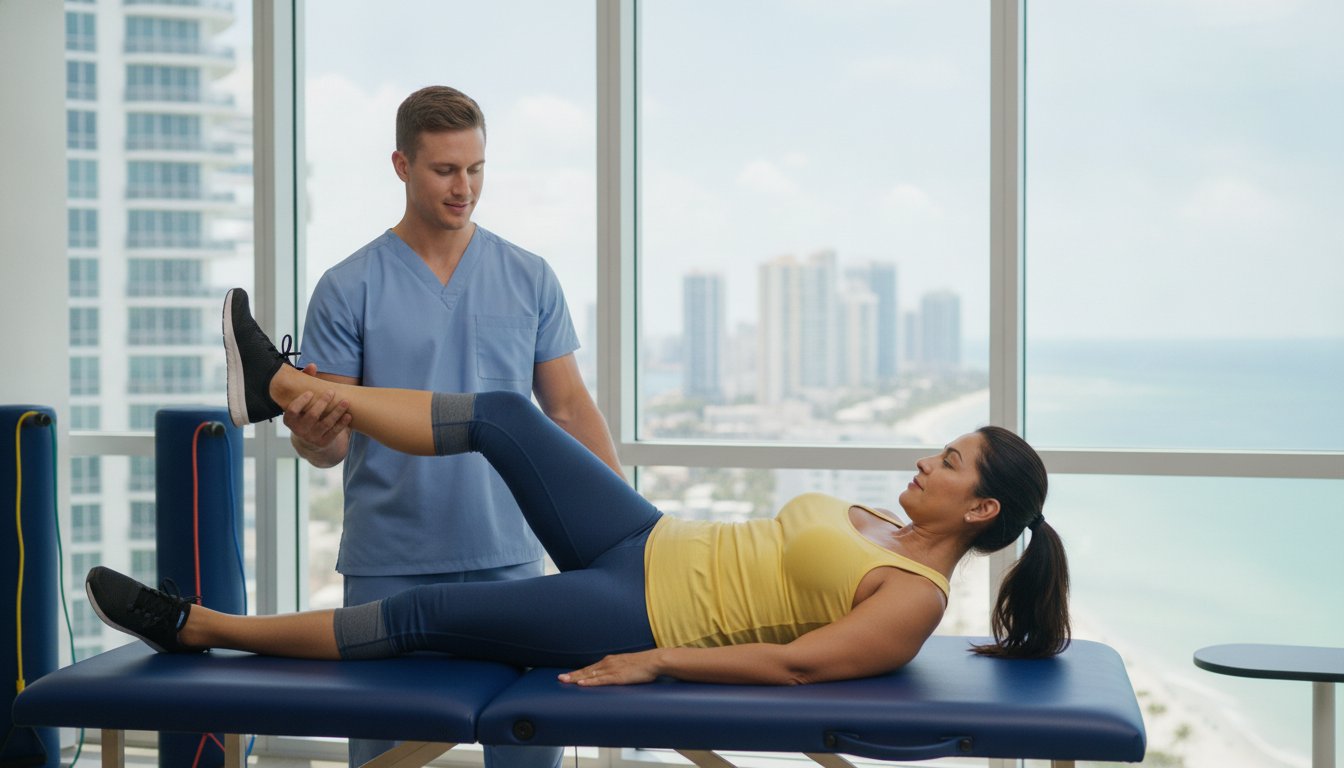
What if the most decisive factor in your recovery journey happens before you ever step into the operating room? You might feel that your current knee pain makes movement nearly impossible, yet the strength you build today serves as the foundation for your independence tomorrow. At Touch of Health Rehab Inc. in Sunny Isles Beach, we see this preparation not as a chore, but as a clinical recalibration that transforms your body into a recovery-ready environment. Starting a targeted program of pre-hab exercises for knee replacement is the most proactive step you can take to reclaim your vitality.
It’s understandable to feel a mix of anxiety and hope as you approach your surgery date. You want a faster return to walking and a significant reduction in post-operative discomfort, but you need a clear path to get there. This guide provides that roadmap, offering a professional perspective on how pre-surgical physical conditioning prepares your joints for trauma. You’ll discover how a structured 4 to 6 week program empowers you to face your procedure with confidence, ensuring that your path to peak physical health is steady, supported, and successful.
Key Takeaways
- Understand the “Better In, Better Out” clinical philosophy and how proactive preparation can significantly reduce your hospital stay and recovery time.
- Identify the specific pre-hab exercises for knee replacement that target your quadriceps and glutes to stabilize the joint before your procedure.
- Learn gentle techniques to maximize your knee extension and keep the joint capsule supple without aggravating your current pain levels.
- Prepare your body for those first post-surgical steps by training your balance and proprioception to counteract the effects of swelling and anesthesia.
- Discover why a personalized clinical plan designed by a physical therapist is essential for addressing your unique musculoskeletal needs and ensuring long-term wellness.
What is Pre-hab and Why is it Critical for Knee Replacement?
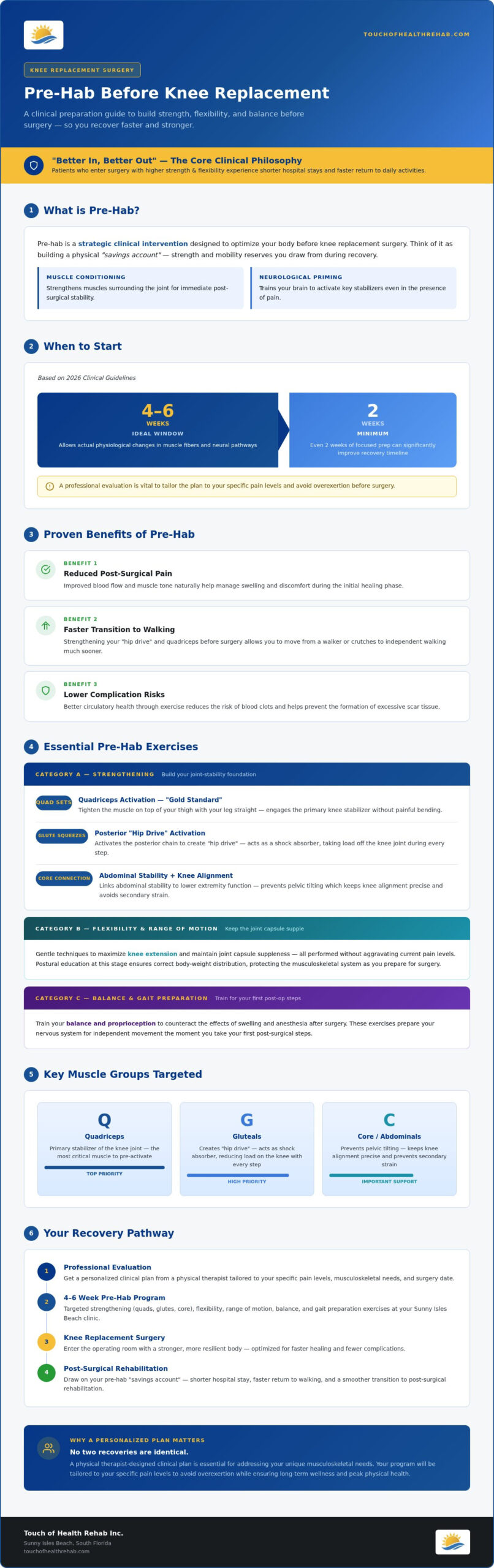
Pre-hab isn’t just a warm-up; it’s a strategic clinical intervention designed to optimize your body before you undergo knee replacement surgery. By engaging in pre-hab exercises for knee replacement, you’re essentially building a physical “savings account” that you’ll draw from during your recovery. Our Sunny Isles Beach clinic serves as a sanctuary where we help you establish this baseline of mobility, ensuring your body is resilient enough to handle the upcoming surgical trauma. This proactive approach focuses on strengthening the muscles surrounding the joint to provide immediate stability once the procedure is complete.
The “Better In, Better Out” philosophy is the cornerstone of modern orthopedics. Clinical evidence suggests that patients who enter surgery with higher levels of strength and flexibility experience shorter hospital stays and a more efficient return to daily activities. It’s not just about the muscles, though. Pre-hab conditions your nervous system, teaching your brain how to activate key stabilizers despite the presence of pain. This neurological preparation is what allows for a smoother transition into our Post-Surgical Physical Rehabilitation program later on.
The Proven Benefits of a Pre-hab Program
Investing time in your physical conditioning now yields dividends immediately after your procedure. You’ll notice the difference in your daily comfort and your ability to regain independence. Key benefits include:
- Reduced post-surgical pain: Improved blood flow and muscle tone naturally help manage swelling and discomfort during the initial healing phase.
- Faster transition to walking: Strengthening your “hip drive” and quadriceps before surgery allows you to move from a walker or crutches to independent walking much sooner.
- Lower complication risks: Better circulatory health through exercise reduces the risk of blood clots and helps prevent the formation of excessive scar tissue.
When Should You Start Your Pre-hab Exercises?
Timing is everything when preparing for a major procedure. Current 2026 clinical guidelines suggest that the ideal window for starting pre-hab exercises for knee replacement is four to six weeks before your surgery date. This duration allows enough time for actual physiological changes in your muscle fibers and neural pathways. However, don’t feel discouraged if your surgery is closer. Even two weeks of focused preparation can significantly improve your recovery timeline. A professional evaluation is vital here; it ensures your plan is tailored to your specific pain levels so you don’t overexert yourself before the big day.
Essential Strengthening Exercises: Building Your Foundation
Building a foundation of strength before your procedure is about more than just muscle mass. It’s about teaching your body how to support itself when the joint is temporarily compromised. When you perform pre-hab exercises for knee replacement, you’re prioritizing the muscles that will take over the heavy lifting during your first few weeks of healing. This clinical focus on knee replacement preparation and recovery ensures that your “hip drive” and core stability are ready to compensate for the surgical site while your new joint integrates.
Gluteal strengthening isn’t just about power; it creates the “hip drive” required for pain-free walking. This posterior power acts as a shock absorber, taking the load off your knee joint during every step. We also focus on the “core connection,” linking abdominal stability to lower extremity function. A strong core prevents your pelvis from tilting, which keeps your knee alignment precise and prevents secondary strain. Integrating Postural Education at this stage ensures your body weight is distributed correctly, protecting your musculoskeletal system as you prepare for change.
Lower Body Strength Staples
Focusing on these movements builds the functional capacity you’ll need for mobility immediately following your surgery.
- Quad Sets: These are the gold standard for maintaining thigh strength. You tighten the muscle on the top of your thigh while keeping your leg straight, engaging the primary stabilizer of the knee without requiring painful bending.
- Glute Squeezes: By activating your posterior chain, you make transfers from beds and chairs significantly safer and easier after surgery.
- Ankle Pumps: Moving your feet up and down like a gas pedal is essential for maintaining circulation and preventing post-operative swelling.
Upper Body Preparation for Assistive Devices
Don’t overlook your arms during your preparation. You’ll likely use a walker or crutches for a short period, and your upper body must be ready to assist. Tricep strengthening gives you the push-power needed to lift your body weight during transitions. Meanwhile, scapular retractions, which involve squeezing your shoulder blades together, help you maintain an upright posture. This prevents the “slumping” that often leads to back pain when using walking aids. If you’re unsure how to begin these movements safely, the dedicated guides at Touch of Health Rehab Inc. can help you design a plan that honors your current pain levels while building the strength you need.
Flexibility and Range of Motion (ROM) Without the Pain
Moving a joint that already feels stiff and painful is one of the biggest hurdles patients face when preparing for surgery. However, maintaining your current range of motion is a vital component of pre-hab exercises for knee replacement. The clinical goal isn’t to force your knee into uncomfortable positions, but rather to maximize your “extension” (the ability to fully straighten the leg) before the joint is replaced. A knee that can straighten fully before surgery is far more likely to achieve a natural walking pattern quickly afterward.
We encourage patients to work within “pain-free zones.” This means moving the joint only as far as it feels like a gentle stretch rather than a sharp pinch. By keeping the joint capsule supple, you ensure that the surrounding soft tissues, like your hamstrings and calves, don’t shorten or tighten in response to chronic inflammation. This softness in the tissue makes the surgeon’s job easier and your initial recovery far less restrictive.
Safe Range of Motion Movements
These movements focus on control and consistency rather than intensity, allowing you to maintain mobility without aggravating the joint.
- Heel Slides: Lie on your back and use a strap or towel around your foot to gently guide your heel toward your buttocks. This provides a controlled way to maintain flexion without straining the joint.
- Seated Knee Extensions: While sitting in a sturdy chair, slowly straighten your leg as much as possible. This builds the muscle memory needed for a solid “lock-out” during your gait.
- Hamstring Stretches: Reducing tension in the back of your leg prevents the muscles from pulling the knee out of its optimal alignment.
Managing Pre-Surgery Inflammation
It’s a common misconception that recovery techniques like the “Ice and Elevate” rule are only for after the procedure. Using these tools now helps manage flare-ups and allows you to stay consistent with your preparation. If current arthritis symptoms feel like a barrier to your progress, our clinical Pain Management Solutions provide the support needed to keep you active in your pre-hab program.
Learning to distinguish between “good” exercise discomfort (a mild muscle ache) and “bad” joint pain (sharp, stabbing sensations) is a skill that will serve you well throughout your entire journey. When you listen to your body and move with intention, you’re not just exercising; you’re mastering the art of self-care before your new joint even arrives. This awareness helps you progress steadily without the setbacks that come from overexertion.
Balance and Gait Preparation: Training for Your First Post-Op Steps
The first 48 hours following surgery are often the most disorienting for your body. While the surgical procedure addresses the joint itself, the combination of anesthesia and post-operative swelling can temporarily dull your sense of balance. This is why incorporating balance training into your pre-hab exercises for knee replacement is a clinical necessity. By practicing these movements now, you’re building a neurological safety net that helps you remain steady when you take those vital first steps in the hospital room.
Stability is often overlooked in general fitness, but in a clinical setting, we focus heavily on proprioception. This is the brain’s ability to understand where your limb is in space without you looking at it. When you engage in specialized Balance and Gait Rehabilitation before your procedure, you’re teaching your nervous system to communicate with your “new” knee. We also emphasize gait training basics, such as the proper “heel-to-toe” strike. Mastering this rhythm before surgery ensures that you don’t default to a limping pattern once the new joint is in place.
Stability Exercises for Pre-hab
Building a stable foundation requires targeting both your “good” leg and your core. Weight shifting exercises are particularly effective; they involve practicing lateral stability to prepare your body for the unique weight distribution of using a walker. We also recommend supported single-leg stances. This strengthens your non-surgical leg to handle the extra load it will inevitably carry during the initial days of recovery. Throughout these movements, practicing core bracing is essential. A stable midsection protects your lower back from the strain that often comes with using assistive devices for the first time.
Practicing Functional Mobility
Functional mobility training turns exercise into real-world preparation. We focus on sit-to-stand mechanics to ensure you can transition from a chair or bed without putting excessive strain on your surgical site. Another critical skill is stair navigation. We teach patients the “Up with the Good, Down with the Bad” rule early. This means you lead with your non-surgical leg when going up stairs and lead with your surgical leg when going down. For patients who may be at a higher risk of trips, our Fall Prevention Therapy provides additional layers of safety and confidence. If you’re ready to secure your foundation and ensure a safer transition home, our team at Touch of Health Rehab Inc. is here to guide your preparation with a personalized clinical plan.
Designing Your Personalized Pre-Surgery Plan in South Florida
While a “one-size-fits-all” YouTube list might offer a basic starting point, it lacks the clinical nuance required for a truly successful outcome. Your body is unique, and your pre-hab exercises for knee replacement should reflect your specific anatomy, current pain levels, and lifestyle goals. At our Sunny Isles Beach clinic, we view this preparation as a collaborative journey. Our physical therapists act as your dedicated guides, ensuring every movement serves your long-term vitality. By choosing a professional clinical environment, you’re not just following a list; you’re engaging in a sophisticated recalibration of your musculoskeletal system.
Our goal is to create a seamless transition from your preparation phase into our Post-Surgical Rehabilitation program. This continuity of care is vital. It allows us to monitor your progress from your baseline and adjust your therapy in real-time as you heal. Our facility serves as a sanctuary for healing, providing the steady, methodical rhythm you need to feel calm and stable as your surgery date approaches.
What to Expect in a Pre-Surgery Evaluation
A comprehensive clinical evaluation is the first step in building your recovery foundation. During this session, we perform a detailed assessment of your current strength, range of motion, and gait patterns. This isn’t just about your knee; we look at how your hips, ankles, and core contribute to your overall mobility. We use this data to set realistic, achievable goals for the first two weeks after your procedure, which helps reduce anxiety and provides a clear roadmap for success.
In addition to physical testing, we provide essential education on home setup and post-operative safety. We’ll discuss how to navigate your specific living environment, from chair heights to bathroom safety. This ensures that when you return home from the hospital, your space is already optimized for your independence and comfort.
The Advantage of Professional Guidance
Professional guidance offers the benefit of real-time feedback that a video or app simply cannot provide. Our therapists ensure you aren’t overcompensating with other joints, a common issue when knee pain is severe. These compensations can lead to secondary hip or back pain if not corrected early. Our customized physical conditioning programs are designed to be flexible, adapting to your daily pain levels so you can stay consistent without the risk of overexertion.
This personalized attention ensures that when the day of your surgery arrives, you aren’t just prepared; you’re empowered. You’ll enter the operating room with the confidence that your body is in its best possible condition for the journey ahead. If you’re ready to secure your foundation and ensure a faster return to the activities you love, we invite you to schedule your pre-hab consultation today at Touch of Health Rehab Inc.
Empowering Your Path to a Stronger Recovery
Your journey toward a pain-free lifestyle begins long before you arrive at the hospital. By prioritizing a structured program of pre-hab exercises for knee replacement, you’re taking active control of your surgical outcome. You’ve discovered how strengthening your foundation, maximizing your range of motion, and training your balance today leads to a faster return to walking tomorrow. This preparation isn’t just about physical conditioning; it’s about providing your body with the resilience it needs to heal with confidence.
At Touch of Health Rehab, our Sunny Isles Beach clinic serves as a sanctuary where you can prepare for this transformation under expert guidance. Led by Lead Physical Therapist Berlin, our team specializes in orthopedic physical therapy and comprehensive post-surgical rehabilitation support. We design personalized therapy plans that respect your unique path to health. Don’t leave your recovery to chance when you can build a stronger foundation right now.
Start Your Pre-hab Journey at Touch of Health Rehab and discover the difference that clinical preparation makes. Your future self will thank you for the dedication you show today. We’re ready to be your partners in this collaborative journey toward lasting vitality.
Frequently Asked Questions
Is it okay to exercise if my knee already hurts before surgery?
Yes, it’s absolutely okay and encouraged to exercise, provided you work within your “pain-free zones.” At our Sunny Isles Beach clinic, we help you identify movements that strengthen the joint without aggravating your current arthritis symptoms. The goal is to build muscle resilience without increasing inflammation. If a movement causes sharp pain, we modify it immediately. This ensures you’re building a foundation for recovery while respecting your body’s current physical limitations.
How long should I do pre-hab exercises before my knee replacement?
Ideally, you should start your program 4 to 6 weeks before your scheduled surgery date. This timeframe allows your body to undergo actual physiological changes, such as increased muscle fiber recruitment and improved neural pathways. However, even two weeks of consistent preparation can have a positive impact on your recovery timeline. Starting early at Touch of Health Rehab ensures your body is in peak physical condition before you enter the operating room for your procedure.
Can pre-hab actually prevent the need for surgery?
While intensive physical therapy can sometimes delay or even prevent surgery for some patients, the primary goal of pre-hab is to optimize your results if a replacement is already scheduled. By strengthening the surrounding muscles and improving joint mechanics, you might find your daily pain becomes more manageable. Regardless of the final outcome, these exercises improve your long-term wellness and musculoskeletal health, making them a valuable investment in your overall vitality and future mobility.
What are the most important muscles to strengthen before knee surgery?
The quadriceps are the most critical muscles to target as they are the primary stabilizers of the knee joint. Additionally, focusing on your glutes is essential for developing the “hip drive” needed for walking and standing safely. We also incorporate core bracing to protect your lower back from secondary strain. Using a targeted program of pre-hab exercises for knee replacement ensures these specific muscle groups are ready to support your new joint from day one.
Will pre-hab make my post-surgical pain worse?
No, pre-hab is specifically designed to reduce your post-surgical pain levels. By improving blood flow and muscle tone before the procedure, your body is better equipped to manage the natural swelling and inflammation that follows surgery. Patients who participate in physical conditioning often report a more comfortable recovery process. Our therapists in Sunny Isles Beach monitor your progress closely to ensure your pre-surgery plan is supportive and encouraging rather than adding stress to the joint.
Do I need a referral for pre-hab physical therapy in Florida?
In Florida, you can benefit from “Direct Access,” which allows you to see a physical therapist for up to 30 days without a physician’s referral. This means you can begin your preparation at our clinic immediately. However, it’s always a good idea to check your specific insurance policy, as some providers may require a referral for reimbursement purposes. We can help you navigate these requirements to ensure your path to healing remains seamless and entirely stress-free.
What equipment do I need for at-home pre-hab exercises?
Most pre-surgery exercises require very little specialized equipment. You can often perform them using common household items like a sturdy chair, a towel for heel slides, or a strap for gentle stretching. As you progress, we might suggest using light resistance bands to further challenge your muscles and improve tone. Our team provides a personalized plan that works with what you have available, ensuring you can stay consistent with your routine in the comfort of your own home.
How does pre-hab help with balance after surgery?
Pre-hab improves balance by training your proprioception, which is your brain’s ability to sense your leg’s position. Since anesthesia and swelling can temporarily disrupt this sense, practicing balance and gait rehabilitation early is vital. We also strengthen your non-surgical leg so it can safely handle extra weight during the initial recovery phase. This proactive training significantly reduces your fall risk and builds the confidence you need for those first post-operative steps in the hospital and at home.