
What if protecting your shoulder at first is an important step toward using it with confidence again? After surgery, it’s natural to wonder which movements are safe, how much activity is appropriate, and whether recovery is taking longer than expected. A shoulder surgery rehabilitation program progresses gradually, following your surgeon’s restrictions as healing allows. Your procedure, recovery needs, and daily goals all help shape the plan.
This guide explains how rehabilitation can move from protecting the shoulder to restoring controlled movement, strength, and everyday function. You’ll learn why progress varies and how to balance rest, prescribed exercises, and daily activities without treating recovery as a race. Touch of Health Rehab Inc. provides personalized post-surgical physical rehabilitation in Sunny Isles Beach and nearby communities, including Aventura, Bal Harbor, North Miami Beach, and Miami Beach.
Key Takeaways
- A shoulder surgery rehabilitation program is tailored to your procedure, clinical instructions, and goals, rather than following one universal schedule.
- Rehabilitation can progress from protecting the shoulder toward restoring comfortable movement, strength, and function.
- Your symptoms, surgeon’s restrictions, health, and previous activity levels can influence your plan and pace.
- Prepare for your first physical therapy appointment by bringing surgical instructions, medication information, and questions about daily challenges.
- Personalized post-surgical physical therapy can support your work toward a more confident return to meaningful everyday activities.
What a shoulder surgery rehabilitation program is designed to help you regain
A shoulder surgery rehabilitation program is a staged, individualized process that helps you restore movement and function while respecting the healing needs of your procedure. It isn’t a fixed exercise sheet or a race through a standard sequence. Your clinical instructions guide what’s appropriate, and your therapist can adapt the plan as your abilities and needs change.
The practical goal is to work toward more comfortable movement, greater strength, and confidence with daily activities. Progress might mean managing a particular reach more easily or returning to a routine task with less difficulty. Your plan should reflect what matters in your everyday life, not just what can be measured during a session.
How rehabilitation supports recovery after shoulder surgery
Your shoulder relies on coordinated movement between the upper-arm bone and shoulder joint, surrounding muscles, and the shoulder blade, also called the scapula. Physical therapy supports mobility and function as healing allows, while helping you build control across this system. Exercises and other therapy activities are selected to match your current stage and clinical guidance, rather than pushing the joint beyond its permitted movement.
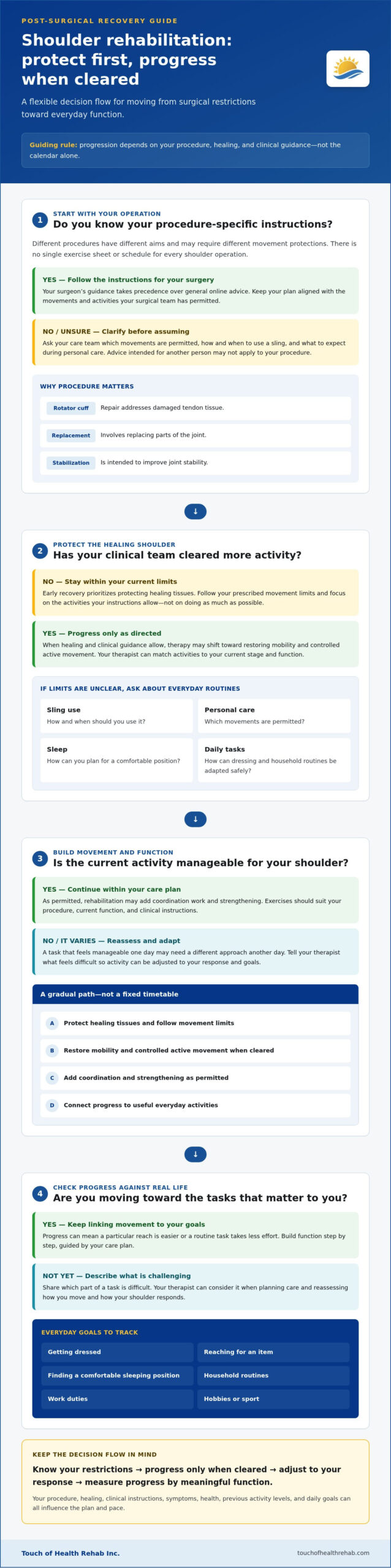
Rehabilitation goals can connect directly to familiar tasks, such as getting dressed, reaching for an item, finding a comfortable sleeping position, or using your arm during household routines. Tracking these activities alongside movement and strength gives you and your therapist practical ways to discuss progress. If a task remains difficult, describe what makes it challenging so your therapist can consider it when planning your care.
Why the operation determines the starting point
Different procedures have different aims. Rotator cuff repair addresses damaged tendon tissue, shoulder replacement involves replacing parts of the joint, and stabilization procedures are intended to improve joint stability. The tissue involved, surgical technique, and surgeon’s instructions can all affect which movements need protection and when activities may progress. There isn’t one set of exercises or schedule that suits every operation.
For background on the procedure itself, Shoulder replacement surgery provides an overview of replacement types and indications. General information can help you understand the terminology, but it doesn’t replace instructions written for your surgery. Your surgeon’s guidance takes precedence over general online advice, including recommendations that don’t account for your specific procedure or healing needs.
Post-surgical physical rehabilitation connects clinical guidance with your mobility and daily goals. Learn more about post-surgical rehabilitation and how physical therapy can support your return to meaningful activities.
How a shoulder rehabilitation program progresses from protection to function
Rehabilitation often moves through broad stages, but these are a flexible framework, not a universal timetable. Early care prioritizes protecting healing tissues and following the movement limits set by your surgical team. As healing and clinical guidance allow, therapy may progress toward more active movement, coordination, and eventually strengthening. Progression depends on your procedure, healing, and clinical guidance, not the calendar alone.
Early recovery: follow restrictions and manage everyday tasks
At first, your role may involve protecting the shoulder while staying within the limits prescribed by your surgeon. Clarify how and when to use a sling, which movements are permitted, and what to expect during personal care. Details vary by procedure, so don’t assume advice for another person applies to you.
Everyday routines may need planning while your movement is restricted. Consider sleep, dressing, and household tasks, and ask your care team how to adapt them safely. The aim is not to do as much as possible, but to support healing while maintaining the activities your instructions allow.
Later recovery: rebuild movement, strength, and useful function
When your clinical team considers it appropriate, therapy may shift toward restoring mobility and controlled active movement. Coordination work and strengthening can be introduced as permitted, with exercises selected to suit your procedure and current function. The American Academy of Orthopaedic Surgeons’ Shoulder Surgery Exercise Guide offers examples of exercises, but it isn’t a substitute for your own post-surgical instructions.
Rehabilitation can gradually connect shoulder movement with the tasks you want to resume, such as reaching, carrying, work duties, hobbies, or sport. Your therapist can reassess how you move and how your shoulder responds, then adjust activity accordingly. A task that feels manageable one day may need a different approach another day, so progress should reflect your response as well as your goals.
A well-guided shoulder surgery rehabilitation program builds function step by step, balancing protection and activity according to your needs. Personalized post-surgical physical therapy can help translate clinical guidance into practical goals. Explore physical therapy support for your recovery at Touch of Health Rehab Inc. as you plan your next steps.
What changes your rehabilitation plan, and how to judge progress
It’s understandable to worry that moving your shoulder could harm recovery. Movement specifically approved by your surgical team or physical therapist is different from activity that exceeds your restrictions. Follow your care plan, and ask before adding exercises or increasing effort if you’re unsure. Your plan can change as your shoulder heals and your needs become clearer.
Why two people with shoulder surgery may follow different plans
Procedure type and tissue healing influence which movements are permitted. A repaired tendon, a replacement joint, and a stabilization procedure don’t necessarily have the same precautions. Your health history, baseline mobility, healing response, and everyday demands also help shape therapy. Age may be one consideration, but it doesn’t predict an individual’s progress on its own.
A personalized shoulder surgery rehabilitation program takes these factors into account rather than measuring your recovery against someone else’s. Your surgeon’s restrictions remain central, while your therapist uses your symptoms and function to guide care within those instructions.
| Plan-shaping factor | How it may guide rehabilitation |
|---|---|
| Procedure | The structures involved and surgical approach influence which movements need protection. |
| Surgeon restrictions | Instructions about permitted movement and activity set the boundaries for therapy. |
| Symptoms and healing | Your response to activity helps your care team decide whether to maintain or adjust the plan. |
| Personal goals | Daily routines, work, and recreational priorities help define useful functional milestones. |
How to recognize progress without relying on pain alone
Pain is only one part of the picture. Progress may also show up in smoother movement, improved control, greater confidence, or finding a daily task easier to manage. Your therapist’s assessment adds context by considering how you move and whether your function is changing in a way that fits your care plan. Symptoms can vary, so share what you notice rather than judging recovery by a single day.
Contact your treating medical team promptly about unexpected or worsening symptoms, such as increasing pain or swelling, new numbness, fever, or changes around the incision, including redness or drainage. Follow your discharge instructions for concerns that need urgent attention. Reporting changes helps your team decide what guidance you need; it doesn’t mean you’ve done something wrong.
How to prepare for shoulder rehabilitation and make sessions useful
A little preparation can help your first physical therapy visit focus on what matters most to you. Bring your surgeon’s written instructions and medication information, and note questions that have come up since surgery. These details help your therapist understand your care plan and tailor rehabilitation to your current needs.
Questions to bring to your first physical therapy visit
You don’t need to have every answer before you arrive. Use the appointment to clarify how your surgical guidance applies to movement and daily life. Consider asking:
- Which shoulder movements and everyday activities are permitted under my current instructions?
- What should I do if symptoms change during or after an activity?
- Who should I contact if I have concerns about my recovery?
- How can therapy support my priorities, such as returning to work, caregiving, or recreation?
Be specific about what feels difficult. For example, describe which part of getting dressed is challenging or what makes a work or caregiving task hard to manage. Clear examples help your therapist connect clinical goals with meaningful activities.
Ways to support consistency between appointments
Your recovery plan continues outside the clinic, but more exercise isn’t automatically better. Follow the home activities prescribed for you, and don’t add online exercises or increase effort without guidance. Your instructions reflect your procedure and current stage of recovery, so follow your care team’s direction before making changes.
Keep a short record of questions and useful observations between visits. Note a daily task that has become easier, an activity that remains difficult, or a symptom change you want to discuss. These concrete details can make each appointment more focused.
Tell your therapist about barriers, too. Transportation, disrupted sleep, or difficulty completing a prescribed activity can affect consistency. Sharing these challenges allows your care team to discuss practical adjustments that remain aligned with your clinical instructions. The aim is steady, appropriate participation, not perfection.
For more about post-surgical rehabilitation, explore how individualized physical therapy can support your recovery goals. You can also learn about physical therapy at Touch of Health Rehab Inc..
Personalized shoulder surgery rehabilitation in Sunny Isles Beach
After shoulder surgery, physical therapy can help turn clinical guidance into a plan that reflects your current function and the activities you hope to resume. At Touch of Health Rehab Inc., post-surgical physical rehabilitation is personalized around your recovery needs and goals, with professional support as you work toward improved mobility and greater confidence in daily life.
What personalized post-surgical physical therapy can address
Your therapy should reflect both your surgical instructions and what you can comfortably do now. A therapist can use your priorities, such as reaching more easily or returning to a meaningful routine, to guide appropriate therapy activities. As your function changes, reassessment and communication help keep the plan responsive to your progress and aligned with your clinical guidance.
This individualized approach recognizes that a shoulder surgery rehabilitation program is not simply a list of exercises. It connects physical therapy with your needs while respecting the precautions set for your procedure. Touch of Health Rehab provides physical therapy and post-surgical rehabilitation to support patients working toward their recovery goals.
Taking the next step with a local rehabilitation team
Touch of Health Rehab Inc. provides post-surgical physical rehabilitation in Sunny Isles Beach and nearby communities, including Aventura, Bal Harbor, North Miami Beach, and Miami Beach. A local rehabilitation team gives you a place to discuss how your shoulder is functioning, share the goals that matter to you, and receive individualized physical therapy support. Your participation and communication help shape the process, while your surgical guidance remains central to the plan.
Recovery is individual, and therapy doesn’t promise a particular outcome or follow one identical path for everyone. Instead, it offers structured support as you work toward your own functional goals, with adjustments informed by your needs and clinical instructions.
Explore physical therapy services at Touch of Health Rehab Inc. to learn about personalized support for shoulder surgery rehabilitation.
Take your next step toward confident shoulder recovery
A shoulder surgery rehabilitation program should respect your procedure and clinical instructions while working toward the activities that matter to you. Progress is individual and guided by more than a calendar: your symptoms, movement, daily function, and care team’s assessment all help shape the plan. Bringing clear questions and sharing your priorities can make physical therapy sessions more useful.
At Touch of Health Rehab Inc., personalized physical therapy and post-surgical physical rehabilitation support recovery goals in Sunny Isles Beach, Aventura, Bal Harbor, North Miami Beach, and Miami Beach. With a plan shaped around your needs and surgical guidance, you can take each step with greater understanding and support.
Your progress doesn’t need to look like anyone else’s. For personalized post-surgical physical rehabilitation, contact Touch of Health Rehab Inc. and explore physical therapy support.
Frequently Asked Questions
What does a shoulder surgery rehabilitation program include?
A shoulder surgery rehabilitation program commonly includes a clinical assessment, review of movement precautions, and therapy goals that progress as recovery allows. Your plan depends on the operation, healing, symptoms, and surgeon’s instructions. A physical therapist can help apply those instructions to daily activities, monitor changes, and adapt therapy with your care team. Touch of Health Rehab provides personalized post-surgical physical rehabilitation in Sunny Isles Beach, Aventura, Bal Harbor, North Miami Beach, and Miami Beach.
How long does shoulder surgery rehabilitation take?
There’s no single timeline for rehabilitation after every shoulder operation. Your recovery may be affected by the procedure, tissue healing, health history, symptoms, and the activities you hope to resume. Your surgeon and physical therapist guide progression according to your specific protocol and clinical response. Try not to measure your progress against another person’s or advance activities just because a certain amount of time has passed.
When should physical therapy start after shoulder surgery?
Physical therapy should start according to the instructions from your surgical team. Depending on the procedure, your plan may begin with education or protected movement, or include specific restrictions before therapy progresses. Share your postoperative instructions with your physical therapist so your care can follow the correct guidance. Don’t begin exercises from a general online program unless your clinical team has approved them for your recovery.
Is pain normal during shoulder rehabilitation after surgery?
Some discomfort may occur during recovery, but what it means depends on your procedure, stage of healing, and individual instructions. Don’t assume you need to push through pain, and don’t conclude that every sensation means something is wrong. Follow your care team’s guidance and describe your symptoms clearly. Seek prompt medical advice for symptoms that are unexpected, severe, or worsening, rather than changing your plan on your own.
Can I do shoulder exercises at home after surgery?
Yes, if they’re part of the home plan provided by your surgeon or physical therapist. The movements considered appropriate can change as healing progresses, so an exercise designed for another procedure or recovery stage may not fit your needs. Ask your therapist to clarify how to perform each activity, how often to do it, and which symptoms to report. Don’t add online exercises or increase difficulty without approval.
What happens if my shoulder recovery seems slower than expected?
A slower period doesn’t, by itself, explain what’s happening with your recovery. Discuss changes in symptoms or daily function with your physical therapist or surgical team so they can review your progress and restrictions in context. Avoid comparing your pace with another person’s or changing exercises independently. Report new, severe, or worsening symptoms promptly to your treating team for guidance on what to do next.