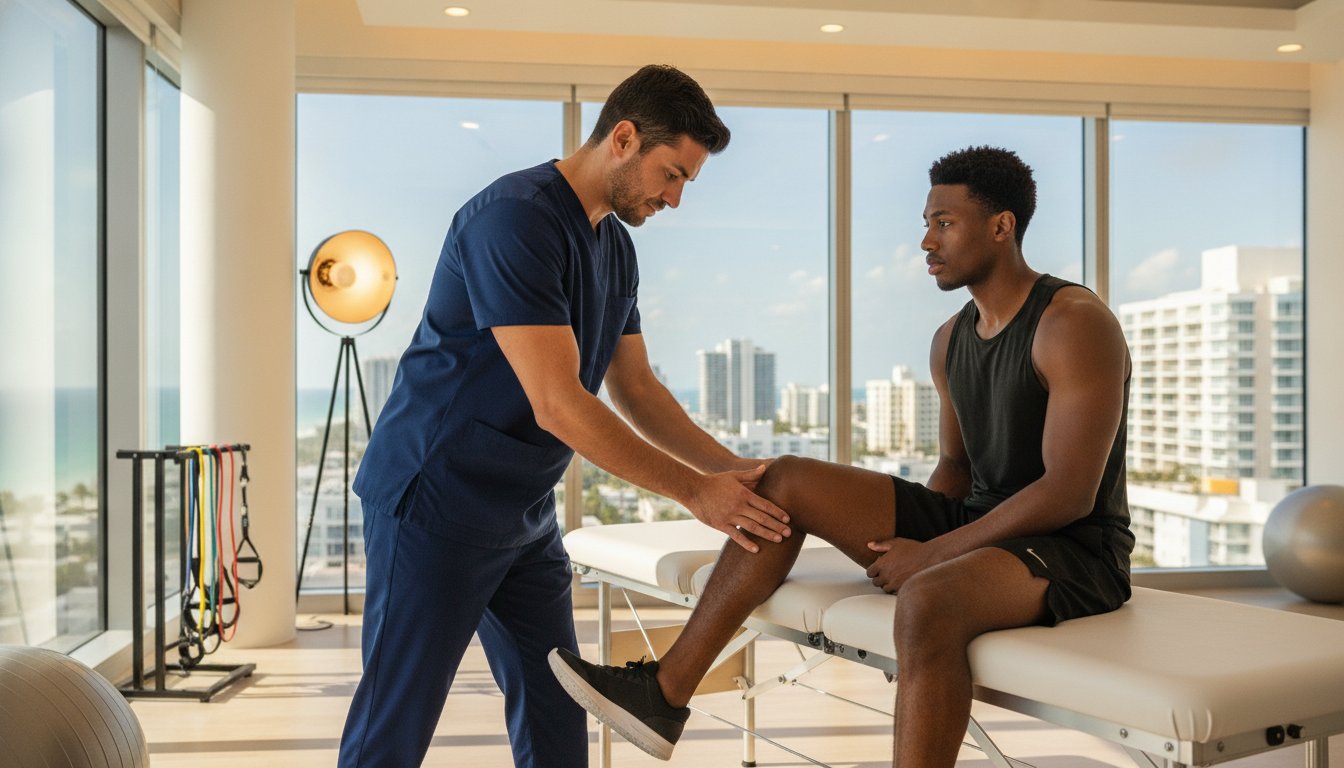
What if the weeks you spend sidelined could actually become the foundation for your strongest season yet? You’ve likely felt the deep frustration of watching from the bleachers, wondering if your speed or power will ever truly return. It’s natural to fear that your body might never feel the same, especially when you’re searching for the right physical therapy for sports injuries to guide your way back. You aren’t just looking to stop the pain; you’re looking to reclaim your identity as an athlete.
We believe that recovery is a collaborative journey, not a period of passive waiting. By choosing a specialized, expert-led approach, you’re opting for a strategic path that transforms your rehabilitation into a genuine performance upgrade. You’ll learn exactly how professional guidance helps you understand the root cause of your setback while building a body that’s more resilient than it was before the injury. This article explores how we move from initial assessment to a full, confident return to the sports you love, ensuring you don’t just recover, but excel.
Key Takeaways
- Learn why active clinical intervention is superior to passive rest for preventing muscle atrophy and ensuring proper tissue healing.
- Discover how professional physical therapy for sports injuries utilizes controlled loading to restore your range of motion and strength safely.
- Understand how addressing underlying postural and gait issues can resolve the root cause of your injury and prevent future setbacks.
- Explore the transition from clinical rehabilitation to sport-specific physical conditioning, preparing you for a confident return to peak performance.
- See what a personalized recovery journey looks like at our Sunny Isles Beach sanctuary, where expert guidance meets compassionate, one-on-one care.
Understanding Sports Injuries: Why Clinical Therapy Beats Passive Rest
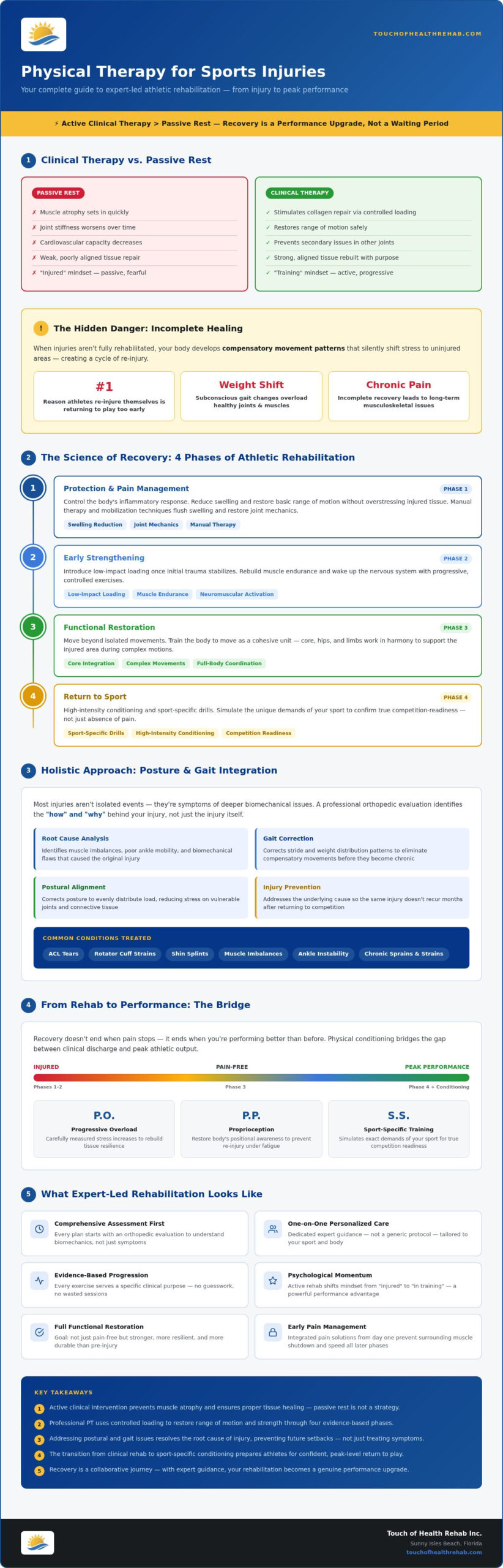
For a long time, the standard advice for a sprain or strain was simple: “Just rest it.” While initial protection is vital, prolonged inactivity is often a hidden enemy to your long-term athletic goals. Passive recovery leads to muscle atrophy, joint stiffness, and a decrease in cardiovascular capacity. When you choose professional physical therapy for sports injuries, you’re opting for a process that stimulates collagen repair through controlled tissue loading. This targeted stress tells your body exactly where and how to rebuild, ensuring the new tissue is strong and aligned with your movement needs.
At our Sunny Isles clinic, we frequently partner with athletes recovering from ACL tears, rotator cuff strains, and shin splints. Each of these conditions requires more than time; they require a roadmap. Beyond the physical, an active recovery plan provides a significant psychological boost. It transforms the “injured” mindset into a “training” mindset, keeping you focused on progress rather than limitations. You aren’t just waiting to heal; you’re actively working to become better.
The Risks of Incomplete Healing
If an injury isn’t fully rehabilitated, your body is incredibly clever at finding “workarounds.” You might start subconsciously shifting your weight or changing your stride to avoid discomfort. These compensatory movements often lead to future chronic musculoskeletal issues in areas you never even injured. Many athletes find that returning to play too early is the primary reason they face the same injury just months later. Without restoring full strength and proprioception, the tissue remains vulnerable to the high demands of competitive sports.
The Role of Professional Clinical Assessment
Effective recovery starts with moving beyond self-diagnosis. A comprehensive orthopedic evaluation allows us to look at the “how” and “why” behind your injury. We often identify biomechanical flaws, such as muscle imbalances or poor ankle mobility, that contributed to the initial strain. Clinical rehabilitation is a structured, evidence-based path to restoration that prioritizes functional movement and long-term health. By partnering with a dedicated guide, you ensure that every exercise serves a specific purpose in your return to the field or court.
The Science of Recovery: Phases of Athletic Rehabilitation
Recovery is rarely a straight line. It is a methodical, evidence-based progression that respects the biological clock of your body while pushing for total restoration. When you engage in physical therapy for sports injuries, you aren’t just doing exercises; you’re following a scientific roadmap designed to rebuild your physical identity. We view this journey through four distinct phases, each serving as a necessary building block for the next.
- Phase 1: Protection and Pain Management. Our immediate goal is to control the body’s inflammatory response. We focus on reducing swelling and restoring basic range of motion without overstressing the injured tissue.
- Phase 2: Early Strengthening. Once the initial trauma stabilizes, we introduce low-impact loading. This phase is about rebuilding muscle endurance and waking up the nervous system.
- Phase 3: Functional Restoration. Here, we move beyond isolated movements. We train your body to move as a cohesive unit, ensuring your core, hips, and limbs work in harmony to support the injured area during complex motions.
- Phase 4: Return to Sport. The final stage involves high-intensity conditioning and sport-specific drills. We simulate the unique demands of your sport to ensure you’re truly ready for the heat of competition.
Managing Inflammation and Early Mobility
The earliest days after an injury are often the most delicate. We use hands-on manual therapy and specialized mobilization techniques to flush out swelling and restore joint mechanics. It’s equally important to keep the rest of your body active during this time. If you have a knee injury, we ensure your hips and ankles stay mobile and strong to prevent secondary issues. By integrating targeted Pain Management Solutions early on, we prevent the “shutdown” of surrounding muscles, making the next phases of your recovery much more efficient.
Rebuilding Tissue Resilience
Rebuilding tissue resilience requires a delicate, expert touch. We apply the principle of progressive overload, which means we carefully measure exactly how much stress your healing tissues can handle at any given moment. Using specialized Orthopedic Physiotherapy, we target the precise muscle-tendon units that were compromised. This isn’t about lifting the heaviest weights; it’s about building endurance and structural integrity. We constantly monitor your response to ensure we’re respecting biological healing timelines while still moving forward. If you’re looking for a partner to guide you through this complex process, we invite you to explore our personalized approach to athletic restoration.
A Holistic Approach: Integrating Posture and Gait into Sports Rehab
Traditional recovery often focuses solely on the site of pain. If your knee hurts, a standard clinic might only treat your knee. However, true physical therapy for sports injuries recognizes that the body functions as an interconnected system. A recurring knee strain often starts with a hip stability issue or restricted ankle mobility. We look beyond the surface to understand how your entire body moves. By addressing these “energy leaks,” we ensure your recovery is comprehensive and your performance is sustainable.
Our approach centers on the athlete as a whole person, not just a set of symptoms on a scan. We utilize Postural Education to help you understand how alignment impacts joint stress. When you learn to maintain optimal positioning during high-impact movements, you naturally reduce the mechanical wear and tear that leads to injury. This shift in perspective empowers you to take control of your physical health, transforming how you train and compete.
Correcting the Kinetic Chain
Your body moves in a kinetic chain; one link affects every other link. If your gait is inefficient, you’re essentially wasting power and inviting repetitive stress. We use detailed gait analysis to help runners and field athletes identify subtle efficiency leaks that might be holding them back. Through Balance and Gait Rehabilitation, we refine your movement patterns to ensure every ounce of energy is directed toward your athletic goals. This process doesn’t just heal an injury; it optimizes your entire movement system for peak efficiency.
Vestibular Health and Athletic Stability
Agility is more than just muscle strength. It’s a complex interaction between your eyes, your inner ear, and your nervous system. For athletes recovering from concussions or those experiencing unexplained dizzy spells, Vestibular Rehabilitation is a critical component of the recovery journey. Enhancing your vestibular health improves your proprioception, which is your body’s ability to sense its position in space. This heightened awareness is your best defense against future falls and ankle sprains. By sharpening these internal sensors, you gain a competitive edge in stability and reaction time, ensuring you return to your sport with more confidence than ever before.
From Rehab to Performance: The Physical Conditioning Bridge
Many athletes make the mistake of stopping their recovery journey as soon as the acute pain disappears. While being pain-free is a significant milestone, it doesn’t automatically mean your body is prepared for the high-velocity demands of competitive play. The gap between clinical healing and athletic excellence is bridged by Physical Conditioning. This specialized phase of your recovery ensures that the foundations built during physical therapy for sports injuries are transformed into the power and speed required for your specific sport.
We focus on building a body that doesn’t just return to its previous state but exceeds it. This involves a collaborative partnership where we analyze your goals and design a path to reach them. Whether you’re looking to add distance to your drive or shave seconds off your sprint, our conditioning programs are built around the unique biomechanics of your movement. We prioritize restoration and empowerment, giving you the tools to move with confidence and precision.
Sport-Specific Functional Drills
We don’t believe in generic exercise protocols because every sport places unique stresses on the body. An Aventura golf enthusiast requires exceptional rotational stability and thoracic mobility, while a Miami Beach runner needs superior shock absorption and rhythmic endurance. We simulate these specific demands in our sanctuary for healing, allowing us to observe your mechanics in a controlled setting. This might involve mimicking the explosive force of a tennis serve or the steady core control needed for swimming laps. By monitoring how your form holds up under simulated fatigue, we can identify and correct subtle movement flaws before they lead to a setback. This level of personalized attention ensures that your transition back to the field, court, or pool is both safe and successful.
Longevity and Preventative Care
The most successful athletes are those who shift their mindset from reactive treatment to proactive Wellness and Preventative Care. Engaging in regular physical conditioning creates a robust musculoskeletal framework that effectively absorbs high-impact forces, significantly lowering the statistical likelihood of experiencing a recurring or new injury. This “pre-hab” philosophy is essential for anyone committed to a long-term athletic lifestyle. We help you develop a personalized maintenance plan that acts as a safeguard for your long-term vitality. If you’re ready to move beyond recovery and start optimizing your performance, schedule your performance evaluation with us today to begin your journey to peak health.
Your Recovery Journey at Touch of Health Rehab
Your path to restoration begins the moment you step into our sanctuary in Sunny Isles Beach. We understand that starting physical therapy for sports injuries can feel daunting, especially when you’re managing the stress of a recent setback. During your initial Sports Injury Treatment session, we prioritize listening to your story. Our team doesn’t just look at an MRI; we look at you, the athlete. We conduct a comprehensive movement evaluation to identify the root cause of your pain and establish clear, measurable goals for your return to performance.
Led by our Lead Physical Therapist Berlin, our team brings a sophisticated blend of clinical expertise and compassionate care to every session. We believe that healing is a collaborative partnership. You’ll work directly with a dedicated guide who is invested in your long-term vitality. This one-on-one attention ensures that your plan is constantly adjusted based on your progress, allowing for a steady and reassuring rhythm of recovery. Our success stories reflect our commitment to helping South Florida athletes reclaim the activities they love with improved resilience and confidence.
Personalized Care in a Welcoming Environment
We’ve intentionally designed our clinic to be the opposite of high-volume, corporate facilities. Our boutique approach allows us to focus entirely on you, providing a level of personalized attention that is rare in modern medicine. For residents of Aventura and Bal Harbor, elite care is available close to home in a setting that feels supportive rather than clinical. We treat every athlete as a unique individual with a specific movement signature. By fostering a deep partnership between therapist and client, we ensure that your journey is not just about healing a tissue, but about attaining peak physical health. You can learn more about our philosophy and meet our team of dedicated professionals to see how we prioritize your well-being.
Next Steps to Your Recovery
Taking the first step toward recovery should be the easiest part of your journey. We strive to make the administrative side of your care as stress-free as possible. Our staff provides comprehensive support for insurance verification and scheduling, ensuring you can focus your energy entirely on your rehabilitation. Whether you’re a competitive professional or a dedicated weekend warrior, you deserve a recovery plan that is as ambitious as your athletic goals. Don’t let a temporary injury become a permanent limitation. Schedule your sports injury consultation today and begin your strategic return to the performance levels you’ve worked so hard to achieve.
Reclaim Your Peak Athletic Potential
Your journey from injury to peak performance is a path of restoration and empowerment. We’ve explored how moving beyond passive rest and addressing the entire kinetic chain ensures a return to sport that is both safe and sustainable. By choosing specialized physical therapy for sports injuries, you’re investing in a movement system that is more resilient and efficient than ever before. Under the guidance of Lead Physical Therapist Berlin, our team combines clinical precision with a deep understanding of postural education and gait analysis to help you exceed your previous limits.
We’re proud to serve as a sanctuary for healing for athletes across Sunny Isles Beach, Aventura, and Miami Beach. Whether you’re navigating the early phases of recovery or looking for that final bridge to high-intensity play, we’re here to be your dedicated guide. Your health is unique, and your recovery should be just as personalized. Start your personalized recovery journey at Touch of Health Rehab today. We look forward to seeing you back in the game, stronger and more confident than you were before.
Frequently Asked Questions
How soon after a sports injury should I start physical therapy?
You should ideally begin your recovery process as soon as the initial acute inflammation stabilizes, which is often within 24 to 72 hours. Early intervention helps manage swelling and prevents the development of restrictive scar tissue. By starting quickly at our Sunny Isles Beach clinic, you protect your range of motion and stop muscle atrophy before it begins. This proactive approach sets the stage for a faster and more complete return to your athletic lifestyle.
Do I need a doctor’s referral for physical therapy in Florida?
No, Florida is a direct access state, which means you can begin treatment with a licensed therapist for up to 30 days without a physician’s referral. This allows you to bypass wait times and start your rehabilitation immediately after an injury occurs. If your recovery requires care beyond the initial 30 day window, our team will collaborate with your doctor to ensure your plan of care remains seamless and professionally authorized.
How long does a typical sports rehab program take?
Recovery timelines are highly individualized, but most comprehensive programs last between 6 and 12 weeks. Minor strains may resolve sooner, while complex ligament repairs require a more methodical progression to ensure tissue maturity. We focus on reaching specific functional milestones rather than just watching the calendar. Your dedication to the prescribed exercises and the complexity of your sport will ultimately influence how quickly you transition from clinical care back to full competition.
Can physical therapy help me avoid surgery for a sports injury?
Yes, evidence-based physical therapy for sports injuries is frequently a successful alternative to surgical intervention for many common conditions. By strengthening the stabilizing muscles and correcting underlying biomechanical flaws, we can often resolve pain and restore function in cases of meniscus tears or rotator cuff strains. This conservative approach avoids the risks and long downtime associated with surgery, allowing your body to heal through guided, natural restoration and strategic movement.
What is the difference between a physical therapist and a personal trainer?
Physical therapists are doctoral-level medical professionals who are licensed to diagnose and treat physical pathologies and movement dysfunctions. While personal trainers are excellent for general fitness and motivation, they don’t have the clinical training to manage the biological healing process of injured tissues. A therapist understands the complex science of orthopedic rehabilitation and provides a higher level of medical oversight to ensure your recovery is safe, effective, and rooted in clinical research.
Is physical therapy for sports injuries covered by insurance?
Most major insurance providers cover physical therapy when it’s medically necessary to treat an injury or restore lost function. Coverage details vary depending on your specific plan, including deductibles and co-pays. Our administrative team in Sunny Isles Beach provides dedicated support to help you verify your benefits before you begin. We aim to make the process transparent and stress-free so you can focus entirely on your physical progression and long-term health.
What should I wear to my first physical therapy appointment?
You should wear loose, comfortable athletic clothing that allows for a full range of motion and easy access to your injury site. For example, if you have a knee injury, shorts are the best choice for a thorough evaluation. Many of our Miami Beach runners find that their standard training gear works perfectly. Proper footwear, such as sneakers, is also essential since you’ll likely participate in movement screens and light functional exercises during your initial visit.
How do I know if I am ready to return to my sport?
Readiness is determined by passing objective functional tests that simulate the high-intensity demands of your specific sport. We look for symmetry in strength, balance, and power between your injured and non-injured limbs. You must be able to complete sport-specific drills at full speed without pain or compensatory movements. Our team uses these clinical benchmarks to ensure you’re truly prepared for competition, which significantly reduces the statistical risk of experiencing a re-injury on the field.