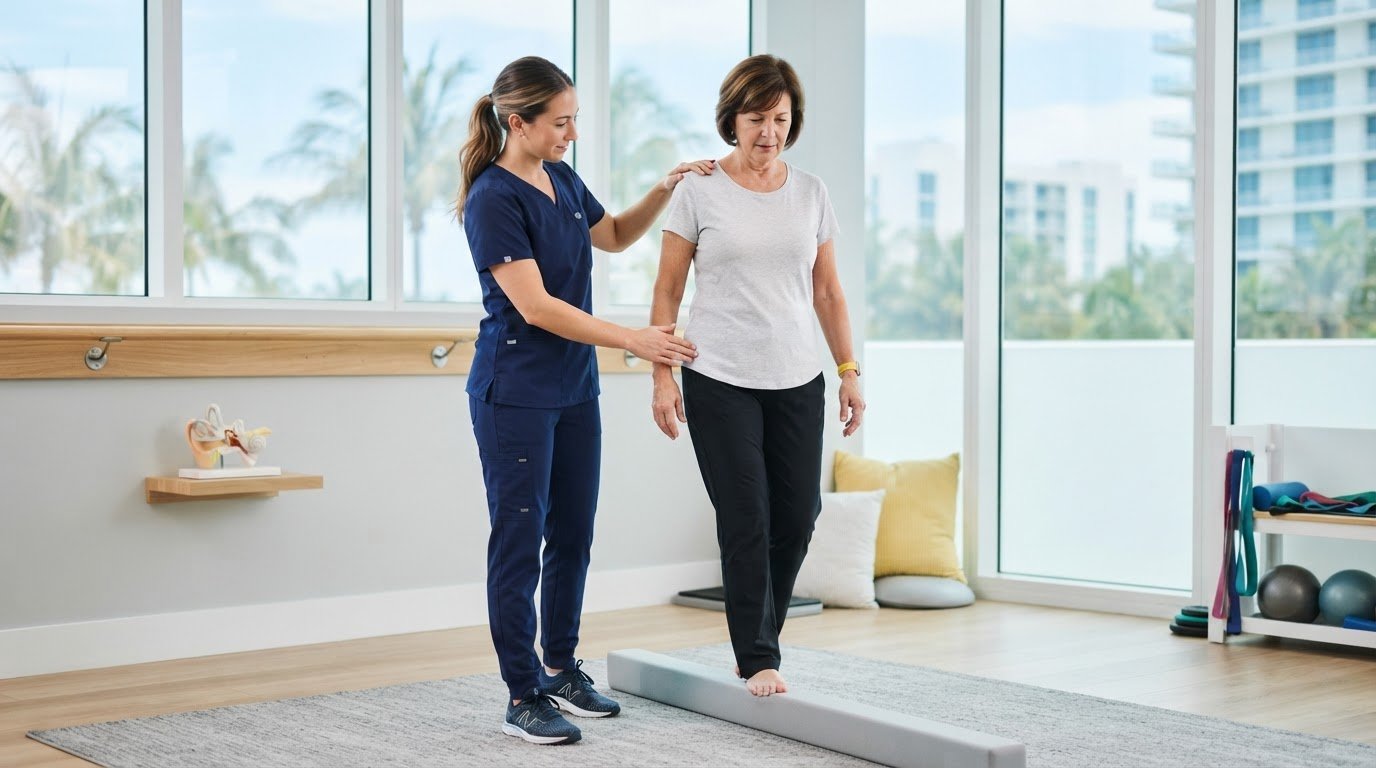
What if stopping the spin is only the first step toward feeling steady again? Vertigo can make walking feel risky, turn ordinary tasks into a struggle, and leave you frustrated when the advice is simply to wait. If you’re wondering how to recover from vertigo, start by understanding what may be causing your symptoms. Benign paroxysmal positional vertigo (BPPV), vestibular neuritis, and vestibular migraine can call for different approaches, so effective care begins with an appropriate assessment.
At Touch of Health Rehab Inc., physical therapists provide personalized vestibular rehabilitation to address balance challenges and support progress. The goal isn’t just to ease dizziness in the moment. It’s to help your brain and body coordinate more effectively so you can manage daily routines with greater confidence. This guide explains how clinicians assess common causes of vertigo, when targeted repositioning maneuvers may help, and how progressive exercises, balance and gait training, and postural education can support recovery. It also covers how a tailored plan can give you a more active path forward than waiting and wondering.
Key Takeaways
- Vertigo has different possible causes. Identifying the source of your symptoms helps guide a safer, more suitable recovery plan.
- The inner ear and brain work together to support balance, and targeted vestibular exercises can help retrain that connection.
- The Epley maneuver can help with certain cases of BPPV, but the right approach depends on an accurate assessment.
- Learn how to recover from vertigo with a personalized plan that may include vestibular rehabilitation, balance training, and practical strategies for daily life.
- Touch of Health Rehab Inc. in Sunny Isles Beach provides personalized vertigo rehabilitation to support steadier movement and confidence.
Understanding Vertigo Recovery: What to Expect When the World Spins
Vertigo is the sensation that you or your surroundings are moving when they aren’t. It can occur when information from the inner ear, which helps detect motion and position, doesn’t match what your brain receives from your eyes and body. That mismatch can affect balance and make walking, turning your head, or focusing difficult. The right care can help your system adapt and support steadier movement.
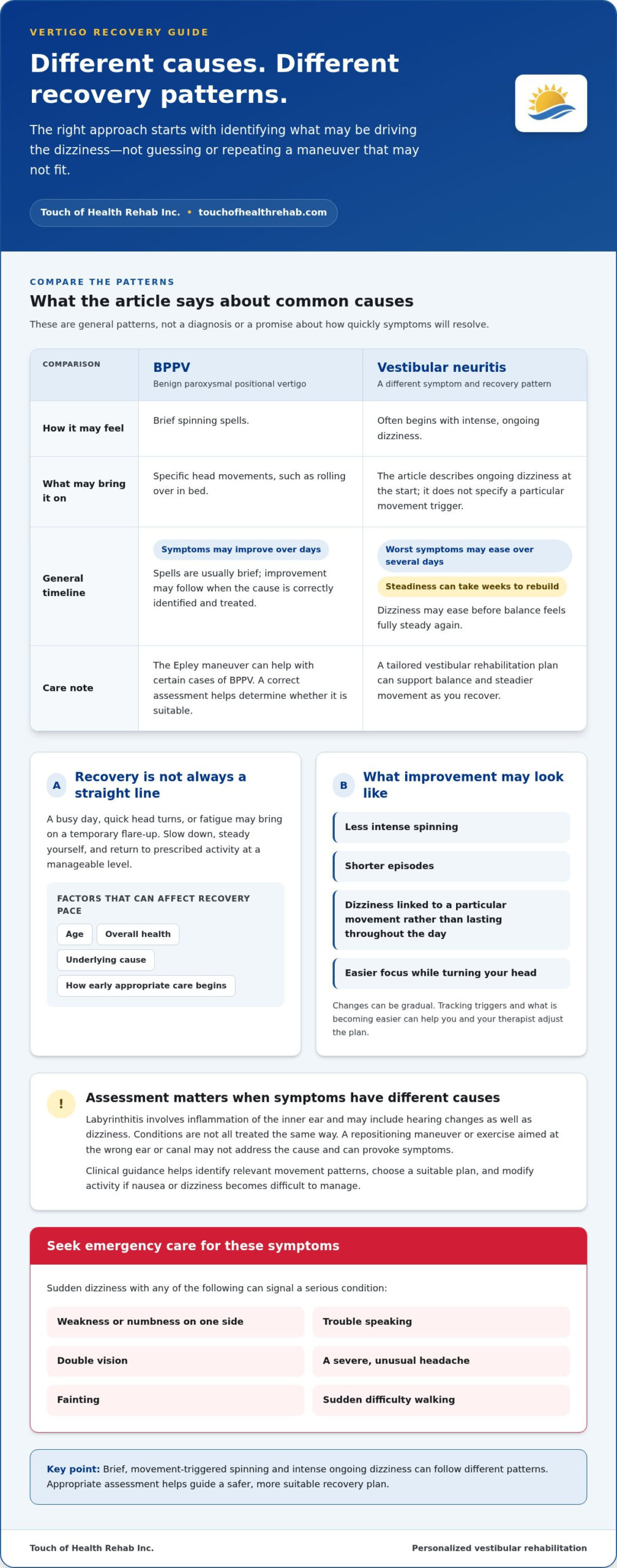
The cause matters. Benign paroxysmal positional vertigo (BPPV) often causes brief spinning triggered by specific head movements, such as rolling over in bed. Read more about Benign Paroxysmal Positional Vertigo. Labyrinthitis, by contrast, involves inflammation of the inner ear and may include hearing changes as well as dizziness. These conditions aren’t treated the same way, so an assessment is more useful than guessing at the cause or repeating a maneuver that may not fit.
Avoiding movement for too long can reduce activity and confidence, making it harder to rebuild balance. Persistent unsteadiness can also increase fall risk, especially when you already feel unsure on your feet. In vestibular rehabilitation, a tailored plan can help you resume movement safely and support vestibular compensation. This is the brain’s process of adapting to changed inner-ear signals and using other information to help steady the body. Learn more about vestibular rehabilitation.
The Recovery Timeline: How Long Does Vertigo Last?
With BPPV, spinning spells are usually brief, and symptoms may improve over days when the cause is correctly identified and treated. Vestibular neuritis often begins with intense, ongoing dizziness. The worst symptoms may ease over several days, while steadiness can take weeks to rebuild. These are general patterns, not promises. Age, overall health, the underlying cause, and how early you receive appropriate care can all affect your pace of recovery.
Progress is rarely a straight line. A busy day, quick head turns, or fatigue may bring on a temporary flare-up. Slow down, steady yourself, and return to prescribed activity at a manageable level. If symptoms change or continue to disrupt daily life, seek clinical guidance rather than assuming you must simply endure them.
Signs Your Body is Beginning to Recalibrate
Improvement may look like less intense spinning, shorter episodes, or dizziness that occurs only with a particular movement rather than lingering throughout the day. You may also find it easier to keep your eyes focused while turning your head. Changes can be gradual. Track what triggers symptoms and what is becoming easier so you and your therapist can adjust your recovery plan.
The Science of Recalibration: How Your Brain Heals from Inner Ear Disorders
Your balance system is constantly combining signals. The semicircular canals detect rotation, such as turning your head, while the otolith organs sense linear movement and the pull of gravity. Your eyes and sensory receptors in your muscles and joints provide additional information. When inner-ear signals become unreliable, your brain may receive conflicting messages, leading to dizziness or unsteadiness.
Recovery can involve more than addressing an inner-ear problem. Through neuroplasticity, the brain can adapt to interpret signals differently and coordinate movement more confidently. Vestibular rehabilitation therapy (VRT) uses carefully selected activities, including gaze-stabilization, balance, and habituation exercises, to encourage that adaptation. Cleveland Clinic’s guide to Vestibular Rehabilitation explains how exercises are tailored to a person’s symptoms and needs.
The Brain-Body Connection in Balance
Your eyes help you stay oriented, your inner ear senses motion, and muscles and joints report how your body is positioned. If one source becomes less dependable, the brain must rely more on the others. A guarded, slouched posture won’t cause an inner-ear disorder, but it can make movement less comfortable and make steady head and body control more difficult. Postural education helps you practice alignment and movement strategies that support balance during everyday tasks.
Vestibular recovery involves helping the brain adapt to balance signals and coordinate movement. Habituation exercises support this process by gradually and safely exposing you to movements that bring on symptoms. Repeated practice may help reduce the nervous system’s sensitivity to those triggers. The goal isn’t to push through intense dizziness. A therapist can adjust the movement, speed, and repetitions to keep practice manageable. That individualized progression is central to learning how to recover from vertigo with greater confidence.
Why Clinical Guidance Is Essential for Safety
A repositioning maneuver or exercise aimed at the wrong ear or canal may fail to address the cause and can provoke symptoms. A therapist’s assessment helps identify relevant movement patterns and guide a suitable plan. During treatment, the clinician can monitor your response and pause or modify an exercise if nausea or dizziness becomes difficult to manage.
Some symptoms need urgent medical assessment rather than a rehabilitation exercise. Seek emergency care for sudden dizziness with weakness or numbness on one side, trouble speaking, double vision, a severe unusual headache, fainting, or sudden difficulty walking. These can signal a serious condition. For ongoing balance concerns, Touch of Health Rehab Inc. provides personalized vestibular rehabilitation and postural education.
Home Exercises vs. Clinical Vestibular Therapy: Choosing the Safe Path
Home exercises can be useful when they match the cause of your dizziness. A maneuver that helps one type of vertigo may do little for another. The Epley maneuver is designed for certain cases of benign paroxysmal positional vertigo (BPPV), in which small crystals affect a specific inner-ear canal. It isn’t a universal fix, and imbalance may persist even after the spinning settles.
The Limitations of the Home Epley Maneuver
The maneuver depends on identifying the affected ear and canal, then following a precise sequence of head and body positions. Incorrect angles, rushed transitions, or holding a position for too little time may reduce its effectiveness. In some cases, repositioning can move particles into another canal, changing the symptoms and the treatment needed. Vestibular migraine, for example, doesn’t result from displaced crystals, so repositioning maneuvers won’t address its underlying cause.
Repeating a maneuver without knowing the diagnosis can prolong discomfort and make it harder to understand what triggers symptoms. A clinician can assess your responses to movement and determine whether a repositioning technique is appropriate before guiding you through it.
What Clinical Vestibular Rehabilitation Adds
Working one-on-one with a vestibular therapist allows exercises to be selected and adjusted according to your symptoms, balance, and response to movement. In some clinical settings, infrared goggles help clinicians observe eye movements that may provide clues about vestibular function. Their use depends on the setting and assessment; no single tool replaces a thorough clinical evaluation.
Supervised practice can also make movement feel less intimidating. Rather than avoiding every trigger or pushing through severe symptoms, you can build exposure gradually with guidance and appropriate adjustments.
Why Balance and Gait Matter After the Spin
Feeling less spinning doesn’t always mean your walking is steady again. You may still feel cautious when turning, walking on uneven ground, or moving through a busy space. Targeted balance and gait rehabilitation addresses these functional challenges, supporting safer movement and helping reduce the risk that unsteadiness leads to a fall or injury.
When considering how to recover from vertigo, look beyond a single maneuver. An appropriate assessment, suitable exercises, and a gradual return to walking and daily activities all matter. A personalized physical therapy plan can connect symptom relief with the balance skills you need to feel more secure in motion.
5 Critical Steps to Accelerate Your Vertigo Recovery Journey
A steady recovery plan does more than address spinning. It helps you rebuild confidence in everyday movement, from turning your head to walking safely. These steps offer a framework, while a physical therapist can tailor the pace and exercises to your symptoms and diagnosis.
- Get an accurate assessment. A physical therapist can evaluate how movement affects your symptoms and whether vestibular rehabilitation is appropriate. Sudden or severe symptoms, especially with weakness, trouble speaking, or double vision, need urgent medical attention.
- Follow a customized VRT plan. Generic exercises may not match your needs. A tailored program can progress from gaze-stability practice to balance and walking activities as your tolerance improves.
- Support your general health. Drink fluids regularly, unless a clinician has advised you to limit them. Choose balanced meals with vegetables, fruit, whole grains, and sources of protein. Nutrition supports overall well-being, but no particular food can treat every cause of vertigo.
- Practice postural education. Comfortable alignment and controlled head and trunk movement can help you manage daily tasks with greater steadiness. Your therapist can help you apply these strategies to sitting, standing, and turning.
- Return to activity gradually. Increase movement in manageable steps rather than avoiding it or pushing through intense symptoms. Clear pathways, use handrails, and keep a stable surface nearby during balance practice to reduce fall risk.
Mastering Gaze Stability and Habituation
If your therapist recommends gaze-stability practice, try focusing on a stationary target at eye level while gently turning your head side to side. Keep the movement comfortable and stop if symptoms become overwhelming. For balance practice, stand near a sturdy counter and begin in a position that feels secure. Older adults can benefit from individualized support through geriatric physical therapy, with exercises adapted to mobility and fall-prevention needs.
Managing the Emotional Toll of Dizziness
Dizziness can feel frightening, and anxiety may make symptoms harder to manage, even though stress alone doesn’t explain every inner-ear problem. During an episode, pause somewhere safe, steady your gaze, and breathe slowly. Let someone you trust know what helps, and involve them as you return to activities. Small, supported steps can build confidence without demanding that you do everything at once.
For practical guidance on how to recover from vertigo, Touch of Health Rehab Inc. provides personalized vestibular rehabilitation, balance and gait training, and postural education. Explore support for your vertigo recovery.
Personalized Vertigo Treatment in Sunny Isles Beach: The Touch of Health Approach
Vertigo can make familiar routines feel uncertain, but you don’t have to manage recovery alone. At Touch of Health Rehab in Sunny Isles Beach, physical therapists provide personalized vertigo recovery and vestibular rehabilitation guided by your symptoms, balance, and goals. The clinic’s Lead Physical Therapist guides care focused on steadier movement and renewed confidence.
Your care begins with understanding how dizziness affects you and which movements or activities feel difficult. From there, your plan may bring together vestibular exercises, balance and gait rehabilitation, and postural education. As your abilities progress, the focus can extend to wellness and preventative care, helping you maintain function and support long-term well-being. Each step is tailored to your needs and goals.
Serving Sunny Isles Beach and Nearby Communities
Touch of Health Rehab is based in Sunny Isles Beach and serves people in nearby communities, including Aventura, Bal Harbour, North Miami Beach, and Miami Beach. If you’re also working with a primary care physician or an ear, nose, and throat specialist, share relevant guidance and updates with your physical therapist. That information can help your rehabilitation plan fit within your broader care. Fall prevention therapy can also support safer balance and mobility during everyday movement.
Take the Next Step Toward Steadier Movement
You don’t need to wait until every symptom disappears before seeking a clearer path forward. A personalized assessment can help identify the challenges affecting your balance and shape a practical recovery plan. If you’re exploring how to recover from vertigo, start with the activities you want to return to, such as walking comfortably, moving your head with less fear, or managing daily routines with greater ease.
Patient experiences can offer encouragement as you consider what rehabilitation may involve. Read Touch of Health Rehab success stories, then take the first step toward personalized vertigo care by connecting with Touch of Health Rehab.
Take the Next Step Toward Steadier Days
Understanding how to recover from vertigo starts with identifying its cause, because different vestibular conditions may need different approaches. A personalized rehabilitation plan can help your brain adapt to movement, rebuild balance, and restore confidence in everyday activities. Progress may take time, but you don’t have to navigate it alone.
At Touch of Health Rehab, vestibular rehabilitation is part of a personalized physical therapy plan. Your care can bring together individualized exercises, balance and gait training, and postural education, with an approach shaped around your needs and goals. The focus is on more than easing dizziness: it’s supporting safer movement and long-term wellness.
Take the first step toward personalized vertigo care with Touch of Health Rehab. Connect with the clinic in Sunny Isles Beach to discuss your balance and movement goals and begin a plan tailored to your needs.
Frequently Asked Questions
Is it possible to recover from vertigo without medication?
Yes, some causes of vertigo can improve with physical treatment rather than medication, but the right approach depends on the diagnosis. For certain cases of BPPV, a clinician may use a repositioning maneuver; vestibular rehabilitation can help address balance and motion sensitivity. Other conditions may need medical assessment or medication. Don’t stop or change prescribed medication without discussing it with the clinician who recommended it.
How long should I wait after a vertigo attack before starting exercises?
There isn’t one waiting period that’s right for everyone. If you’re having intense spinning, severe nausea, or trouble standing safely, don’t start unsupervised balance exercises during the episode. Once you’re safe to move, a physical therapist can assess your symptoms and advise when and how to begin. The cause of vertigo matters, so avoid copying an exercise plan before you know it suits your condition.
Can vertigo be permanently cured with physical therapy?
Physical therapy can resolve symptoms for some people, while others may need ongoing strategies or further medical care. Outcomes depend on the cause: a maneuver may address certain cases of BPPV, while vestibular rehabilitation can help the brain adapt to balance-system changes. Symptoms can sometimes return, so lasting progress isn’t guaranteed. A clinician can help set realistic goals and adjust your plan if dizziness recurs.
What happens if the Epley maneuver doesn’t work for me?
If the Epley maneuver doesn’t help, it may not match the cause of your vertigo, the affected side or canal may need reassessment, or the movement sequence may need clinical guidance. Some conditions, such as vestibular migraine, aren’t caused by displaced inner-ear crystals and won’t respond to repositioning. Rather than repeating it indefinitely, seek an assessment to clarify the diagnosis and next steps.
Can poor posture really cause or worsen my vertigo symptoms?
Poor posture doesn’t usually cause an inner-ear disorder, but it can affect how steady and comfortable you feel as you move. A guarded head position or stiff movement may make turning and walking feel harder. Postural education can help you practice more controlled alignment and movement as part of rehabilitation. If dizziness is new, persistent, or worsening, don’t assume posture is the only cause; get an appropriate assessment.
Is it safe to drive while recovering from vertigo?
Don’t drive while you’re experiencing spinning, blurred vision, unsteadiness, nausea, or difficulty turning your head and focusing. These symptoms can interfere with the attention and control needed to drive safely. Wait until they’ve settled and you can move and see comfortably, and discuss returning to driving with your healthcare professional if symptoms persist or recur. Arrange another way to travel while you’re unsure or symptomatic.
What is the difference between dizziness and vertigo?
Dizziness is a broad term for sensations such as lightheadedness, imbalance, or feeling faint. Vertigo is a specific sensation that you or your surroundings are moving or spinning when they aren’t. People may use the words interchangeably, but describing exactly what you feel, how long it lasts, and what triggers it can help a clinician assess possible causes and guide appropriate care.
How many sessions of vestibular rehabilitation are typically needed?
There’s no set number of sessions that applies to everyone. The plan depends on the cause of your symptoms, your balance and mobility, and how you respond to exercises between visits. At Touch of Health Rehab in Sunny Isles Beach, vestibular rehabilitation is personalized for your needs. The clinic serves people in Aventura, Bal Harbour, North Miami Beach, and Miami Beach, with care focused on balance and function.