
The first visit is about finding the right starting point, not simply seeing how much dizziness you can tolerate. Vestibular rehabilitation is individualized, exercise-based physical therapy that can help ease dizziness, vertigo, and balance problems. Your initial appointment typically includes a review of your symptoms, medical history, and goals, along with physical and sensory checks to guide a plan suited to you.
It’s understandable to feel uncertain about exercises when movement can bring on symptoms. Knowing what to expect from vestibular rehabilitation can help you feel more prepared: your therapist may assess balance, walking, and eye and head movements, then explain which exercises suit your needs and how to practise them safely.
This article explains which symptoms vestibular rehabilitation may address, what an initial evaluation can involve, and how a personalized exercise plan may progress. You’ll also learn when to stop home exercises and contact your provider, so you can take your next step with greater confidence.
Key Takeaways
- Vestibular rehabilitation uses tailored exercises to help your brain adapt to changes in balance signals and manage dizziness or vertigo.
- Gaze stabilization exercises train you to keep your focus on a target while your head moves.
- Your symptoms, medical history, movement, and personal goals help shape the initial evaluation and treatment plan.
- Balance and walking difficulties can have different causes, so the assessment helps identify which activities and exercises fit your needs.
- Learn which new or worsening symptoms during home exercises mean you should stop and contact a provider.
What Is Vestibular Rehabilitation Therapy?
Vestibular rehabilitation therapy uses individualized exercises to help your brain adapt to irregular signals from the balance system. It can help manage dizziness, vertigo, and imbalance, but it doesn’t cure the underlying cause.
In the United States, costs depend on the evaluation and treatment plan, while insurance coverage depends on your plan’s benefits. Review your coverage terms to understand how they apply to therapy.
Gaze Stabilization Exercises
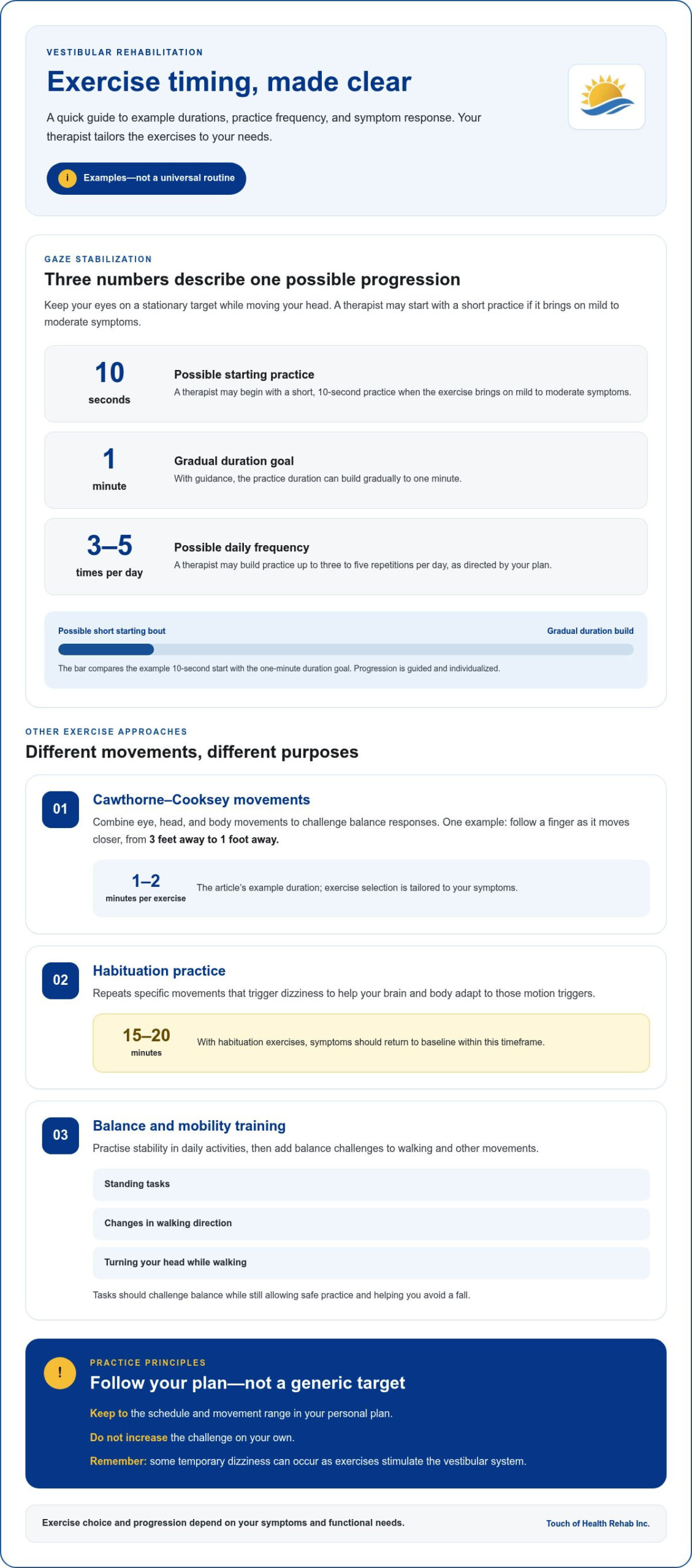
Gaze stabilization exercises train you to keep your eyes focused on a stationary target while moving your head. This supports clearer vision during motion, such as turning to look at someone while walking. A therapist may begin with a short, 10-second practice if it brings on mild to moderate symptoms. With guidance, the duration can build gradually to one minute and up to three to five repetitions per day.
Cawthorne-Cooksey and Habituation Exercises
Cawthorne-Cooksey exercises combine eye, head, and body movements to challenge balance responses. Habituation exercises repeat movements that trigger dizziness, helping your brain and body adapt to specific motion triggers. A Cawthorne-Cooksey routine might involve following a finger as it moves closer, from three feet away to one foot away. Each exercise may last one to two minutes, with the selection tailored to your symptoms.
Balance and Mobility Training
Balance training practises stability during daily activities, while mobility exercises add balance challenges to walking and other movements. Your program may include standing tasks, changes in walking direction, or turning your head while walking. These exercises address situations that feel difficult, such as moving through a busy space or looking around as you walk. Each task should challenge your balance while allowing you to practise safely and avoid a fall.
Exercise Consistency and Symptom Response
Consistent practice gives your nervous system repeated opportunities to adapt, so a therapist may prescribe exercises frequently or daily. Keep to the schedule and movement range in your personal plan rather than increasing the challenge on your own. Some temporary dizziness can occur as exercises stimulate the vestibular system. With habituation exercises, symptoms should return to baseline within 15 to 20 minutes.
Vestibular rehabilitation exercises may include gaze stabilization, habituation, balance retraining, walking tasks, and stretching or strengthening. The right combination depends on your symptoms and functional needs, not a standard routine. The vestibular rehabilitation approach centers exercises on those individual needs. Because vestibular rehabilitation can manage symptoms without curing their cause, the exercise plan works alongside care for the underlying condition.
Conditions and symptoms treated with vestibular rehabilitation
Vestibular rehabilitation may help manage dizziness, vertigo, unsteadiness, and difficulty walking steadily. It can benefit people with benign paroxysmal positional vertigo (BPPV), vestibular neuritis, Ménière’s disease, or post-concussion syndrome. It may also support people with reduced vestibular function on one or both sides, or balance changes after acoustic neuroma removal. The diagnosis matters because conditions affect movement and balance in different ways.
Symptoms can also accompany migraines, multiple sclerosis, or Parkinson’s disease. In these cases, therapy addresses balance problems and daily activities affected by symptoms, rather than treating the underlying condition. Someone who feels unsteady when turning their head may practise that movement while walking. A person with visual discomfort during motion may work on exercises suited to that challenge. Understanding what to expect from vestibular rehabilitation can help connect therapy goals with the activities you want to regain.
An initial consultation connects your symptoms with practical goals. The therapist reviews your medical history, asks when dizziness occurs, and learns which activities have become difficult. You might describe trouble looking at a moving object, walking through a crowded space, or changing position without feeling unsteady. A physical and sensory evaluation helps identify impairments and guide treatment planning. Share the situations that matter most to you, as they help shape relevant exercises.
Your exercise program is tailored to your impairments, limitations, lifestyle, occupation, and daily roles. If they match your symptoms and goals, a plan might combine gaze-related tasks, balance practice, and walking activities. Progress can be assessed through changes in symptoms, balance, and your ability to complete activities. A patient-specific functional scale can record difficult activities and track changes over time. Even if symptoms aren’t present during a session, therapy can address challenges identified in your assessment.
Session frequency and treatment length depend on the plan and your progress. Vestibular rehabilitation sessions are typically scheduled once or twice a week, and many people have six to eight weekly sessions. A commonly prescribed program lasts around four weeks, with two to three treatment sessions per week. Some programs continue for six or eight weeks; rehabilitation may also take several weeks or months, depending on symptom severity and individual progress. These differences reflect the condition, response, and goals being addressed.
To prepare for care, note your symptoms, the movements that bring them on, and the activities you want to regain. This can help you discuss a plan that fits your daily life. A clearer picture of what to expect from vestibular rehabilitation can also help you describe your priorities and follow your progress over time. You can discuss your symptoms and rehabilitation goals as you consider a personalized next step.
What happens during an initial vestibular therapy session
Your first appointment typically begins with a thorough review of your symptoms, medical history, and goals, followed by physical and sensory checks. To find a vestibular physical therapist near you, the Vestibular Disorders Association (VEDA) offers a healthcare provider listing; look for a practitioner who evaluates balance and vestibular needs.
Assessment and Therapy Suitability
The assessment helps determine which movements, balance challenges, and treatment approaches suit your symptoms. Your therapist may ask when dizziness occurs, whether head movements affect your focus, and which activities feel difficult.
Evaluation can include eye and head movements, balance, walking, strength, and flexibility. The therapist may also assess cranial nerves and neurological function. If your symptoms suggest benign paroxysmal positional vertigo (BPPV), specific positional testing can help identify the affected canal and guide treatment. Your diagnosis, test findings, and goals help determine whether vestibular exercises are appropriate and which ones to begin with.
Temporary Dizziness and Nausea
Some people experience temporary dizziness or nausea during vestibular therapy, particularly when exercises challenge their response to motion. A therapist observes your symptoms and adjusts the movement or activity to suit your response.
Symptoms may rise briefly during an exercise, but how you respond matters. Tell the therapist if nausea or dizziness becomes difficult to manage, or if a movement feels different from your usual symptoms. This information helps distinguish a tolerable exercise response from a reason to adjust the plan.
An individual treatment session typically lasts around one hour. After discussing your history and goals, the therapist performs tests that may involve eye movements, balance, walking, and head movement. For example, you may follow a visual target while moving your head or complete a balance task with different sensory demands. These checks show how your body responds to signals involved in balance.
If testing identifies BPPV, treatment may include a canalith repositioning maneuver selected for the type identified during assessment. Other findings may lead to gaze exercises, balance training, or walking tasks. The therapist explains each activity’s purpose and how it relates to a daily challenge, such as turning your head while moving through a room.
Vestibular physical therapists use specialized assessment and exercise approaches, though formal credentials and titles can differ. Ask how the practitioner evaluates vestibular symptoms, adapts exercises, and tracks progress. Coordination with your physician can also help align rehabilitation with medical care, especially if your diagnosis or symptoms change during treatment.
How the vestibular system supports balance
Your vestibular system helps your brain interpret head movement and maintain balance. It works with visual information and signals from your body, including feedback from your feet and joints. If those signals don’t match, you may feel imbalanced or dizzy during ordinary movement. For example, turning your head while walking asks your eyes, inner ear, and body to coordinate quickly. Vestibular rehabilitation helps you practise using available sensory information when vestibular signals are disrupted.
An assessment looks at how your balance changes across tasks, not just whether you can stand still. A therapist may observe your posture, walking, eye movements, and response to head movement. The Romberg test is one example: you stand with your feet together while the therapist observes how balance changes when visual information is reduced. The Sensory Organization Test (SOT) is another example that can help assess balance. These findings help identify which sensory conditions make stability harder.
Positional testing can help investigate symptoms triggered by lying down, rolling over, or looking up. For suspected benign paroxysmal positional vertigo (BPPV), a therapist uses positional tests to assess whether changing head position brings on vertigo and characteristic eye movements. The result helps guide the next step, including whether a canalith repositioning maneuver is appropriate. This matters because BPPV-related symptoms call for a different approach than general imbalance or reduced vestibular function.
Balance and posture retraining practises steady alignment during tasks that challenge your sensory system. A therapist may start with a stable standing position, then add a controlled head turn or reduce reliance on vision. The aim is to develop steadier responses, not to test how long you can tolerate symptoms. Each activity should suit your abilities and allow safe practice. As your control improves, the task can reflect a practical goal, such as turning to reach for an object.
Gait training brings balance practice into walking, where your body must adjust with each step. Your plan may involve walking while turning your head, changing direction, or responding to a visual target. These tasks connect balance strategies with daily movement, such as looking across a room while walking. The therapist can compare your stability across activities and adjust the challenge. If you feel unsteady during a specific task, that response helps guide what to practise next.
Progress can be tracked through changes in balance tests and everyday function. For example, repeating the Romberg test or SOT can help show how your balance responds over time. Your ability to walk, turn, and manage positional changes also provides practical information. The goal is to build strategies that support daily activity, with exercise choices tied to your assessment findings and personal goals.
Symptoms that require contacting a provider
The vestibular system in your inner ear helps your brain interpret movement and maintain balance. Inner ear disorders can disrupt those signals, leading to vertigo, unsteadiness, or difficulty walking. Symptoms can also follow a concussion or other injury. A change in your symptom pattern matters: note what you feel, which movement brings it on, and whether it affects everyday activities.
Contact your provider right away if home exercises bring on a sudden hearing change, painful ear pressure, new or increased ringing, or fluid from the ear. Stop the exercises and seek help if your symptoms worsen. Also contact your provider about exercise-related neck or back pain or discomfort. These changes may need assessment rather than a decision to push through the activity.
Track your response to exercise with a simple symptom record. Note the activity, the movement involved, how symptoms changed, and how long they lasted. A suggested symptom scale runs from 0, meaning no symptoms, to 5, meaning severe symptoms. Follow your therapist’s instructions about which level is appropriate for your exercises. For habituation practice, symptoms should return to baseline within 15 to 20 minutes.
Recovery depends on the underlying disorder, its severity, your health and fitness, other life stressors, and how consistently you complete prescribed home exercises. A symptom diary can help you and your therapist identify patterns across sessions. Record practical changes too, such as whether you can turn your head while walking or complete a daily task with less imbalance. These details help show progress beyond how you feel during one appointment.
After a concussion, vestibular symptoms may appear immediately or develop several weeks after the injury. Dizziness, visual discomfort, or difficulty with head movements can affect daily activities even if symptoms didn’t begin on the day of impact. Tell your provider when the concussion occurred, when symptoms started, and how they have changed. This timeline helps them interpret your symptoms alongside your recovery and assessment findings.
Pacing means following the prescribed exercise plan instead of increasing repetitions or difficulty without guidance. If symptoms rise, write down which exercise triggered them and whether they settled afterward. Don’t continue an exercise that worsens your symptoms. Clear notes help your therapist adjust movements, balance tasks, or the overall program, while your provider can assess new ear symptoms or pain.
If dizziness or imbalance is disrupting daily activities, discuss your symptoms and exercise response with a provider. Connect with a provider about vestibular rehabilitation to discuss an assessment and a plan shaped around your needs.
Touch of Health Rehab: Physical Therapy
Touch of Health Rehab Inc. provides physical therapy, including vestibular rehabilitation, for people managing dizziness, vertigo, or balance and walking difficulties. If these symptoms affect daily activities, tailored rehabilitation exercises can help you work toward steadier movement. Postural education may also support better awareness of alignment during everyday tasks.
Bring a clear account of your symptoms, the movements that trigger them, and the activities you want to regain. This gives your therapist helpful context for discussing your goals and next steps. Contact Touch of Health Rehab Inc. to discuss vestibular rehabilitation and whether it fits your needs.
Take Your Next Step Toward Steadier Movement
Knowing what to expect from vestibular rehabilitation can make it easier to move from uncertainty to a focused next step. Consider which activities you want to feel more comfortable doing, and bring those goals into a conversation about care. Progress starts with a plan connected to your life.
Touch of Health Rehab Inc. offers physical therapy, vestibular rehabilitation, and postural education to support your movement and functional goals. If dizziness or balance concerns affect your routines, a conversation can help you explore a suitable path forward. Your questions and priorities belong in that discussion.
Contact Touch of Health Rehab Inc. to discuss your next step. With thoughtful guidance and a plan shaped around your goals, you can work toward greater confidence in everyday movement.
Frequently Asked Questions
Are there any risks?
Vestibular rehabilitation exercises don’t pose physical risks, but they can temporarily increase dizziness or nausea. Practising balance tasks safely matters, especially if unsteadiness makes falling a concern. Follow the therapist’s instructions rather than adding movements or making exercises harder independently. Stop and contact your provider if symptoms worsen, or if you notice a sudden hearing change, painful ear pressure, new ringing, ear fluid, or exercise-related neck or back discomfort.
Does VRT Hurt?
Vestibular rehabilitation is exercise-based therapy, not a surgical procedure, though some exercises can briefly bring on dizziness or nausea. That response is different from pain. Tell your therapist what you feel and which movement caused it, such as turning your head or changing position. Neck or back pain during home exercises is a reason to stop and contact your provider, rather than trying to work through it.
How Long Will It Take For You to Feel the Benefits of VRT?
There isn’t one timetable for noticing changes; progress depends on the underlying disorder, symptom severity, overall health, and consistency with prescribed exercises. A therapist may track whether dizziness eases, balance improves, or a personally difficult activity becomes more manageable. Some people need only one or two sessions, while others follow a longer plan. Improvement in one daily task can count as useful progress, even if other symptoms remain.
How long will I need this treatment?
Treatment length depends on your diagnosis, the extent of the balance problem, your goals, and how your symptoms respond. A common course is six to eight weekly sessions, though vestibular rehabilitation may last several weeks or months. Your plan can change as you progress and your functional needs become clearer. Home exercises are part of the plan, so share any barriers that make regular practice difficult.
What Should a Patient Expect at the First Session?
Expect conversation and movement-based assessment, not a test of endurance. Before you go, note when symptoms occur, what movements bring them on, and which activities you want to make easier. For example, record whether rolling over, looking upward, or walking while turning your head affects you. These observations help connect the evaluation to your everyday priorities and give the therapist useful context.
What Types of Problems Benefit From VRT?
VRT may help manage dizziness or balance problems associated with benign paroxysmal positional vertigo, vestibular neuritis, Ménière’s disease, or post-concussion syndrome. It may also support people with reduced vestibular function on one or both sides. The aim is to address balance or movement difficulties that affect daily life. For example, therapy goals may focus on steadier walking or greater comfort with head movement.
What is the Vestibular System?
The vestibular system is the balance-sensing system in your inner ear. It sends information about head movement and position to the brain, which uses those signals alongside vision and body feedback to help maintain stability. If information from these systems doesn’t align, you may feel dizzy or unsteady. Turning your head while walking is one everyday example of these systems working together.
What is vestibular rehabilitation and who is it for?
Vestibular rehabilitation is individualized physical therapy using exercises to help manage dizziness, vertigo, or imbalance. It can suit people whose vestibular symptoms affect movement or daily activities, including after a concussion or with an inner-ear disorder. Touch of Health Rehab Inc. offers vestibular rehabilitation and physical therapy for people in Sunny Isles Beach and nearby communities, including Aventura, Bal Harbor, North Miami Beach, and Miami Beach.