What if the key to stopping the world from spinning isn’t more rest, but a precise recalibration of your brain’s internal compass? For many, the constant fear of falling or the sharp jolt of movement-triggered vertigo makes even simple tasks feel like an exhausting gamble. If you feel overwhelmed by clinical jargon like BPPV or simply tired of living life on a tilt, please know that your experience is valid and help is available. Understanding exactly what to expect from vestibular therapy is the first step toward reclaiming your stability and your peace of mind.
At Touch of Health Rehab Inc., we believe recovery is a collaborative journey where professional expertise meets compassionate care. This 2026 guide demystifies the step-by-step process of vestibular rehabilitation, ensuring you feel safe and supported at every turn. We’ll explore the structure of your initial clinical evaluation, provide a realistic timeline for your recovery, and explain why this protocol is the gold standard for restoring peak physical health. You don’t have to navigate this path alone; we’re here to turn your uncertainty into a clear, life-affirming plan for long-term vitality and confidence.
Key Takeaways
- Understand how vestibular rehabilitation therapy (VRT) uses targeted exercises to recalibrate the inner ear’s spatial signals to your brain.
- Get a detailed breakdown of what to expect from vestibular therapy during your initial evaluation, ensuring you feel safe and in control from the very first session.
- Learn about the three primary exercise pillars used to retrain your balance and how they are customized to your specific type of dizziness.
- Discover the “Yellow Zone” strategy for managing symptoms, which helps you navigate the recovery process without fear or unnecessary discomfort.
- See how personalized, one-on-one care in Sunny Isles Beach helps you transition from clinical success to total confidence in your daily environment.
Understanding Vestibular Rehabilitation Therapy (VRT)
Vestibular Rehabilitation Therapy, or VRT, is a specialized branch of physical therapy designed to resolve the root causes of dizziness and imbalance. It’s more than just a set of exercises; it’s a scientific approach to stabilizing your world. When you begin to research what to expect from vestibular therapy, you’ll find that the focus is on your vestibular system. These are the delicate organs in your inner ear that act as your body’s internal GPS, sending constant signals to your brain about where you are in space.
Conditions like Benign Paroxysmal Positional Vertigo (BPPV), Labyrinthitis, and Ménière’s disease can disrupt these sensors. When they fail, your brain receives garbled data about your position. Our primary goal in therapy is to achieve “compensation.” This process involves teaching your brain to prioritize other sensory inputs to maintain perfect balance, essentially recalibrating your entire equilibrium system for long-term stability.
The Science of Equilibrium
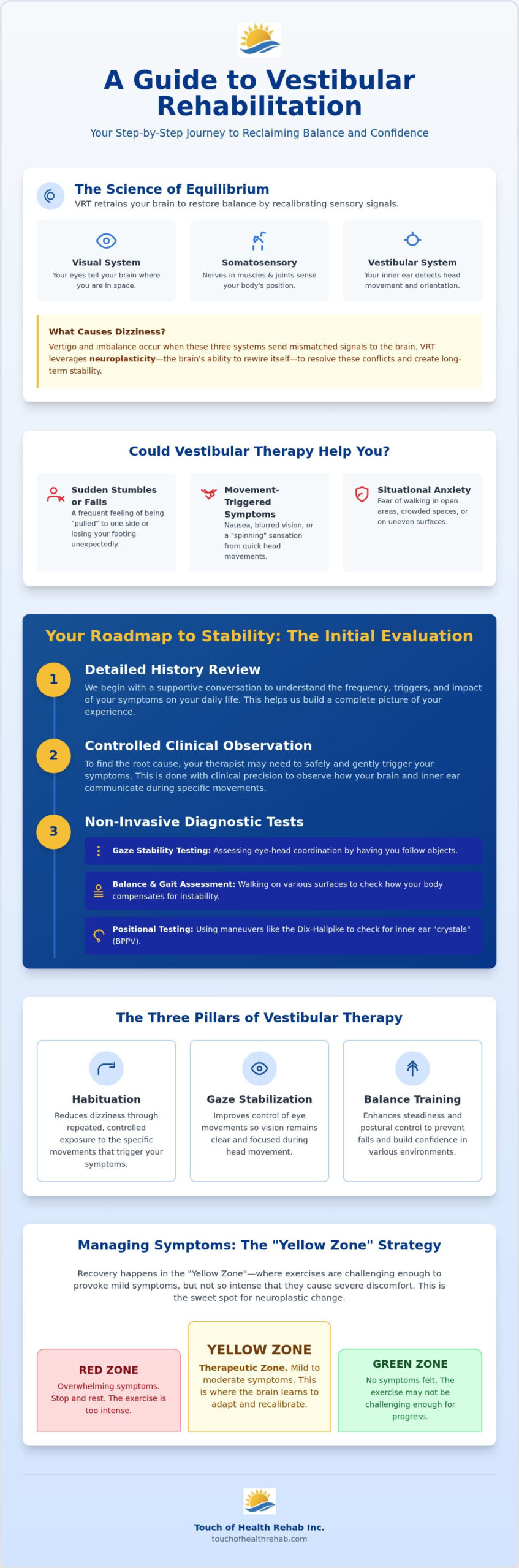
Your balance depends on a constant conversation between three distinct systems: your eyes (visual), your muscles and joints (somatosensory), and your inner ear (vestibular). Vertigo occurs when these signals become mismatched. Imagine your eyes telling your brain you’re standing still while your inner ear insists you’re spinning. This conflict creates the debilitating sensation of dizziness. VRT leverages neuroplasticity, which is your brain’s natural ability to reorganize itself, to resolve these contradictions and restore steady, confident movement.
Who is a Candidate for VRT?
Many people live with lightheadedness or a “spinning” sensation, thinking it’s just a part of aging or a permanent condition. It isn’t. You’re a candidate for this specialized care if you experience:
- Sudden stumbles or a feeling of being “pulled” to one side.
- Nausea or blurred vision triggered by quick head movements.
- Anxiety about walking in open or crowded spaces like a grocery store.
A clinical diagnosis is vital before starting, as it ensures your protocol is built for your specific physiological needs. Whether you’re a young professional recovering from an inner ear infection or a senior looking to prevent falls, age is never a barrier to successful recovery. Gaining a clear view of what to expect from vestibular therapy helps you approach your first session with confidence rather than apprehension. We’re here to guide you through every step of this restorative process.
The Initial Evaluation: Your Roadmap to Stability
Walking into a clinic when you feel like the ground is shifting beneath you requires immense trust. We understand that the fear of a vertigo attack can be paralyzing. That’s why we ensure your initial evaluation is a safe, controlled, and deeply supportive environment. This isn’t just a medical checkup; it’s a collaborative mapping session where we identify the exact nature of your imbalance and build a bridge back to your normal life. Understanding what to expect from vestibular therapy starts with this comprehensive first step.
Your therapist will begin by reviewing your medical history in detail. We’ll talk about the frequency of your dizzy spells, the specific movements that trigger them, and how they impact your daily confidence. To find the root cause, your therapist may need to “trigger” your symptoms slightly. While this sounds intimidating, it’s done with clinical precision to observe how your brain and inner ear communicate during movement. This clear roadmap ensures you never have to guess about what to expect from vestibular therapy as you move toward total balance.
Common Clinical Tests You May Encounter
During your evaluation, we use several non-invasive tests to pinpoint the dysfunction. These aren’t just exercises; they’re diagnostic tools that provide a clear picture of your nervous system’s health:
- Gaze Stability Testing: We’ll ask you to follow objects with your eyes or keep your eyes fixed while moving your head. This checks your eye-head coordination, which is often disrupted in vestibular cases.
- Balance and Gait Assessment: You might walk on different surfaces, such as firm floors or soft foam, to see how your body compensates for instability.
- Positional Testing: Using movements like the Dix-Hallpike maneuver, we can determine if your vertigo is caused by displaced “crystals” in the inner ear, a common condition known as BPPV.
Setting Your Recovery Timeline
Recovery is a steady progression, not an overnight fix. While every individual’s path is unique, most of our patients see a significant improvement in their balance and a reduction in vertigo within 6 to 8 weeks. The speed of your recovery often depends on how long you’ve been experiencing symptoms and your consistency with the program. Our goal is to move you from the clinic back to the activities you love, whether that’s walking along Sunny Isles Beach or driving safely to work.
Your success is anchored in a personalized therapy plan that evolves as you get stronger. If you feel ready to regain your independence, our specialists are here to provide the expert vertigo recovery support you deserve. We’ll work together to set meaningful goals, ensuring you feel empowered at every stage of your journey.
Core Techniques: How We Retrain Your Brain
When you begin your journey with us, you’ll learn that recovery isn’t about avoiding dizziness; it’s about mastering it. The brain is remarkably adaptable. By using specific, controlled movements, we can teach your nervous system to filter out the “noise” caused by a damaged vestibular system. This recalibration is the core of what to expect from vestibular therapy. We customize every protocol to your unique dysfunction, ensuring that the exercises you perform in our Sunny Isles Beach clinic and at home are both safe and effective. Knowing what to expect from vestibular therapy helps you stay committed to the process, especially since our licensed therapists provide one-on-one support during every session.
Habituation and Gaze Stabilization
These two techniques form the foundation of most recovery plans. Habituation involves repeated exposure to the specific movements that trigger your dizziness. By gently provoking the symptom in a controlled way, your brain eventually learns to ignore the signal, much like how you stop noticing the background hum of an air conditioner. Gaze stabilization, on the other hand, focuses on keeping your vision clear while your head is in motion. This is vital for navigating busy environments. Imagine being able to scan the shelves while grocery shopping without the world tilting; that’s the real-world benefit of these precise eye-head coordination drills. It’s a process of building resilience through repetition.
Balance and Gait Training
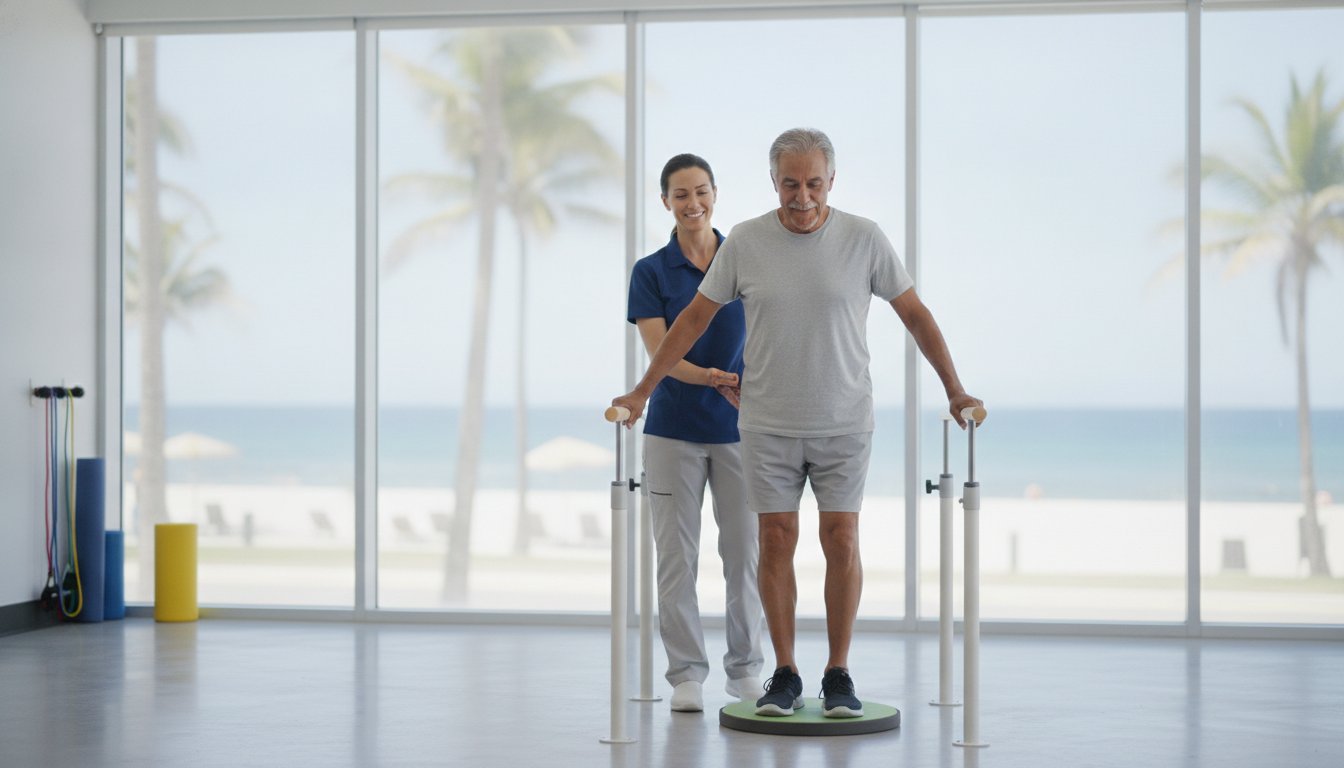
While the first two pillars focus on the “software” of your brain, this pillar addresses the “hardware” of your physical stability. We utilize balance and gait rehabilitation to help you feel grounded on any surface. You might practice standing on specialized foam or walking on uneven paths to challenge your sensory systems. To make these sessions even more effective, we often incorporate dual-task training. This involves performing a physical task, like walking, while engaging in a cognitive one, such as counting backward or holding a conversation. This prepares you for the complexities of real life, ensuring you can walk through a crowded park in Miami Beach with total confidence. By the time you finish your program, you’ll have the tools to handle the unexpected movements of everyday life without fear.
Managing Symptoms During Your Recovery Journey
One of the most common questions we hear when discussing what to expect from vestibular therapy is: “Will these exercises make me feel more dizzy?” It’s a completely valid concern. To retrain your brain, we must gently challenge the systems that are currently misfiring. This means you will likely experience mild symptoms during your sessions. We refer to this as the “Yellow Zone.” On a scale of zero to ten, we aim for a temporary symptom increase of only two or three points. This mild provocation is the “sweet spot” where your brain is challenged enough to adapt without becoming overwhelmed. It’s a necessary part of the recalibration process that leads to long-term stability.
After a therapy session, you might feel a unique sense of mental fatigue or a temporary increase in lightheadedness. Your brain is essentially doing a heavy workout to process new spatial signals. We recommend scheduling a brief period of quiet rest immediately following your drills to allow your nervous system to integrate the work. Consistency is the true engine of your recovery. While our one-on-one sessions provide the expert guidance you need, your commitment to your home exercise program ensures that your progress doesn’t stall between appointments. These daily repetitions bridge the gap between clinical success and total real-world confidence.
Safety Precautions and Home Exercises
Creating a safe environment for your home drills is essential for your peace of mind. We suggest choosing a clutter-free area with firm flooring rather than thick rugs. Always use a “safety anchor” during balance work. This could be a sturdy chair placed in front of you or performing your exercises in the corner of a room where the walls are within easy reach on both sides. This physical backup allows you to focus entirely on your movements without the fear of falling. If you ever notice a sudden change in the nature of your symptoms, such as new hearing loss or a different type of spinning, you should contact your vestibular therapist immediately to adjust your protocol.
The Emotional Side of Recovery
There is a profound physiological link between your vestibular system and the areas of your brain that manage anxiety. It’s common to feel a sense of “impending doom” or panic when your world feels unstable. As you gain a clearer understanding of what to expect from vestibular therapy, you’ll see that regaining physical balance is the fastest way to restore your emotional confidence. Be patient with yourself. Your nervous system is learning an entirely new way to navigate the world, and this transformation happens in steady, incremental steps. If you’re ready to move from a state of constant worry to a life of steady movement, start your journey toward recovery with our dedicated team today.
Vestibular Success in Sunny Isles Beach: Personalized Care
In South Florida, our daily lives are defined by movement and vibrant environments. Whether you’re navigating the busy corridors of Aventura Mall or enjoying a sunset stroll along the Atlantic, your balance is your foundation for independence. At Touch of Health Rehab Inc., we don’t just treat symptoms in a vacuum; we prepare you for the world outside our doors. When people ask what to expect from vestibular therapy in our clinic, the answer lies in our commitment to one-on-one, personalized care. By working exclusively with a licensed therapist, you receive the undivided attention necessary to catch subtle eye movements or postural shifts that a group setting might miss.
We integrate local environmental factors into your sessions to ensure your recovery is practical. If your goal is to walk on the uneven sand of Sunny Isles Beach, your drills will mirror those specific challenges. If you need to manage the visual stimulation of Miami Beach traffic, we simulate those conditions safely. This approach turns clinical exercises into life-affirming progress, positioning our center as a specialized sanctuary for those ready to reclaim their vitality in 2026. Understanding what to expect from vestibular therapy means knowing that your environment is part of your healing process.
Why Choose Touch of Health Rehab Inc.?
Our facility is built on the belief that every path to health is unique. We offer a specialized focus on vertigo treatment and inner ear health, moving beyond generic protocols to find the specific root of your dizziness. Our compassionate experts act as dedicated guides, combining clinical precision with a warm, human touch. For residents in Sunny Isles, Aventura, and Bal Harbor, our location provides easy access to high-end care without the cold atmosphere of a large hospital. You aren’t just another patient here; you’re a partner in a journey toward restoration and empowerment.
Ready to Regain Your Balance?
The transition from your first evaluation to total, confident mobility is a methodical, rewarding process. You’ve learned about the science of your inner ear, the role of neuroplasticity, and the “Yellow Zone” of progress. Now, it’s time to put that knowledge into action and move toward the attainment of peak physical health. We’ve seen firsthand how a dedicated protocol can transform a life of fear into one of stability.
We invite you to take that first courageous step toward a dizzy-free life. If you’re looking for inspiration, we encourage you to read through our success stories to see how others have regained their stability and confidence. Your journey to peak physical health starts with a single consultation. Let’s work together to make 2026 the year you find your center again and return to the activities you love most.
Reclaiming Your Balance and Confidence
The journey from a spinning world to total equilibrium is a path paved with precision and patience. By embracing the recalibration process, you move beyond the limitations of vertigo and toward a future defined by steady, purposeful movement. Understanding what to expect from vestibular therapy transforms the clinical experience from a series of tests into a roadmap for your long-term vitality. Whether you’re navigating the “Yellow Zone” of initial drills or mastering complex balance tasks, each step brings you closer to reclaiming your independence and peace of mind.
At Touch of Health Rehab Inc., we’re dedicated guides for the Sunny Isles Beach and Aventura communities, offering the one-on-one clinical support required for true restoration. Our licensed specialists provide the expertise needed for lasting vertigo and BPPV recovery in a sanctuary designed for healing. You deserve to move through life with absolute certainty and grace. Schedule your vestibular evaluation at Touch of Health Rehab Inc. today to begin your collaborative journey toward peak physical health. Your path to a stable, confident life is ready whenever you are.
Frequently Asked Questions
Is vestibular therapy painful or dangerous?
Vestibular therapy is a non-invasive and safe protocol that doesn’t involve pain or surgery. While some exercises are designed to slightly provoke your symptoms to help your brain recalibrate, these movements are always performed in a controlled clinical environment. Your therapist monitors your stability and comfort throughout every session. The goal is restoration, not distress, ensuring that every movement contributes to your long-term physical health and confidence without putting you at risk.
Can I drive myself home after my first vestibular therapy session?
We recommend having a friend or family member drive you home after your initial evaluation and first treatment session. Because the therapist may need to trigger mild dizziness to identify the root cause of your imbalance, you might feel temporary fatigue or lightheadedness. Having a ride ensures your safety as you leave our Sunny Isles Beach clinic. Once you understand how your body responds to the protocol, you can discuss future driving arrangements with your therapist.
How long does it take for vestibular therapy to work?
Most patients experience significant improvements in balance and a reduction in vertigo within six to eight weeks of consistent treatment. When you learn what to expect from vestibular therapy, you’ll see that recovery is a steady progression rather than an overnight fix. Factors like the duration of your symptoms and your consistency with home exercises influence the timeline. We work closely with you to track your gains in stability and emotional confidence at every milestone.
What happens if vestibular therapy makes me feel worse?
If your symptoms intensify temporarily, it’s often a sign that your brain is working hard to process new spatial information. This “Yellow Zone” of mild discomfort is a necessary part of the recalibration process that leads to long-term healing. We adjust your personalized plan immediately if the intensity becomes overwhelming. Open communication with your licensed therapist ensures that your protocol remains effective yet manageable. We prioritize your well-being, making sure the path to recovery feels safe and supportive.
Are there specific exercises I can do for vertigo at home?
Yes, home exercises are a vital component of your recovery journey and are specifically tailored to your clinical diagnosis. You’ll likely perform gaze stabilization drills to improve vision during head movement or habituation exercises to reduce sensitivity to certain positions. Knowing what to expect from vestibular therapy includes mastering these techniques in the clinic so you can safely replicate them at home. These daily repetitions accelerate your brain’s ability to ignore false signals and restore your natural equilibrium.
Will I need vestibular therapy forever, or is it a temporary fix?
Vestibular rehabilitation is a temporary program designed to provide permanent results through brain compensation and recalibration. Once your nervous system has successfully adapted and your balance is restored, you won’t need ongoing clinical sessions. You’ll graduate from therapy with a set of tools and exercises you can use independently if you ever feel a minor flare-up. Our mission is to empower you with total mobility and the confidence to navigate your world without needing constant professional intervention.
Does insurance typically cover vestibular rehabilitation in 2026?
In 2026, most major insurance providers continue to cover vestibular rehabilitation when it’s deemed medically necessary and performed by a licensed physical therapist. Since these programs are evidence-based treatments for balance disorders and fall prevention, they fall under standard physical therapy benefits. We recommend contacting your specific provider to verify your coverage details, including any co-pays or deductible requirements. Our staff is also available to help you navigate these administrative steps so you can focus entirely on your healing.