
What if balance rehabilitation starts with understanding what feels unsteady, rather than asking you to push through generic exercises? It’s natural to wonder what to expect from balance rehabilitation, especially if movement brings on dizziness or discomfort, or you’re unsure how progress will be measured.
Your first visit is a chance to talk through your symptoms, daily challenges, and personal goals. Your therapist can use that conversation, along with an assessment of how you move and balance, to shape a plan around your needs. At Touch of Health Rehab Inc. in Sunny Isles Beach, balance and gait rehabilitation is tailored to your abilities. Vestibular rehabilitation is also available when dizziness is part of the picture.
In this guide, you’ll learn what an initial assessment may involve, what exercises and activities can look like, and how your care plan may change as you build confidence. You’ll also learn how to describe symptom triggers and everyday tasks so therapy can progress at a manageable pace and stay focused on what matters to you.
Key Takeaways
- Learn what to expect from balance rehabilitation, from an individualized assessment to activities shaped around your mobility goals.
- Prepare to discuss your symptoms, relevant health history, daily challenges, and the activities you hope to make easier.
- Understand how therapist-guided balance, mobility, or gait practice may be adapted to how you feel during a session.
- Track progress by noticing changes in daily function and sharing what feels easier, unchanged, or more challenging between visits.
- Identify a personal goal and concerns to bring to a physical therapist at Touch of Health Rehab Inc. in Sunny Isles Beach.
What to Expect from Balance Rehabilitation, and Who It Can Help
Balance rehabilitation uses an individualized assessment and guided activities to address your balance, walking, and mobility goals. In plain language, balance rehabilitation is a personalized therapy process that helps you practice movements and everyday tasks that feel less steady. The focus isn’t a standard set of exercises for everyone. It’s understanding what you’re experiencing and shaping care around your abilities and priorities.
You might notice unsteadiness while turning, feel less confident walking on uneven ground, or find routine activities more challenging than before. These experiences can be frustrating, especially when they make you cautious about moving through your day. They’re valid reasons to discuss your concerns with a physical therapist, but they don’t point to one cause on their own. An assessment helps clarify how balance and mobility are affected and what goals may be appropriate.
Which balance challenges may lead someone to seek rehabilitation?
People seek support for different changes in balance and movement. You may feel uncertain when standing up, walking, changing direction, or managing everyday tasks. Someone else may be concerned about dizziness or a growing reluctance to move around independently. These experiences can have different causes, so an individual assessment matters. Therapy is planned around your symptoms, abilities, and daily activities rather than assuming one exercise or approach suits everyone.
How balance and vestibular rehabilitation relate
Balance rehabilitation is a broad term for care focused on balance, mobility, and function. Vestibular rehabilitation is a more specific approach for concerns such as dizziness or inner-ear-related symptoms that affect balance. A physical therapist can assess how your symptoms relate to movement and daily activities, then discuss the approach that fits your needs. Touch of Health Rehab Inc. provides balance and gait rehabilitation in Sunny Isles Beach, as well as vestibular rehabilitation care for balance concerns associated with dizziness.
Vestibular rehabilitation may use carefully selected movement activities to address symptoms and function. For a general overview of its purpose and common approaches, see Vestibular Rehabilitation. The right plan depends on the person, so a general description of treatment isn’t a substitute for an assessment of your particular concerns.
Knowing what to expect from balance rehabilitation starts with recognizing that care is individualized. You don’t need to arrive with a diagnosis or a perfect description of what feels wrong. Notice which movements or tasks feel difficult, when dizziness or unsteadiness occurs, and what you’d like to do with more confidence. Those details give your physical therapist a practical starting point for discussing your goals and possible next steps.
What Happens During Your First Balance Rehabilitation Assessment?
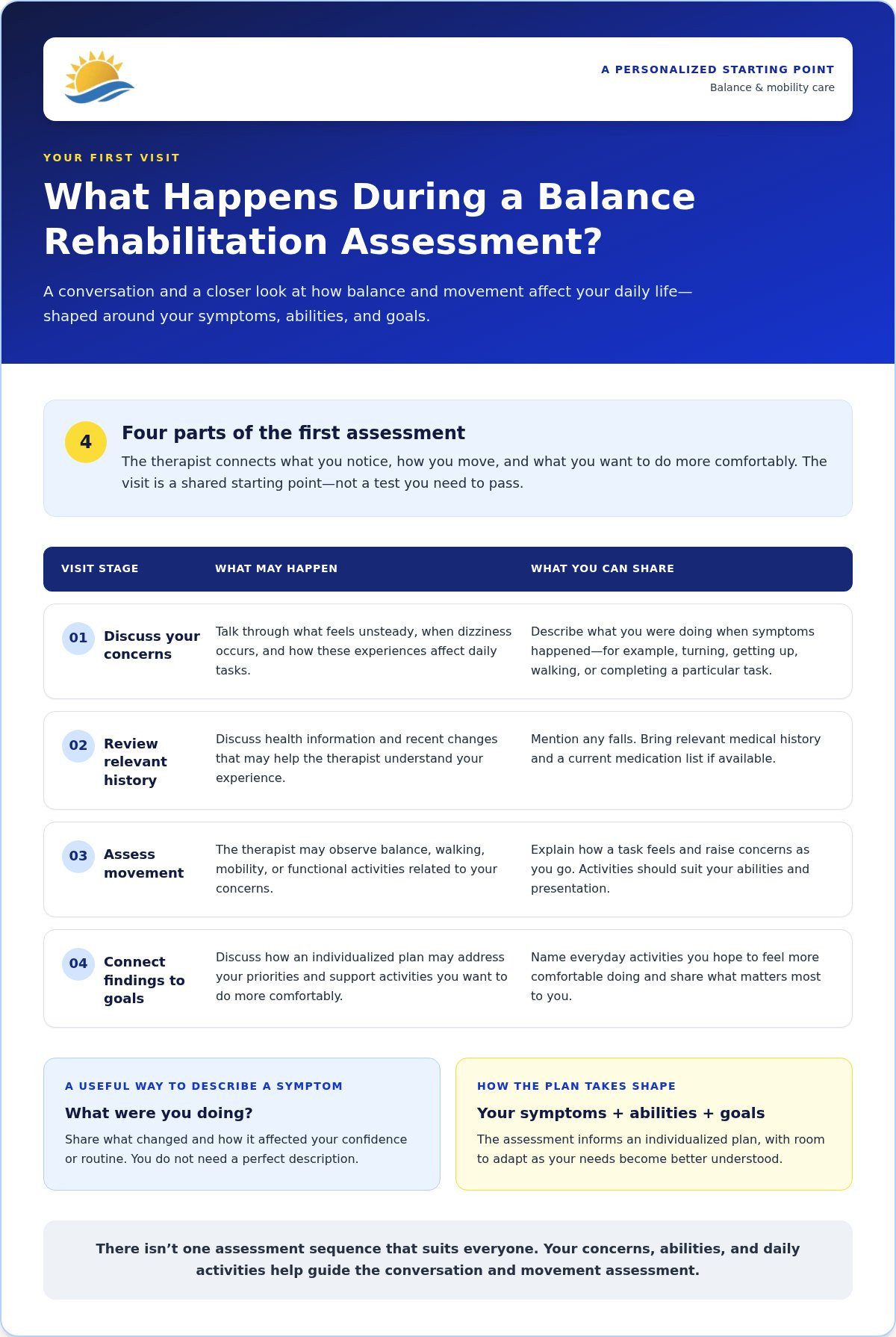
Your first assessment is a conversation and a closer look at how balance and movement affect your life. You’ll have time to explain what you’ve noticed, ask questions, and share what you hope to do more comfortably. The assessment should reflect your symptoms, abilities, and daily activities, rather than follow a fixed routine that may not fit you.
A helpful way to picture the visit is as a sequence:
- Discuss your concerns. Describe what feels unsteady, when dizziness occurs, and how these experiences affect daily tasks.
- Review relevant history. Share health information, recent changes, falls, and a medication list if available.
- Assess movement. The therapist may observe balance, walking, or mobility activities suited to your needs.
- Connect findings to goals. Discuss what you’d like to do more comfortably and how an individualized plan may address those priorities.
The first assessment informs an individualized rehabilitation plan by connecting your symptoms, abilities, and everyday goals. That plan gives therapy a clear direction while leaving room to adapt as your needs become better understood. Knowing what to expect from balance rehabilitation can make it easier to prepare, but you don’t need to arrive with every detail perfectly organized.
What information should you share at the first visit?
Describe when unsteadiness or dizziness happens and what you’re doing at the time. For example, you might notice a change while turning, getting up, walking, or completing a particular daily task. Mention recent changes or falls, and name activities you’d like to feel more comfortable doing. If available, bring relevant medical history and a current medication list. Sharing concerns openly helps the therapist understand your experience and adapt the assessment and discussion to you.
How the therapist may assess balance and mobility
The therapist may observe how you move during functional activities related to your concerns, such as walking or changing position. Activities should match your abilities and presentation; there isn’t one assessment sequence that suits everyone. You can explain how a task feels and raise concerns as you go. Touch of Health Rehab Inc. provides balance and gait rehabilitation tailored to individual needs.
Think of the first visit as a shared starting point, not a test you need to pass. If you’re unsure how to describe a symptom, explain what you were doing, what changed, and how it affected your confidence or routine. These practical details help connect the assessment to meaningful goals. For information about the clinic’s physical therapy services in Sunny Isles Beach, visit Touch of Health Rehab Inc..
What a Balance Rehabilitation Session May Feel Like
A balance rehabilitation session is guided practice, not a test of how steady you can be. Depending on your goals, it may include activities focused on balance, mobility, or walking. Your therapist explains what to do, observes how the activity feels for you, and adjusts the task as needed. Activities vary because each plan is shaped around the person, not a standard routine.
Activities are adjusted to your responses so therapy can stay relevant to your goals and current abilities. Expect clear directions and opportunities to ask questions or describe what you notice. If you feel uncertain about an activity, say so. Your feedback helps your therapist understand your experience and guide the next step.
How activities can connect to everyday movement
Practice may relate to a daily task you want to approach with more confidence. For example, if walking or changing direction feels challenging, a therapist may choose an activity that relates to those movements. These are illustrative possibilities, not exercises everyone will do. Your priorities help shape what you practice, whether that means moving around more comfortably or feeling steadier during a familiar routine.
Therapist-guided activities differ from an unsupervised list of exercises. The therapist can explain the purpose of a task, observe how you respond, and modify it to suit your presentation. That guidance keeps practice connected to your functional needs rather than asking you to repeat movements without context. Touch of Health Rehab Inc. offers balance and gait rehabilitation tailored to individual care needs.
What if movement brings on dizziness or uncertainty?
Some activities may feel challenging, and some people may notice dizziness or increased uncertainty during movement. That doesn’t mean you should silently push through. Tell your therapist what you’re feeling, when it starts, and whether it changes as you move. You don’t need special clinical terms; a simple description is useful.
Your feedback gives the clinician a chance to consider an adjustment, such as changing the activity or how it’s performed. The goal isn’t to ignore discomfort or prove you can manage a difficult task. It’s to work together so practice reflects your response and supports the goals you’ve discussed.
As you learn what to expect from balance rehabilitation, remember that one session may not feel exactly like another. Your needs and responses guide how activities are selected and adapted over time. Help by sharing what feels manageable, what brings on symptoms, and which everyday movements you’d like to work toward. This open exchange makes the session a collaborative part of your rehabilitation, with room to progress thoughtfully at your pace.
How Progress Is Reviewed, and What If Symptoms Fluctuate?
Progress in balance rehabilitation is best understood in relation to your own goals and day-to-day function, not a guaranteed timeline. You and your therapist can discuss whether a familiar activity feels more manageable, whether walking feels different, or whether a challenge remains unchanged. Small observations help guide the conversation, even if your symptoms vary from one day to another.
A temporary change in symptoms doesn’t automatically mean therapy is failing. Balance and dizziness concerns can fluctuate, and one difficult day doesn’t tell the whole story. Share what happened and any context you noticed, such as the activity you were doing or how the change affected your routine. Your therapist can consider that information alongside your goals and response to care.
How progress can be discussed with your therapist
Think about practical changes, not just whether you feel “better.” Perhaps you feel more confident standing to prepare a meal, walking through a familiar space, or turning to look behind you. Or perhaps a task still feels difficult, but you’re approaching it differently. These details give your therapist a clearer picture of how therapy relates to daily life.
At follow-up conversations, describe what feels easier, what hasn’t changed, and what now feels more challenging. Your clinician may review your goals and adjust the plan as appropriate. Progress isn’t limited to a single measure or a specific exercise; it can also include changes in confidence, participation, and how you manage activities that matter to you.
When to report a change in symptoms
Tell your therapist about new, worsening, or concerning symptoms during your care. Describe when the change began, what you were doing, and whether it affected your usual activities. You don’t need to interpret the cause yourself. Clear communication helps your clinician understand your experience and consider an appropriate response to your situation.
Sudden, severe symptoms or signs that could indicate an emergency warrant urgent medical attention. Don’t wait for a routine therapy discussion if you believe you may need immediate care. For other changes, share your concerns with your therapist so they can discuss what they mean for your plan. This guidance doesn’t replace individualized medical advice.
Understanding what to expect from balance rehabilitation includes knowing that the plan can be reviewed as your needs and responses become clearer. Keep a simple note between visits: what felt easier, what stayed the same, and what was harder than expected. Bring those observations to your physical therapist at Touch of Health Rehab Inc. to discuss how your care relates to your functional goals. For details about the clinic, visit Touch of Health Rehab.
Your Next Steps for Balance Rehabilitation in Sunny Isles Beach
You don’t need to have every answer before discussing balance concerns with a physical therapist. Start by identifying one or two daily activities you’d like to manage with more confidence. That could be walking through a familiar space, changing direction, or completing another routine task that currently feels less steady. A clear personal goal helps make the conversation practical and gives care a meaningful starting point.
How to prepare for a first conversation about care
Before your visit, jot down when you notice unsteadiness or dizziness, what you were doing, and how it affected your day. Include relevant health history and recent changes you think may be important. You might also note a fall or a task you’ve started avoiding. These reminders can make it easier to describe your experience, but there’s no need to prepare a perfect summary.
Bring your questions, too. Explain what you hope to return to and what makes movement feel uncertain. Your physical therapist can use these details to understand your priorities and discuss care in relation to your needs and goals. Knowing what to expect from balance rehabilitation can help you feel more prepared, but the conversation is a chance to shape the plan together, not a test.
Where local balance and vestibular care fit
Touch of Health Rehab Inc. is a physical therapy center in Sunny Isles Beach offering balance and gait rehabilitation and personalized therapy plans. The clinic serves people in Sunny Isles Beach, Aventura, Bal Harbour, North Miami Beach, and Miami Beach. If dizziness is part of your balance concern, vestibular rehabilitation services are also available. A physical therapist can consider your symptoms, movement, and daily activities when discussing an appropriate path for care.
Think beyond a symptom and name the moments in your day you want to address. For instance, instead of saying only “I feel off balance,” you could mention that turning while walking feels difficult or that you’re less confident moving around a familiar room. These examples don’t determine a diagnosis; they give your therapist a clearer picture of what matters to you. Your needs and goals can guide the conversation from the outset.
You can take a simple note with three prompts: What feels difficult? When does it happen? What would you like to do more comfortably? Even brief answers can help you begin a focused conversation and make space for questions about assessment, therapy activities, or how care may progress. There’s no single preparation routine you have to follow.
For information about balance rehabilitation and physical therapy in Sunny Isles Beach, visit Touch of Health Rehab Inc.
Take a Confident First Step Toward Steadier Movement
You don’t need to solve every balance concern before seeking support. Start with one meaningful goal and bring it into a conversation with a physical therapist. Your priorities can help shape care around the activities and confidence you want to build, while your therapist guides the process at a pace suited to you.
Understanding what to expect from balance rehabilitation can make the first step feel less uncertain, but your own experience is what makes the plan personal. Touch of Health Rehab’s Sunny Isles Beach clinic offers balance and gait rehabilitation, along with vestibular rehabilitation for dizziness-related balance concerns. You can explore these services and consider what you’d like to discuss.
Contact Touch of Health Rehab Inc. to discuss balance rehabilitation in Sunny Isles Beach. Your goals are a meaningful place to begin, and you can move forward one conversation at a time.
Frequently Asked Questions
Is balance rehabilitation painful or uncomfortable?
Balance rehabilitation isn’t intended to make you push through pain, though some activities may feel challenging or bring on temporary discomfort or dizziness. Tell your therapist what you notice, including when it begins and whether it changes as you move. That feedback helps them decide how to proceed. If you have pain or another concern during an activity, speak up rather than trying to hide it or finish at all costs.
How long does a balance rehabilitation session usually last?
Session length can vary based on your care plan, goals, and the activities planned for that visit. There isn’t one duration that applies to every person or appointment, so avoid assuming an online estimate will match your situation. Allow time to discuss how you’re feeling and ask questions about your care, not just complete the activities. Your therapist can explain the schedule connected to your individual plan.
Can balance rehabilitation help if I feel unsteady while walking?
Yes, balance rehabilitation may address walking-related balance and mobility goals, but an assessment is needed to understand your specific needs. Notice when walking feels difficult, such as on a familiar route, while turning, or when the walking surface changes. Share those details with a physical therapist. Touch of Health Rehab offers balance and gait rehabilitation in Sunny Isles Beach, with care tailored to individual concerns.
What should I wear to a balance rehabilitation appointment?
Choose comfortable clothing that lets you move freely, such as flexible pants and a shirt that won’t restrict your arms or legs. Supportive, secure footwear can be helpful for walking and balance activities. Avoid clothing or shoes that make movement difficult, such as long hems that could catch underfoot. If you use a mobility aid in daily life, bring it along so you can discuss how it relates to your movement goals.
Can balance rehabilitation help after a stroke?
Balance and mobility concerns after a stroke may be addressed as part of an individualized rehabilitation plan. Activities and goals depend on your abilities, health history, and the movements you want to work on. Tell the physical therapist about changes in walking, standing, or confidence since the stroke, and share any guidance from your medical team. Touch of Health Rehab offers stroke recovery therapy and balance and gait rehabilitation.
How often will I need balance rehabilitation?
The frequency of visits depends on your individual assessment, goals, response to therapy, and care plan. Your schedule may be reviewed as your needs change, so a fixed number of appointments can’t be assumed in advance. If travel, work, or other responsibilities affect your availability, mention that during care planning. A clear conversation about your routine can help you and your therapist consider a practical approach to rehabilitation.
What should I do if my dizziness suddenly becomes severe?
Seek urgent medical attention if dizziness suddenly becomes severe, especially if you feel unsafe or experience other alarming symptoms. Don’t wait for your next rehabilitation visit to raise an urgent concern. If symptoms are new, worsening, or concerning but not an emergency, let your therapist and healthcare professional know promptly. They can consider your situation and advise on appropriate next steps. This information isn’t a substitute for individualized medical care.