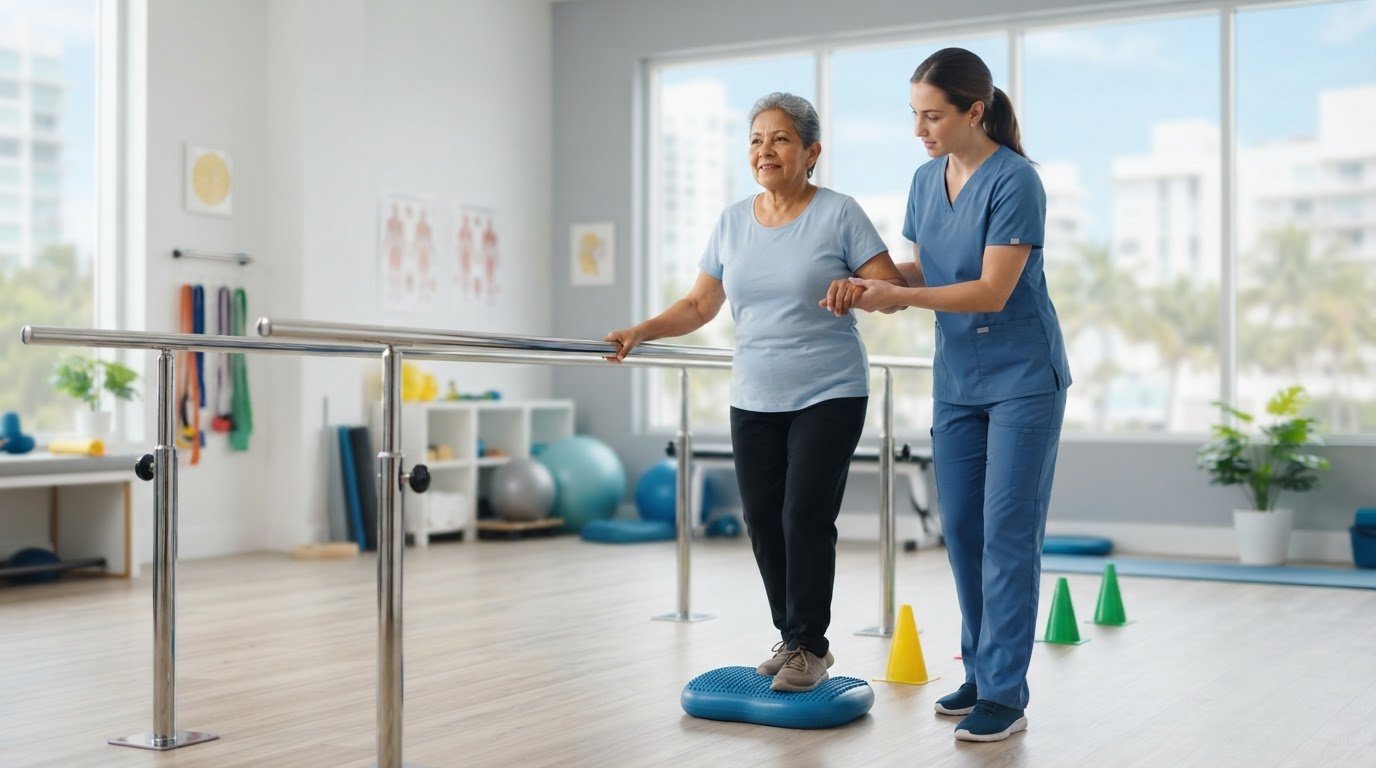
What if feeling unsteady now doesn’t determine how steady you’ll feel in the future? If you’re asking, “will my balance ever return to normal,” it’s understandable to want a clear answer, especially when dizziness or unsteadiness makes everyday movement feel less safe.
Balance recovery depends on what’s causing the change. Inner-ear conditions, illness, injury, medication effects, and age-related changes can all affect steadiness, so there isn’t one timeline or treatment that fits everyone. An individualized assessment can help identify what may be contributing and where to focus care.
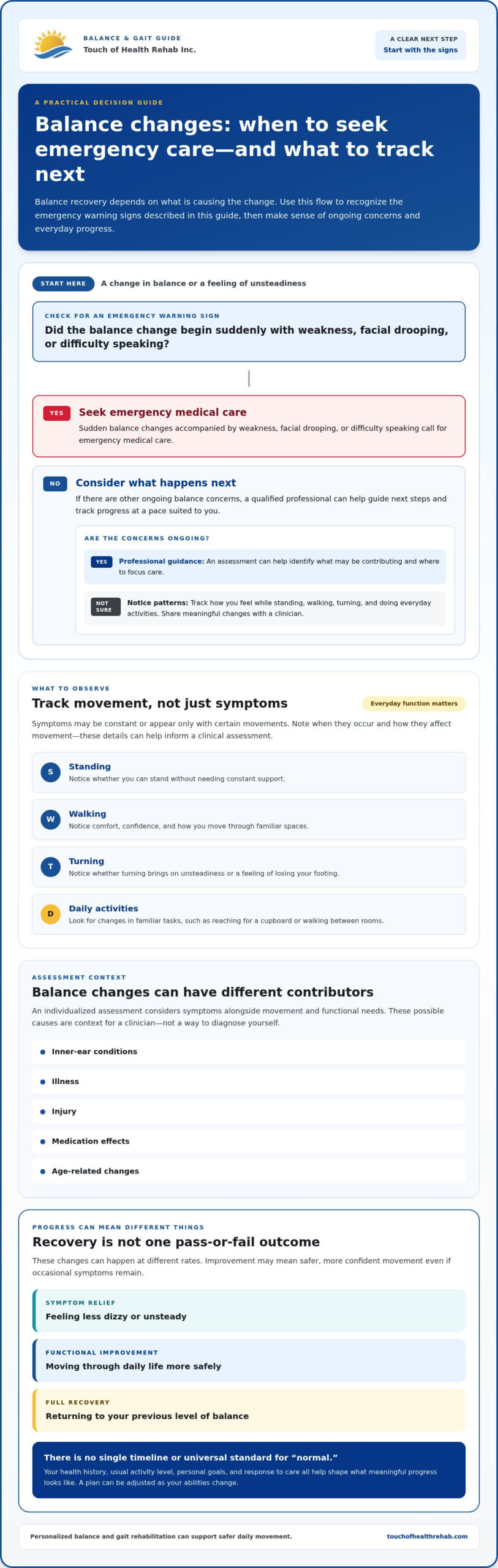
In this article, you’ll learn why recovery varies, what signs call for prompt medical attention, and how vestibular or balance and gait rehabilitation may support safer movement and daily function. If balance changes begin suddenly with symptoms such as weakness, facial drooping, or difficulty speaking, seek emergency medical care. For other ongoing concerns, a qualified professional can help guide next steps and track progress at a pace suited to you.
Key Takeaways
- The answer to “will my balance ever return to normal” depends on the cause, your overall health, and what recovery means for your daily life.
- Your brain combines signals from your eyes, inner ears, and body to help you stay steady, so changes in any of these systems can affect balance.
- Balance changes can have several possible causes. Noting when symptoms occur and how they affect movement can help inform a clinical assessment.
- Track how you feel while standing, walking, turning, and doing everyday activities to notice meaningful changes and share them with your clinician.
- Personalized balance and gait rehabilitation can address your specific movement challenges and support safer, more confident daily function.
Will my balance ever return to normal? What recovery can realistically mean
Persistent unsteadiness can make ordinary moments feel uncertain: standing at the sink, walking through a busy room, or turning to answer someone. If you’re wondering, “will my balance ever return to normal,” the honest answer depends on what’s affecting your balance and how your body responds over time. Improvement is possible for many people, but recovery doesn’t always mean every sensation disappears or that you feel exactly as you did before.
Symptom relief means feeling less dizzy or unsteady. Functional improvement means moving through daily life more safely. Full recovery means returning to your previous level of balance. These can happen at different rates. You may walk more confidently and resume valued activities even if occasional symptoms remain. For others, a realistic goal is establishing a steadier, safer baseline that supports independence.
What does normal balance feel like in everyday life?
In practical terms, balance helps you stand without needing constant support, walk at a comfortable pace, turn without feeling as though you might lose your footing, and adjust when a surface or setting changes. You might notice progress first in a familiar activity, such as reaching for a cupboard or walking from one room to another, before you feel fully comfortable in every situation.
There isn’t one universal standard for normal. Your age, health history, usual activity level, and personal goals all shape what a meaningful return to function looks like. This guide to balance disorders provides a broad overview of conditions that can affect steadiness, but it can’t determine the cause of your own symptoms.
Why recovery does not follow one fixed timeline
The time it takes to feel steadier varies because balance changes can have different causes and patterns. Symptoms may be constant or occur only with specific movements, and other health factors can influence how your body adapts. A timeline that fits one person may not reflect what’s realistic for someone else.
An assessment helps connect your symptoms with your movement and functional needs. What a clinician observes, along with your health history and goals, can inform the next steps. Your response to care also matters: as your abilities change, the plan and expectations can be adjusted. Rather than measuring progress only by whether symptoms have vanished, notice whether you can stand, walk, turn, or complete meaningful activities with greater ease and confidence.
Recovery is best understood as a process, not a single pass-or-fail outcome. With individualized guidance, you can work toward progress that matters in daily life, whether that means returning to familiar activities or moving more securely within a new baseline.
How your eyes, inner ears, brain, and body work together to keep you steady
Balance isn’t controlled by one body part. Your brain continually combines information about your movement, your position, and what’s happening around you, then coordinates adjustments that help you stay upright. These signals work together in the background as you stand, walk, or turn. If one source sends confusing or reduced information, the brain may have a harder time matching the signals, which can contribute to dizziness, unsteadiness, or difficulty walking.
This helps explain why the same symptom can feel different from person to person. Turning your head might bring on dizziness, while someone else may feel unsure on an uneven surface or in a dim room. The sensation alone doesn’t identify the cause. It’s one piece of information about how your balance systems are working together, and a clinician can assess your symptoms in context.
How the vestibular system and vision guide movement
The vestibular system, located in the inner ear, helps detect head movement and orientation. Vision gives your brain information about your body’s position in relation to the room, nearby objects, and the horizon. Your brain compares these inputs as you move. If turning your head makes you feel less steady, for example, the motion-related signals may not be aligning comfortably with what your eyes see.
Vision also provides helpful reference points. When you walk while looking at a stable object, your brain can use it to interpret movement. In a dark room or a visually busy setting, those cues may be harder to rely on, making steadiness feel more challenging for some people. These examples help explain how symptoms can relate to movement and surroundings, but they aren’t a way to diagnose a balance condition on your own.
How muscles and joints provide position information
Proprioception is your body’s sense of where it is and how it is moving. Receptors in your muscles, joints, and skin send the brain information about pressure, position, and motion. As you stand, for instance, sensations from your feet help you notice how your weight is distributed. While walking, feedback from your legs and joints helps your brain coordinate each step.
These systems interact rather than operating separately. If information from the inner ear is disrupted, your brain may rely more heavily on vision and body-position cues. If several inputs are affected, the challenge may be greater or show up in different ways, such as feeling less stable while walking and turning at the same time. That’s why understanding will my balance ever return to normal starts with looking beyond a single sensation to the movement patterns and body systems involved.
Personalized physical therapy can consider how balance challenges affect the movements that matter in your day. If you’re seeking guidance on dizziness or steadiness, explore physical therapy support as a step toward understanding your next move.
What can affect your balance recovery: causes, assessment, and individual factors
Unsteadiness can arise from different parts of the body, and the sensation alone rarely tells you why it’s happening. A vestibular issue, a change in sensation, or a medication effect may all make walking feel difficult, but each calls for a different kind of evaluation. These are possible contributing factors, not a diagnosis. A clinical assessment helps put symptoms in context and guide appropriate next steps.
Broad categories include:
- Vestibular factors: Inner-ear conditions, including benign paroxysmal positional vertigo, can affect how movement and head position are sensed.
- Neurological factors: Conditions such as stroke or traumatic brain injury may affect how the brain coordinates movement and balance.
- Sensory factors: Changes in vision or in the body’s ability to sense position can make it harder to adjust to surroundings.
- Medication-related factors: Some medicines may contribute to dizziness or unsteadiness. Don’t change a prescribed medication without discussing it with the prescribing clinician.
- Musculoskeletal factors: Pain, weakness, or limited movement can affect how comfortably and securely you stand or walk.
Why the cause matters when estimating recovery
Different underlying factors can call for different care, so identifying what may be contributing makes recovery expectations more personal and useful. A clinician may ask whether symptoms began suddenly or gradually, what brings them on, and how they affect daily activities. Feeling dizzy only when turning your head, for example, presents a different pattern from feeling unsteady throughout a walk.
More than one factor can be involved. Someone might have an inner-ear problem alongside reduced leg strength or a medication that contributes to dizziness. Age may influence balance, but it shouldn’t be assumed to explain new symptoms or determine the outcome on its own. Your health history, movement, and response to care all help shape an individualized plan.
What a balance assessment can help clarify
A balance assessment may include a review of your symptoms, relevant health history, and medications, along with observing how you stand, walk, or move through tasks that feel challenging. This helps connect what you’re experiencing with functional difficulties, such as turning, changing direction, or feeling secure on your feet. It also provides a basis for deciding what kind of support may be appropriate.
For dizziness or concerns that may involve the inner ear, vestibular rehabilitation can be part of a tailored physical therapy approach. Assessment and care work best as a collaboration: you share what you notice, and your clinician uses those details to guide next steps. That process offers a more grounded way to consider “will my balance ever return to normal” than trying to predict recovery from symptoms alone.
How to track balance progress and stay safer while recovery unfolds
Progress isn’t always a straight line, and a difficult day doesn’t automatically mean you’re moving backward. A brief record of what feels easier, what still feels challenging, and when symptoms occur can help you notice meaningful patterns and give your clinician useful information. Keep observations simple. You’re looking for changes in everyday function, not trying to diagnose yourself or prove that you’re recovering.
Use these prompts to reflect on changes during activities you already do. Don’t deliberately test your limits or try an activity that feels unsafe just to fill in a note.
- Standing: Do you feel more secure while standing for a routine task, such as brushing your teeth?
- Walking: Has walking in a familiar, safe setting become more comfortable or less tiring?
- Turning: Do changes in direction or head movement feel different from before?
- Daily confidence: Are you more willing to do everyday activities, and do you feel safer doing them?
Recognizing meaningful progress beyond symptom scores
Alongside symptoms, note what you can do, how steady you feel, and whether you recover more easily after movement. Record possible triggers, such as turning, busy surroundings, or getting up, and whether symptoms interfere with a task. A short note after an activity can be more useful than trying to remember every detail later.
Symptoms can fluctuate. One harder moment doesn’t erase progress, so look for patterns over time rather than judging recovery by a single experience. Share your observations with a qualified healthcare professional, who can help interpret them alongside your assessment and goals.
When balance changes need prompt medical attention
Ongoing unsteadiness deserves professional attention, but a sudden, severe change is different. Seek emergency medical assessment if sudden imbalance comes with possible stroke warning signs, such as facial drooping, weakness or numbness on one side, trouble speaking, confusion, or sudden vision changes. New neurological symptoms warrant urgent evaluation, even if you’re unsure what’s causing them.
Don’t try balance exercises or wait to see whether symptoms settle when a sudden severe change or neurological warning sign occurs. Rehabilitation exercises are meant to address assessed needs; they’re not a substitute for urgent medical care. For persistent, non-emergency concerns, an individualized plan can help you work toward safer movement. Generic online routines may not suit your symptoms or abilities, and some movements could be inappropriate for your situation.
If you’re asking yourself, “will my balance ever return to normal,” tracking function can help make progress more concrete while you work with a professional. Explore personalized balance and gait rehabilitation as a step toward safer, more confident movement.
How personalized balance and gait rehabilitation can support your next steps
Once you have a clearer picture of what may be affecting your balance, the next step is to choose care that fits your needs. A physical therapist can use assessment findings, your health history, and the activities you want to manage more comfortably to shape an individualized plan. The aim isn’t to follow a standard routine regardless of how you feel. It’s to work on relevant movement challenges in a considered way.
For one person, the priority may be walking with greater confidence; for another, it may be feeling steadier while turning or moving through familiar daily tasks. Your therapist can take your symptoms, abilities, and personal goals into account, then adapt activities as your needs and tolerance change. Progress is not guaranteed or identical for everyone, but a tailored approach gives you a structured way to work toward safer movement and improved function.
What individualized balance rehabilitation may address
Balance and gait rehabilitation focuses on stability and the movements involved in standing and walking. Depending on assessment findings, a physical therapist may guide activities that build control during everyday movements, with the level and progression chosen for your individual situation. The goal is practical: to support safer mobility and help you participate more comfortably in daily life.
Therapy should reflect how your balance concerns show up, not simply the name of a symptom. Balance and gait rehabilitation can address movement challenges such as feeling uncertain on your feet or having difficulty changing direction. If dizziness or inner-ear-related symptoms are part of your experience, vestibular rehabilitation may also be relevant. Your clinician can help determine which areas of care fit your assessment and goals.
Taking a supported next step in Sunny Isles Beach
At Touch of Health Rehab Inc., physical therapy plans are personalized, with care focused on your concerns and function. The clinic provides balance and gait rehabilitation for stability and safer movement, as well as vestibular rehabilitation for dizziness and balance concerns. These approaches help translate assessment findings into a plan centered on the activities you want to manage with greater confidence.
Touch of Health Rehab Inc. serves people in Sunny Isles Beach, Aventura, Bal Harbor, North Miami Beach, and Miami Beach. If you’re in one of these communities, share what makes you feel unsteady, what you’ve stopped doing, and what you hope to regain. Those details help your physical therapist understand your priorities and shape care collaboratively, rather than relying on generic online exercise advice.
Wondering, “will my balance ever return to normal?” You don’t have to figure out the next step alone. An individualized plan can help you track meaningful changes and work toward safer movement, whether your goal is returning to familiar activities or establishing a steadier baseline. Explore personalized physical therapy support to learn about care at Touch of Health Rehab Inc.
Take a steady next step toward confident movement
When you’re asking, “will my balance ever return to normal,” uncertainty can make it tempting to wait for a perfect answer before taking action. You don’t need to predict the entire recovery path today. A useful next step is to identify one movement or daily activity you want to feel safer doing, then discuss that goal with a physical therapist who can help shape an appropriate plan.
At Touch of Health Rehab, care includes specialized vestibular rehabilitation for dizziness and balance concerns, alongside balance and gait rehabilitation focused on stability and safer movement. Your priorities can guide the conversation, whether you’re hoping to feel more secure walking or regain confidence in familiar routines. Progress is personal, and support can help you work toward practical changes at a pace suited to your needs.
Explore personalized physical therapy support and take a considered step toward moving with greater confidence. Your next step can be small, purposeful, and centered on the life you want to live.
Frequently Asked Questions
Can balance problems improve even if they have lasted a long time?
Yes, longstanding balance problems can still improve, although the kind and extent of progress depend on what’s contributing to them. A longer history doesn’t automatically mean improvement is impossible. If you’re wondering, “will my balance ever return to normal,” a useful first step is discussing what you’d like to do more comfortably with a clinician. Touch of Health Rehab Inc. serves people in Sunny Isles Beach and nearby communities with physical therapy tailored to individual needs.
How long does it take for balance to return to normal?
There isn’t one reliable timeline for everyone. The cause of the problem, your overall health, and how your symptoms change with care all affect the pace. Ask your clinician what signs of progress to watch for and when to review your plan. For example, you might track whether you can complete a familiar household task with less hesitation, even if occasional symptoms are still present.
Could medication make me feel off balance?
Yes, some medications can contribute to dizziness or feeling unsteady, and effects may be more noticeable after starting a medicine or changing a dose. Keep a record of when symptoms occur and which medicines you take, including when you take them. Share this information with the prescribing clinician or pharmacist. Don’t stop or adjust a prescribed medication on your own, since that may create other health risks.
Is feeling unsteady always caused by an inner-ear problem?
No. An inner-ear condition is one possible cause, but unsteadiness can also relate to other health factors, such as vision changes, neurological conditions, medication effects, or movement limitations. Similar sensations can have different explanations, so the feeling alone can’t identify the source. If symptoms persist, disrupt daily activities, or are getting worse, describe what you experience and when it happens during a clinical evaluation.
Can anxiety make balance symptoms feel worse?
Yes, anxiety may make you more alert to sensations of dizziness or unsteadiness, which can make them feel more distressing. That doesn’t mean the symptoms are imaginary, or that anxiety is necessarily their only cause. Notice whether worry rises before, during, or after an activity, and share that pattern with a healthcare professional. Addressing both your symptoms and concerns can help guide supportive next steps.
When should I seek urgent help for a balance problem?
Seek emergency medical help for sudden, severe imbalance, especially if it occurs with facial drooping, weakness or numbness, trouble speaking, confusion, or sudden vision changes. These may be signs of a serious neurological emergency. Don’t drive yourself or try exercises to see whether the symptoms pass. Contact emergency services and note when the symptoms began, if you can do so safely. New or rapidly worsening symptoms also need prompt medical assessment.