
What if the most empowering tool against Meniere’s disease isn’t found in a pill bottle, but in the way your brain processes movement? While the sudden vertigo attacks feel unpredictable, the lingering imbalance between episodes is something you can actively change. Specialized physical therapy for Meniere’s disease offers a path to reclaim your stability by retraining your vestibular system to compensate for inner ear changes. You don’t have to live in constant fear of the next dizzy spell or feel trapped by the persistent brain fog that makes every step feel like walking on a boat.
We understand that the anxiety of falling in public or struggling on uneven surfaces can make your world feel smaller. It’s exhausting to always be on guard. This guide will show you how specialized vestibular rehabilitation can stabilize your balance and reduce the chronic dizziness that holds you back. We’ll explore seven key signs that indicate it’s time to partner with a dedicated guide to restore your confidence, provide practical tools for “off” days, and improve your daily quality of life.
Key Takeaways
- Recognize the seven specific signs that your inner ear needs professional recalibration to stop feeling “unsteady” or “drunk” between vertigo attacks.
- Understand how physical therapy for Meniere’s disease utilizes gaze stabilization and habituation to retrain your brain for lasting stability.
- Distinguish between medical interventions that control fluid levels and vestibular rehabilitation that addresses long-term balance damage.
- Gain practical tools to manage “off” days and improve your confidence when walking on uneven surfaces like grass or sand.
- Discover the benefits of a personalized vestibular evaluation to map your unique balance deficits and accelerate your recovery journey.
Understanding Meniere’s Disease and the Balance System
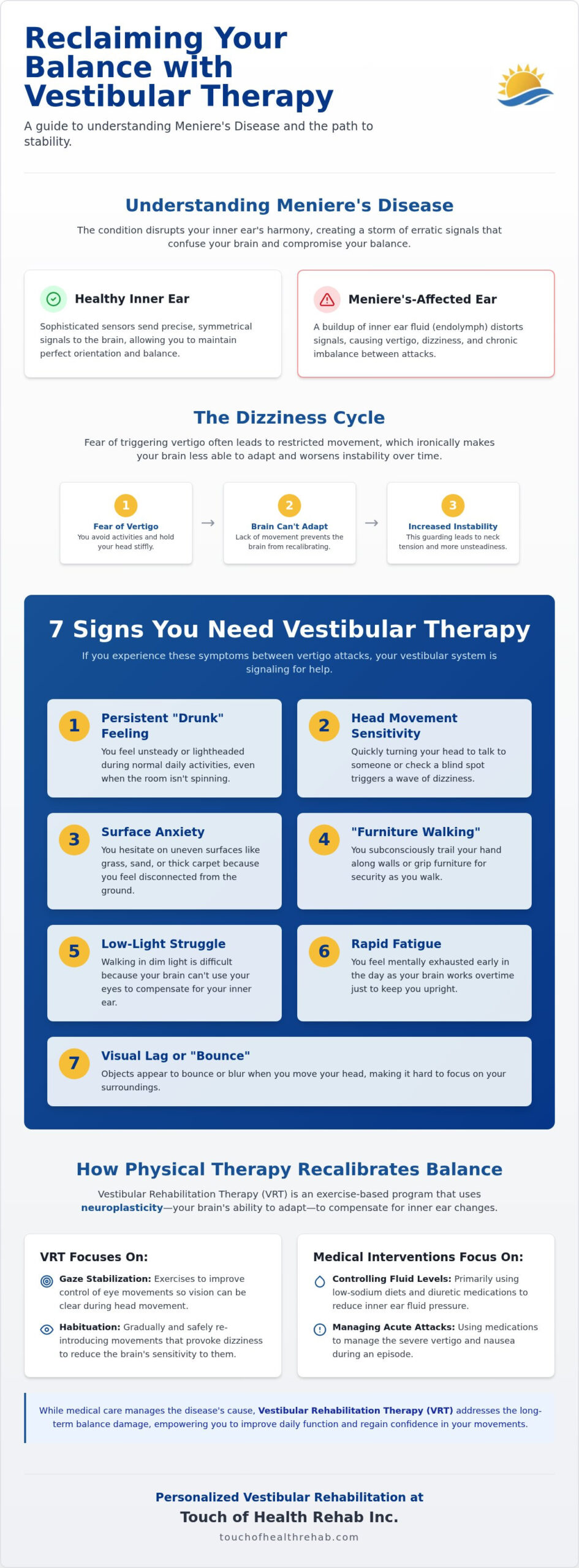
Your inner ear acts as a sophisticated sensory hub, constantly communicating with your brain to maintain your orientation in space. In a healthy system, these signals are precise and symmetrical. However, Meniere’s disease disrupts this harmony. The condition involves a buildup of excess fluid, known as endolymph, within the delicate inner ear chambers. This fluid pressure creates a “storm” of erratic signals that conflict with the data coming from your healthy ear. Your brain becomes understandably confused by these fluctuating inputs, which leads to the debilitating spinning sensations of an acute attack.
While the intense vertigo attacks are the most visible symptom, the chronic imbalance that lingers between episodes is often more disruptive to your daily life. Even after the spinning stops, your vestibular system may remain slightly damaged or “out of tune.” Your brain struggles to trust the signals it receives, leaving you in a state of constant high alert. This persistent state of being “off” is why many people seek out physical therapy for Meniere’s disease. It addresses the underlying instability that persists long after the acute episode has passed, helping you feel grounded and secure in your movements once again.
The ‘Dizziness Cycle’ in Meniere’s Patients
When you live in fear of the next attack, your natural instinct is to move as little as possible. You might hold your head stiffly or avoid looking up or down to prevent triggering a spell. This restricted movement creates a “dizziness cycle.” Your brain never gets the chance to practice processing movement, which actually delays your recovery. Additionally, this constant “guarding” leads to secondary muscle tension in your neck and shoulders. We often see how this physical stress compounds the initial problem, making you feel even more unsteady and fatigued.
What is Vestibular Rehabilitation Therapy (VRT)?
Vestibular Rehabilitation Therapy (VRT) is a non-invasive exercise-based program used to improve balance and reduce dizziness-related problems. It is a specialized form of vestibular rehabilitation that leverages the power of neuroplasticity. This is your brain’s remarkable ability to reorganize itself and form new neural connections. By performing specific, guided exercises, you teach your brain to compensate for the permanent or semi-permanent changes in your inner ear. This dedicated approach to physical therapy for Meniere’s disease transforms your recovery from a passive waiting game into an active, empowering journey toward peak physical health.
7 Signs You Need Vestibular Rehabilitation for Meniere’s
Once you have been diagnosed with Meniere’s disease, your focus often shifts to surviving the next vertigo attack. But what about the days in between? If you feel like you’re walking on a moving deck even when the room isn’t spinning, your vestibular system is signaling for help. Identifying these signs early allows you to start physical therapy for Meniere’s disease before your world becomes unnecessarily small. Recognizing these patterns is the first step toward reclaiming your independence.
- Persistent “Drunk” Feeling: You feel unsteady or lightheaded during normal activities, even without an active vertigo attack.
- Head Movement Sensitivity: Turning to answer a friend or checking your blind spot while driving triggers a wave of dizziness.
- Surface Anxiety: You hesitate to walk on grass, sand, or thick carpets because your feet don’t feel “connected” to the ground.
- Furniture Walking: You find yourself subconsciously trailing your hand along walls or gripping the backs of chairs for security.
- Low-Light Struggle: Walking down a hallway at night becomes a precarious task because your brain can’t rely on your eyes to compensate for your ears.
- Rapid Fatigue: You feel mentally drained by mid-afternoon because your brain is working overtime just to keep you upright.
- Visual Lag: Objects seem to “bounce” or blur when you move your head, making it difficult to focus on signs or faces.
Visual and Spatial Warning Signs
Busy environments like a crowded grocery store or one of our local South Florida malls can feel like a sensory assault. When your inner ear sends faulty data, your brain tries to use your eyes as a backup. In a crowded space with moving people and bright lights, this backup system becomes overwhelmed. You might feel a persistent sense of tilting or as if an invisible force is pulling you to one side. This spatial disorientation is a classic indicator that your balance system needs recalibration through physical therapy for Meniere’s disease.
When Imbalance Becomes a Fall Risk
Many patients wait for a significant fall before seeking professional support. However, stumbles and “near-misses” are your body’s urgent warnings. These moments of instability often lead to a loss of confidence that restricts your social life and physical activity. Engaging in balance and gait rehabilitation early can prevent these stumbles from turning into dangerous injuries. At Touch of Health Rehab, we partner with you to identify these deficits during a one-on-one evaluation, ensuring you can navigate your home and community with renewed certainty.
How Physical Therapy Recalibrates Your Balance
Recalibrating your balance is a methodical process that turns your brain into a master of compensation. When you commit to physical therapy for Meniere’s disease, you aren’t just performing repetitive movements; you’re participating in a sophisticated rewiring of your sensory systems. According to Johns Hopkins Medicine, vestibular rehabilitation therapy is a cornerstone for managing the chronic imbalance that persists between attacks. This journey of restoration focuses on three primary pillars of recovery.
- Gaze Stabilization: We use specific eye-tracking exercises to ensure your vision remains clear even when your head is in motion. This training prevents the disorienting “visual bounce” that makes walking feel precarious.
- Habituation: We carefully introduce movements that typically trigger your dizziness. By repeating these in a controlled environment, we desensitize your brain, teaching it that these movements are safe rather than threatening.
- Sensory Organization: When your inner ear provides erratic data, we train your brain to prioritize information from your eyes and the nerves in your feet. This creates a redundant backup system that keeps you grounded even when your ear fluctuates.
Consistency is the key to this “rewiring” process. Just as a musician practices scales to build muscle memory, your brain requires regular, purposeful input to master these new balance strategies. This steady progression builds the confidence you need to return to your favorite activities without the constant fear of a stumble. If you are also experiencing symptoms similar to those seen in other inner ear conditions, understanding vestibular neuritis physical therapy techniques can offer additional insight into how the brain compensates for inner ear imbalances.
Customizing Exercises for Meniere’s Fluctuations
Meniere’s is notoriously unpredictable, so a rigid, one-size-fits-all plan is rarely effective. We adjust your sessions based on your current state; stable days focus on challenging your limits, while flare-up days prioritize gentle stabilization and comfort. Integrating postural education helps you maintain a stable center of gravity, which reduces the secondary neck tension that often compounds your dizziness. Professional supervision ensures that we push your boundaries just enough to see progress without triggering a full vertigo episode.
The Role of Strength and Gait Training
We focus on strengthening the postural muscles in your core and legs, providing a solid foundation for your balance. Many patients subconsciously develop a “widened” gait to feel more secure, but this actually increases physical fatigue. Improving your walking patterns through gait training reduces the metabolic energy required just to stand still. This means you leave our sanctuary for healing with more energy for your daily life, rather than being exhausted by the simple act of maintaining your upright posture.
Meniere’s Management: VRT vs. Medical Intervention
Managing Meniere’s requires a two-pronged approach that balances medical stability with functional recovery. Medical intervention, such as diuretics or steroids, focuses on controlling fluid levels and stopping the acute vertigo storm. In contrast, physical therapy for Meniere’s disease addresses the functional damage left behind once the storm has passed. While your ENT doctor works to stabilize the inner ear’s environment, a physical therapist helps your brain make sense of the new, perhaps permanent, changes in your hearing and balance. This collaborative effort ensures that while the disease is managed, your quality of life is restored.
It’s common to rely on anti-dizziness medications like meclizine during an attack. However, using these suppressants long-term can actually hinder your progress in vestibular rehab. These drugs “quiet” the vestibular system, which is helpful during a crisis, but VRT requires your brain to actively engage with movement to learn how to compensate. If the system is constantly suppressed, your brain never receives the necessary signals to rewire itself. Think of it like trying to learn a new language while wearing earplugs; you need the input to make the connection. Learning how vestibular rehabilitation exercises for vertigo actively engage the nervous system can help you understand why this movement-based approach is so critical to long-term recovery.
When is the Best Time to Start PT?
You don’t need to wait for the “burnout” phase, where the inner ear has lost most of its function, to begin your recovery journey. Early intervention is vital for preventing the chronic anxiety that often accompanies unpredictable dizziness. If you’ve undergone a chemical or surgical labyrinthectomy to stop severe attacks, starting a specialized program immediately is essential for a successful outcome. This proactive approach ensures your brain begins adapting the moment the medical situation is stable, rather than letting chronic imbalance become your new normal.
Addressing Secondary Symptoms: Neck Pain and Tension
Many people develop what we call “stiff neck” syndrome because they are afraid to move their heads and trigger an attack. This constant guarding leads to painful muscle tension and tension headaches, which can ironically make your dizziness feel even more intense. Integrating pain management techniques alongside your vestibular exercises helps break this cycle of tension and discomfort. By combining postural education with targeted therapy, we help you move with freedom instead of restriction.
If you’re ready to move beyond just managing attacks and want to start your active recovery, explore our specialized vertigo treatment to see how we can help you regain your balance.
Personalized Vestibular Rehab at Touch of Health Rehab
Located near the serene shores of Miami Beach, Touch of Health Rehab serves as a sanctuary for healing for those navigating the complexities of inner ear disorders. We believe that every individual’s path to recovery is unique, which is why our approach to physical therapy for Meniere’s disease centers on one-on-one clinical support. You aren’t just another patient in a busy waiting room; you’re a partner in a collaborative journey toward restoration. Our therapists specialize in mapping your specific balance deficits to create a plan that reflects your lifestyle and personal goals.
Living in South Florida offers a vibrant outdoor life that should be enjoyed without the constant fear of a vertigo attack. Whether your goal is to enjoy a sunset stroll along the Atlantic or to feel confident navigating a busy social outing in Sunny Isles Beach, we provide the tools to make it possible. Our vestibular rehabilitation program is designed to bridge the gap between clinical recovery and the life-affirming activities you love. We focus on your long-term vitality, ensuring you have the stability to embrace every moment with confidence.
Our Sunny Isles Beach Clinical Expertise
Our dedicated team projects the image of a “Compassionate Expert,” combining high-end clinical authority with a deeply human touch. We understand that Meniere’s affects more than just your ears; it impacts your sense of safety in the world. By integrating fall prevention therapy into your personalized plan, we address the immediate risks of imbalance while building a foundation for permanent health. This methodical, steady rhythm of care ensures that you never feel rushed or unheard during your sessions.
Start Your Journey to Stability
Your first visit to our clinic is a comprehensive step toward regaining your independence. During this initial evaluation, we perform a series of specialized tests to understand exactly how your balance system is compensating for Meniere’s. We look at your eye-tracking, your gait patterns, and your postural stability to identify the precise areas where your brain needs the most training. This data-driven approach allows us to move beyond general exercises and focus on the specific movements that will yield the fastest results for your unique needs.
We’ve seen many of our neighbors transform their lives through this dedicated process, moving from a state of constant anxiety to one of empowerment and strength. These success stories drive our passion for the craft of healing and our investment in your success. If you’re ready to stop letting dizziness dictate your schedule, we’re here to guide you back to a life of movement and joy. Schedule your balance assessment today and take the first step toward a more stable, confident future.
Your Path to Lasting Stability Starts Here
Meniere’s disease often makes you feel like you’ve lost control of your own body, but the chronic imbalance you experience between attacks is a challenge you can overcome. By recognizing the subtle signs of vestibular dysfunction and utilizing the science of neuroplasticity, you can retrain your brain to find its center again. Specialized physical therapy for Meniere’s disease provides the structured, evidence-based exercises necessary to turn “off” days into active ones, reducing your risk of falls and clearing the brain fog that follows constant dizziness.
At Touch of Health Rehab, our expert specialists provide personalized one-on-one therapy plans designed to meet your specific needs. We are conveniently located for residents of Sunny Isles and Aventura, offering a sanctuary where your recovery is our priority. You don’t have to navigate this journey alone. It’s time to move beyond survival and start thriving in the activities you love most. We invite you to partner with us as we guide you back to peak physical health and confidence.
Take Control of Your Balance—Book a Vestibular Consultation in Sunny Isles Beach
Frequently Asked Questions
Can physical therapy cure Meniere’s disease?
Physical therapy cannot cure Meniere’s disease, as the condition is a medical disorder involving inner ear fluid pressure. However, it’s highly effective at managing the functional consequences that linger between attacks. While medications address fluid levels, physical therapy for Meniere’s disease focuses on retraining your brain to compensate for any permanent or semi-permanent damage to your balance sensors. This restoration of function allows you to live a full life even with the diagnosis.
Will vestibular rehab make my vertigo attacks worse?
Vestibular rehabilitation will not make your vertigo attacks more frequent or severe. The exercises are specifically designed to be performed during stable periods to build your resilience and confidence. You might experience a temporary increase in “off” feelings or mild dizziness during the session as we challenge your balance, but these sensations are a normal part of the recalibration process. We always work within your comfort levels to ensure your safety and progress.
How long does it take to see results from physical therapy for Meniere’s?
Most patients begin to notice improvements in their stability within 2 to 6 weeks of consistent therapy. The exact timeline depends on whether the condition affects one ear or both and how long you’ve experienced symptoms. While the “spinning” attacks are medical, the brain’s ability to adapt to imbalance happens gradually through neuroplasticity. Your commitment to a personalized home exercise program alongside your clinical sessions will significantly accelerate your journey toward restoration.
Is vestibular rehabilitation covered by insurance for Meniere’s disease?
Yes, most insurance providers, including Medicare, cover vestibular rehabilitation when it’s deemed medically necessary. For 2026, the Medicare therapy threshold is $2,480 for combined physical and speech therapy services. If your treatment exceeds this amount, your therapist can apply a KX modifier to certify the necessity of continued care. We recommend checking your specific plan’s copay requirements, which typically range from $20 to $50 per visit at in-network providers.
Can I do Meniere’s balance exercises at home?
You can and should perform balance exercises at home, but they must be prescribed by a professional first to ensure they are safe for your specific condition. Performing the wrong movements or doing them with incorrect form can lead to falls or unnecessary strain. Once your therapist has evaluated your specific deficits, they’ll provide a customized home program. These daily exercises act as “booster shots” for your brain, reinforcing the progress made during your one-on-one clinical sessions.
What happens if I don’t treat the balance issues from Meniere’s?
Leaving balance issues untreated often leads to a “shrinking” of your daily world as you avoid activities out of fear. Without intervention, you may develop a high risk for falls and chronic anxiety about moving in public spaces. This often results in secondary problems like “stiff neck” syndrome and mental fatigue as your brain works overtime to keep you upright. Early physical therapy for Meniere’s disease prevents these complications and helps you maintain your long-term independence.
Do I need a doctor’s referral for vestibular rehab in Florida?
In Florida, you can start physical therapy without a doctor’s referral under “Direct Access” for up to 30 days. This allows you to begin your recovery journey immediately when you notice signs of instability or persistent dizziness. However, some insurance plans still require a formal referral for reimbursement purposes beyond the initial period. Our team can help you navigate these requirements to ensure your care is covered while you focus on regaining your stability.
Is physical therapy effective if I only have Meniere’s in one ear?
Physical therapy is exceptionally effective for those who have Meniere’s disease in only one ear. This is because your brain can use the clear, healthy signals from your unaffected ear as a reference point to recalibrate. By strengthening the communication between your brain and your healthy ear, we help you compensate for the erratic signals coming from the affected side. This process significantly reduces daily dizziness and improves your confidence when walking on uneven surfaces.