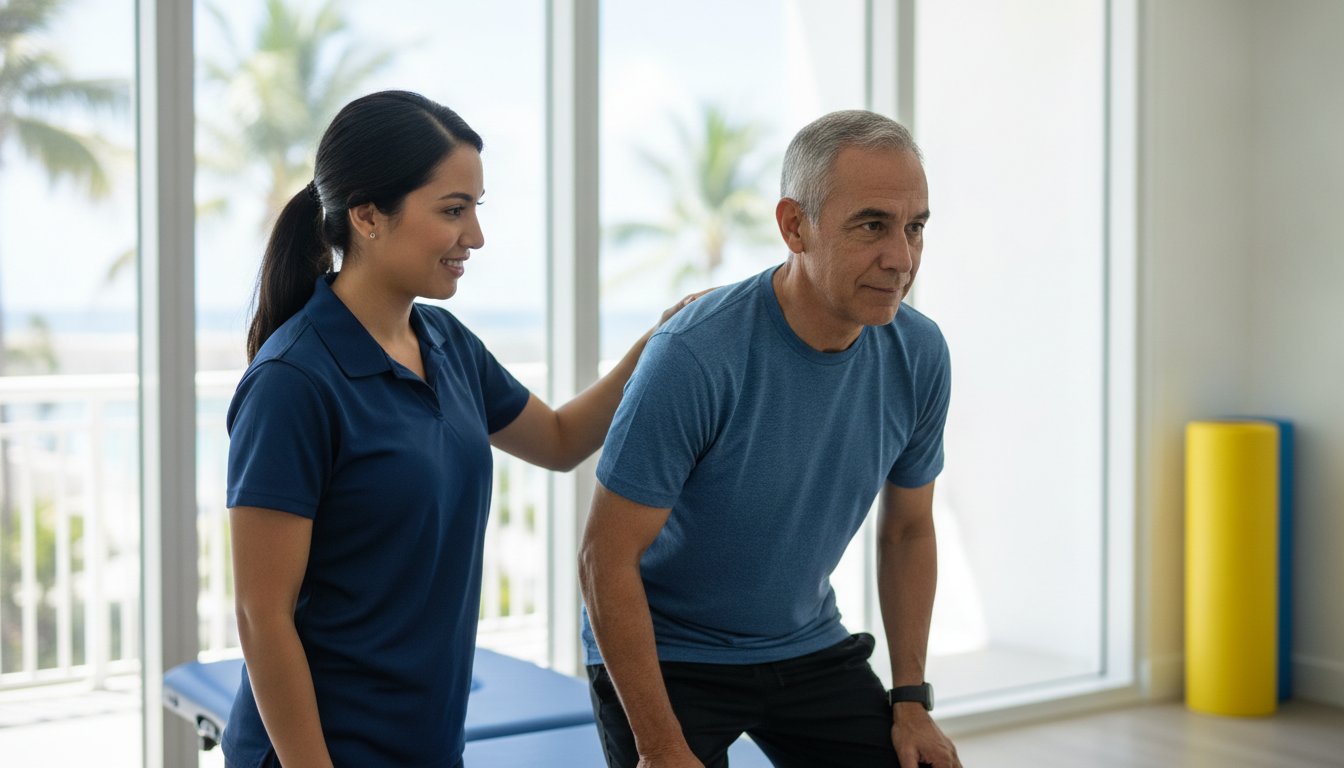
What if the key to stopping the world from spinning isn’t more rest, but more movement? If you’re struggling with the sudden onset of nausea when you turn your head or the constant fear of losing your footing in public, you’ve likely been told to just “wait it out.” It’s frustrating to feel like a passenger in your own body, wondering if your stability will ever return. By utilizing specialized vestibular rehabilitation exercises for vertigo, you can actually retrain your brain to compensate for inner ear imbalances, effectively silencing the dizziness at its source.
We believe that recovery shouldn’t be a waiting game, but a collaborative journey toward restoration. In this guide, you’ll discover how these therapeutic movements empower your nervous system to find its center again, restoring your balance for a more active, stable life. We’ll explore how targeted physical therapy reduces the frequency of dizzy spells and builds your confidence to walk without assistance. Understanding the cause of your vertigo is the first step, and an active, professional approach is the most reliable path back to the vitality you deserve.
Key Takeaways
- Understand why your brain and inner ear are out of sync and how specialized therapy bridges that gap to eliminate dizziness.
- Learn about vestibular compensation, the remarkable process where your brain reorganizes itself to prioritize stability and visual clarity.
- Discover how to perform specific vestibular rehabilitation exercises for vertigo, such as gaze stabilization, to retrain your focus and reduce nausea.
- Explore a safe, step-by-step progression from seated exercises to real-world walking to rebuild your confidence in public spaces.
- Recognize the importance of a professional, personalized assessment to ensure your recovery plan matches your unique clinical needs.
Understanding Vertigo: Why Your Brain Needs Vestibular Rehabilitation
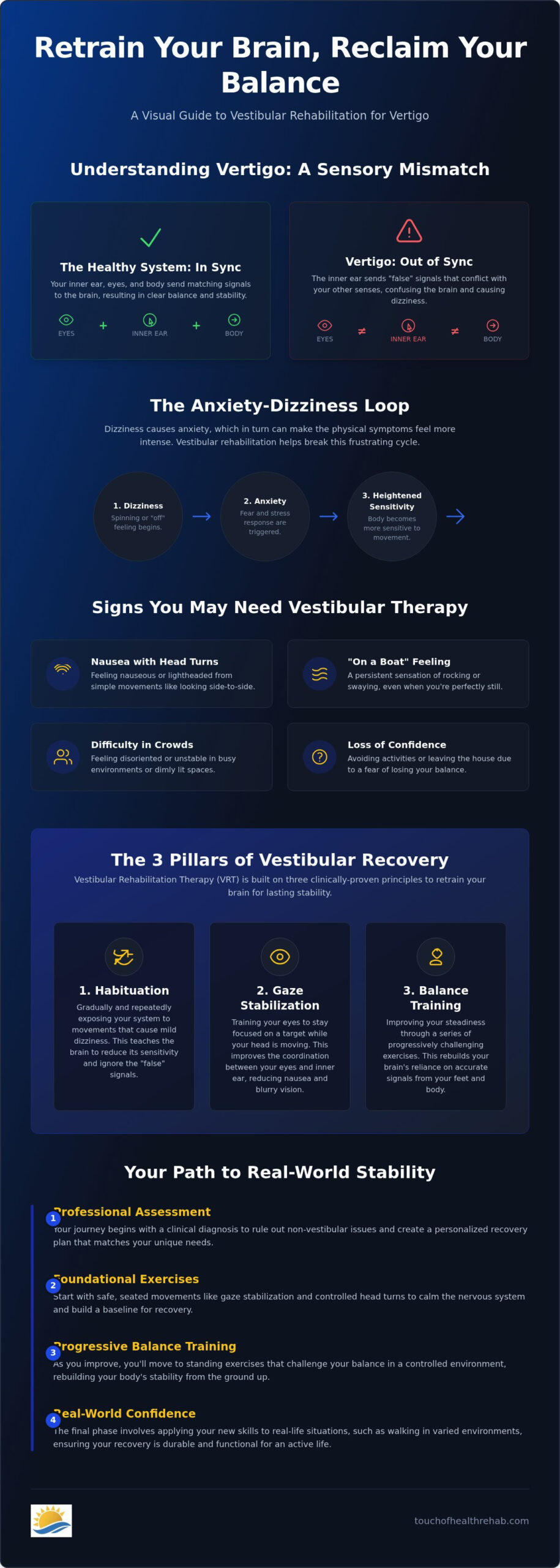
Vertigo isn’t just a physical sensation; it’s a profound disruption of your connection to the world. It happens when your inner ear, known as the vestibular system, sends signals that don’t match what your eyes see or what your body feels. This disconnect leaves your brain confused, resulting in that exhausting spinning or “off” feeling. Many people believe the best way to heal is to stay perfectly still and wait for the symptoms to vanish. However, prolonged rest can actually delay your recovery. Your brain is a master of adaptation, but it requires active data to learn how to recalibrate your balance.
So, What is Vestibular Rehabilitation? It is a specialized form of physical therapy designed to address these sensory conflicts directly. Instead of simply masking symptoms with temporary medication, we use purposeful, controlled movements to retrain your neural pathways. These vestibular rehabilitation exercises for vertigo act as a reset button for your nervous system. They teach your brain to ignore the “false” signals from a damaged inner ear and instead rely on more accurate information from your vision and your sense of touch. This process of neural retraining is the most effective way to achieve long-term stability.
The Anxiety-Dizziness Loop
When the floor feels like it’s tilting, your body naturally enters a “fight or flight” state. This stress response releases hormones that can actually make your dizziness feel more intense. It’s a frustrating cycle: the dizziness causes anxiety, and that anxiety heightens your sensitivity to every small movement. We break this loop by starting with the basics of nervous system regulation. Diaphragmatic breathing is often our first tool for stability. By calming your system through deep, rhythmic breaths, you create a quiet environment for your brain to process balance. It signals to your central nervous system that you’re safe, even if you feel slightly unsteady, allowing you to progress through therapy with less fear.
Signs You Need Professional Vestibular Therapy
Recognizing the need for help is the first step toward reclaiming your active life. You don’t have to wait for the spinning to become unbearable before seeking a solution. If you experience any of the following, vestibular rehabilitation may be the path you need to follow:
- Nausea or lightheadedness triggered by turning your head quickly.
- A persistent feeling of being “on a boat” or “spaced out” during daily tasks.
- Difficulty walking in crowded places or dimly lit hallways.
- A loss of confidence in your balance that prevents you from leaving the house.
An estimated one-third of adults in the United States deal with some form of vestibular dysfunction. Because of this, a professional clinical diagnosis is vital. It ensures we’re treating the vestibular system specifically and ruling out other non-vestibular issues, such as blood pressure or neurological concerns, before we begin your personalized recovery plan.
The Science of Recovery: How Vestibular Compensation Works
The path to stability isn’t found in avoiding movement, but in embracing it with clinical precision. Your brain possesses an incredible capacity for change through a process known as vestibular compensation. This isn’t just a passive healing phase; it’s an active reorganization where your central nervous system learns to interpret balance signals in a new way. By utilizing Vestibular Rehabilitation Therapy (VRT), we provide the specific stimuli your brain needs to build these new neural pathways. These vestibular rehabilitation exercises for vertigo are the primary tools we use to facilitate this neurological shift.
The clinical framework for this recovery rests on three essential pillars: Habituation, Gaze Stabilization, and Balance Training. Each serves a distinct purpose in your journey. Habituation is the reduction in response to a repeated stimulus. Gaze stabilization focuses on keeping your vision clear during head movements, while balance training improves your steady footing. Together, these components of vestibular rehabilitation exercises for vertigo ensure your recovery is both thorough and lasting.
Habituation: Reducing Sensitivity to Movement
If certain movements, like bending over or looking up, trigger your symptoms, your first instinct might be to avoid them. However, habituation works by safely exposing you to those exact triggers. When you repeat a “dizzying” movement in a controlled environment, your brain eventually realizes the signal isn’t a threat and begins to tune it out. We follow the “just enough” rule; we push your symptoms slightly to trigger healing, but never to the point of total exhaustion. This consistent, gentle challenge is what allows your nervous system to recalibrate and find its center again.
Proprioception and Visual Dependency
When the inner ear is unreliable, your brain turns to other sources of information: your eyes and your sense of touch, or proprioception. You might find yourself staring at the ground to stay upright or feeling for furniture as you walk. While these are helpful temporary fixes, becoming over-reliant on vision can make you feel even more dizzy in busy environments like grocery stores. Our approach to balance and gait rehabilitation focuses on strengthening the signals from your feet and joints. This reduces the burden on your eyes and allows for a more natural, confident stride. If you’re ready to start this process, our team is here to guide your personalized recovery.
Essential Vestibular Rehabilitation Exercises for Vertigo Relief
Moving from understanding the “why” to the “how” is an empowering step in your recovery. While the science of neural retraining is complex, the actual vestibular rehabilitation exercises for vertigo are often surprisingly simple. These movements are designed to challenge your balance system just enough to trigger adaptation without overwhelming your senses. To ensure your safety, we always recommend performing these initial exercises in a sturdy chair. This seated environment allows you to focus entirely on the movement of your head and eyes without the immediate fear of falling. It’s about building a foundation of stability before you move on to more complex tasks.
Gaze Stabilization (VOR x1) Step-by-Step
Gaze stabilization exercises, specifically the Vestibulo-Ocular Reflex (VOR) x1, are considered the gold standard for restoring visual clarity during movement. They train your eyes to stay fixed on a target even while your head is in motion. Follow these steps to begin:
- Step 1: Focus on a stationary target. Place a post-it note with a single letter on it at eye level, about three feet away from your chair.
- Step 2: Perform the ‘Head Shake No’. While keeping your eyes locked on the letter, slowly rotate your head side-to-side. Repeat this with a ‘Head Nod Yes’ movement by moving your head up and down.
- Step 3: Gradually increase your speed. As long as the target remains in clear focus, you can move faster. If the letter begins to blur or jump, slow down; this is your brain’s current limit, and we want to work right at that edge.
Brandt-Daroff Exercises for Positional Vertigo
For individuals specifically managing Benign Paroxysmal Positional Vertigo (BPPV), Brandt-Daroff exercises offer a systematic way to habituate the nervous system. This sequence is particularly helpful when the tiny crystals in your inner ear have been displaced. While some may use the Home Epley Maneuver for immediate relief, Brandt-Daroff is often used to reduce residual dizziness and help the brain adapt to changing positions. This structured movement is a cornerstone of effective vertigo treatment.
To perform these, start by sitting upright on the edge of your bed. Quickly lie down on one side, turning your head 45 degrees toward the ceiling. Hold this position for 30 seconds or until the spinning stops. Return to the upright sitting position for another 30 seconds, then repeat on the opposite side. If these vestibular rehabilitation exercises for vertigo cause intense nausea, don’t push through blindly. Pause, breathe, and let the sensation settle. These feelings are often a sign that your brain is receiving the input it needs to heal, but the process should always feel manageable and safe.
Safe Progression: Moving from Exercises to Real-World Stability
Moving from a chair to your feet can feel like a daunting leap. We often hear patients say, “I’m afraid I’ll fall if I do these standing up.” This fear is completely valid. However, the goal of vestibular rehabilitation exercises for vertigo is to prepare you for the unpredictable nature of daily life. You don’t live your life sitting down, so your recovery shouldn’t stop there either. By gradually narrowing your base of support and introducing environmental challenges, we help you reclaim the confidence to navigate your home and community safely.
Safety is our absolute priority during this transition. We recommend practicing fall prevention techniques at home by ensuring your environment is clear of trip hazards and well-lit. As your brain becomes more efficient at processing balance signals, we’ll introduce “Environmental Challenges.” This might involve practicing your movements on a slightly uneven rug or in a hallway with dimmed lighting. These scenarios mimic the real world, where surfaces aren’t always flat and lighting isn’t always perfect. This controlled exposure is what truly bridges the gap between clinical exercise and genuine stability.
Standing Balance Challenges
When you’re ready to stand, we begin by manipulating your base of support. Standing with your feet wide apart is the easiest position because it provides a large, stable foundation. As you progress, you’ll move your feet closer together until they’re touching. The ultimate challenge is the tandem stance, where you place one foot directly in front of the other, heel-to-toe. This narrow base forces your brain to rely heavily on vestibular and proprioceptive input rather than just muscle strength.
To stay safe, use the “Corner Technique.” Stand in the corner of a room with your back toward the walls but not touching them. Place a sturdy chair in front of you. This setup ensures that if you lose your balance in any direction, a support surface is within reach. Once you feel steady in these positions, you can begin to reintroduce the head turns you mastered while seated.
Walking and Dynamic Movement
The final stage of clinical recovery involves dynamic movement. Walking with head turns is the ultimate test of vestibular compensation. It requires your brain to keep your vision clear and your body upright while your center of gravity is constantly shifting. Start by walking down a narrow hallway. The walls provide a nearby “safety net” if you feel a wave of dizziness. Turn your head left and right every few steps, then try up and down. This mimics the action of looking for items on a grocery store shelf or checking for traffic before crossing a street. For more detail on this progression, you can read our guide on how physical therapy helps with balance. If you’re ready to move beyond the chair and back into the world, start your stability journey today with a professional assessment.
Clinical Vertigo Recovery in Sunny Isles Beach: The Touch of Health Approach
While digital guides provide a helpful foundation, recovery from chronic dizziness often requires a more nuanced, hands-on approach. At Touch of Health Rehab in Sunny Isles Beach, we serve as a sanctuary for those in Aventura and North Miami Beach who are tired of “waiting out” their symptoms. We understand that your experience with vertigo is as unique as your own nervous system. By choosing a local clinical setting, you gain access to professional expertise that ensures your vestibular rehabilitation exercises for vertigo are performed with the correct intensity and form. Our team, led by Lead Physical Therapist Berlin, acts as your dedicated guide, transforming a confusing medical condition into a clear, manageable path toward restoration.
Customized Therapy Plans
A common pitfall in vertigo recovery is the use of one-size-fits-all exercise lists. These generic plans often fail because they don’t account for the specific type of vestibular dysfunction you’re experiencing. Whether your dizziness stems from displaced crystals or a lingering inner ear imbalance, your treatment must be targeted to be effective. By refining your vestibular rehabilitation exercises for vertigo to match your specific clinical profile, we accelerate the brain’s ability to compensate. In our clinic, we integrate vestibular work with postural education and manual therapy to address the secondary neck tension that often accompanies chronic dizziness. This holistic view of your health is why so many of our patients share success stories of regaining their independence and returning to the activities they love.
Your First Visit: What to Expect
Your journey begins with a comprehensive, personalized assessment designed to identify the root cause of your instability. We use specialized clinical tools to evaluate your eye movements and your body’s reaction to specific positional changes. This evaluation isn’t just about finding what’s wrong; it’s about discovering your baseline for recovery. We’ll look at how you walk, how you stand, and how your vision interacts with your balance. From this data, we craft a personalized physical therapy plan that evolves as you get stronger. You don’t have to navigate this alone. We invite you to schedule your vestibular assessment today and take the first step toward a more stable, confident future.
Step into a More Stable and Confident Future
Recovery from vertigo is an active process that requires patience, clinical precision, and the right guidance. You’ve learned that your brain is capable of remarkable adaptation when given the correct signals through vestibular rehabilitation exercises for vertigo. By moving from foundational gaze stabilization to real-world walking challenges, you can effectively retrain your nervous system to ignore false signals and prioritize lasting stability. Movement is the most powerful medicine for your balance system, and it’s time to put that medicine to work.
Don’t let the fear of falling or the frustration of constant dizziness limit your life any longer. At Touch of Health Rehab, we provide specialized Vestibular and Balance Rehabilitation programs led by Lead Physical Therapist Berlin. Our clinic is conveniently located for Sunny Isles Beach and Aventura residents, offering a supportive sanctuary where your healing is our primary focus. We’re ready to partner with you to create a personalized recovery plan that restores your confidence and vitality. Reclaim your balance; schedule your Vertigo Recovery Consultation in Sunny Isles Beach today. Your journey back to a steady, active life starts with a single step toward expert care.
Frequently Asked Questions
Can vestibular rehabilitation exercises make my vertigo worse?
Exercises might temporarily increase your dizziness as your brain works to process new, conflicting information. This is a normal, expected part of the habituation process. It signals that your nervous system is being challenged enough to begin recalibrating. If your symptoms become overwhelming or take hours to settle, we simply adjust the intensity to ensure you’re progressing toward healing without unnecessary distress or prolonged discomfort.
How long does it take for vestibular exercises to start working?
Most patients notice significant improvements within four to six weeks of consistent practice. While some individuals find relief much sooner, neural retraining is a gradual process that requires steady repetition. Your brain needs time to build new pathways and learn to rely on accurate sensory data. Staying committed to your daily routine is the most reliable way to achieve the long-term stability you’re looking for.
Do I need a doctor’s referral for vertigo physical therapy in Florida?
You don’t need a doctor’s referral to begin your journey toward recovery. Florida law allows for direct access to physical therapy services for up to 30 days. This allows you to seek professional help immediately when symptoms arise. If your treatment needs to extend beyond that initial period, we’ll handle the coordination with your physician to ensure your care remains seamless and fully supported throughout the process.
Is it safe to do these exercises alone if I have a high fall risk?
If you’re at a high risk of falling, you shouldn’t practice these movements alone at home. It’s much safer to perform vestibular rehabilitation exercises for vertigo under professional supervision in a clinical setting. This ensures that you can push your limits safely while an expert provides the physical support and guidance needed to prevent accidents as your balance and confidence gradually return during each session.
What should I do if I feel nauseous during the exercises?
If you feel nauseous, pause the exercise immediately and allow the sensation to pass. It’s common to feel slightly “off” during therapy, but you shouldn’t push yourself to the point of actual vomiting. Take several slow, deep breaths to calm your nervous system. Once the nausea settles, you can resume at a slower pace or with a smaller range of motion to stay comfortable while still making progress.
Can vestibular rehab help with Meniere’s disease or Vestibular Neuritis?
Yes, vestibular rehabilitation is highly effective for managing the symptoms of Meniere’s disease and vestibular neuritis. While the therapy doesn’t cure the underlying medical condition, it empowers your brain to compensate for the sensory damage. By retraining your central nervous system, you can reduce the impact of dizzy spells and improve your overall quality of life even when dealing with chronic inner ear issues.
How often should I perform these exercises for the best results?
Consistency is the most important factor in your recovery. Most clinical plans recommend performing vestibular rehabilitation exercises for vertigo two to three times per day. These sessions don’t need to be long; in fact, short and frequent bursts of activity are often more effective for neural retraining than one long, exhausting workout. This steady rhythm keeps your brain in a constant state of learning and adaptation.
Will I ever be 100% free of dizziness?
Many people achieve a complete return to their normal, active lives without any lingering dizziness. While some may experience very minor residual sensations during high-stress moments or extremely fast movements, they gain the skills to manage those feelings effectively. The goal of our program is to ensure you feel stable, confident, and fully in control of your body’s movements every single day of your life.