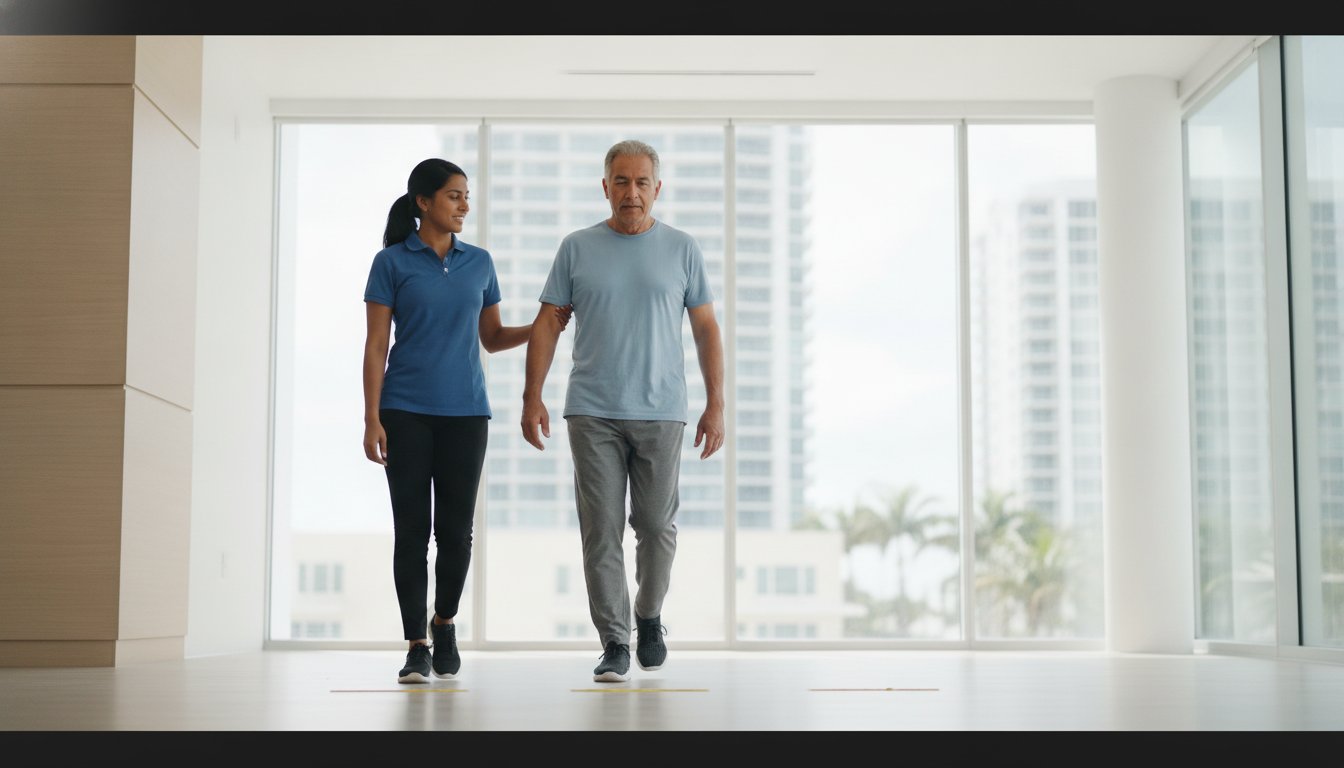
What if the secret to stopping those frustrating shuffling steps isn’t just about strengthening your legs, but about recalibrating how your brain perceives every movement? Many people living with Parkinson’s feel as though their world is shrinking because of a constant fear of falling in public or the sudden, paralyzing sensation of “freezing” mid-stride. It’s incredibly draining to lose your sense of independence, but specialized physical therapy for parkinson’s balance offers a proven path to retraining your neurological pathways and reclaiming your stability.
We understand that you want to move through your day without the anxiety of a near-miss or the limitation of small, hesitant steps. This article will show you how targeted neurological care can help you walk with longer, more confident strides and significantly reduce your risk of falls. You’ll learn about the latest 2026 advancements in neuroplasticity, including the LSVT BIG program and how personalized postural education can help you manage freezing episodes with ease. It’s time to shift the focus from what you’ve lost to the vibrant, active future you can still build.
Key Takeaways
- Understand the “Balance Gap” where your brain misinterprets the size of your movements and learn how to recalibrate your internal sense of stability.
- Discover how specialized physical therapy for parkinson’s balance utilizes amplitude training to help you “think big” and replace small, shuffling steps with confident strides.
- Learn how professional postural education corrects stooped alignment, shifting your center of gravity to prevent falls and improve your walking efficiency.
- Master practical techniques to manage “freezing of gait” and navigate tricky turns, which are the leading causes of balance loss in public spaces.
- Explore how a personalized, one-on-one approach in Sunny Isles Beach provides the neurological sanctuary needed to restore your independence and long-term vitality.
Understanding the Parkinson’s ‘Balance Gap’: Brain vs. Body
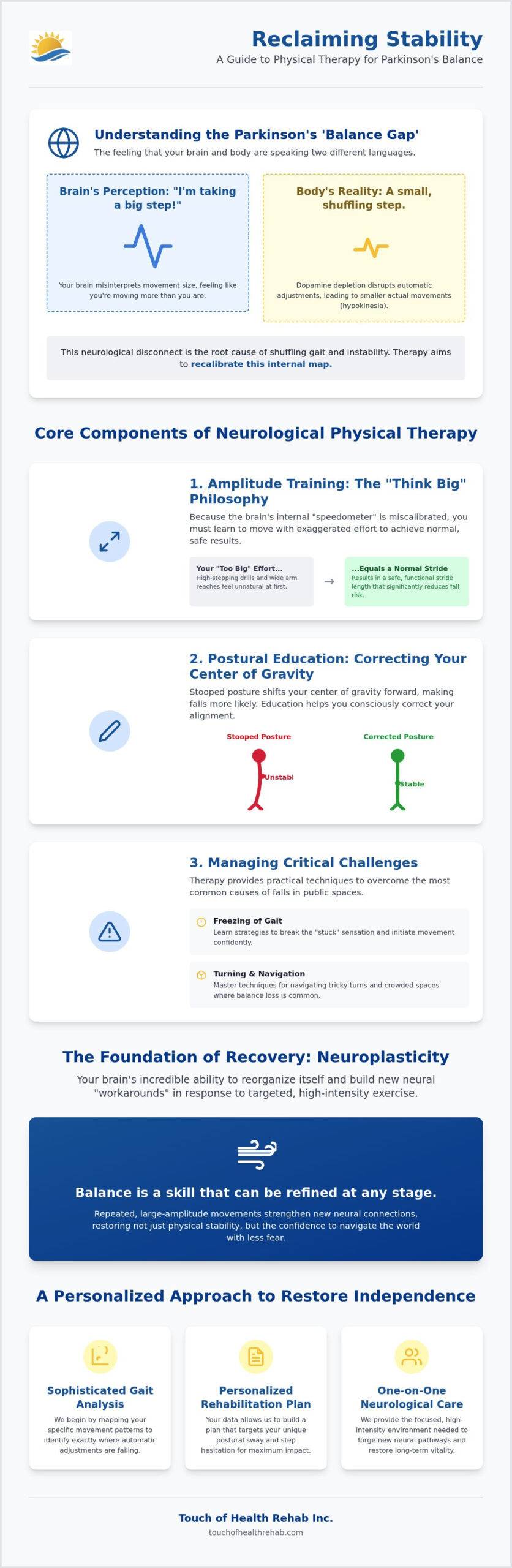
Living with Parkinson’s often feels like your body and brain are speaking two different languages. We call this phenomenon the “Balance Gap.” It’s a specific internal miscalibration where your brain perceives your movements as being much larger than they actually are. While you might feel like you’re taking a full step, your body is only moving a few inches. This disconnect happens because dopamine depletion in the basal ganglia disrupts your automatic postural adjustments. Instead of your body naturally correcting its center of gravity, those signals become muffled or lost. This is why many people with Parkinson’s feel they’re standing perfectly straight when they’re actually leaning forward or to the side. Neuro-physical therapy serves as a specialized method to retrain these sensory-motor pathways, helping you “reset” your internal map of movement.
The Basal Ganglia and Automatic Movement
Think of the basal ganglia as your body’s “cruise control” system. It’s responsible for the background details of movement you usually don’t have to think about, like how far your arms swing or the length of your stride. When Parkinson’s affects this region, it leads to hypokinesia, which causes movements to become small and cramped. This is the root cause of the characteristic Parkinsonian gait, where steps become shorter and more frequent. Because the automatic system is compromised, you have to switch to “manual” control. Specialized physical therapy for parkinson’s balance teaches you how to use conscious effort to bypass these damaged pathways, allowing you to regain the stride length and stability that once came naturally.
Neuroplasticity: The Foundation of Balance Recovery
The most encouraging aspect of modern rehabilitation is neuroplasticity. This is your brain’s incredible ability to reorganize itself and build new neural “workarounds” in response to targeted, high-intensity exercise. By engaging in repeated, large-amplitude movements, you’re essentially teaching your brain a new way to process balance. It’s a myth that balance is something you either have or you don’t; it’s a skill that can be practiced and refined at any stage of the journey. Through dedicated balance and gait rehabilitation, you can strengthen these new connections. This process doesn’t just improve your physical stability; it restores the walking confidence you need to navigate the world with less fear and more freedom.
Core Components of Physical Therapy for Parkinson’s Balance
Effective physical therapy for parkinson’s balance in 2026 relies on a structured, high-intensity approach that begins with a sophisticated gait analysis. While many general programs overlook this diagnostic phase, we prioritize mapping your specific movement patterns to identify exactly where your automatic adjustments are failing. This personalized data allows us to build a rehabilitation plan that targets your unique postural sway and step hesitation. By adhering to the latest clinical standards, we focus on frequency and intensity to ensure your brain receives the consistent stimulation it needs to forge new neural pathways. Understanding how physical therapy helps with balance at a clinical level can give you greater confidence in the rehabilitation process and help you set realistic, meaningful goals for your recovery.
One of the most vital elements of your recovery is the restoration of reciprocal patterns. This involves retraining the rhythmic coordination between your arm swings and leg movements, which often becomes “disconnected” as Parkinson’s progresses. Specialized Gait Training helps you regain this natural walking cadence, transforming a robotic, stiff walk into a fluid, confident stride. If you’re ready to see how these techniques can be tailored to your specific needs, you can consult with our specialized team to begin your journey toward restored stability.
Amplitude Training: Re-teaching the Brain to Move Large
The “Thinking Big” philosophy is the cornerstone of modern Parkinson’s care. Because your brain’s internal speedometer is miscalibrated, you must learn to move with exaggerated effort to achieve normal results. During your sessions, we utilize high-stepping drills and wide-arm reaches that feel “too big” to you, but actually result in a safe, functional stride length. This professional intervention provides the immediate benefit of reducing your fall risk during daily activities. By practicing these high-amplitude movements, you reset your brain’s perception of space, allowing you to navigate your home and community with newfound ease.
Rhythm and Auditory Cueing
When your brain’s internal timing fails, external rhythms can step in to bridge the gap. We use metronomes, rhythmic music, and even visual cues like lines on the floor to trigger larger, more deliberate steps. These external “pacemakers” help you bypass the damaged basal ganglia, using different parts of your brain to maintain a steady walking speed. Interestingly, many of these rhythmic strategies are also fundamental in Stroke Recovery Therapy, proving that the brain is remarkably capable of using auditory signals to overcome motor deficits. This approach doesn’t just improve your walking speed; it provides a reliable tool you can use to “restart” your movement whenever you feel a freezing episode coming on.
The Role of Postural Education in Preventing Falls
Parkinson’s doesn’t just affect how you move; it fundamentally changes how you stand. You might notice a persistent forward lean, a condition medically referred to as Camptocormia. This stooped posture shifts your center of gravity ahead of your feet, forcing your brain into a constant state of high alert to prevent a fall. When your weight is out of alignment, every step becomes a mechanical challenge. Professional Postural Education provides you with the sensory tools to recognize when you’re leaning and the physical strength to pull yourself back into a neutral, upright position. By re-centering your vertical alignment, you create a more stable foundation for every movement you make.
This misalignment is also a primary driver of retropulsion, that unsettling feeling of being pulled backward without the ability to stop. It’s a core component addressed during physical therapy for parkinson’s balance. By focusing on core strengthening, we help you build the deep abdominal and back muscles that act as your body’s natural stabilizer. This internal support system makes it much easier to maintain your equilibrium, whether you’re standing in a grocery line or navigating a crowded sidewalk. When your core is strong, your spine has the “scaffolding” it needs to resist the pulling forces of the disease, allowing you to stand taller and move with greater freedom. Many seniors in the area also find that addressing co-existing conditions like joint stiffness is equally important; exploring arthritis pain relief for seniors in Sunny Isles Beach can further support your ability to maintain the upright posture you work so hard to achieve in therapy.
Correcting the Forward Lean
To counter the “Parkinson’s flexed” position, we often use tactile feedback through exercises like the Wall Drill. By standing with your back to a flat surface, you receive immediate information about your spinal alignment, helping you “feel” what straight actually is. We also incorporate chest-opening stretches to release the tight muscles that pull your shoulders forward. Integrating Orthopedic Physiotherapy into your routine ensures your joints remain flexible enough to support this new, taller posture. This specialized care prevents the joint rigidity that often locks you into a stooped position, ensuring your body is physically capable of maintaining the corrections you learn in therapy.
Center of Gravity Awareness
True stability comes from knowing how to recover when you’re off-balance. We teach you to distinguish between the “Ankle Strategy” for minor sways and the “Hip Strategy” for larger stumbles. Weight-shifting exercises are a practical part of this process, simulating daily tasks like reaching into a high cabinet or stepping over a rug. Developing this awareness is a lifelong skill that evolves as your needs change. As you become more attuned to your center of gravity, you’ll find that you can move through your day with a much higher level of precision and safety, significantly reducing the frequency of near-falls.
Managing ‘Freezing of Gait’ and Turning Challenges
Freezing of Gait (FOG) is often described as the unsettling sensation that your feet have suddenly been glued to the floor. This temporary inability to move usually happens during “transitions,” such as walking through a narrow doorway, navigating a crowded room, or feeling a sudden surge of anxiety. It’s a significant barrier to independence, but specialized physical therapy for parkinson’s balance provides the specific drills you need to navigate these “sticky” moments. By understanding your personal triggers, you can transform a moment of panic into a controlled, predictable recovery that keeps you moving forward.
Turning is statistically the number one cause of falls for those living with Parkinson’s. When you try to pivot on the spot, your base of support narrows significantly, making it nearly impossible for your brain to maintain your equilibrium. We teach a “U-Turn” strategy instead of a sharp pivot. This wide-arc approach keeps your feet apart and your center of gravity stable. To help you regain control during a freeze, we utilize the “4S” method:
- Stop: Cease trying to move forward immediately to prevent a loss of balance.
- Stand Tall: Reset your posture to ensure your weight isn’t leaning too far forward.
- Sway: Shift your weight from side to side to “unweight” the foot you want to move.
- Step Big: Use a high-amplitude movement to break the freeze and restart your stride.
Strategies to Break the ‘Freeze’
Weight-shifting is the most effective way to unstick a foot. By gently swaying your hips, you signal to your brain which leg is ready to lift. We also use mental visualization techniques, such as imagining you’re stepping over a large log. This mental “cue” bypasses the damaged automatic pathways and engages the conscious motor cortex to initiate movement. Our Fall Prevention Therapy focuses heavily on these high-risk moments, giving you the tools to handle doorways and elevators with total confidence.
Safe Turning Techniques
A “Clock Turn” or “Wide Arc” turn is essential for maintaining stability during daily tasks. Instead of twisting your torso, you take several small, deliberate steps in a wide circle, similar to following the numbers on a clock face. Head-eye coordination plays a vital role here; you must lead the turn with your eyes and head, allowing your body to follow. This sequence keeps your vestibular system informed and prevents the dizziness that often leads to a stumble. If you’re ready to master these techniques and move with renewed freedom, schedule your specialized fall prevention assessment today.
Specialized Parkinson’s Rehabilitation in Sunny Isles Beach
Touch of Health Rehab Inc. serves as a dedicated sanctuary for neurological healing right here in Sunny Isles Beach. We recognize that managing Parkinson’s requires more than just a general exercise plan; it demands a sophisticated, clinical approach tailored to your specific neurological needs. Led by Lead Physical Therapist Berlin, our team focuses on providing a human-centered environment where recovery is a collaborative journey. For residents in Aventura, Miami Beach, and North Miami Beach, this means having access to expert-led physical therapy for parkinson’s balance without having to travel far from home.
One-on-one sessions are the cornerstone of our practice, especially for complex balance cases that require undivided professional attention. We don’t believe in a one-size-fits-all model. Instead, we offer a personalized Balance and Gait evaluation that serves as the blueprint for your restoration. Whether you’re dealing with the frustration of shuffling steps or the fear of falling in public, our goal is to help you regain your walking confidence through methodical, step-by-step rehabilitation.
A Personalized Path to Stability
Your journey begins with a comprehensive gait analysis and balance assessment. This isn’t a surface-level check; we look deep into the mechanics of your movement to identify the specific “Balance Gap” where your brain and body have lost their synchronization. We’re committed to seeing the person behind the symptoms, ensuring that every session reflects your unique goals and lifestyle. Patients from Bal Harbor and Aventura often tell us they feel at home here, finding comfort in a clinic that prioritizes their long-term vitality over quick, temporary fixes. It’s about building a foundation of strength that allows you to move through your world with precision.
Taking the First Step Toward Confidence
Starting your recovery doesn’t have to be overwhelming. In 2026, managing your care is more straightforward than ever. For instance, the Medicare Part B deductible is $283; once met, Medicare typically covers 80% of your approved therapy services. We’re here to help you understand these details so you can focus entirely on your healing. This clarity allows you to commit fully to specialized physical therapy for parkinson’s balance without unnecessary administrative stress. We encourage you to explore the Success Stories of local patients who have already reclaimed their independence through our programs. If you’re ready to stop the shuffling and start walking with longer, more confident strides, the first step is a simple consultation to map out your recovery goals.
Schedule your Parkinson’s balance evaluation at Touch of Health Rehab Inc. today and discover how specialized care can transform your quality of life.
Reclaiming Your Freedom of Movement
Recalibrating your stability isn’t just about managing symptoms; it’s about rewriting your brain’s internal map so you can move with confidence again. By bridging the “Balance Gap” through high-intensity amplitude training and specialized postural education, you can replace hesitant, shuffling steps with the long, purposeful strides you deserve. We’ve discussed how targeted physical therapy for parkinson’s balance provides the neurological “workarounds” needed to bypass damaged pathways and manage high-risk moments like turning or walking through doorways.
At Touch of Health Rehab, Lead Physical Therapist Berlin provides the expert guidance required for this collaborative journey. Our clinic serves as a welcoming sanctuary for residents in Sunny Isles Beach, Aventura, and Miami Beach who are ready to transition from a fear of falling to a life of restored vitality. You don’t have to face these challenges alone. With the right specialized care, your body can learn to find its center once more.
Restore your confidence and stability; Book your Parkinson’s Balance Evaluation today
Your path to better movement is waiting, and we’re here to guide you every step of the way.
Frequently Asked Questions
Can physical therapy really help if my Parkinson’s is progressing?
Physical therapy is effective at every stage of the disease, including during periods of active progression. By working with a neurological specialist, you can address movement issues as they arise and establish a baseline for your future care needs. It helps you maintain your current level of function while providing the safety strategies needed to prevent falls as your symptoms change over time.
What is the best type of exercise for Parkinson’s balance?
High-amplitude training, often referred to as the LSVT BIG style, is widely considered the gold standard for Parkinson’s rehabilitation. These exercises focus on large, exaggerated movements that help reset your brain’s internal perception of space and movement speed. Incorporating rhythmic auditory cueing or visual markers also helps you bypass automatic movement deficits and maintain a steady, confident walking pace in your daily life.
How often should I attend physical therapy for Parkinson’s?
Clinical standards for 2026 suggest that a high-intensity approach, typically involving two to three sessions per week, yields the best results for neurological recovery. Consistency is vital because your brain requires repeated, purposeful stimulation to build and strengthen new neural pathways. Your therapist will customize a schedule that balances professional one-on-one sessions with a home exercise program to ensure you maintain your progress between clinic visits.
What should I do if I ‘freeze’ while walking in public?
If you experience a freezing episode in a public space, the most effective response is to immediately stop and reset your posture. Use the “4S” method by standing tall, swaying your weight from side to side to unweight your “stuck” foot, and then taking a single, large step forward. Visualizing an imaginary object to step over can also help your brain initiate the movement and break the freeze safely without a fall.
Is physical therapy covered by insurance for Parkinson’s in Florida?
Yes, physical therapy for parkinson’s balance is covered by Medicare and most private insurance plans throughout Florida. For 2026, the Medicare Part B deductible is $283, and once you meet this, Medicare typically covers 80% of the approved amount for your therapy services. There’s no longer a hard annual cap on visits, provided your physical therapist can demonstrate that the treatment is medically necessary for your safety and mobility.
Can physical therapy help with Parkinson’s-related dizziness?
Specialized physical therapy can directly address dizziness through vestibular rehabilitation techniques tailored to your specific needs. Many people with Parkinson’s experience lightheadedness or a sense of spinning that complicates their stability. By performing targeted eye and head coordination exercises, you can stabilize your visual field and reduce the sensory confusion that contributes to instability, making it much easier to navigate your environment with confidence. For a deeper understanding of these techniques, our clinical guide on how physical therapy helps with balance explores the full range of vestibular and postural strategies used in 2026 rehabilitation standards.
What is the difference between general PT and neurological PT for Parkinson’s?
Neurological physical therapy focuses specifically on the brain-body connection and the principles of neuroplasticity, whereas general physical therapy often centers on orthopedic muscle or joint injuries. A neurological specialist understands how dopamine depletion affects your automatic movements and uses specific techniques to retrain your nervous system. This specialized approach is essential for addressing the unique sensory-motor mismatches that cause shuffling steps and postural sway.
How long does it take to see improvements in my walking and balance?
While every individual’s journey is unique, many patients begin to notice improvements in their walking confidence within four to eight weeks of consistent, high-intensity therapy. Initial changes often include a reduction in near-falls and a more upright, stable posture. Over time, these small gains accumulate into significant improvements in your stride length and your ability to manage complex tasks like turning in narrow spaces or navigating crowded sidewalks.