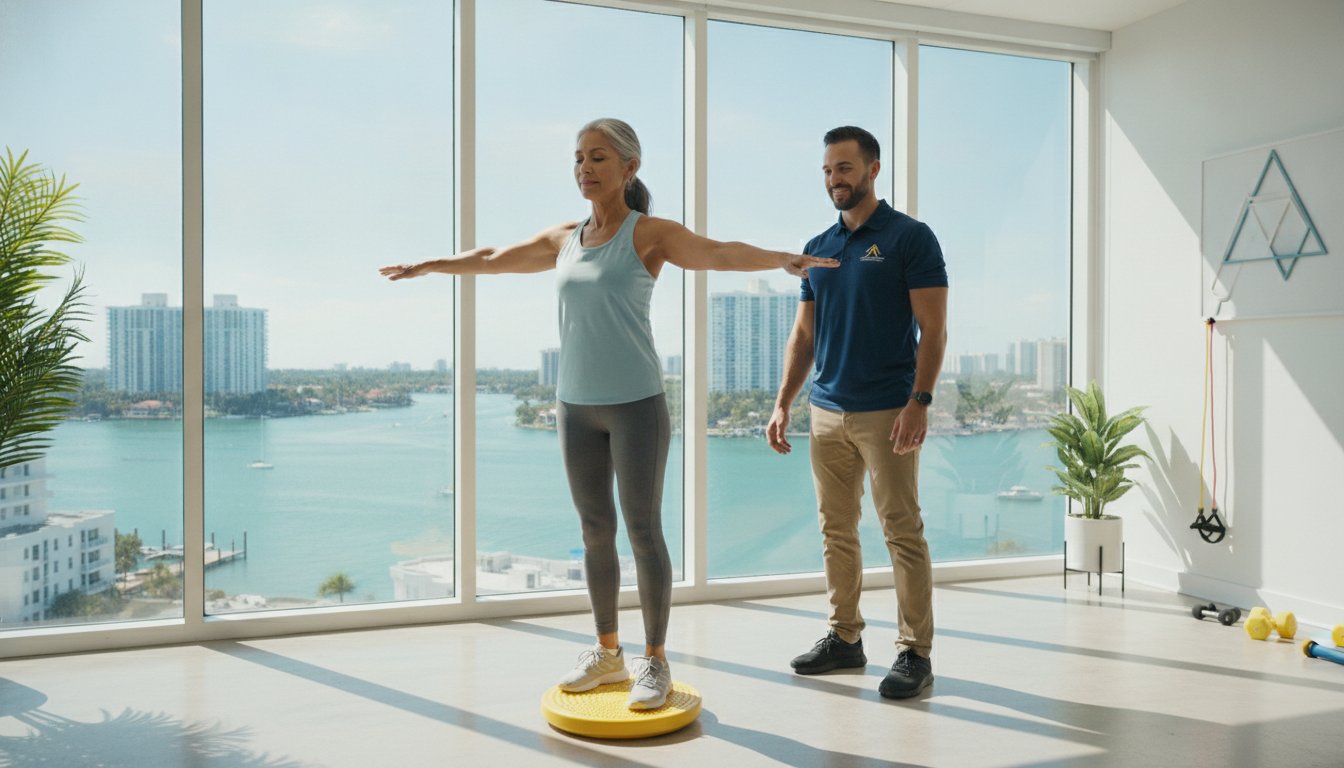
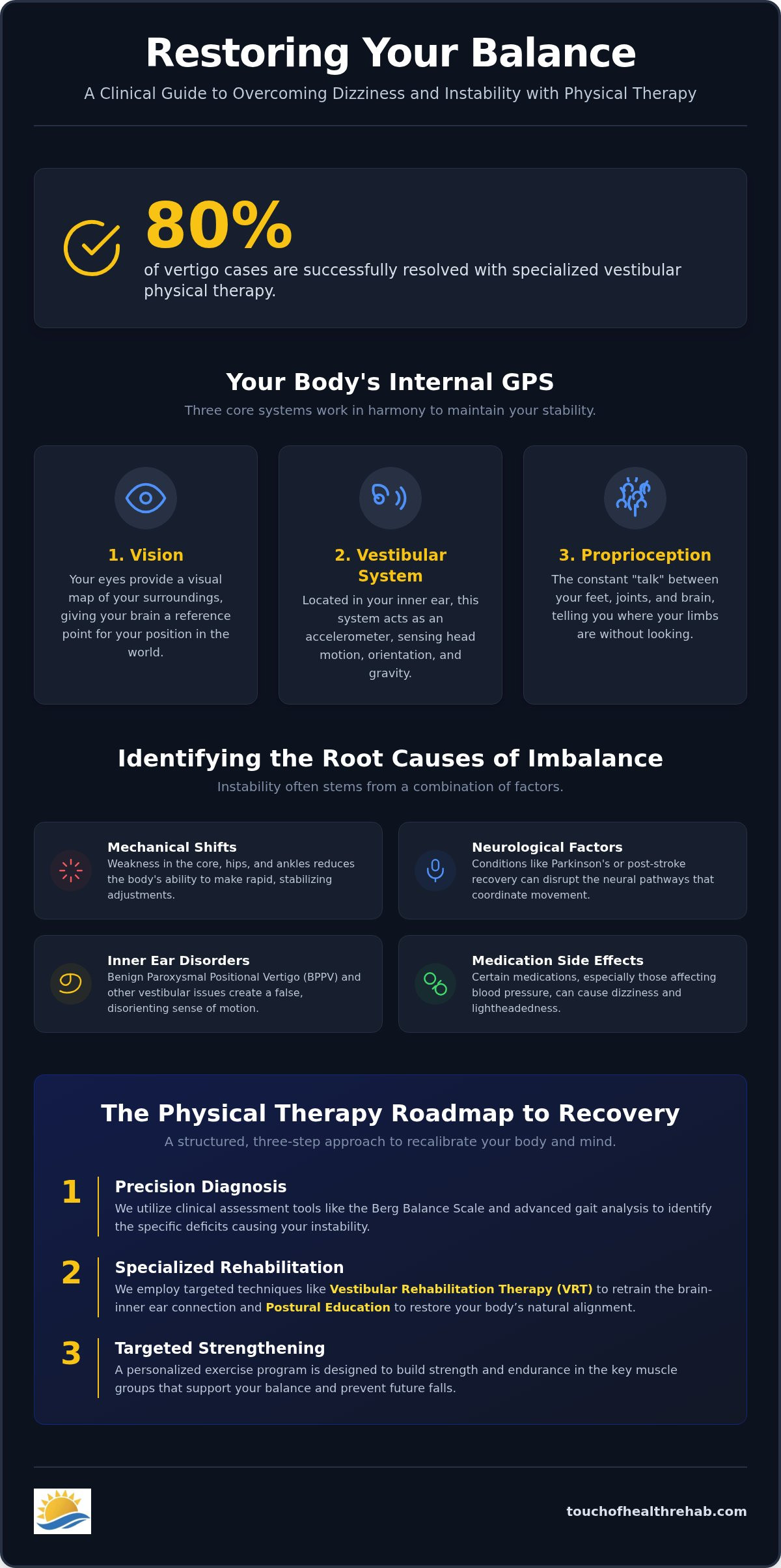
Many people believe that losing your footing is just a natural consequence of getting older, but clinical evidence shows that vestibular physical therapy resolves vertigo in 80% of cases. Understanding how physical therapy helps with balance is the first step toward reclaiming a life without the constant anxiety of a potential fall. You might feel a growing sense of worry when walking across a crowded room or fear that a single slip could mean losing your independence. It’s completely understandable to feel frustrated when you’re unsure if your dizziness is a normal part of aging or a treatable condition that can be managed with expert care.
In this clinical guide, you’ll discover how specialized techniques recalibrate your body’s natural stability systems to restore your confidence and prevent future injuries. We’ll explore the latest 2026 rehabilitation standards; this includes postural education and gait analysis designed to help you identify the root cause of your instability. By the end of this article, you’ll have a clear roadmap for returning to your active Sunny Isles Beach lifestyle with the steady, certain steps you deserve.
Key Takeaways
- Understand the three pillars of stability—Vision, Vestibular, and Proprioception—and how their coordination is essential for maintaining your natural posture.
- Discover how physical therapy helps with balance by addressing the mechanical root causes of instability, such as core weakness and neurological shifts.
- Learn about clinical assessment tools like the Berg Balance Scale and gait analysis that allow our team to design a precision-targeted rehabilitation plan for you.
- Explore how specialized Vestibular Rehabilitation and Postural Education work together to eliminate dizziness and provide a foundation for long-term health.
- See how a personalized, one-on-one journey at our Sunny Isles Beach sanctuary can restore your confidence and help you reclaim an active, independent life.
The Science of Stability: Why Balance Matters More Than You Think
Balance is a complex, real-time symphony performed by your brain, nervous system, and muscles. Your brain acts as the lead conductor, processing millions of sensory signals every second to keep you upright and moving through the world. It’s easy to take this for granted until you feel that first momentary wobble or a sudden sense of unsteadiness. While many people assume that losing stability is an unavoidable part of getting older, clinical research suggests otherwise. Inactivity often plays a larger role than age itself. When you stop challenging your stability systems, they begin to “rust” from disuse. We view your fall risk not as an inevitability, but as a manageable health metric that can be improved with the right intervention. Understanding how physical therapy helps with balance is the first step in moving from a place of fear to a position of proactive health.
The Visual-Vestibular-Proprioceptive Connection
Your body relies on three distinct pillars to maintain its center of gravity. Your eyes provide the primary horizon line, giving your brain a visual map of your surroundings and your position within them. Meanwhile, your inner ear acts as the body’s internal accelerometer. If this system is compromised by injury or illness, vestibular rehabilitation therapy (VRT) can help retrain the brain to process these signals correctly. The third pillar is proprioception, which is the constant “talk” between your feet, joints, and brain. This feedback loop tells you exactly where your limbs are without you having to look at them. When these systems are in sync, you move with effortless confidence.
When the Systems Desync: The Feeling of Imbalance
There is a meaningful clinical difference between true vertigo and general disequilibrium. Vertigo often feels like the world is spinning around you, while disequilibrium is a persistent feeling of being “off” or lightheaded. You might notice this most when walking on uneven surfaces, such as the shifting sands of Sunny Isles Beach or a thick carpet. This lack of coordination often leads to an emotional toll that includes social withdrawal and deep-seated anxiety about falling in public. This is exactly how physical therapy helps with balance; it recalibrates these desynced systems through targeted vestibular rehabilitation. Our goal is to restore the communication between your senses and your muscles, allowing you to reclaim your independence and return to the activities you love.
Identifying the Root Cause: Why Your Balance is Shifting
Balance isn’t a static trait; it’s a dynamic response that requires every part of your body to work in harmony. When you feel unsteady, it’s rarely due to a single “glitch.” Instead, it’s often a combination of mechanical and sensory shifts. Muscle weakness in the core and lower extremities serves as a primary mechanical cause for instability. If your ankles, hips, or glutes lack the strength to make rapid micro-adjustments, a small trip can quickly turn into a fall. Neurological factors also play a major role. Conditions such as Parkinson’s disease or the challenges faced during stroke recovery disrupt the neural pathways that coordinate movement. This is where professional guidance becomes essential. According to the Physical Therapy Guide to Balance Problems, a therapist can pinpoint these specific deficits to create a targeted recovery program.
Beyond physical strength, your internal environment matters. Medication side effects, particularly those affecting blood pressure, can cause sudden dizziness when you stand up too quickly. Additionally, inner ear disorders like Benign Paroxysmal Positional Vertigo (BPPV) create a false sense of motion that can be incredibly disorienting. For seniors who also experience joint stiffness in the knees or hips that limits their ability to walk comfortably, exploring arthritis pain relief for seniors in Sunny Isles Beach can be an important part of addressing the full picture of mobility challenges. Our approach involves a thorough review of your history to ensure we address every contributing factor. Understanding how physical therapy helps with balance starts with this comprehensive look at your body as a whole system rather than just a set of symptoms.
Age-Related Changes vs. Clinical Disorders
Many seniors in Aventura and Bal Harbor assume that a shuffling gait or a wider stance is just an unavoidable part of getting older. It’s vital to distinguish between a natural “slowing down” and clinical gait abnormalities that significantly increase your injury risk. We specialize in geriatric physical therapy to help you identify these differences. If you’ve noticed a change in your walking pattern, scheduling a clinical assessment with our team is the best way to gain clarity and restore your peace of mind.
The Role of Posture and Alignment
Your posture acts as the scaffolding for your stability. When you develop “Forward Head Posture,” your center of gravity shifts too far forward, forcing your back and leg muscles to work twice as hard just to keep you upright. This structural misalignment can lead to “desynced” signals between your spine and brain, making you feel perpetually off-balance. For a deeper look at this specific issue, you can read our guide on physical therapy for forward head posture. Proper alignment ensures that balance signals travel efficiently, which is exactly how physical therapy helps with balance over the long term. By correcting these structural shifts, we provide the stable foundation you need to move with confidence again.
How Physical Therapy Recalibrates Your Balance and Gait
Recalibrating your balance is a precise clinical process that goes far beyond simple standing exercises. It begins with a meticulous clinical assessment using validated tools like the Berg Balance Scale, which evaluates your ability to maintain equilibrium during various functional tasks. Unlike a general fitness routine, this assessment identifies exactly where the “desync” is happening in your sensory systems. This is a primary way how physical therapy helps with balance; it provides a data-driven starting point for your recovery. We don’t just guess why you feel unsteady; we measure it.
A critical component of this recalibration is neuromuscular re-education. This specialized technique focuses on the speed and accuracy of the communication between your brain and your feet. While many people believe they just need “stronger legs,” the reality is often that the signal to stabilize is arriving too late. By practicing specific, high-repetition movements, we help your nervous system react faster to unexpected changes in your environment. This shortened reaction time is what prevents a minor wobble from turning into a dangerous fall. To see how this process unfolds in practice, our physical therapy for seniors balance clinical case study illustrates exactly how these techniques are applied to restore real-world stability.
Comprehensive Gait Analysis: Watching How You Move
Your gait, or the way you walk, is a complex sequence of movements that requires perfect timing. During a comprehensive gait analysis, we measure specific metrics such as stride length, cadence, and foot placement. We look for “compensatory patterns,” which are subtle changes in your walking style that you might have adopted to feel safer. For example, taking shorter, shuffling steps might feel more stable, but it actually increases your risk of tripping over small obstacles. By correcting these patterns through balance and gait rehabilitation, we help you move with greater efficiency and less fear.
Strength and Conditioning for Real-World Stability
True stability depends on the “stabilization chain,” which includes the muscles of your ankles, hips, and core. These aren’t the large muscles you typically train on gym machines; these are the stabilizer muscles that hold your joints in place. We prioritize functional exercises that mimic real-world movements, such as stepping over a curb or navigating a narrow hallway. This approach is far more effective than standard weightlifting because it challenges your balance and strength simultaneously. Integrating a personalized physical conditioning program ensures that your body is prepared for the unpredictable surfaces of daily life. This targeted training is how physical therapy helps with balance over the long term, providing you with the physical resilience needed to maintain your independence.
Specialized Techniques: Vestibular Rehab and Postural Education
Specialized clinical techniques move the focus from your legs to the intricate connection between your brain and inner ear. This is where we solve the deeper mysteries of instability that general exercise often misses. Many of our clients arrive feeling that their world is constantly tilting, and we use evidence-based protocols to steady that horizon. Understanding how physical therapy helps with balance involves looking at the sophisticated ways your brain and body communicate through these specialized systems. We use a variety of tools to challenge and strengthen these pathways:
- Foam pad training: Simulating walking on soft or uneven surfaces like sand or grass to improve ankle reaction time.
- Single-leg stands: Building the reflexive strength needed to recover from a trip before it becomes a fall.
- Multi-tasking drills: Practicing balance while holding a conversation or carrying an object to mirror real-life demands.
- Habituation exercises: Gradually desensitizing the brain to specific movements that trigger dizziness.
These real-world simulations are exactly how physical therapy helps with balance in a way that standard gym routines cannot match. By safely pushing your limits in a controlled environment, we help you build the resilience needed for everyday life.
Vestibular Rehabilitation: Solving the Dizziness Puzzle
If you feel a sense of spinning when you roll over in bed or turn your head quickly, you’re likely dealing with gaze instability or an inner ear imbalance. Our vestibular rehabilitation programs include gaze stabilization exercises that train your eyes to stay fixed on a target while your head is in motion. We also provide clinical treatments like the Epley maneuver, which is a highly effective series of movements used to resolve BPPV by repositioning displaced crystals in the inner ear. These interventions don’t just mask the symptoms; they stop the dizziness at its source. This allows you to navigate your home and community without the constant, draining fear of a sudden vertigo attack.
Postural Education: Finding Your Center
While many clinics focus solely on the inner ear, we recognize that your posture is the ‘secret weapon’ for long-term stability and fall prevention. Postural education is the clinical correction of body alignment to optimize mechanical efficiency. When your spine is properly aligned, your nervous system can transmit balance signals with minimal interference and maximum speed. Our approach to postural education focuses on correcting the structural shifts that often lead to chronic pain and increased fall risk. By refining your alignment, we ensure that your body’s mechanical foundation is strong enough to support every other aspect of your recovery. This holistic focus on alignment helps you maintain your progress long after your formal sessions have ended. If you’re ready to find your center again, contact us today to start your personalized stability program.
Reclaiming Your Independence at Touch of Health Rehab Inc.
Recovery is a collaborative journey that requires more than just clinical expertise; it requires a sanctuary for healing. At Touch of Health Rehab Inc. in Sunny Isles Beach, we prioritize your individual story. We don’t use one-size-fits-all templates because your balance challenges are as unique as your gait. Led by Lead Therapist Berlin, our specialized clinical team acts as your dedicated guide, ensuring every session moves you closer to peak physical health. This personalized attention is exactly how physical therapy helps with balance for our neighbors in North Miami Beach and Aventura. We’ve seen residents return to morning beach walks and social gatherings with a renewed sense of empowerment and a steady step.
Our clinic is designed to be a welcoming environment where you feel supported at every stage of your progression. We focus on the attainment of your specific lifestyle goals, whether that means playing with your grandchildren or enjoying a round of golf without dizziness. By choosing a provider that understands the nuances of vestibular and orthopedic care, you aren’t just treating a symptom. You’re investing in your long-term vitality and reclaiming the freedom to move through South Florida with confidence.
Fall Prevention for a More Active Lifestyle
Staying active is the most effective way to maintain your physical resilience. Our fall prevention therapy empowers seniors to embrace an active lifestyle without the looming anxiety of an injury. We integrate safety training directly into your clinical care, teaching you how to optimize your home environment for maximum stability. This includes practical advice on lighting, rug placement, and footwear that complements your progress in the clinic. You can read about the life-changing results our patients have achieved in our success stories. These narratives prove that walking without fear isn’t just a goal; it’s a reality we achieve together every day at Touch of Health Rehab Inc.
Your Next Steps Toward Stability
Your journey begins with a comprehensive first evaluation at our Sunny Isles Beach clinic. During this visit, we perform the detailed sensory testing and functional movement screens discussed earlier to map out your specific needs. Under Florida’s 2026 direct access laws, you can begin your recovery immediately and receive treatment for up to 30 days without a physician’s referral. This makes it easier than ever for residents in Bal Harbor and Miami Beach to prioritize their health. To schedule your consultation for balance and gait rehabilitation, simply reach out to our team. We’re here to provide the steady, compassionate guidance you need to step forward with absolute certainty. Understanding how physical therapy helps with balance is the first step, and we’re ready to help you take the next one.
Step Forward with Confidence and Stability
Regaining your balance is more than a physical goal; it’s a return to the freedom and independence you deserve. We’ve explored how your visual, vestibular, and proprioceptive systems must work in harmony to keep you upright. By addressing the root causes of instability through specialized vestibular and gait training, you can move past the fear of falling. This guide has shown how physical therapy helps with balance by recalibrating these internal systems and correcting postural misalignments that often go unnoticed. You don’t have to accept unsteadiness as a permanent part of your life.
At Touch of Health Rehab Inc., we provide dedicated, one-on-one care with expert physical therapists who are committed to your long-term vitality. Our team proudly serves the Sunny Isles Beach and Aventura communities, offering a supportive sanctuary where your recovery is our primary focus. Take the first step toward stability—Schedule your Balance Evaluation at Touch of Health Rehab Inc. today! You’re not alone on this journey. We’re here to guide you every step of the way as you reclaim your active lifestyle and walk with absolute certainty once again.
Frequently Asked Questions
Is dizziness a normal part of aging that I should just accept?
Dizziness is never a normal part of aging that you should simply accept. While your sensory systems may change over time, persistent unsteadiness is usually a signal of a treatable clinical condition or a sensory desync. Our team works closely with you to identify the root cause, whether it stems from the inner ear or muscle weakness. Addressing these symptoms early allows you to maintain your independence and continue enjoying your favorite activities without the constant fear of a fall.
How many sessions of physical therapy do I need for balance improvement?
The number of sessions you require depends on your specific diagnosis and the severity of your symptoms. Many patients begin to feel a noticeable improvement in their stability within four to six weeks of consistent, personalized therapy. During your initial evaluation, we will create a tailored timeline that reflects your unique goals and physical needs. Each visit is a step in a collaborative journey designed to build your confidence and restore your body’s natural equilibrium.
Can physical therapy help if I have a neurological condition like Parkinson’s?
Yes, physical therapy is a vital tool for managing balance challenges associated with neurological conditions like Parkinson’s disease. We use specialized techniques to improve your gait and teach you practical strategies to overcome postural instability or movement “freezing.” By focusing on neuromuscular re-education, we help your brain and body communicate more effectively. This dedicated approach focuses on maximizing your safety and helping you move through your home and community with greater ease and certainty.
What is the difference between vertigo and general balance problems?
Vertigo is specifically the false sensation that you or your surroundings are spinning, while general balance problems feel more like persistent unsteadiness or lightheadedness. Vertigo is often caused by inner ear issues like BPPV, which we can treat with specialized clinical maneuvers. General imbalance might stem from core weakness or a lack of coordination between your eyes and feet. Understanding how physical therapy helps with balance involves identifying which of these distinct issues is affecting your stability so we can apply the right solution.
Do I need a doctor’s referral for balance and gait rehabilitation in Florida?
You do not need a doctor’s referral to begin balance and gait rehabilitation in Florida. Under current state law, you have “Direct Access” to physical therapy services for up to 30 days without a physician’s signature. If your personalized treatment plan requires care beyond that initial month, we will then coordinate with your doctor to secure the necessary plan approval. This allows you to start your recovery immediately, ensuring that your path to stability isn’t delayed by paperwork.
Are there specific exercises I can do at home to help with my balance?
There are several effective exercises you can perform at home, but they should always be prescribed by your therapist first to ensure your safety. We often recommend gentle activities like heel-to-toe walking or standing on one leg while near a sturdy support, such as a kitchen counter. These home programs are designed to reinforce the progress we make during your clinical sessions. Consistent practice at home helps your nervous system stay sharp and accelerates your return to a confident, active lifestyle.
How does postural education help with my risk of falling?
Postural education reduces your fall risk by aligning your body’s center of gravity directly over your base of support. When your head, shoulders, and hips are properly positioned, your muscles don’t have to work twice as hard just to keep you upright. This mechanical efficiency allows for much faster reactions if you happen to trip or lose your footing. By refining your alignment, we provide a stable structural foundation that makes every movement you take safer and more fluid.
What should I wear to my first physical therapy appointment for balance?
You should wear comfortable, loose-fitting athletic clothing and supportive, closed-toe shoes to your first appointment. It’s important that you can move freely and that your footwear provides a stable grip during our initial gait analysis. We want to observe how you move in a natural state so we can accurately assess how physical therapy helps with balance in your specific case. Wearing the right attire ensures you feel prepared and confident as we begin your clinical evaluation.