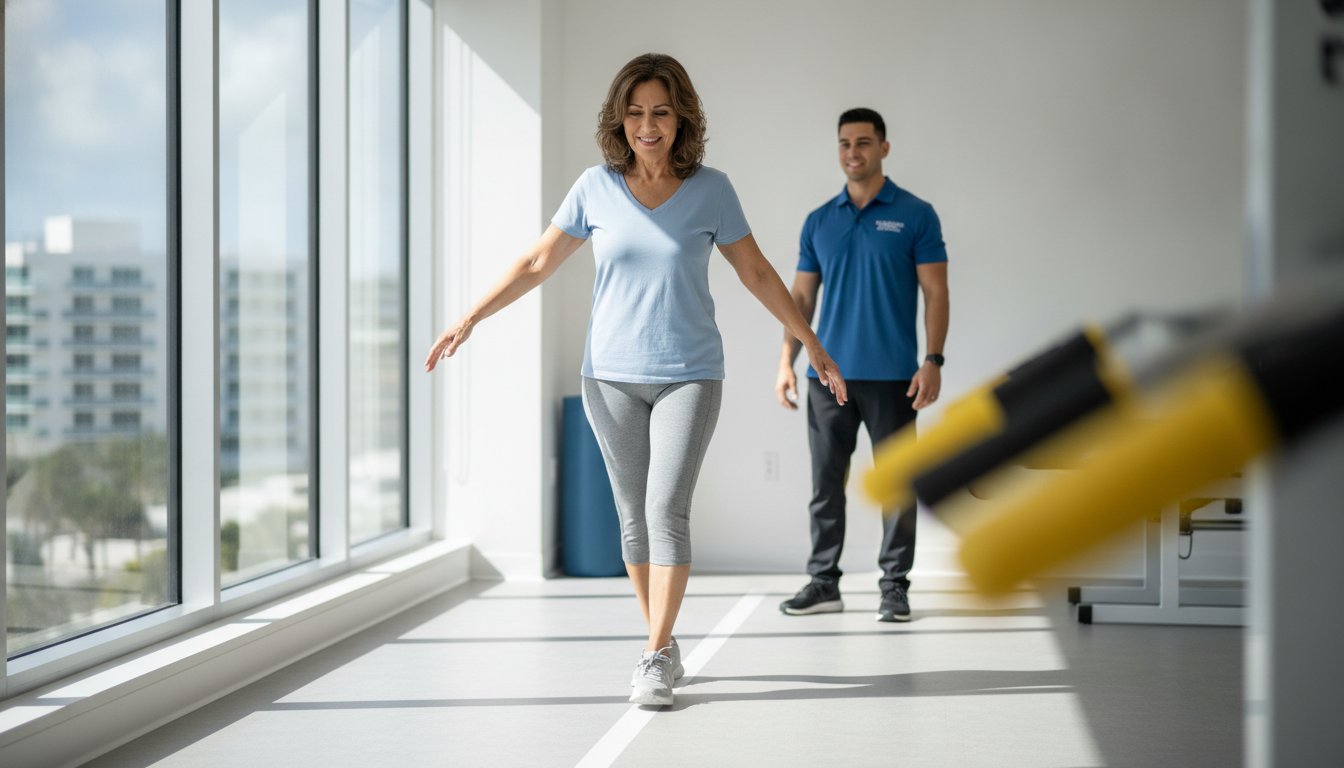
When you’re struggling with the room-spinning sensations of vestibular neuritis, your first instinct is likely to stay as still as possible. However, the path to true stability often requires doing the exact opposite. Resting in a dark room might offer temporary relief, but it can actually delay your brain’s ability to recalibrate. It’s completely natural to feel frustrated by the slow pace of natural healing or to feel a sense of dread about losing your balance in public.
We understand how exhausting this journey is, and we’re here to act as your dedicated guide. By engaging in specialized vestibular neuritis physical therapy, you can proactively retrain your brain to compensate for inner ear imbalances. This active approach focuses on clinical vestibular rehabilitation techniques that move you beyond passive waiting. In this guide, you’ll learn how to eliminate dizziness during head movements and gain the tools needed to walk confidently without support. We’ll outline a clear path toward restoration, helping you understand the timeline for a full recovery and a return to your peak physical health.
Key Takeaways
- Understand how inflammation affects the eighth cranial nerve and why identifying these sudden symptoms is the first step toward reclaiming your stability.
- Explore the science of neural compensation through vestibular neuritis physical therapy, where your brain learns to rely on visual and body cues to restore your balance.
- Gain clear instructions for gaze stabilization exercises that help you maintain a steady field of vision and reduce nausea when you move your head.
- Discover how advanced gait training and postural education work together to help you walk confidently in public spaces without needing constant support.
- Learn why a customized clinical approach at Touch of Health Rehab ensures your recovery plan is tailored to your unique needs rather than a generic template.
Understanding Vestibular Neuritis and the Role of Physical Therapy
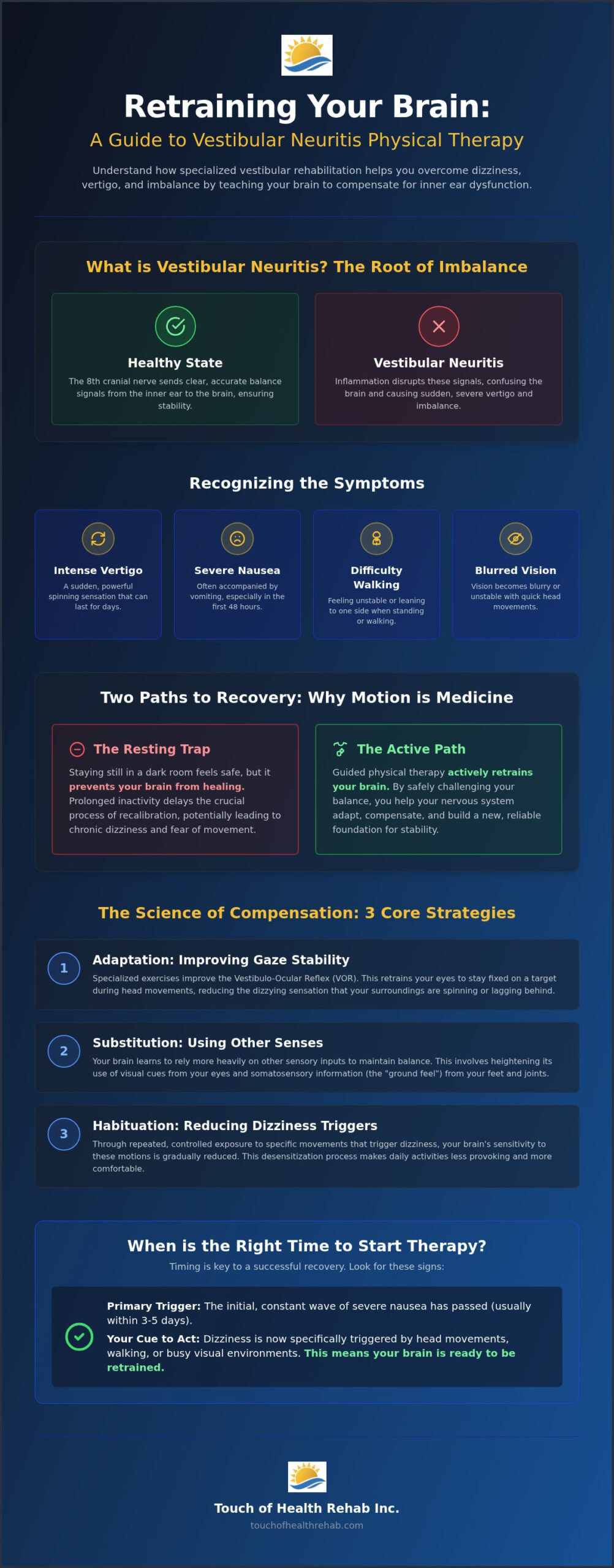
Vestibular neuritis occurs when the eighth cranial nerve, the vital link between your inner ear and your brain, becomes inflamed. This inflammation disrupts the flow of balance information, leaving your brain confused and your body feeling unstable. The onset is typically sudden and dramatic. You might experience intense vertigo, severe nausea, and a frightening sense of imbalance that makes even simple tasks feel overwhelming. It’s a heavy burden to carry, but it is a condition that responds exceptionally well to targeted clinical intervention.
The symptoms of this condition are often unmistakable. You may experience:
- A sudden, intense spinning sensation that lasts for days.
- Severe nausea or vomiting, especially during the first 48 hours.
- Difficulty walking or standing without leaning toward one side.
- Blurred vision when you move your head quickly.
It’s helpful to distinguish this condition from Benign Paroxysmal Positional Vertigo (BPPV). While BPPV involves loose calcium “crystals” in the ear canal, neuritis is a functional disruption of the nerve itself. You can’t simply “shake” the symptoms away with a quick maneuver. Instead, the recovery process requires a dedicated effort to retrain how your brain interprets signals. Engaging in vestibular neuritis physical therapy provides the structured environment your nervous system needs to find its new equilibrium and return you to your daily life with confidence.
Why Motion is Medicine for Your Inner Ear
Many patients unintentionally fall into the “Resting Trap.” When the world is spinning, your natural instinct is to stay perfectly still in a dark, quiet room. While this offers temporary comfort, prolonged inactivity actually prevents your brain from healing. Your brain is incredibly plastic, but it requires movement to recognize that the balance signals it’s receiving are inaccurate. At Touch of Health Rehab Inc., we prioritize movement as the primary tool for recovery because if you stay still, the brain never learns to adjust.
By safely challenging your balance under professional guidance, we help your brain “recalibrate” its internal map. We focus on fostering compensation, which is a key part of the healing process. Vestibular compensation is the brain’s ability to use other senses, such as your vision and the sensation in your feet, to maintain balance when the inner ear is compromised.
When to Start Vestibular Rehabilitation
The transition from the acute phase to the recovery phase is a critical window for your long-term health. Once the initial wave of constant, debilitating nausea passes, usually within three to five days, it’s time to begin. If you notice that your dizziness is now triggered specifically by head movements, walking, or busy environments, your brain is signaling that it’s ready for a challenge. Starting a professional vestibular rehabilitation program early ensures you don’t develop secondary issues like neck stiffness or a persistent fear of falling. We guide you through this process step-by-step, transforming a confusing recovery into a predictable path toward health.
How Inner Ear Balance Rehabilitation Works: The Science of Compensation
Recovery from nerve inflammation is an active neurological process rather than a period of passive waiting. When the vestibular system on one side sends weakened or distorted signals, your brain experiences a sensory mismatch, resulting in the vertigo and instability discussed earlier. The Science of Vestibular Compensation confirms that the brain can recalibrate by prioritizing input from your vision and the sensory receptors in your joints and feet. This neuroplasticity is the core engine behind vestibular neuritis physical therapy, allowing the nervous system to regain its center.
To facilitate this recovery, we utilize three clinical strategies:
- Adaptation: Improving the Vestibulo-Ocular Reflex (VOR) to maintain clear vision during head movement.
- Substitution: Teaching the brain to lean on visual and “ground feel” cues to replace the missing inner ear data.
- Habituation: Gradually desensitizing the brain to specific movements that currently trigger dizziness.
Rewiring these pathways requires precise, repetitive movement. Think of it as establishing a new communication route within the brain; the more frequently the route is used, the more reliable it becomes. By engaging in these controlled challenges, you provide the brain with the “error signals” it needs to recognize and correct its balance calculations.
Adaptation: Training the Nerve
If some nerve function remains after the initial inflammation, adaptation exercises encourage those remaining fibers to work more efficiently. At Touch of Health Rehab Inc., we use provocative movements to stimulate this process. While it may feel counterintuitive to perform actions that cause mild unsteadiness, these exercises are essential for neural growth. A slight increase in dizziness during your session is a clinical indicator that your brain is actively learning to process balance information more effectively.
Habituation: Reducing Sensitivity
Habituation is the process of making “scary” movements feel normal again. If you’ve started avoiding looking up or turning your head quickly, your brain has become hypersensitive to those triggers. Through repeated, gentle exposure, we help your nervous system lower its alarm response. This desensitization is a fundamental component of professional vertigo treatment. If you’re ready to move past these sensory limitations, speaking with a balance specialist at Touch of Health Rehab Inc. can help you identify which specific triggers your brain needs to conquer first.
Step-by-Step Gaze Stabilization Exercises for Vertigo Relief
Gaze stabilization exercises are the cornerstone of vestibular neuritis physical therapy. These movements are designed to strengthen the connection between your eyes and your inner ear, ensuring your vision remains clear even when your head is in motion. Before you begin, safety is the priority. Always perform these exercises while seated in a sturdy chair with your feet flat on the floor. It’s common to feel a temporary increase in symptoms, so having a stable base prevents falls and allows you to focus entirely on the task at hand.
To start, you’ll need a “target.” This is simply a small, clear letter (like an ‘X’ or ‘A’) or a distinct dot written on a sticky note and placed on a wall at eye level. As you exercise, use a dizziness scale from 0 to 10 to track your progress. A “0” means you feel perfectly fine, while a “10” represents severe vertigo. We aim for a “3” or “4” during the session. If your dizziness spikes higher, slow down or take a break. The “little and often” rule is most effective here; practicing for just one or two minutes, several times a day, is better for neural rewiring than one long, exhausting session.
Level 1: VOR x 1 Exercises
The VOR x 1 exercise focuses on keeping your eyes fixed on a stationary target while your head moves. To perform horizontal turns, keep your eyes locked on the letter and slowly rotate your head from left to right, similar to signaling “no.” For vertical nods, move your head up and down as if signaling “yes.” The goal is to move your head as quickly as possible without the letter becoming blurry or appearing to jump. If the target loses its crisp edges, you’ve exceeded your brain’s current processing speed. Slow down slightly until the image is clear again, then gradually build your pace over several days.
Level 2: VOR x 2 and Complex Backgrounds
Once you can move your head rapidly during Level 1 without blurring, it’s time to increase the challenge. In VOR x 2 exercises, you hold the target in your hand at arm’s length. As you move your head to the right, move the target to the left, keeping your eyes pinned to the letter. This opposing motion forces your brain to work much harder to maintain visual stability. You can further advance this by placing your target against a “busy” background, such as a patterned wallpaper or a shelf full of books. This “visual noise” simulates real-world environments like grocery stores. For a deeper understanding of how these movements fit into a complete recovery plan, explore our guide on vestibular rehabilitation exercises for vertigo and how they empower your nervous system to find its center again. When you feel steady while seated, you can begin transitioning these exercises to a standing position to further challenge your balance and gait.
Advanced Balance and Gait Training for Long-Term Recovery
Once you have achieved visual clarity through gaze stabilization, the next phase of your recovery involves integrating your entire body. While your eyes are powerful tools for stability, true recovery from nerve inflammation requires your brain to trust the signals coming from your muscles and joints. This transition from “vision-based” to “body-based” balance is a pivotal moment in vestibular neuritis physical therapy. It moves you beyond simply managing symptoms and toward a full return to your active lifestyle.
During this stage, we place a heavy emphasis on postural education. It’s common for individuals dealing with chronic dizziness to adopt a “protective” posture, such as slouching forward or constantly looking at the ground. While this might feel safer in the moment, it actually limits your body’s natural ability to react to slips or trips. By retraining your posture, we help you stand tall and open up your field of vision, which significantly reduces the fear of falling. This specialized balance and gait rehabilitation ensures that your movements become fluid and instinctive once again.
Static Balance Challenges
We begin by narrowing your base of support to challenge your center of gravity. You might start by standing with your feet touching, then progress to a tandem stance where one foot is directly in front of the other, heel-to-toe. To truly force your brain to use your inner ear and the sensors in your feet, we introduce the “Eyes Closed” challenge. Removing visual input acts as a catalyst for neural adaptation. For an even greater challenge, we may have you stand on foam surfaces. This decreases the reliable feedback from your ankles, leaving your brain with no choice but to recalibrate using the vestibular signals that were previously disrupted.
Dynamic Gait and Walking Exercises
Real-world movement is rarely linear or perfectly still. To prepare you for the busy environments of Sunny Isles Beach, we introduce walking exercises that incorporate head turns. You will practice walking in a straight line while slowly turning your head left to right or nodding up and down. We also utilize “Stop and Turn” drills, which simulate the common real-world experience of hearing someone call your name and needing to pivot quickly. These exercises are vital for preventing falls and ensuring you can navigate crowds or uneven sidewalks with ease. If you are ready to move with precision and grace again, schedule a comprehensive balance assessment with our dedicated team today.
Personalizing Your Vestibular Rehabilitation in Sunny Isles Beach
While the internet offers a wealth of information, a “one-size-fits-all” YouTube exercise plan often fails to address the complexities of your specific condition. Every case of nerve inflammation is unique; the specific movements that help one person might be ineffective or even counterproductive for another. Without a professional clinical assessment, it’s difficult to know if you’re moving too fast or if you’re neglecting the specific sensory inputs your brain needs to prioritize. Your recovery deserves a roadmap tailored to your body’s specific compensatory patterns and healing pace.
At Touch of Health Rehab Inc., we bridge the gap between general advice and clinical results. We integrate your recovery plan with specialized postural education to ensure that as your balance improves, your body alignment supports that new stability. This holistic approach prevents the development of secondary tension in the neck and shoulders, which often occurs when you’re subconsciously bracing against dizziness. By choosing professional vestibular neuritis physical therapy, you’re choosing a partnership that prioritizes your long-term vitality and safety.
The Touch of Health Rehab Inc. Approach to Vertigo
Our philosophy centers on one-on-one sessions where you are the sole focus of our expertise. Led by Lead Physical Therapist Berlin, we don’t just look at the inner ear; we conduct a comprehensive screening to identify other factors that might be contributing to your imbalance, such as cervical stiffness, visual tracking issues, or decreased lower-body strength. We utilize specialized vestibular rehabilitation equipment to provide precise data on your progress. For residents in Sunny Isles Beach, Aventura, and North Miami Beach, this high-end clinical care is available right in your neighborhood, making it easier to stay consistent with your sessions.
Success Stories: From Spinning to Stability
We’ve seen many neighbors in our community transform from feeling trapped by the fear of falling to walking confidently along the beach. Our success stories reflect a deep commitment to individualized care and the belief that a full recovery is a standard, achievable goal. According to clinical guidelines, most patients see significant improvement within 4 to 6 weeks of dedicated therapy. This timeline is a testament to the brain’s incredible ability to adapt when it’s given the right challenges and professional support. If you’re ready to stop the room from spinning and start moving with confidence again, the next step is a comprehensive evaluation to determine the best path forward for your unique journey.
Reclaiming Your Stability and Confidence
Restoring your sense of balance after nerve inflammation is a journey of neural adaptation. By committing to structured exercises and professional guidance, you’re teaching your brain how to navigate the world again. We’ve explored how gaze stabilization and advanced gait training move you from a state of constant spinning to a place of steady, confident movement. Recovery isn’t just about waiting; it’s about the active pursuit of your peak physical health through a collaborative partnership that prioritizes your long-term vitality.
At Touch of Health Rehab, our team is led by Lead Physical Therapist Berlin. We provide a specialized focus on balance and gait rehabilitation that addresses the root of your dizziness, ensuring your vestibular neuritis physical therapy is both safe and effective. Our facility is conveniently located for residents in Miami Beach and Aventura, offering a welcoming sanctuary for healing that’s close to home. You don’t have to navigate this path alone. Schedule your specialized vestibular evaluation at Touch of Health Rehab in Sunny Isles Beach today. We’re here to help you move forward with clarity, confidence, and a renewed sense of stability.
Frequently Asked Questions
How long does physical therapy for vestibular neuritis take?
Supervised therapy typically lasts between 2 and 6 weeks for most unilateral cases. This timeframe allows your brain to effectively develop the new neural pathways required for stability. If your condition is bilateral, meaning it affects both ears, the process may extend to 8 or 12 weeks to ensure a thorough and lasting recovery. We work with you to monitor your progress and adjust your plan as you regain your strength.
Can vestibular neuritis go away on its own without therapy?
While the initial inflammation might eventually settle, the brain frequently fails to fully recalibrate on its own. Without targeted exercises, you may experience long-term unsteadiness or a sense of being “off” during quick movements. Professional therapy ensures your compensation is complete, preventing the development of chronic balance issues that can limit your daily activities and your overall quality of life.
Will vestibular rehabilitation exercises make me feel more dizzy at first?
It’s normal to feel slightly more dizzy when you first begin your exercises. This sensation is actually a positive indicator that your brain is receiving the “error signals” it needs to start the recalibration process. We teach you how to manage these symptoms using a dizziness scale, ensuring the intensity remains within a safe and productive range for your healing and restoration.
How often should I do my inner ear balance exercises at home?
For acute or subacute cases, you should practice your gaze stabilization exercises at least 3 times daily for a total of 12 minutes. If you’re managing a chronic condition, we recommend 3 to 5 sessions per day for at least 20 minutes. Consistency is the key to “rewiring” your system and achieving a return to your peak physical health and daily function.
Is vestibular neuritis the same as labyrinthitis?
No, they are different conditions, even though the vertigo feels similar. Vestibular neuritis specifically affects the nerve responsible for balance. Labyrinthitis, however, involves inflammation of the inner ear’s labyrinth, which typically results in hearing changes or ringing in the ears alongside the spinning sensations. Understanding this distinction helps us create the most accurate and effective plan for your personalized recovery journey.
What happens if I don’t do physical therapy for my inner ear problem?
Skipping vestibular neuritis physical therapy often leads to incomplete recovery and persistent unsteadiness. You may find yourself avoiding social situations or physical activities due to a fear of falling. Additionally, many people develop secondary neck stiffness or headaches as they subconsciously try to keep their head perfectly still to avoid triggering dizzy spells, which can delay your return to vitality.
Can I drive while undergoing vestibular rehabilitation?
You should only resume driving once your therapist confirms that your vision remains stable during quick head turns. In the early stages of recovery, the rapid scanning required for lane changes or intersections can trigger vertigo. We prioritize your safety and will guide you through specific milestones to ensure you feel confident and secure behind the wheel once again.
Does insurance cover vestibular physical therapy in Florida?
Yes, vestibular rehabilitation is a specialized form of physical therapy and is covered by many insurance plans in Florida. Because every policy is unique, it’s a good idea to check with your specific provider regarding co-pays or session limits. Our team is here to help you navigate these details so you can focus entirely on your journey back to stability and confidence.