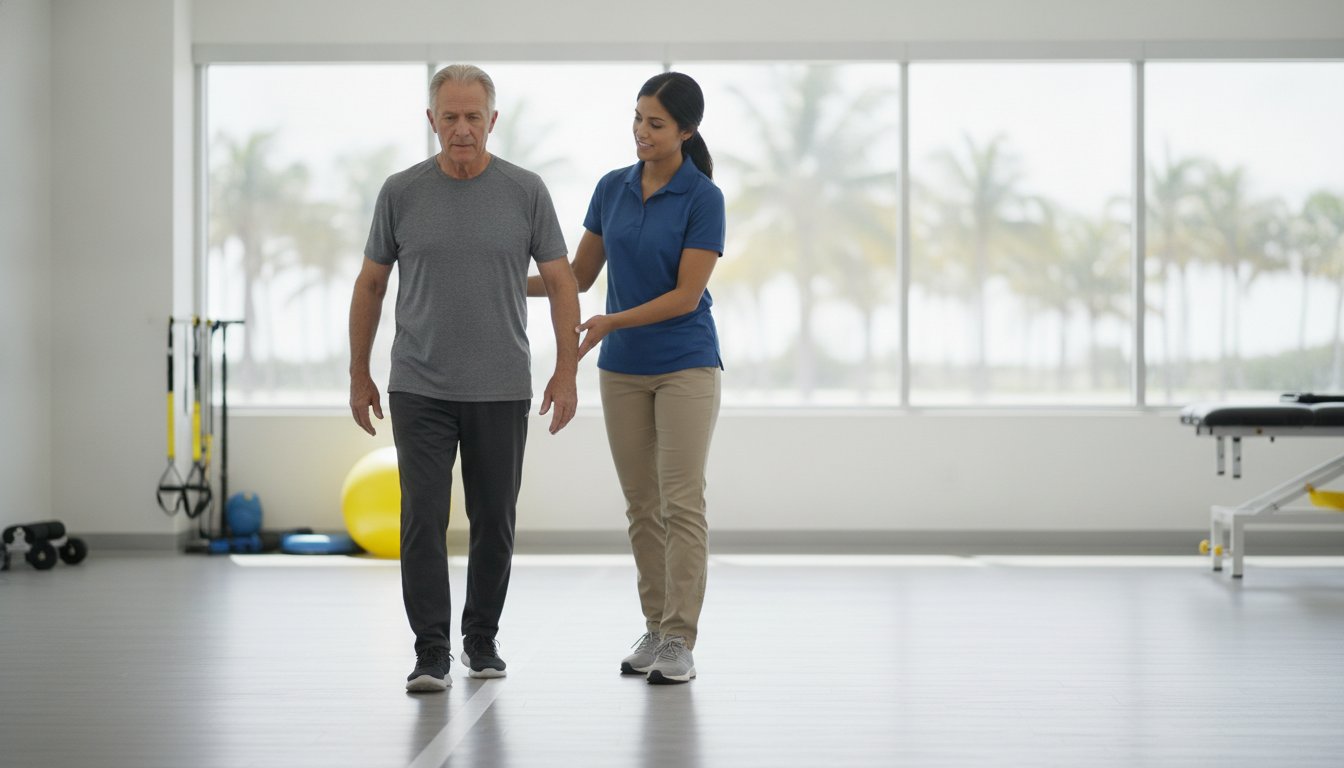
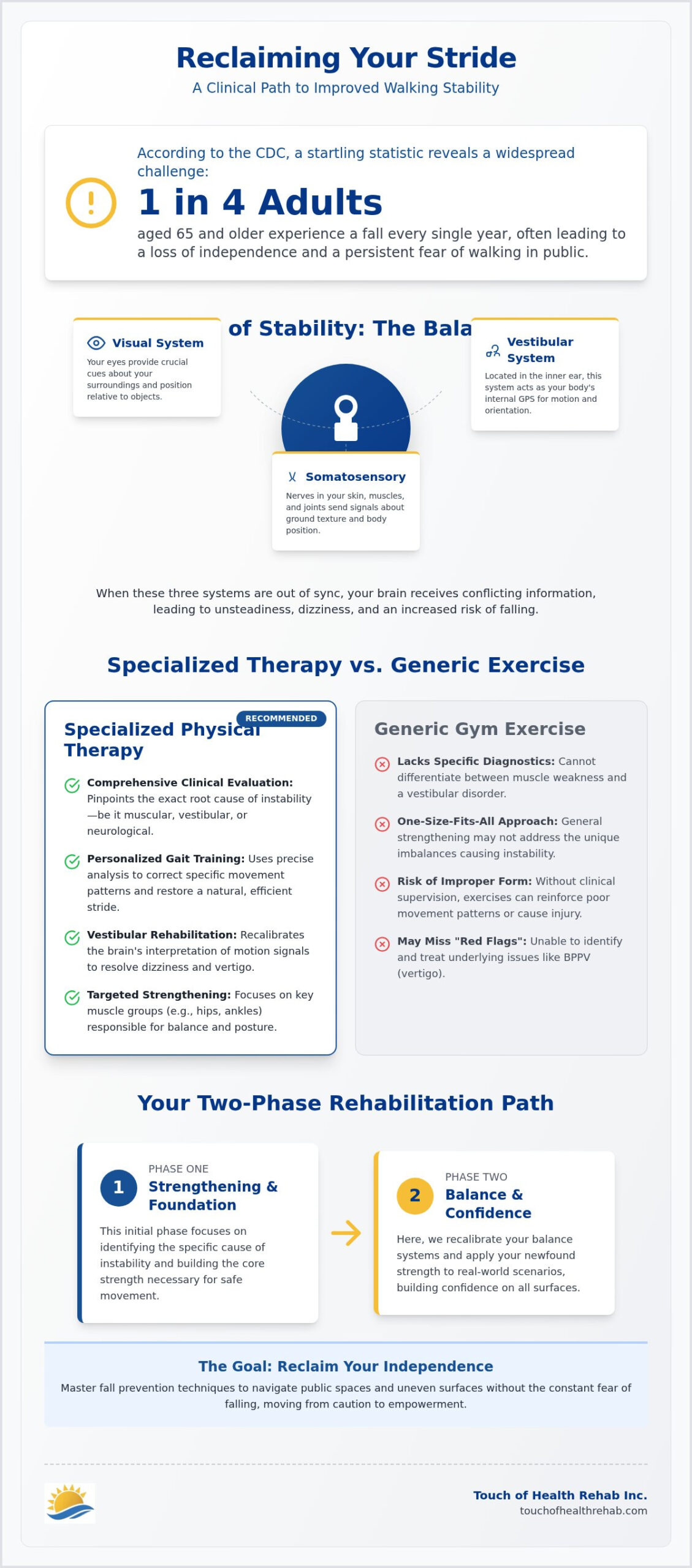
Did you know that according to the CDC, more than one in four adults aged 65 and older experience a fall every year? It’s a startling figure that often leads to a quiet, persistent fear of walking in public or a frustrating loss of independence. You might find yourself wondering if your unsteadiness is just simple muscle weakness or something more complex within your inner ear. If you want to improve walking stability physical therapy Aventura specialists provide a clinical path to help you reclaim your stride. At Touch of Health Rehab, we believe true balance is a sophisticated collaboration between your vision, your vestibular system, and your posture.
It’s natural to feel hesitant when stepping onto the uneven grass at local Aventura parks or navigating a busy sidewalk. We agree that your safety and confidence shouldn’t be left to chance. This guide will show you how targeted interventions help you walk without a cane and finally understand the root cause of your instability. We’ll explore how personalized gait training and vestibular rehabilitation work together to restore your mobility. This journey focuses on your unique needs, ensuring you move from a state of caution to one of empowerment and long-term vitality.
Key Takeaways
- Understand the “Balance Trifecta” and how your visual, vestibular, and somatosensory systems collaborate to keep you upright and moving safely.
- Discover how specialized clinical programs help improve walking stability physical therapy Aventura residents rely on to outperform generic gym exercise routines.
- Learn about the comprehensive clinical evaluation process that identifies whether your instability stems from muscle weakness or a vestibular issue.
- Explore the two-phase rehabilitation path that combines targeted strengthening with balance recalibration to restore your confidence on uneven surfaces.
- Reclaim your independence by mastering fall prevention techniques designed to help you navigate public spaces without the constant fear of falling.
Understanding Walking Instability: Why Your Gait Changes Over Time
Walking stability is more than just staying on your feet; it’s the dynamic ability to maintain an upright posture while your body is in motion. This complex process involves your brain, muscles, and sensory systems working in perfect harmony. When one part of this system falters, your stride changes, often without you realizing it. Understanding the mechanics of human gait is the first step toward reclaiming your confidence. The gait cycle consists of two main phases: the stance phase, where your foot is in contact with the ground, and the swing phase, where it moves through the air. Any disruption in this rhythm can lead to unsteadiness.
Factors like aging, post-surgery weakness, or neurological shifts often trigger these changes. Beyond the physical impact, the emotional weight of feeling unsteady is profound. The fear of falling in public often causes people to stay home more often. This creates a self-fulfilling cycle where inactivity leads to further muscle loss and increased instability. Breaking this cycle requires a clear understanding of what’s happening beneath the surface.
The Hidden Causes of Unsteady Walking
Many people assume unsteadiness is just a part of getting older, but it often stems from specific musculoskeletal imbalances. Weakness in the hips or stiffness in the ankles can force your body to compensate, altering your natural stride. If you’ve had surgery, scar tissue can interfere with joint proprioception, which is your body’s ability to sense its position in space. You might start shuffling to feel safer, but this “compensatory walking” actually increases your risk of tripping over small obstacles. These subtle changes in how you move can accumulate, making every step feel like a challenge.
When to Seek Professional Physical Therapy in Aventura
Recognizing “red flag” symptoms is crucial for your long-term safety. If you experience dizziness while moving, find yourself frequently tripping, or notice you’re leaning to one side, it’s time to take action. Early intervention through specialized balance and gait rehabilitation can prevent secondary injuries like fractures from a fall. To effectively improve walking stability physical therapy Aventura specialists like those at Touch of Health Rehab offer a level of detail you won’t find in a standard doctor’s visit. Our specialized gait analysis uses precise clinical tools to identify exactly where your movement pattern is breaking down, allowing us to build a path back to steady, confident movement.
The Science of Balance: How Vestibular and Postural Health Drive Stability
Your ability to stay upright is a high-speed conversation between three distinct systems. We call this the “Balance Trifecta.” Your eyes provide visual cues about your surroundings. Your feet and joints send somatosensory signals about the ground texture. Finally, your inner ear houses the vestibular system, which acts as your body’s internal GPS. When you attempt to improve walking stability physical therapy Aventura specialists focus on ensuring these three systems speak the same language. If you’re navigating the bustling Aventura Mall or walking along the shimmering intracoastal, your brain must process these signals instantly to prevent a stumble. Without this synergy, even a familiar hallway can feel like a challenge.
Gait and balance disorders often occur when these sensory inputs fall out of sync. This is where vestibular rehabilitation becomes essential. It doesn’t just treat dizziness; it recalibrates how your brain interprets motion. By performing specific, controlled movements, you teach your nervous system to compensate for imbalances. This process moves you away from a state of constant caution toward a life of fluid, natural movement.
The Inner Ear Connection: Vestibular Health and Gait
Vertigo and BPPV (Benign Paroxysmal Positional Vertigo) are common culprits behind a drifting gait. If you feel like the world is spinning when you turn your head, your walking stability is compromised. Clinical exercises retrain the brain to ignore “false” signals from a damaged inner ear. This restoration of function is a key part of our specialized approach to healing. We focus on stabilizing your gaze so that moving your head doesn’t mean losing your footing.
Alignment Matters: Postural Correction for Better Movement
Your posture acts as the foundation for every step you take. Postural education focuses on keeping your center of gravity over your base of support. Many people develop a “forward head posture” from years of looking at phones or computers. This subtle shift moves your weight forward, making you much more prone to stumbles. Proper spinal alignment ensures your legs can move efficiently without unnecessary strain. By correcting these postural habits, you not only walk more steadily but also prevent the chronic back pain that often accompanies a guarded gait. This structural harmony allows you to walk longer distances with significantly less fatigue.
Why Specialized Physical Therapy in Aventura Outperforms Generic Exercise
Many people believe that hitting a local gym or following a generic workout video is enough to fix unsteadiness. While general fitness is valuable, it often misses the neurological nuances required to truly stabilize your gait. Generic exercises focus on raw muscle strength, but clinical gait training prioritizes the sophisticated coordination between your brain and your limbs. To effectively improve walking stability physical therapy Aventura residents choose should offer a level of precision that a standard personal trainer simply can’t provide. Our therapists act as your dedicated guides, ensuring every movement serves your long-term restoration.
When you commit to a personalized physical therapy plan, you’re moving beyond one-size-fits-all routines. We utilize high-end clinical equipment specifically designed for balance disorders, providing a level of feedback that’s impossible to get at home. This professional partnership transforms your recovery from a solo struggle into a collaborative journey toward peak health. You’ll work with experts who understand that your path to healing is as unique as your stride.
Clinic-Based Stability Training vs. At-Home Workouts
At-home workouts offer convenience, but they lack the controlled environment and safety features of a specialized facility. In our clinic, we use specialized gait tracks and professional balance boards that allow you to push your limits without the risk of a fall. Immediate manual feedback from a therapist is critical; we can see the micro-adjustments in your posture that you might not feel yourself. This real-time correction ensures you’re building the right habits rather than reinforcing compensatory movements that could lead to future injury.
Navigating the Aventura Lifestyle: Beach Sand to High-Rise Hallways
Living in South Florida presents unique environmental challenges that require specific training. Walking on the shifting sand of Sunny Isles Beach is vastly different from navigating the polished marble floors of a high-rise condominium. We adapt your therapy to meet these real-world demands. Our program helps you master the “long walk” through the Aventura Mall or the trek from your parking garage to your front door. By simulating these varied surfaces and distances, we prepare you to navigate your community with absolute confidence. You won’t just learn to walk in a clinic; you’ll learn to thrive in the world you live in every day.
What to Expect During Your Balance and Gait Rehabilitation Program
Your path to steady movement is a methodical progression that transforms hesitation into confidence. At Touch of Health Rehab, we guide you through a four-phase clinical journey designed to address the root causes of your unsteadiness. To improve walking stability physical therapy Aventura experts focus on a structured approach that ensures no detail of your movement is overlooked. This collaborative process ensures you aren’t just performing movements; you’re rebuilding the foundation of your independence. Our specialized program to improve walking stability physical therapy Aventura residents rely on moves you from a state of caution to a life of fluid, natural motion.
The program follows a logical flow: we begin with a deep evaluation, move into targeted strengthening, integrate your sensory systems, and finally master functional movements. This step-by-step nature of physical rehabilitation creates a sense of calm and stability, suggesting that your recovery will be handled with thoroughness and care. You are never alone in this process; our therapists act as dedicated guides at every stage.
Step 1: The Clinical Stability Assessment
We begin with a comprehensive clinical stability assessment to understand your unique challenges. We use standardized tools like the “Timed Up and Go” (TUG) test to measure your baseline fall risk. This data is critical, as CDC research indicates that more than one in four adults aged 65 and older fall each year. We evaluate your joint range of motion and core stability while also analyzing your footwear. Often, the wrong shoes can significantly impact your walking pattern without you even realizing it. This initial phase identifies whether your issues stem from muscle weakness, joint stiffness, or a sensory mismatch.
Step 2: Progressive Gait Training Exercises
Once we establish your baseline, we move into progressive gait training. We target the “stability muscles” such as your glutes, calves, and deep core to provide the physical strength needed for a secure stride. We also introduce dual-tasking, which involves walking while performing a secondary task like talking or moving your head. This mimics the real-life distractions you face in busy public spaces. By correcting your stride length and foot placement, we help you develop a more efficient, safer walking pattern. This phase is about retraining your body to move with precision and ease.
As you advance, we incorporate sensory integration and vestibular exercises to sharpen your balance and recalibrate your brain’s response to movement. The final phase involves functional gait training on slopes, stairs, and uneven surfaces. This ensures you’re prepared for the real-world environments of South Florida. If you’re ready to start your journey toward a more secure stride, connect with our team to schedule your clinical evaluation today.
Regaining Independence: Your Path to Confident Movement at Touch of Health Rehab
The journey from feeling hesitant on your feet to mastering fall prevention is one of the most rewarding paths you can take. It’s not just about the physical mechanics of walking; it’s about reclaiming the freedom to move through your world without a second thought. At Touch of Health Rehab, we don’t just treat symptoms. We act as your dedicated partners in recovery, providing a human-centered sanctuary where your well-being is the only priority. When you seek to improve walking stability physical therapy Aventura specialists at our clinic offer a blend of high-end clinical expertise and genuine compassion.
Our team, led by Lead Physical Therapist Berlin, understands that every step toward recovery is a collaborative effort. We’ve seen firsthand how specialized care transforms lives, moving patients from a state of guarded caution to one of vibrant empowerment. By choosing a clinical path rather than a generic exercise routine, you’re investing in a future where your mobility is a source of strength rather than a cause for concern. This commitment to individualized care is what makes our facility a trusted choice for the Aventura community.
A Personalized Approach to Stability
We recognize that your needs are entirely unique to your stage of life. For active seniors, we tailor our geriatric physical therapy plans to focus on the specific balance challenges encountered in daily South Florida living. If you’re currently managing post-surgical rehabilitation for a hip or knee replacement, we focus on restoring joint proprioception and muscle symmetry. This ensures your gait is not only stable but also efficient. By integrating postural education into every session, we help you maintain this structural harmony for years to come, preventing the chronic pain that often stems from a misaligned stride.
Schedule Your Stability Consultation Today
Reclaiming your independence is closer than you think. Our clinic is conveniently located in Sunny Isles Beach, offering easy access and specialized equipment for those looking to improve walking stability physical therapy Aventura residents deserve. When you arrive for your first appointment, bring your favorite walking shoes and a list of your specific goals. We’ll perform a thorough evaluation to uncover the root cause of your unsteadiness and build a plan that fits your life. Remember, you don’t have to accept instability as a natural part of growing older. You can choose a path of restoration and confidence. Reach out today and let’s take that first steady step together.
Step Confidently Into Your Future
Mastering your movement is a collaborative journey that begins with understanding the root cause of your unsteadiness. We’ve explored how your vestibular system and posture work together to keep you upright, and why specialized clinical equipment like balance and gait tracks provides a level of safety you won’t find at home. At Touch of Health Rehab, we offer a human-centered sanctuary for healing where your path to restoration is handled with patience and thoroughness. Led by Lead Physical Therapist Berlin, our team ensures that every exercise moves you closer to a life without the constant fear of falling.
If you’re ready to improve walking stability physical therapy Aventura experts at our facility can provide the clinical evaluation you need to reclaim your stride. You don’t have to navigate this path alone; we’re here to act as your dedicated guides through every phase of recovery. Schedule your stability assessment at Touch of Health Rehab today and rediscover the joy of moving with absolute confidence. Your journey toward peak physical health and long-term vitality starts with one steady step forward.
Frequently Asked Questions
How can physical therapy improve my walking stability?
Physical therapy addresses the specific root causes of your unsteadiness by identifying deficits in your strength, flexibility, or sensory systems. Your therapist uses specialized exercises to retrain your brain and body to work together. By focusing on gait training and sensory integration, we help you develop a more secure stride. This clinical approach allows you to improve walking stability physical therapy Aventura specialists provide through personalized care plans tailored to your unique environment.
How many sessions of gait training will I need to see results?
The number of sessions varies depending on your initial evaluation and specific health goals. Many patients begin to notice a difference in their confidence and movement patterns within six to twelve sessions. We focus on a steady, methodical progression to ensure your results are long-lasting. Your therapist will continuously monitor your progress and adjust your plan to ensure you’re reaching your peak physical health safely and efficiently.
Does insurance cover balance and gait rehabilitation in Florida?
Most insurance plans, including Medicare, cover these services when they’re medically necessary. In 2026, the Medicare Part B deductible is $283, and patients are typically responsible for 20% of the approved amount after that. There’s also a KX modifier threshold of $2,480 for combined physical therapy and speech services. We recommend verifying your specific benefits with your provider to understand your coverage for specialized balance and gait rehabilitation programs.
Can physical therapy help if I have a history of falls?
Yes, physical therapy is highly effective for those with a history of falls. According to the CDC, falling once doubles your chances of falling again, so early intervention is vital. Our fall prevention programs identify why your previous falls occurred and address those specific risks. We work with you to build the strength and coordination needed to navigate your home and the Aventura community with renewed confidence and safety.
What is the difference between balance therapy and regular physical therapy?
While regular physical therapy often focuses on general injury recovery or strength, balance therapy is a specialized subset. It specifically targets the vestibular system, gaze stabilization, and the sensory-motor coordination required for steady movement. This focused approach is essential to improve walking stability physical therapy Aventura residents need for complex environments. It goes beyond simple muscle building to recalibrate how your brain processes balance signals from your eyes and inner ears.
Is walking stability therapy painful?
Walking stability therapy shouldn’t be painful. The focus is on controlled, functional movements that challenge your balance without causing distress. You might experience some mild muscle soreness as you begin to use “stability muscles” that haven’t been active, but this is a natural part of the restoration process. Our therapists act as dedicated guides, ensuring every exercise is performed within your comfort level while still promoting meaningful progression and healing.
Do I need a doctor’s referral for physical therapy in Aventura?
Florida law allows for direct access to physical therapy, meaning you can start your journey without a referral. However, some insurance providers, including Medicare, still require a practitioner’s signature on your plan of care for reimbursement. Recent legislative trends in Florida also aim to expand access to wellness and preventative services. We can help you navigate these requirements during your initial consultation to ensure your path to recovery is seamless and stress-free.
Can vestibular rehab help me walk better even if I don’t have vertigo?
Absolutely. Many walking stability issues stem from subtle vestibular imbalances that don’t cause a spinning sensation. You might simply feel “off” or experience a vague sense of floating while you move. Vestibular rehabilitation recalibrates your internal GPS, helping your brain better understand your body’s position in space. This improvement in spatial orientation leads to a more confident stride and better stability, even if you’ve never experienced traditional vertigo symptoms.