What if the hesitation you feel before every single step isn’t a lack of muscle strength, but a temporary disconnect in how your nervous system perceives stability? When you’re trying to regain confidence walking after injury, the fear of stepping onto uneven pavement or triggering a sudden flare-up can feel paralyzing. You might find yourself limping out of habit, bracing against familiar movements, or wondering whether every slight twinge means you’re doing more damage. It’s an exhausting cycle, and feeling protective of your healing body is entirely natural.
Real recovery happens when you recalibrate your sensory-motor control, not just by forcing muscles to work harder. In this guide, you’ll discover how to overcome movement anxiety, restore joint stability, and master a smooth, natural gait without limping. We’ll map out a clear clinical path to rebuild your balance, safely retire walking aids, and restore complete trust in every step you take.
Key Takeaways
- Learn why walking instability often stems from altered joint mechanoreceptors and protective guarding, rather than simple muscular weakness.
- Follow a clinical five-step progression to regain confidence walking after injury, moving methodically from static weight-bearing to dynamic stride control.
- Master targeted home balance exercises using secure boundaries to safely challenge your stability and eliminate unconscious limping.
- Discover how specialized balance and gait rehabilitation uses precise biomechanical assessments to help you safely transition away from assistive devices.
Understanding Walking Hesitation: Why You Lose Confidence After an Injury
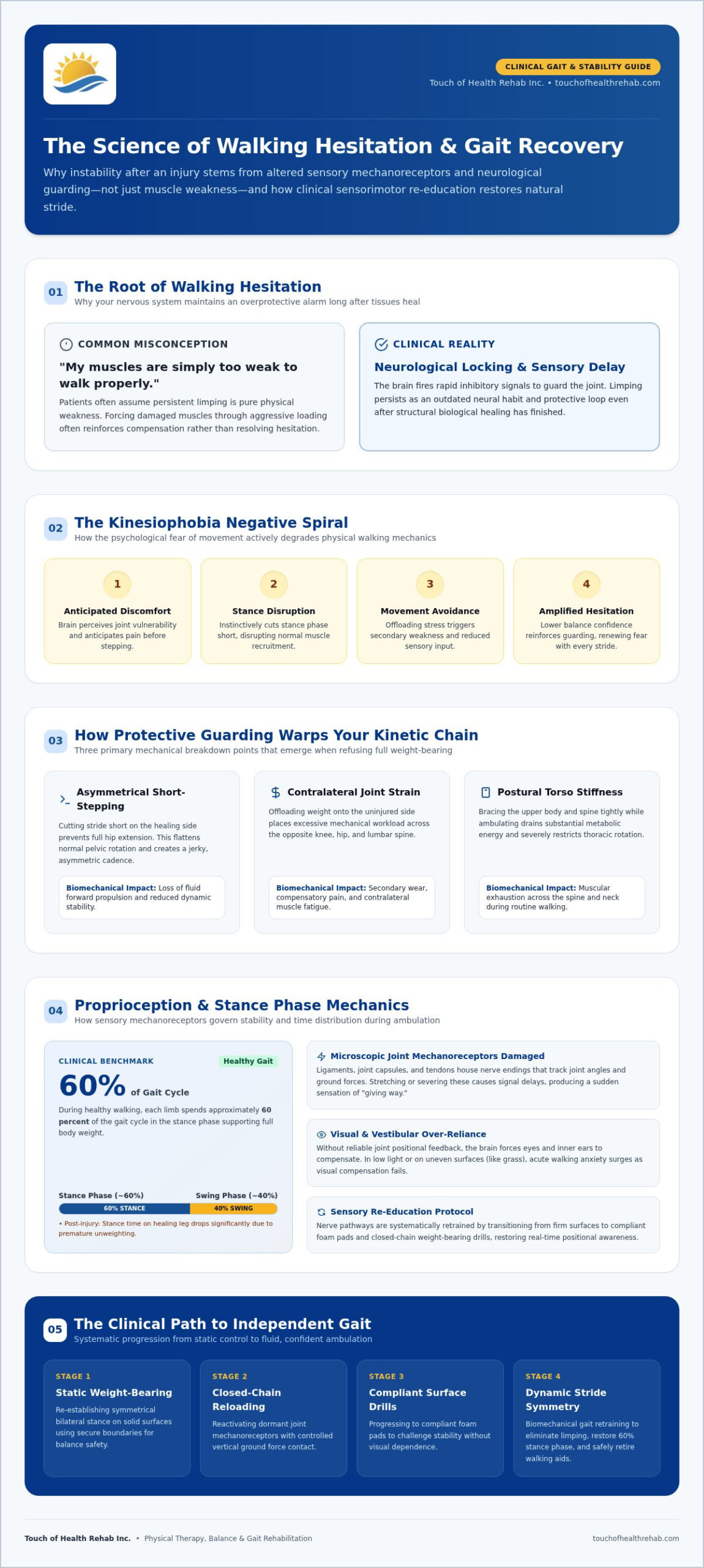
When an ankle twists, a bone fractures, or a surgeon repairs a joint, your central nervous system immediately steps in as an overprotective guardian. To prevent further damage, your brain fires rapid inhibitory signals to surrounding muscle groups, effectively locking down joint mobility. Long after biological tissues knit back together, however, this neurological alarm often stays switched on. Limping frequently persists as a learned neural habit rather than an indicator of ongoing physical damage. To regain confidence walking after injury, you must teach your brain that your body is structurally sound enough to support you again.
The Psychology of Kinesiophobia and Fear of Falling
Kinesiophobia is the debilitating fear of movement resulting from perceived vulnerability. When you anticipate sharp discomfort, your brain instinctively disrupts normal muscle recruitment patterns during the stance phase of walking. This hesitation creates a negative spiral: movement avoidance triggers secondary muscle weakness, which reduces balance confidence and leads to even greater hesitation. Recognizing that your trepidation is a normal, temporary physiological safety net is the first step toward overcoming it. Grounding your recovery in the science of stability helps you understand that cautious steps are simply outdated neural habits, not permanent physical limitations.
How Protective Muscular Guarding Alters the Gait Cycle
Guarding reshapes the way your entire body travels through space. When you refuse to bear full weight on a recovering limb, compensations ripple upward through your kinetic chain:
- Asymmetrical short-stepping: Cutting your stride short on the healing side prevents proper hip extension, flattening your normal pelvic rotation and producing a jerky, uneven cadence.
- Contralateral joint strain: Offloading stress onto your uninjured side places excessive mechanical demand on the opposite knee, hip, and lower back, often causing secondary pain.
- Postural stiffness: Bracing your torso tightly while walking wastes immense energy, creating muscular fatigue across your spine and neck.
Overcoming these guarded movement patterns requires targeted neuro-motor retraining. Through specialized clinical guidance such as balance and gait rehabilitation, you can safely reload your lower extremities, restore natural symmetry, and regain confidence walking after injury step by step.
The Science of Stability: How Injuries Disrupt Proprioception and Balance
Every joint capsule, ligament, and tendon in your body is packed with microscopic sensory mechanoreceptors. These specialized nerve endings act as your internal navigation system, sending constant updates to your brain about joint angles, muscle tension, and foot placement. Following a severe sprain, bone fracture, or joint replacement, these delicate sensors are stretched or severed. Without clear positional signals, your brain is forced to rely on your visual and vestibular systems to stay upright. This explains why walking through dim hallways or over uneven grass can suddenly trigger acute anxiety; when your eyes cannot compensate for missing joint feedback, your body feels unmoored. Truly learning to regain confidence walking after injury requires repairing this internal guidance system.
Sensory Re-Education and Joint Position Sense
Damaged mechanoreceptors communicate with a subtle time delay. When your brain receives delayed positional signals from your ankle or knee, micro-adjustments arrive a fraction of a second too late, creating that unmistakable feeling of “giving way.” Sensory re-education retrains your nerve pathways to register ground forces accurately once again. Targeted exercises, such as progressing from firm surfaces to compliant foam pads or using closed-chain weight-bearing drills, wake up sluggish receptors. When recovering from joint procedures, structured post-surgical rehabilitation accelerates this sensory restoration, while specialized protocols in Clinical Gait Rehabilitation demonstrate how systematic sensorimotor practice restores fluid mobility even after complex trauma.
Identifying Asymmetrical Weight-Bearing Patterns
Proprioceptive deficits almost always lead to noticeable timing differences between your limbs. During healthy ambulation, each leg spends roughly 60 percent of the gait cycle in the stance phase supporting your body weight. After an injury, you might unconsciously rush through this phase, spending only a fraction of that time on the healing side before swinging it forward again. Real-time biofeedback methods, such as force plates and mirrored gait training, help you recognize and correct this hidden avoidance. If you are struggling with persistent balance changes, reading how physical therapy helps with balance provides deeper context on these biomechanical adjustments. Partnering with a dedicated clinical physical therapy team ensures your movement plan targets these subtle asymmetries, allowing you to regain confidence walking after injury with measurable, balanced strides.
5 Progressive Steps to Regain Confidence Walking After Injury
Restoring an effortless, symmetrical stride is not an all-or-nothing milestone. It is a methodical physiological progression that gradually introduces load, recalibrates stability, and rebuilds trust in your body’s structural integrity. Moving systematically through five distinct phases allows you to safely regain confidence walking after injury without provoking inflammation or reigniting guarded hesitation.
Stage 1 to 2: Establishing Static Grounding and Weight Transfer
Before taking fluid steps, your nervous system requires proof that holding your weight is completely safe:
- Stage 1: Bilateral Static Grounding. Stand with your feet hip-width apart while lightly resting both hands on a sturdy countertop. Placing two bathroom scales side by side under each foot provides immediate, objective visual feedback. Practice equalizing the numbers until you can hold a steady 50-50 weight split for 60 seconds without gripping the surface for dear life.
- Stage 2: Multi-Directional Weight Shifting. Once equal standing feels secure, slowly glide your hips side to side, transferring up to 70 percent of your body weight onto the healing leg before shifting back. Progress into gentle anterior-posterior shifts, rocking from your heels to the balls of your feet. These controlled transfers stimulate joint mechanoreceptors safely without overloading healing structures.
Stage 3 to 5: Dynamic Stepping and Real-World Terrains
Transitioning from stationary stability to forward motion requires deliberate biomechanical discipline across three progressive steps:
- Stage 3: Supported Gait Recalibration. Practice walking along an unobstructed hallway with a hand skimming the wall for safety. Focus consciously on clean gait mechanics: a gentle heel-strike, a controlled roll through mid-stance, and an active push-off through the big toe. Integrating postural education keeps your shoulders stacked over your pelvis, preventing the forward hunch that destabilizes your center of mass.
- Stage 4: Supervised Device Weaning. Transition away from canes or walkers only when you meet objective clinical benchmarks: symmetrical step lengths, zero hip dropping, and minimal discomfort during single-leg stance. Wean progressively by practicing unassisted walking inside the home for five-minute intervals before attempting longer community distances.
- Stage 5: Dynamic Community Navigation. True independence means handling unexpected environments. Challenge your stability by stepping over low obstacles, transitioning between plush carpets and hard tile, and practicing walking outdoors on slight inclines.
Mastering these five phases gives you the mechanical stability and peace of mind needed to regain confidence walking after injury for the long term.
Targeted Balance and Gait Drills You Can Practice Safely at Home
Rebuilding your motor control doesn’t require complex gym machinery; it begins with deliberate, consistent micro-challenges in a controlled environment. Performing daily neuromuscular exercises in your own living space strengthens stabilizing muscles and teaches your brain to trust your physical capacity again. By practicing intentional drills in secure positions, you create the repetition your nervous system needs to regain confidence walking after injury.
Static Stance Drills: Narrowing Your Base of Support
Begin by positioning yourself inside the corner of a room or facing a sturdy kitchen counter, placing your hands hovering just an inch above the surface for safety:
- Feet-Together Stance: Stand with your feet touching side by side. Maintain a light fingertip touch on the counter, holding your posture tall for 30 seconds while your ankles make micro-adjustments to keep you centered.
- Semi-Tandem Stance: Slide one foot forward so the heel rests alongside the instep of the opposite foot. Alternate the lead foot every 30 seconds to stimulate stabilizing ligaments on both sides.
- Single-Leg Progression: Advance to standing on your injured leg alone only after bilateral stances are completely pain-free and steady for several consecutive days.
Dynamic Stepping and Functional Cadence Drills
Static balance provides the base, but walking requires fluid weight transfers. Practice slow, controlled marching in place while keeping an arm’s length from a wall. Raising each thigh toward hip height retrains dormant hip flexors and restores the foot clearance necessary to eliminate toe-dragging. Pair this with lateral side-stepping along your kitchen counter. Moving sideways directly activates your gluteus medius, the primary pelvic stabilizer that prevents your hip from dropping during forward strides. If you feel unsteadiness or dizziness during these drills, engaging in professional fall prevention therapy provides the supervised guidance needed to advance safely.
Setting Up an Injury-Safe Home Walking Environment
Creating a low-risk recovery zone at home dramatically reduces psychological stress during practice. Remove loose throw rugs, tuck away trailing cords, and install bright nightlights in hallways and bathrooms. Always wear supportive, closed-toe athletic shoes with non-slip rubber soles rather than socks or slippers, giving your feet tactile stability and proper arch support. Positioning sturdy chairs as resting checkpoints along longer hallways eliminates fatigue-induced anxiety. If you are ready to take your recovery further, you can schedule a personalized mobility evaluation with our licensed therapists to regain confidence walking after injury on your own terms.
Clinical Gait Rehabilitation: How Professional Physical Therapy Restores Independence
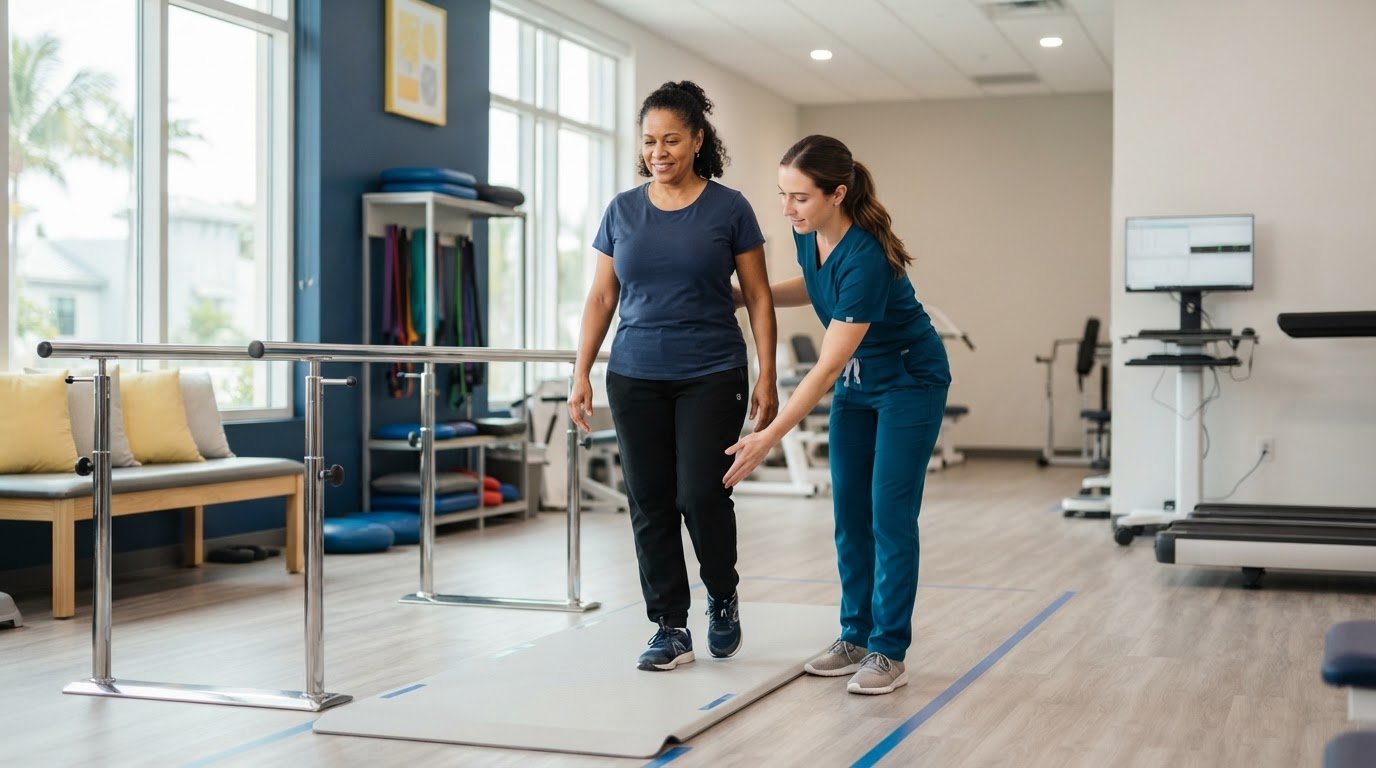
Home drills build routine, but clinical rehabilitation provides the diagnostic precision and secure environment needed to unlock full mobility. Physical therapists examine your movement beyond basic visual checks, utilizing parallel bars, support harnesses, and objective movement tracking to identify hidden deficits. When joint restrictions limit your range of motion, hands-on manual therapy mobilizes stiff capsules and tight soft tissue, allowing your joints to move freely. This focused clinical guidance ensures you regain confidence walking after injury with measurable, lasting progress.
Objective Clinical Gait Analysis and Targeted Correction
Subtle movement compensations often go unnoticed on your own. You might hike your hip to clear your toes or push off early to protect a tender joint. Precision matters. A licensed physical therapist spots these silent habits immediately. Sensor-based movement tracking and video gait analysis pinpoint exact timing discrepancies between your limbs. Inside the safety of parallel bars, clinicians use real-time verbal and visual biofeedback to help you align your posture, lengthen your stride, and eliminate protective limping. Comprehensive balance and gait rehabilitation retrains your neuromuscular pathways, restoring the natural rhythm of every step.
Regaining Freedom in Sunny Isles Beach and South Florida
True physical recovery extends far beyond clinical flooring. Living an active life requires stepping comfortably across varied surfaces, navigating busy crosswalks, and strolling along coastal boardwalks. At Touch of Health Rehab, our licensed movement specialists design individualized, one-on-one treatment programs for residents throughout Sunny Isles Beach, Aventura, Bal Harbour, and North Miami Beach. We prepare your body for real-world demands by systematically bridging the gap between indoor stability and outdoor confidence. Fear fades as your balance solidifies. You can schedule a specialized gait assessment with our dedicated team to regain confidence walking after injury and return to the coastal lifestyle you enjoy.
Restoring Trust in Every Step You Take
Overcoming walking hesitation is never just about muscle strength; it requires retraining the vital sensory communication between your joints and brain. By understanding protective guarding, practicing structured balance progressions, and allowing your body to adapt gradually to full weight-bearing, you can dismantle movement anxiety. True mobility returns when your sensory-motor system and your mindset align. With patience, consistent practice, and proper biomechanical cues, you can eliminate limping and regain confidence walking after injury.
You don’t have to navigate this journey alone. Located in Sunny Isles Beach and conveniently serving Aventura, Bal Harbour, and North Miami Beach, Touch of Health Rehab delivers specialized balance, vestibular, and post-surgical physical rehabilitation. Our licensed clinicians provide dedicated one-on-one care centered on long-term fall prevention and effortless community mobility. When you’re ready to reclaim your stride and step forward without fear, schedule your comprehensive balance and gait assessment with Touch of Health Rehab today.
Frequently Asked Questions
How long does it typically take to regain confidence walking after an injury?
Most patients regain confidence walking after injury within six to twelve weeks of consistent neuromuscular and balance retraining. Simple sprains may resolve faster, whereas complex fractures or post-surgical joint reconstructions often require several months of gradual progression. The timeline depends heavily on restoring joint mechanoreceptor signaling and systematically reducing protective guarding rather than simply waiting for calendar weeks to pass.
Is it normal to limp even after the doctor says my injury has fully healed?
Yes, persistent limping is entirely normal because movement guarding often outlasts tissue repair. When pain resolves, your central nervous system frequently maintains a learned avoidance pattern to protect the limb from perceived vulnerability. Retraining this movement pattern requires conscious gait cues, equal weight distribution drills, and sensory-motor exercises to convince your brain that bearing full weight is structurally safe once again.
What should I do if I experience sudden anxiety or dizziness while walking?
Pause immediately and rest your hand on a sturdy support or sit down safely. Focus your vision on a stationary focal point directly ahead while taking slow, diaphragmatic breaths to downregulate your nervous system. If dizziness accompanies your walking hesitation, it may indicate inner ear involvement. A specialized vestibular rehabilitation evaluation can determine whether your balance challenges stem from sensory mismatch rather than musculoskeletal weakness.
How do I know when it is safe to stop using my cane or walker?
You are ready to transition away from assistive devices when you can bear equal weight without pain, maintain steady single-leg balance, and walk without dropping your hip. Relying on an assistive device too long reinforces asymmetrical gait habits, but discarding it prematurely increases fall risks. A licensed physical therapist should evaluate your cadence and stability before you retire your device permanently.
Can physical therapy help if I have had an altered walking gait for months?
Yes, physical therapy can successfully retrain an altered gait even months or years after your initial trauma. The brain retains neuroplasticity, allowing you to unlearn compensatory habits like hip hiking or shortened stride length. Through targeted balance and gait rehabilitation, licensed therapists use biofeedback and joint mobilization to correct persistent biomechanical imbalances and help you regain confidence walking after injury.
What is the difference between general walking exercise and clinical gait training?
General walking simply involves moving forward, which often reinforces abnormal limping mechanics and muscular compensations. Clinical gait training, by contrast, is a structured medical intervention led by licensed movement specialists. It incorporates comprehensive biomechanical gait analysis, targeted manual therapy to restore joint play, parallel bars for safe balance loading, and specific biofeedback to re-establish symmetrical, energy-efficient movement patterns.
How do I prevent swelling and joint stiffness after practicing walking drills?
Manage post-exercise joint stiffness by elevating the limb above heart level and applying cold packs for 15 to 20 minutes following your session. Incorporating gentle, active range-of-motion exercises, such as ankle pumps or seated knee flexions, promotes lymphatic drainage without overloading recovering tissues. If swelling or soreness lingers past 24 hours, reduce your walking drill intensity during your next session.