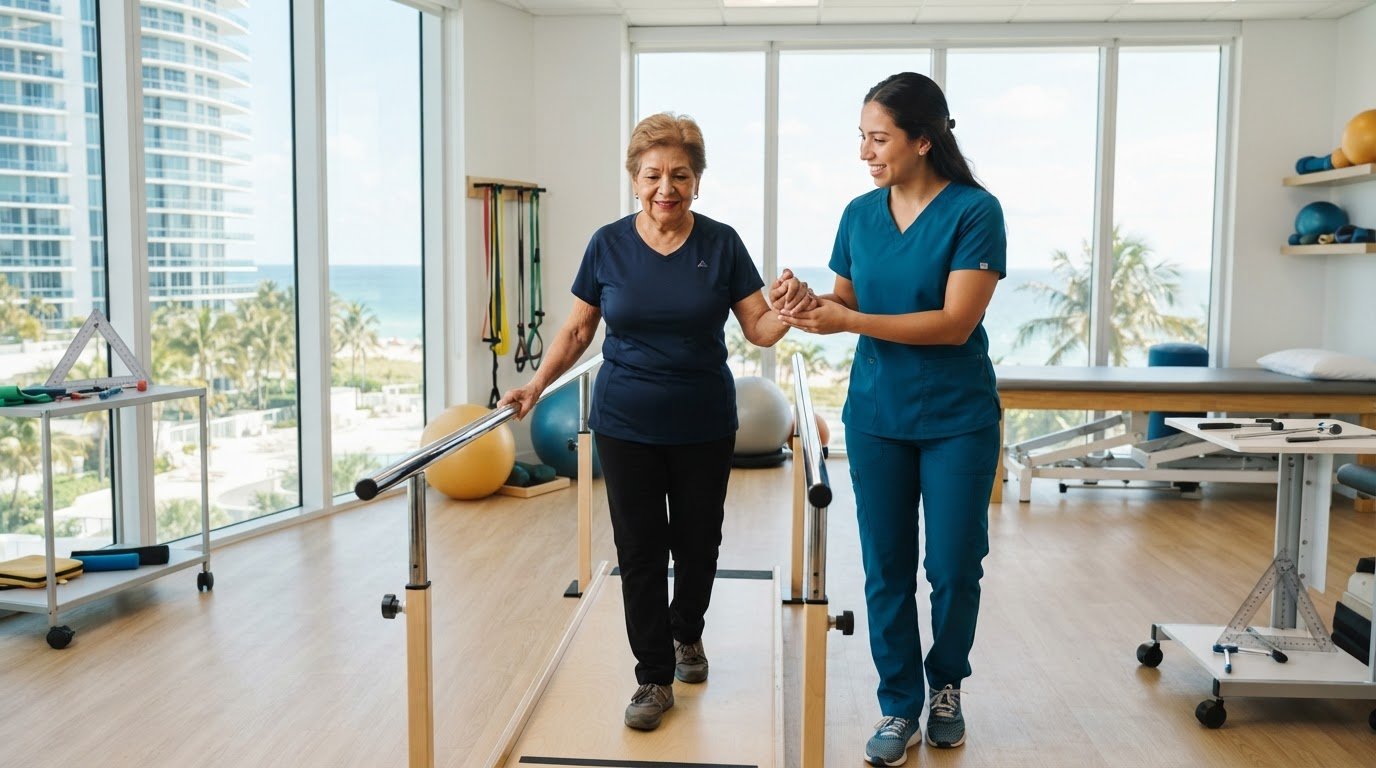
What if balance loss isn’t an inevitable symptom of aging, but a treatable signal that your body’s neurological equilibrium needs recalibration? When sudden unsteadiness catches you off guard or progressive leg weakness slows your walking pace, it’s completely natural to fear a catastrophic injury or the loss of personal independence. Specialized fall risk reduction therapy provides a reassuring, clinical solution, approaching stability not as a permanent decline, but as a responsive physical system that can be retrained, strengthened, and restored.
You shouldn’t have to plan your day around fear, hesitate at thresholds, or accept restrictive mobility aids as your only path forward. Discover how specialized fall risk reduction therapy targets vestibular, muscular, and postural deficits to keep you steady on your feet. Ahead, we examine objective clinical assessments and scoring systems, outline proven therapeutic exercises that rebuild physical stability, and guide you toward walking with lasting confidence throughout your daily life.
Key Takeaways
- Discover how standardized clinical assessments evaluate sensory, vestibular, and muscular deficits to identify subtle instability before a fall occurs.
- Learn how personalized fall risk reduction therapy retrains reactive postural reflexes and improves gait mechanics to restore your balance.
- Explore targeted vestibular exercises and postural education techniques designed to overcome sudden dizziness and boost walking stamina.
- Identify practical environmental adjustments and lifestyle strategies that remove hidden tripping hazards throughout your living spaces.
- Understand how dedicated outpatient physical therapy helps you rebuild lasting functional mobility and walk with steady confidence.
Understanding Fall Risk: Why Balance Changes as We Age
In clinical terms, fall risk reduction therapy restores physical stability through targeted motor learning, neuromuscular re-education, and musculoskeletal conditioning. Across the country, complications stemming from falls in older adults remain a leading cause of emergency care visits and sudden loss of personal independence. Upright balance isn’t an automatic constant; it relies on continuous, real-time coordination between sensory inputs and motor responses. Age-related instability is a treatable physical condition rather than an inevitable consequence of growing older. When you understand how your internal systems process spatial orientation, you can actively reverse functional decline.
The Tri-System Sensory Model of Human Stability
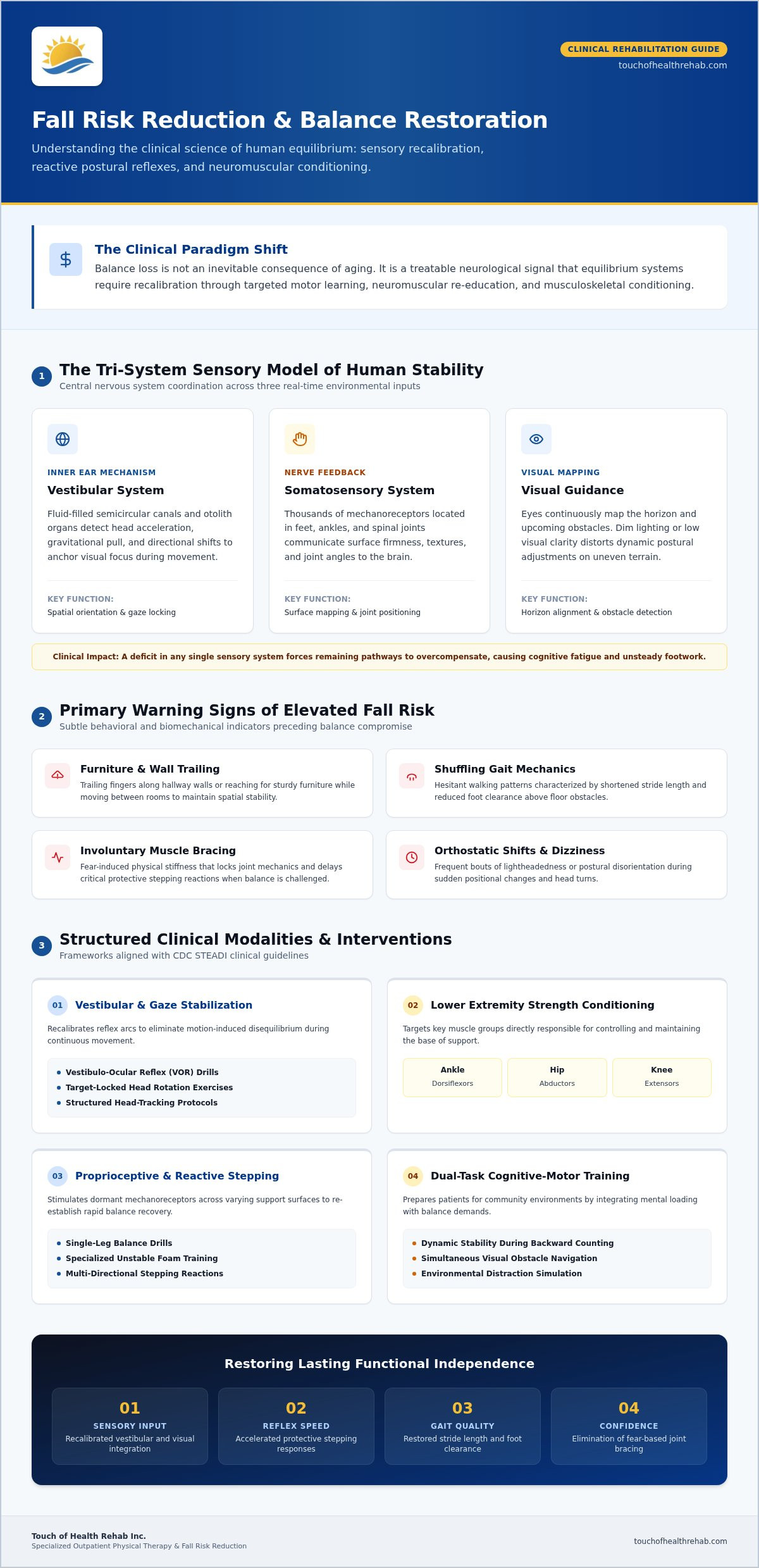
Your central nervous system manages equilibrium through three coordinated sensory streams that process environmental data simultaneously:
- Vestibular Inner Ear Mechanism: Fluid-filled semicircular canals and otolith organs detect head acceleration, gravitational pull, and directional shifts, anchoring your visual focus during movement.
- Somatosensory Nerve Feedback: Thousands of mechanoreceptors in your feet, ankles, and spinal joints communicate surface firmness, texture, and joint angles directly to your spinal cord and brain.
- Visual Guidance: Your eyes map the surrounding horizon and upcoming obstacles. When visual clarity dims, an over-reliance on sight distorts dynamic postural adjustments, particularly in dimly lit rooms or across uneven terrain.
A deficit in any single system forces the remaining pathways to overcompensate, creating cognitive fatigue and unsteady footwork.
Primary Warning Signs of Elevated Fall Risk
Balance compromises often announce themselves quietly long before an unexpected stumble occurs. You might catch yourself trailing fingers along hallway walls or reaching for sturdy furniture while moving between rooms. During outdoor walks, this insecurity frequently emerges as a hesitant, shuffling gait characterized by shortened stride length and reduced foot clearance.
Persistent bouts of lightheadedness, orthostatic shifts, or a growing fear of falling also compromise your safety. Anxiety prompts involuntary muscle bracing; this stiffens joint mechanics, delays protective stepping reactions, and paradoxically increases stumble probability. Addressing these subtle indicators through personalized fall prevention therapy empowers you to rebuild functional movement before minor balance lapses turn into serious injuries.
Clinical Modalities in Targeted Fall Risk Reduction Therapy
Skilled physical therapy delivers structured interventions targeting the root sources of balance impairment rather than merely reacting to symptoms. In modern fall risk reduction therapy, clinicians combine progressive muscular force production, reactive postural reflex retraining, and precise head-eye coordination drills. Grounded in proven assessment frameworks like the CDC STEADI clinical guidelines, treatment progressively challenges balance across varying support surfaces, visual conditions, and functional tasks to rebuild physical resilience.
Vestibular and Gaze Stabilization Training
Motion-induced dizziness often traces back to mismatched inner ear signals. Specialized vestibular rehabilitation protocols recalibrate these reflex arcs so you can move smoothly without disequilibrium. Clinicians guide you through vestibulo-ocular reflex drills, training your eyes to lock onto a clear target while your head rotates. By mastering structured head-tracking exercises, you overcome motion disorientation. For deeper clinical context on these exercises, explore how physical therapy helps with balance during complex head turns.
Lower Extremity Strength and Proprioceptive Conditioning
Steady foot placement requires rapid, coordinated muscular recruitment. Clinical conditioning focuses heavily on stabilizing the ankle dorsiflexors, hip abductors, and knee extensor groups, which directly control your base of support. You practice reactive stepping and single-leg balance drills on specialized foam surfaces to stimulate dormant joint mechanoreceptors. Clinicians also introduce dual-task training, which challenges your motor stability while performing cognitive tasks like backward counting, preparing you for everyday community distractions.
Postural Alignment and Dynamic Gait Retraining
Excessive spinal flexion shifts your center of mass forward, amplifying stumble momentum and compromising foot clearance. Corrective postural education restores vertical alignment, ensuring optimal joint loading from your hips to your feet. Clinicians integrate these corrections into comprehensive balance and gait rehabilitation to restore stride symmetry, walking velocity, and push-off power. If you are ready to move past unsteadiness, engaging with specialized outpatient physical therapy provides the dedicated clinical guidance you need to walk with lasting confidence.
Comprehensive Clinical Assessment: What to Expect During Evaluation
Entering a clinical setting for a balance evaluation begins with an in-depth conversation about your daily physical routine and movement history. Your physical therapist reviews prior stumbles, near-misses, subtle dizziness, and potential medication interactions that could influence stability. Therapists systematically isolate specific musculoskeletal deficiencies before developing an individualized care plan tailored to your lifestyle. Objective baseline testing ensures targeted, measurable recovery by replacing subjective guesswork with actionable clinical data. During specialized fall risk reduction therapy, these initial scores establish clear milestones for your rehabilitation journey.
Standardized Functional Balance and Mobility Tests
To quantify your balance under real-world conditions, clinicians guide you through a series of evidence-based functional movement screens:
- Step 1: Timed Up and Go (TUG) Test: You rise from a standard chair, walk three meters at a comfortable pace, turn, and sit back down while your therapist assesses transitional control and movement fluidity.
- Step 2: Berg Balance Scale: Clinicians score 14 static and dynamic tasks, including transfers, standing with eyes closed, reaching forward beyond arm’s length, and pivoting in place.
- Step 3: 4-Stage Balance Test: You progress through four timed foot positions, beginning with feet side-by-side and advancing to a challenging heel-to-toe tandem stance.
- Step 4: Dynamic Gait Index: This protocol evaluates how effectively you adapt your walking pattern while changing speeds, turning your head vertically and horizontally, and stepping over low obstacles.
Biomechanical Posture and Joint Range Examination
Standardized scores reveal functional limitations, but a hands-on physical exam reveals why those limitations exist. Clinicians assess ankle dorsiflexion flexibility, a critical range of motion necessary for safe foot clearance during the swing phase of your stride. Limited ankle mobility often leads to toe scuffing and accidental trips over low rugs or floor thresholds.
Therapists also measure hip and spine extension mobility, confirming that your trunk can naturally sustain an upright center of gravity. Through clinical screening and hands-on postural education, your clinician checks for leg length discrepancies, excessive foot pronation, and uneven weight distribution patterns. Resolving these mechanical restrictions ensures your fall risk reduction therapy builds lasting stability upon a solid, aligned foundation.
Proactive Fall Prevention: Environmental and Lifestyle Adaptations
Skilled physical therapy extends beyond the walls of the clinic into your daily domestic routines and lifestyle habits. Environmental modifications remove physical friction points that overburden compromised sensory or motor pathways. Modifying your home environment transforms living spaces into safe, supportive zones for daily movement. When paired with structured fall risk reduction therapy, these proactive adjustments reinforce neuromuscular gains, ensuring stability translates directly into independent living.
High-Impact Home Modifications to Minimize Hazards
Thoughtful residential adjustments significantly reduce environmental tripping triggers. Focus on these high-yield updates:
- Clear Walking Corridors: Lift unsecured throw rugs, relocate loose electrical cords behind baseboards, and keep main hallway passages free of low-lying clutter.
- Reinforce Wet Environments: Mount dual grab bars into wall studs inside showers and beside commodes, and apply non-skid textured mats across smooth tub surfaces.
- Upgrade Illumination Pathways: Place high-lumen, glare-free nightlights along hallways connecting bedrooms to bathrooms, and install motion-sensor task lighting beside bedside nightstands.
Daily Movement Strategies and Footwear Selection
Footwear directly dictates the quality of somatosensory feedback transmitted from the floor to your central nervous system. Floppy, backless slippers or heavy socks introduce sensory distortion and increase tripping odds. Select supportive, firm-soled shoes built with rigid heel counters and low, beveled heels. These structural elements stabilize the calcaneus, prevent lateral ankle roll, and enhance ground-reaction feedback during stride push-off.
Patience during postural shifts prevents sudden disequilibrium. When rising from a bed or deep armchair, pause in a seated position for five to ten seconds. This mindful transition allows autonomic blood pressure to equilibrate before you initiate forward gait, eliminating dizzy spells caused by orthostatic changes. Exploring specialized fall prevention therapy helps you master these vital transitional movement habits under skilled guidance. If you are ready to eliminate household tripping risks and restore lasting balance, schedule a comprehensive consultation with our clinical team today.
Restoring Vitality: Specialized Physical Therapy in South Florida
Rebuilding your balance is a deeply personal journey, but you don’t have to navigate it alone. Outpatient rehabilitation provides the structured, one-on-one clinical guidance required to overcome balance insecurity in a safe, supportive setting. For adults enjoying South Florida’s coastal communities, maintaining functional mobility means protecting your active lifestyle: strolling outdoors, visiting local markets, or moving comfortably through your home. Beginning specialized fall risk reduction therapy early protects your personal freedom, ensuring you stay in command of your daily routine.
A Collaborative Path to Confident, Independent Living
Your recovery begins with an attentive physical evaluation led by a dedicated clinical team. Rather than prescribing generic exercise sheets, skilled therapists listen to your personal goals and craft progressive programs matching your unique physical capacity. At Touch of Health Rehab Inc., therapy blends progressive lower-body conditioning, targeted vestibular retraining, and real-time postural adjustments into a cohesive treatment plan. Every session builds systematically on the last, transforming steady clinical milestones into renewed personal confidence.
Accessible Rehabilitation Across Coastal Miami-Dade
Living along the coast presents distinct movement environments, from slick condominium tile and high storm sill thresholds to uneven curbs and crowded outdoor promenades. Under Florida direct access regulations, you can begin outpatient physical therapy evaluation and care immediately without needing a physician referral for the first 30 days. Located in Sunny Isles Beach, our outpatient clinic proudly serves residents from Aventura, Bal Harbour, North Miami Beach, and Miami Beach.
Through focused geriatric physical therapy, clinicians train you to conquer slick surfaces, sudden elevator stops, and transitional thresholds with steady footwork. Committing to proactive fall risk reduction therapy at Touch of Health Rehab Inc. gives you the physical resilience to navigate your community with lasting stability.
Step Forward into Lasting Balance and Independence
Balance loss isn’t an unavoidable consequence of getting older, but a clear signal that your body’s equilibrium systems need focused retraining. By identifying the root causes of instability through objective assessments, specialized fall risk reduction therapy targets vestibular, muscular, and postural deficits to restore steady footwork. When you combine clinical conditioning with mindful movement and practical environmental adjustments, walking transforms from a source of anxiety back into a confident expression of freedom.
You don’t have to navigate balance concerns alone. At our comprehensive outpatient rehabilitation center in Sunny Isles Beach, our licensed clinical staff delivers personalized, one-on-one physical therapy to resolve complex mobility and gait disorders for residents across South Florida. Reclaim your balance and independence with Touch of Health Rehab, and take your next steps with renewed strength, steady grace, and lasting vitality.
Frequently Asked Questions
Is fall risk reduction therapy only for seniors who have already fallen?
No, fall risk reduction therapy is proactive rather than purely reactive. Many people begin therapy after noticing subtle warning signs, like grabbing hallway walls, feeling unsteady on stairs, or walking more slowly. Starting before a serious tumble protects joint health, builds lower-limb strength, and prevents the loss of personal independence. Taking early action ensures you stay active, confident, and safe in your daily routine.
How long does a typical physical therapy program for fall prevention take?
A typical outpatient course of balance and fall prevention therapy spans six to twelve weeks, with sessions scheduled two to three times per week. Your timeline depends on baseline stability, underlying vestibular or neurological conditions, and personal mobility goals. Throughout treatment, clinicians regularly re-evaluate your functional progress, progressively updating your exercises so you develop durable, lifelong stability at a steady, comfortable pace.
Can inner ear or vertigo issues cause balance problems that therapy can treat?
Yes, inner ear dysfunctions and vertigo frequently disrupt equilibrium and represent a major cause of unsteadiness. When vestibular organs send faulty spatial signals to your brain, you experience dizziness, disorientation, and delayed reflex reactions. Through specialized vestibular rehabilitation and vertigo recovery protocols, physical therapists retrain your gaze stabilization reflexes and sensory processing pathways. This focused intervention directly clears motion sensitivity and restores secure footing.
What should I wear and bring to my initial balance evaluation appointment?
You should wear comfortable, non-restrictive athletic clothing and supportive, closed-toe walking shoes with firm rubber soles. Avoid loose slippers or heavy boots, as therapists need an accurate assessment of your typical gait. Bring your photo identification, insurance cards, an up-to-date list of current prescription medications, and any mobility aids you currently use, such as a cane or walker, for an accurate clinical review.
How do physical therapists test balance safely without risking an actual fall?
Physical therapists maintain complete patient safety by utilizing specialized gait belts, parallel bars, and hands-on guarding techniques throughout every assessment. Clinicians stand immediately beside you during testing to provide continuous physical support if you waver. Every dynamic challenge is calibrated carefully to your current functional tolerance, allowing therapists to measure your true balance thresholds in a controlled, completely secure clinical environment.
Will Medicare or private health insurance cover fall risk reduction therapy?
Yes, Medicare Part B and most private insurance plans cover medically necessary fall risk reduction therapy when delivered by licensed outpatient clinicians. Coverage applies when therapy addresses documented balance impairments, gait instability, or functional mobility limitations. Under Florida direct access rules, you can begin treatment immediately at our Sunny Isles Beach clinic without a physician referral for your initial 30 days of skilled outpatient care.
Can poor posture really increase my risk of tripping or losing balance?
Yes, poor postural alignment significantly increases your risk of tripping by shifting your center of mass forward over your toes. Rounded shoulders and forward head posture limit your visual field and disrupt normal gait biomechanics. This forward shift reduces foot clearance during swing phase, making stumbles over floor thresholds much more likely. Targeted postural education restores spinal alignment, allowing your muscles and joints to stabilize you naturally.