Did you know that approximately 43% of people living with chronic neck pain also struggle with a persistent, disorienting sense of dizziness? If you’ve ever felt “spaced out” or lightheaded simply by turning your head to check traffic, you know how unsettling this “sensory mismatch” can be. You aren’t just dealing with a stiff neck; you’re managing an invisible barrier to your confidence that makes every trip into public feel like a risk. We understand that this floating sensation isn’t just in your head. It’s often rooted in the delicate mechanics of your upper cervical spine.
The good news is that you don’t have to navigate this instability alone. Specialized physical therapy for cervicogenic dizziness offers a proven clinical path to recalibrate your balance and reclaim your vitality. By addressing the root cause of your symptoms through professional manual therapy and targeted vestibular exercises, we can help you move freely again without the fear of a spinning room. This guide explains how specialized care restores the vital connection between your neck and brain, providing you with a clear roadmap to lasting stability and a life lived with total confidence.
Key Takeaways
- Discover how a sensory mismatch between your neck receptors and inner ear creates the disorienting floating sensations you experience daily.
- Understand the vital role your upper cervical spine plays in sending accurate balance and positioning signals to your brain.
- Learn why specialized physical therapy for cervicogenic dizziness provides more effective, lasting relief than attempting DIY exercises alone.
- Explore a comprehensive 4-pillar rehabilitation framework that combines professional manual therapy with advanced sensorimotor training.
- Gain a clear roadmap for recovery through personalized care plans that focus on restoring your stability and long-term confidence.
What is Cervicogenic Dizziness? The Neck-Balance Connection
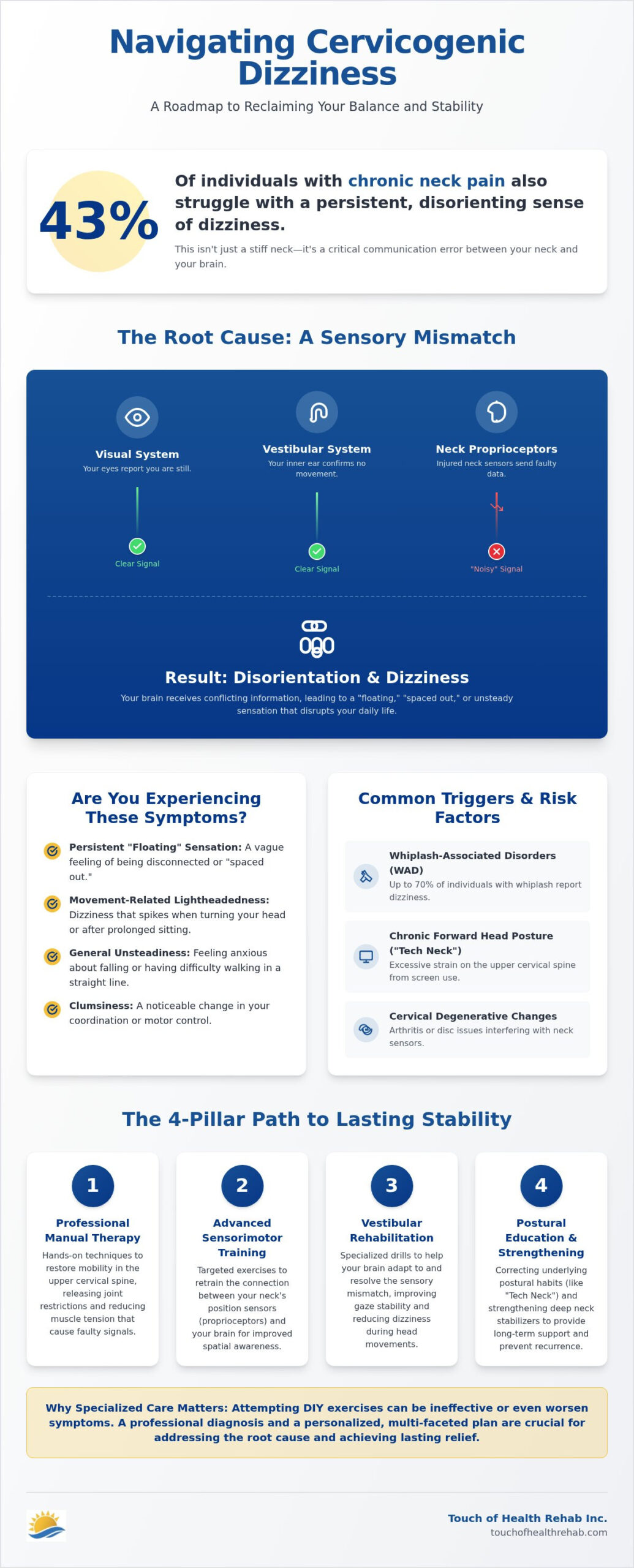
Cervicogenic dizziness (CGD) is a clinical syndrome where you experience a persistent sense of disequilibrium or unsteadiness directly linked to neck pain or stiffness. It isn’t a problem with your inner ear’s hardware or your brain’s processing power. Instead, it’s a communication error. Your brain relies on a “tripod” of information to keep you upright: your eyes, your inner ear, and the proprioceptors (position sensors) in your neck. When your neck muscles or joints are injured or strained, they send “noisy” data to your brain. This creates a sensory mismatch. Your eyes say you’re still, your ears say you’re still, but your neck sends signals suggesting movement. The result is a disorienting sensation that can make you feel disconnected from your environment.
Specialized physical therapy for cervicogenic dizziness is designed to clear this “noise” and restore accurate communication between your body and your brain. It’s vital to distinguish this condition from other balance disorders to ensure you receive the right care. Unlike Benign Paroxysmal Positional Vertigo (BPPV), which causes intense, short bursts of “room-spinning” vertigo, or Meniere’s Disease, which involves hearing loss and ear pressure, CGD is characterized by a more constant, vague sense of instability. Common symptoms include:
- A persistent “floating” or “spaced out” sensation.
- Lightheadedness that isn’t related to blood pressure or fainting.
- A feeling of unsteadiness that makes you anxious about falling in public.
- General clumsiness or difficulty walking in a straight line.
Common Triggers and Risk Factors
Many of our clients find that their symptoms began after a specific trauma or developed gradually due to lifestyle habits. Research shows that up to 70% of people with chronic whiplash-associated disorders (WAD) report some form of dizziness. Chronic forward head posture, often called “Tech Neck,” is another leading cause, as it places excessive strain on the upper cervical spine. Additionally, cervical spondylosis or degenerative disc changes can interfere with the mechanoreceptors in your neck, triggering that familiar sense of imbalance.
How to Identify Neck-Related Dizziness
You can often identify if your neck is the culprit by looking for a direct link between your movements and your symptoms. If your lightheadedness spikes when you turn your head to look over your shoulder or after sitting at a desk for hours, the neck is likely the primary driver. There is usually a strong correlation between the intensity of your neck pain and the degree of your imbalance. By utilizing vestibular rehabilitation and postural education, we help you recalibrate these systems to restore your natural stability.
The Science of Proprioception: How Your Neck Controls Your Balance
Your neck is much more than a simple support structure for your head; it’s a high-precision sensory organ. Within the deep muscles and delicate joints of your upper neck, specifically levels C1 through C3, lies an incredibly dense network of cervical mechanoreceptors. These tiny sensors act like a biological compass, constantly feeding your brain real-time data about where your head is in relation to your body. When you participate in physical therapy for cervicogenic dizziness, we focus on these sensors because they’re the primary source of information your brain uses to interpret visual and vestibular data. If these signals are clear, your balance remains steady. However, when chronic muscle tension or joint stiffness occurs, it “blurs” this information. Your brain receives static instead of a clear signal, leading to that unsettling, “spaced out” feeling.
The Role of the Upper Cervical Spine
The C1 (atlas) and C2 (axis) vertebrae serve as the true balance centers of your spine. Because these two joints allow for the majority of your head’s rotation, they’re packed with more nerve endings than almost any other part of your body. When inflammation or minor mechanical restrictions occur here, your spatial orientation suffers immediately. “When your neck joints send faulty GPS coordinates to your brain, the result is the disorienting fog of cervicogenic dizziness.” This is why Specialized Cervicogenic Dizziness Treatment focuses so heavily on restoring the mechanical integrity of these top two vertebrae to ensure they communicate accurately with your central nervous system.
Postural Alignment and Vestibular Health
Your daily posture directly dictates how well your balance system functions. When you struggle with forward head posture, often caused by prolonged screen use, your center of gravity shifts forward. This forces your upper neck muscles to work overtime just to keep your eyes level. This constant “slumping” doesn’t just cause stiffness; it actively interferes with your vestibular-ocular reflex (VOR). The VOR is the mechanism that keeps your vision stable while your head is in motion. If your neck is out of alignment, this reflex lags, making the world feel like it’s “catching up” to you. By integrating postural education into your recovery plan, we help you reset your physical foundation. Correcting your alignment is often the first, most critical step in achieving long-term relief. If you’re ready to stop feeling “off,” our team can help you restore your natural stability through a personalized care plan.
Physical Therapy for Cervicogenic Dizziness: Manual Therapy vs. Self-Exercise
When you’re searching for relief from constant unsteadiness, you might wonder if you can simply stretch your way back to health at home. While movement is essential, clinical evidence shows that physical therapy for cervicogenic dizziness is most effective when it combines specialized hands-on techniques with targeted movement. Relying solely on DIY exercises often misses the underlying mechanical restrictions that keep your symptoms active. A professional approach ensures that we address the root cause rather than just masking the discomfort.
The Power of Manual Therapy
Manual therapy serves as a vital tool to quiet the “noisy” signals coming from your upper neck. One of the most effective methods we use is the Mulligan “Sustained Natural Apophyseal Glide,” or SNAG. Unlike aggressive “cracking” or high-velocity manipulations, which are often unnecessary and can sometimes be counterproductive for dizziness, SNAGs are gentle, sustained mobilizations. These techniques help restore natural joint gliding in the C1 through C3 segments while you move, effectively “resetting” the feedback loop between your neck and your brain. This process reduces muscle guarding and calms your nervous system, providing a stable foundation for vestibular rehabilitation to take hold. As noted by the Vestibular Disorders Association on CGD, this combination of manual therapy and exercise is the gold standard for restoring spatial orientation.
Why Clinical Guidance Beats YouTube Exercises
It’s easy to find balance exercises on social media, but without a precise diagnosis, these movements can sometimes trigger a flare-up. Every person’s “sensory mismatch” is unique. When you work with a specialized physical therapist, we tailor the intensity of your program to your specific tolerance levels. This personalized oversight is crucial for monitoring “red flags” that a video cannot detect, such as vascular issues or specific neurological deficits that require a different medical path. By choosing physical therapy for cervicogenic dizziness under professional guidance, you ensure that every movement you perform is moving you closer to recovery rather than inadvertently reinforcing your symptoms. We act as your dedicated guides, adjusting your plan in real-time to ensure your journey back to stability is both safe and steady.
Reclaiming Stability: The 4-Pillar Rehabilitation Framework
Recovery from neck-related balance issues isn’t achieved through a single “miracle” stretch. It requires a structured, multi-faceted approach that addresses both your physical alignment and your neurological processing. At Touch of Health Rehab Inc., we utilize a comprehensive 4-pillar framework to ensure your path to recovery is thorough and lasting. This clinical strategy moves you systematically from pain relief to peak performance. By participating in specialized physical therapy for cervicogenic dizziness, you engage with these four critical stages:
- Pillar 1: Manual Therapy. We begin by addressing joint restrictions and muscle guarding in the upper cervical spine to clear the “noisy” signals sent to your brain.
- Pillar 2: Sensorimotor Training. We use specialized exercises to retrain the communication between your neck sensors and your eyes.
- Pillar 3: Balance and Gait Rehabilitation. This stage focuses on restoring your real-world stability, ensuring you feel confident walking on uneven surfaces or in busy environments.
- Pillar 4: Postural Education. We teach you how to maintain optimal alignment during daily activities to prevent your symptoms from returning.
Sensorimotor and Gaze Stability Training
One of the most disorienting aspects of cervicogenic dizziness is the feeling that your vision can’t “keep up” with your head movements. We address this through precision training, often using laser-guided head tracking. By wearing a small, lightweight laser on a headband, you can visualize your neck’s movement accuracy on a target. This biofeedback helps you retrain your eyes to stay steady while your neck moves, effectively recalibrating your internal GPS. Integrating this type of balance therapy into your daily routine allows your brain to trust the signals coming from your body once again.
Strengthening the Deep Neck Flexors
Just as your lower back relies on your “core” for support, your neck has an inner core of deep flexor muscles. When these muscles are weak, the larger, superficial muscles take over, leading to the chronic tension that triggers dizziness. We guide you through simple chin-tuck progressions that activate these vital stabilizers without overstraining your system. As your strength improves, we help you transition from these clinical exercises to more advanced physical conditioning. This progression ensures that your neck remains resilient during sports, work, and the demands of daily life. If you’re ready to build a foundation of lasting stability, schedule your personalized assessment with our expert team today.
Specialized Cervicogenic Dizziness Treatment in Sunny Isles Beach
When you’re dealing with the constant fog of unsteadiness, you need more than a generic exercise sheet; you deserve a clinical partner who understands the complexities of the neck-brain connection. At Touch of Health Rehab, we’ve established ourselves as the South Florida leader in vestibular and cervical rehabilitation by prioritizing accuracy and empathy. Our facility isn’t just a clinic; it’s a sanctuary for healing where your long-term vitality is our primary focus. We believe that every individual’s path to health is unique, which is why our approach to physical therapy for cervicogenic dizziness begins with a deep, personalized assessment.
We don’t leave your recovery to chance. Our evaluation process is designed to rule out other potential causes of dizziness, such as inner ear issues or vestibular migraines, ensuring we target the true source of your symptoms. This thoroughness allows us to create a plan that works in harmony with your body’s needs. We also believe in a collaborative journey, frequently working alongside your ENT or primary care physician to ensure your care is seamless and comprehensive. By bridging the gap between medical diagnosis and physical restoration, we provide you with a clear, stable path forward.
Serving Sunny Isles, Aventura, and Miami Beach
Finding high-end clinical care shouldn’t be a source of stress. We’re proud to serve the vibrant communities of Sunny Isles Beach, Aventura, Miami Beach, North Miami Beach, and Bal Harbor. Local residents trust our team, led by Lead Physical Therapist Berlin, because we provide the one-on-one attention that complex conditions like cervicogenic dizziness require. You won’t be just another number in a crowded room. Instead, you’ll receive the focused, evidence-based care necessary to restore your confidence. If you’ve been searching for comprehensive physical therapy near you, our doors are open to help you reclaim your balance.
Start Your Recovery Today
It’s easy to fall into the trap of “waiting it out,” hoping the lightheadedness will simply disappear. However, early intervention is the most effective way to prevent acute neck issues from becoming chronic balance problems. The longer you wait, the more your brain begins to accept these “noisy” signals as its new normal. We encourage you to move from passive waiting to active healing. Our team is here to act as your dedicated guides, providing the tools and support you need to feel steady on your feet again. We invite you to schedule your personalized evaluation today and take the first step toward a life free from the limitations of dizziness.
Step Into a Steadier, More Confident Future
Living with the persistent fog of unsteadiness can make your world feel unpredictable; however, it doesn’t have to be your permanent reality. You’ve learned how the “sensory mismatch” in your upper cervical spine creates that disorienting floating sensation and why correcting your postural alignment is the foundation of long-term stability. By choosing specialized physical therapy for cervicogenic dizziness, you move beyond temporary fixes and address the mechanical root of your imbalance through a proven clinical framework.
Our team at Touch of Health Rehab provides the specialized vestibular and balance rehabilitation you need to recalibrate your internal GPS. Through expert postural education programs and dedicated one-on-one care in Sunny Isles Beach, we help you transition from feeling “spaced out” to feeling secure in every step. You deserve a recovery path that is as unique as your journey to health. It’s time to stop waiting for the symptoms to fade and start your active path toward a clearer, more vibrant life. Schedule Your Dizziness Recovery Consultation at Touch of Health Rehab and let us help you restore your natural sense of stability today.
Frequently Asked Questions
Can physical therapy really cure dizziness caused by my neck?
Physical therapy for cervicogenic dizziness is highly effective because it resolves the underlying mechanical dysfunction in your upper spine. By restoring joint mobility and calming overactive muscles, we stop the “noisy” signals sent to your brain. This process eliminates the sensory mismatch that causes your lightheadedness. Our patients in Sunny Isles Beach often see a significant reduction in symptoms as we recalibrate the connection between their neck receptors and their visual system.
How many sessions of physical therapy will I need for cervicogenic dizziness?
Most patients require between 6 and 12 sessions to achieve lasting stability, though your specific timeline depends on the severity of your symptoms. We typically recommend two visits per week initially to build momentum in your recovery. During your first evaluation, we’ll create a personalized plan that outlines your path to a dizziness-free life. Every person heals at a different pace; therefore, we adjust your program based on your real-time progress and comfort.
Is it safe to have my neck treated if I feel dizzy?
It’s absolutely safe when performed by a specialized therapist who conducts a thorough clinical screening first. We carefully rule out vascular issues and neurological “red flags” before beginning any manual therapy. Our techniques, such as gentle joint glides, are designed to be comfortable and non-invasive. You aren’t just a patient; you’re a partner in this process. We always work within your tolerance levels to ensure you feel secure and supported during every session.
What is the difference between vertigo and cervicogenic dizziness?
The main difference lies in the sensation and the cause. Vertigo often feels like the room is spinning and is usually tied to inner ear crystals or BPPV. Cervicogenic dizziness feels more like you’re floating, “spaced out,” or unsteady on your feet. While vertigo is a vestibular issue, your neck-related dizziness stems from restricted joints in your upper spine. Understanding this distinction is the first step in choosing the right rehabilitation path for your recovery.
Will I have to do exercises at home as part of my treatment?
Yes, home exercises are a vital component of your recovery journey. These simple, targeted movements reinforce the progress we make during your one-on-one sessions in the clinic. We’ll guide you through sensorimotor drills and gaze stability training that you can easily integrate into your daily routine. Consistent practice helps your brain adapt to new, healthy signals from your neck. This dedication at home ensures that your results are both rapid and permanent.
Can poor posture actually be the main cause of my dizziness?
Poor posture is one of the most frequent triggers for neck-related imbalance. When you struggle with forward head posture or “Tech Neck,” you place immense strain on the upper cervical mechanoreceptors. This constant tension “blurs” the balance signals sent to your brain, leading to persistent lightheadedness. Our postural education programs help you realign your spine. By correcting your daily habits, you remove the primary stressor causing your disorientation and restore your natural center of gravity.
What happens if physical therapy doesn’t resolve my dizziness?
If your symptoms don’t resolve as expected, we don’t stop looking for answers. We maintain a collaborative relationship with local ENTs and primary care doctors to ensure no stone is left unturned. Since dizziness can be complex, we may recommend further testing to rule out vestibular migraines or other underlying conditions. Our goal is your total well-being. We’ll continue to act as your dedicated guide until we find the right clinical path for your specific needs.
Do I need a referral to see a physical therapist for dizziness in Florida?
In Florida, you can benefit from “direct access,” which means you don’t need a physician’s referral to begin physical therapy for the first 30 days of treatment. This allows you to start your recovery in Sunny Isles Beach or Aventura without delay. However, some specific insurance plans still require a referral for reimbursement purposes. We recommend checking with your provider first. Our administrative team is happy to help you navigate these requirements so you can focus on healing.