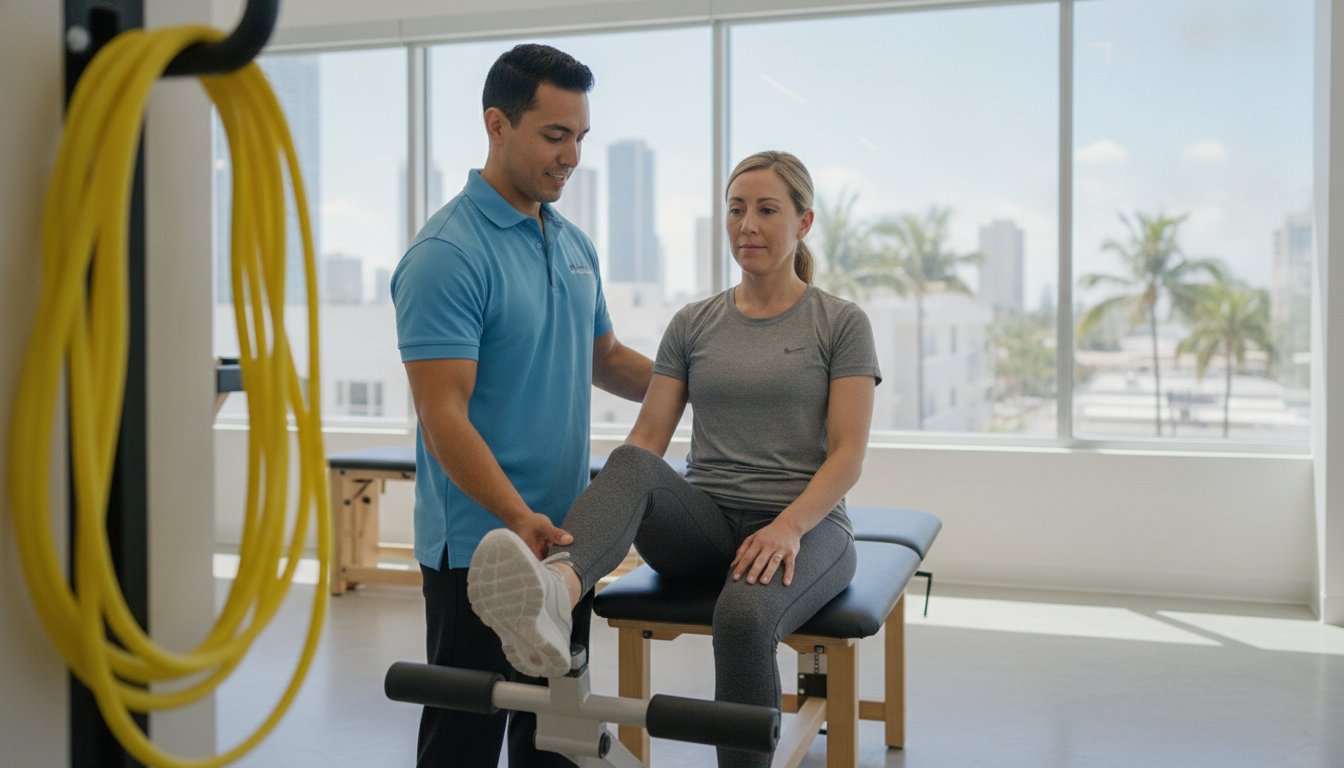
The very couch you’re sitting on to “rest” your injury might be the biggest obstacle standing between you and your recovery. For decades, the standard advice for any sprain or strain was to stay still and wait for the pain to vanish. It’s completely understandable if you feel a surge of anxiety at the thought of moving too soon. You don’t want to risk a setback, and the stiffness that sets in after hours of inactivity only adds to the confusion. You might be hearing one thing from a well-meaning friend and something entirely different from your doctor.
We’re here to provide clarity and compassionate guidance during this uncertain time. You’ll discover why modern clinical research is moving away from total rest in favor of “optimal loading.” This article explains the critical differences between physical therapy vs rest for injury recovery, showing you how a personalized, active approach safely restores your mobility. We’ll provide the scientific justification for starting movement early and offer a clear timeline for your journey back to peak health. By shifting from passive waiting to a collaborative partnership with expert care, you can reclaim your strength and return to the activities you love much faster than you thought possible.
Key Takeaways
- Understand why modern medicine is moving away from total rest to prevent the “Fear-Avoidance Model” that often leads to chronic stiffness and loss of mobility.
- Compare the specific benefits of physical therapy vs rest for injury recovery to see how active movement safely accelerates your return to your favorite daily activities.
- Learn how controlled stress helps your body’s cells turn movement into healing signals, ensuring your new tissue grows back strong and flexible rather than weak and disorganized.
- Identify the specific “green lights” that tell you when it’s time to transition from the couch to the clinic for professional, one-on-one guidance.
- Discover how integrating postural education into your recovery plan helps you maintain long-term health and empowers you to avoid future setbacks.
The Traditional Dilemma: Is ‘Wait and See’ Actually Hurting Your Recovery?
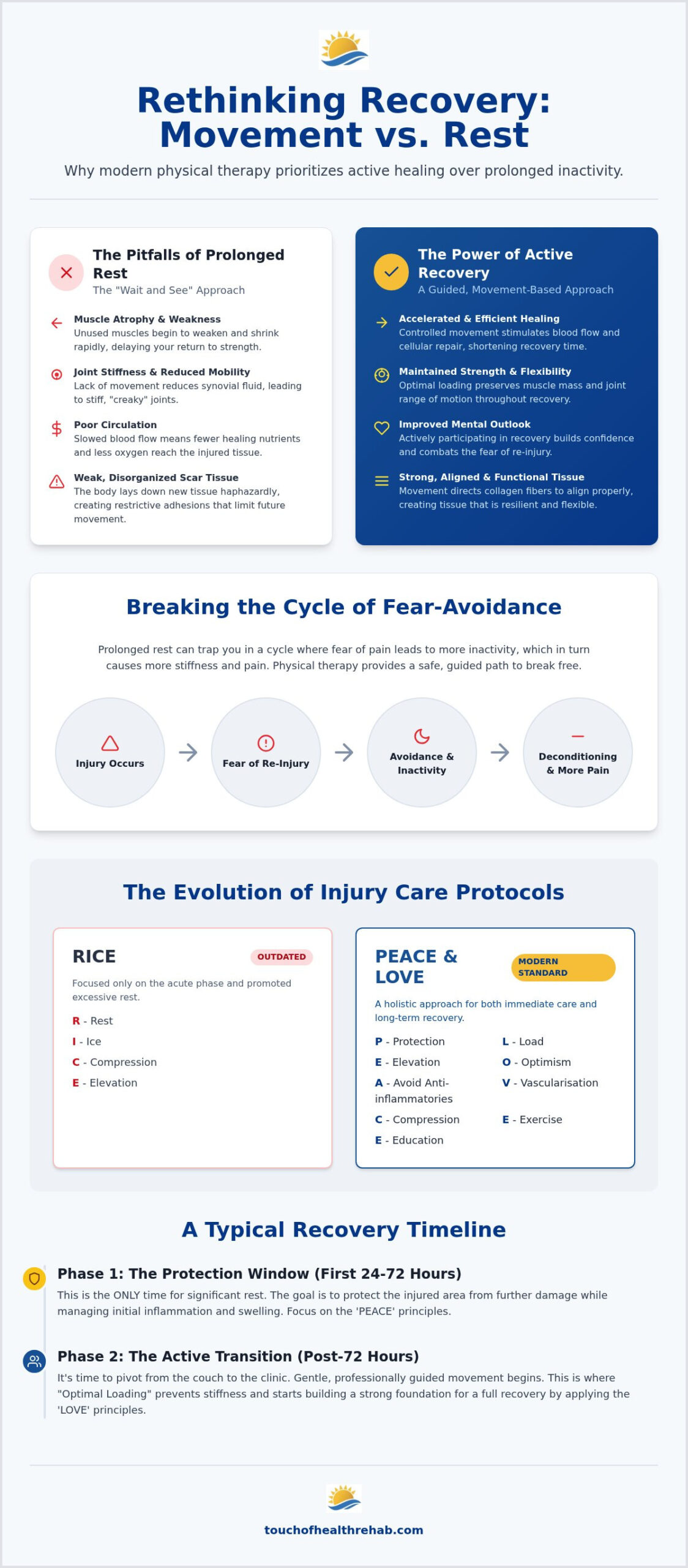
The instinct to stay perfectly still after an injury is deeply rooted in our survival biology. You want to protect the area, avoid any sharp twinges, and let nature take its course. However, when we look at the comparison of physical therapy vs rest for injury recovery, it’s clear that the “wait and see” approach often morphs into a cycle of chronic inactivity. While total rest serves as a necessary tool during the initial moments of trauma, it isn’t a sustainable lifestyle for long-term health. Understanding What is Physical Therapy? helps you see it as a structured bridge between initial protection and a full return to your favorite activities.
Many patients fall into the “Fear-Avoidance Model.” This happens when the fear of re-injury leads you to avoid movement altogether, which ironically makes your body more sensitive to pain. We validate your caution; your body is sending signals for a reason. But without professional guidance, that caution can lead to stiffness that feels permanent. At Touch of Health Rehab Inc., we see ourselves as your dedicated guides, helping you navigate this fear by replacing it with confident, measured progression in our sports injury treatment programs.
Why Rest is the Default (And Where It Fails)
Inflammation is your body’s way of saying “pay attention.” It is a natural signal for temporary protection, but it shouldn’t be a permanent stop sign. In the past, the RICE method (Rest, Ice, Compression, Elevation) was the gold standard for every bump and bruise. Today, clinical protocols have evolved into “PEACE & LOVE,” which prioritize protection and elevation initially, followed by vascularization and exercise. The protection phase should only last 24–72 hours. Beyond this window, absolute rest begins to work against your body’s natural drive to repair itself.
The Hidden Risks of Prolonged Inactivity
Staying in bed or on the couch too long has physical consequences that extend beyond the injury site. Muscles begin to atrophy quickly, and your joints lose the essential “grease” provided by synovial fluid. This lack of movement slows down blood circulation, meaning fewer healing nutrients and oxygen reach the damaged tissue. Additionally, prolonged inactivity can impact your vestibular system and balance stability. When you don’t move, your brain receives fewer signals about where your body is in space, which can make you feel unsteady or dizzy when you finally do try to stand up. Transitioning to active recovery ensures your entire system remains tuned and ready for movement.
The Physiology of Healing: Why Movement is Medicine for Injured Tissue
Healing happens at a microscopic level, but it requires macroscopic action to be truly effective. When we compare physical therapy vs rest for injury recovery, the biological difference lies in a process called mechanotransduction. This is how your cells sense mechanical pressure and translate it into chemical healing signals. Think of your body as a construction site. Rest provides the raw materials, but movement is the foreman directing where the bricks should go. Without this direction, your body might lay down collagen fibers in a disorganized jumble, creating thick, restrictive scar tissue that limits your future range of motion. Active remodeling ensures your new tissue is resilient and functional from the start.
Passive healing relies on the body’s baseline repair speed, which is often slow and prone to complications like joint stiffness. In contrast, physical therapy uses controlled stress to align new collagen fibers along the lines of tension. This structural alignment is what gives your tendons and ligaments their long-term strength. By moving early under professional guidance, you prevent the formation of the messy, restrictive adhesions that often follow prolonged rest. This proactive approach turns your recovery from a period of waiting into a period of active restoration where every session builds a more durable foundation for your body.
Phase 1: Controlled Loading and Tissue Repair
Gentle, purposeful movement does more than just maintain flexibility; it acts as a vital pump for your lymphatic system. Unlike your heart, which pumps blood, the lymphatic system relies on muscle contraction to move fluid and reduce the swelling that often lingers after an injury. This is why “optimal loading” is far superior to total immobilization. By engaging in comprehensive physical therapy, you provide the exact amount of stimulus needed to clear inflammation without risking further damage. It’s a delicate balance that requires the expertise of a dedicated guide to get right, ensuring you don’t stall your progress by doing too much or too little.
Phase 2: Neuromuscular Re-education
An injury doesn’t just affect your tissues; it interrupts the conversation between your brain and your body. After a trauma or surgery, your nervous system often “forgets” how to recruit specific muscles as a protective measure. If you rely solely on rest, this disconnection persists, leading to poor balance and a higher risk of falling. This is particularly true for those recovering from inner ear issues or head trauma, where vestibular rehabilitation becomes essential. We help you recalibrate your sense of space and restore your natural gait, ensuring your mind and body work in harmony once again. If you’re ready to start this collaborative journey toward peak health, our team at Touch of Health Rehab Inc. is here to support you.
Physical Therapy vs. Absolute Rest: A Comparative Framework
When you’re sidelined by a sudden injury, the choice between physical therapy vs rest for injury recovery often feels like a choice between safety and speed. Timing is everything. Absolute rest acts as a protective shield during the initial crisis, but staying on the couch too long creates a secondary set of problems. We often see patients who “rested” their way into chronic back pain because they spent weeks limping and overcompensating with other muscle groups. Relative rest is a far more effective strategy. This involves protecting the specific injury while keeping the rest of your body active, which maintains your overall conditioning and prevents the mental fog that often accompanies total inactivity.
Choosing between physical therapy vs rest for injury recovery is about more than just speed; it’s about the quality of your long-term health. Long-term outcomes tell a clear story. Research consistently shows that those who engage in early, supervised movement have significantly lower re-injury rates than those who rely on passive healing alone. Without strengthening the surrounding structures, the original weak point remains vulnerable. By choosing an active path, you aren’t just healing the current wound; you’re building a more resilient body that’s better equipped for the demands of daily life.
Absolute Rest: The ‘Couch’ Strategy
This approach is best reserved for the “acute” phase of an injury. It provides immediate pain reduction and ensures you don’t accidentally turn a small tear into a complete rupture. There are specific scenarios where absolute rest is non-negotiable, such as stabilized fractures, severe concussions, or the first 24 hours following a major surgical procedure. However, the costs of staying here too long are high. You risk a loss of bone density, joint stiffness, and a noticeable decline in mood. It’s a temporary pit stop, not the destination.
Physical Therapy: The ‘Active’ Strategy
Physical therapy offers a faster return to daily function through professional monitoring and improved circulation. While it requires a greater time commitment and may involve some temporary discomfort during “good” pain, the rewards are immense. You’ll move with confidence knowing an expert is watching your form to prevent setbacks. This is why personalized therapy plans are so vital. Unlike generic YouTube exercises, a custom plan accounts for your unique anatomy and history, ensuring every movement serves your recovery rather than hindering it. Our team acts as your dedicated guide, ensuring you never have to guess if you’re doing too much or too little.
How to Know When to Pivot: From the Couch to the Clinic
When weighing physical therapy vs rest for injury recovery, the most dangerous mindset is believing you must be pain-free before starting rehab. If you wait for total silence from your body, you’ve likely allowed secondary issues like muscle atrophy to take hold. The goal isn’t to wait for the pain to hit zero; it’s to identify the “green lights” that signal your tissue is ready for controlled loading. Understanding the difference between “healing pain” and “injury pain” is essential. Healing pain often feels like a dull ache or a stretching sensation that improves as you warm up. In contrast, injury pain is sharp, stabbing, or electrical, and it serves as a clear signal to scale back.
Identifying these signals allows you to transition from a passive observer to an active participant in your healing. While rest protects you in the short term, professional guidance ensures that your return to movement is both safe and effective. You don’t have to navigate this transition alone; we invite you to schedule a consultation with our team to find your safest path forward.
The 48-Hour Rule for Acute Injuries
The first two days following an injury are truly about protection. During this window, focus on ice, elevation, and very light mobility that doesn’t provoke sharp pain. This is the time to respect the inflammatory process. If your swelling does not subside or the area remains hot to the touch after 48 hours, you should contact our specialists in Sunny Isles Beach to ensure your recovery is on the right track. Once you pass this 48-hour mark, the focus must shift from pure protection to gradual mobilization to prevent the joint from “freezing” or the muscles from weakening.
Signs You Are Resting Too Long
While the couch feels safe, staying there too long creates its own set of complications. You might notice morning stiffness that lasts longer than 30 minutes, or you may see visible muscle wasting in the injured limb compared to the healthy side. Another subtle but significant sign is a growing sense of anxiety about performing simple daily tasks, like walking to the mailbox or reaching for a high shelf. This hesitation often indicates that your nervous system has become overprotective. Transitioning to sports injury treatment helps break this cycle by proving to your brain that movement is safe and beneficial.
The Touch of Health Approach: Personalized Progression in Sunny Isles Beach
At Touch of Health Rehab Inc., we believe that recovery is a collaborative journey rather than a solitary struggle. Our sanctuary for healing in Sunny Isles Beach moves beyond the cold, detached atmosphere of traditional clinics to provide a space where you feel seen, heard, and supported. When you are deciding between physical therapy vs rest for injury recovery, our “Compassionate Expertise” philosophy offers a clear, evidence-based path forward. We prioritize one-on-one care, ensuring that every movement you make is supervised by a professional who understands your unique history. By integrating postural education into your sessions, we don’t just heal the current injury; we empower you with the mechanical knowledge to prevent future setbacks. This holistic focus on long-term wellness is why so many Miami-area residents choose our guided approach over the uncertainty of a solo recovery.
For those navigating the complexities of post-surgical rehabilitation, the stakes are exceptionally high. While we have discussed how resting too long can lead to restrictive scar tissue, moving incorrectly can jeopardize your surgeon’s work. Our local clinical supervision provides the safety net you need to progress with confidence. We understand the delicate balance required to protect your surgical site while gently restoring your function, acting as the bridge between your operation and your return to daily life.
Specialized Care for Complex Recoveries
We specialize in recoveries that require more than just simple stretches or generic advice. Our team handles intricate vestibular and neurological balance training, which is a vital component often overlooked in the standard debate of physical therapy vs rest for injury recovery. Whether you are coming to us from Aventura or Miami Beach for sports injury treatment, we bridge the gap between initial healing and your return to peak performance. For athletes and active individuals looking to push their physical limits, we offer specialized sports conditioning to ensure your body is truly resilient and ready for the specific demands of your lifestyle.
Start Your Journey to Peak Health
Your first evaluation at our Sunny Isles Beach clinic is a methodical, deeply reassuring experience. We begin by acknowledging your specific needs and explaining our personalized approach in detail, ensuring you understand the “why” behind every part of your plan. From there, we build your confidence through small, measurable wins that prove your body is capable of restoration and growth. You don’t have to heal alone; our staff at Touch of Health Rehab Inc. is here to act as your dedicated guides every step of the way. We invite you to experience a process handled with care, patience, and thoroughness, leading you back to the quality of life you deserve.
Reclaiming Your Vitality Through Active Recovery
Choosing between physical therapy vs rest for injury recovery is the first step toward a stronger, more resilient future. We’ve explored how movement acts as a powerful signal for tissue repair, helping you avoid the pitfalls of chronic stiffness and muscle atrophy. While initial rest protects you, professional guidance ensures that your return to activity is both safe and accelerated. You don’t have to navigate the transition from the couch to the clinic alone; our team is here to act as your dedicated partners in healing.
At Touch of Health Rehab, we provide one-on-one sessions with expert therapists and utilize specialized vestibular and post-surgical equipment to meet your unique needs. Conveniently located for residents in Sunny Isles, Aventura, and Miami Beach, our sanctuary for healing is designed to prioritize your long-term vitality. Take the next step in your collaborative journey by visiting us today. Schedule Your Personalized Recovery Consultation in Sunny Isles Beach and begin your path back to peak health. Your body is built for movement, and with the right support, you can return to the life you love with absolute confidence.
Frequently Asked Questions
Is it better to rest or do physical therapy for a pulled muscle?
Initial rest for 24 to 48 hours is vital to manage inflammation, but early physical therapy significantly speeds up the remodeling of muscle fibers. A guided approach prevents the muscle from healing in a shortened, stiff position. By transitioning to active care, you ensure the new tissue is both strong and flexible, which reduces the risk of pulling that same muscle again during your next workout or daily activity.
Can physical therapy make an injury worse if I start too soon?
While jumping into intense exercise alone can cause setbacks, professional physical therapy is designed to prevent re-injury through “optimal loading.” We use clinical assessments to determine exactly how much stress your tissue can handle without damage. Starting early under expert supervision actually protects the injury by maintaining joint lubrication and preventing the compensatory movements that often lead to secondary pain in other areas of your body.
How long should I rest before starting physical therapy after surgery?
Most post-surgical protocols recommend starting very gentle physical therapy within 24 to 72 hours to prevent blood clots and joint stiffness. While you must follow your surgeon’s specific weight-bearing restrictions, early movement is essential for a successful outcome. We coordinate closely with your medical team to ensure your progression is safe, focusing on circulation and light mobility before moving toward more demanding strengthening exercises in our clinic.
What happens if I only rest and never do physical therapy?
Relying solely on rest often leads to incomplete healing, characterized by weak scar tissue and reduced range of motion. When comparing physical therapy vs rest for injury recovery, those who only rest frequently experience recurrent injuries because the underlying weakness was never addressed. Without active rehabilitation, your body may develop permanent compensations, such as a limp or altered posture, which can eventually cause pain in your back or hips.
Should I do physical therapy if I am still in pain?
Yes, physical therapy is often the most effective way to reduce persistent pain. We use specialized techniques to desensitize your nervous system and improve blood flow to the injured area. You don’t need to wait for your pain to reach zero before starting; in fact, movement is often the catalyst that finally breaks the chronic pain cycle. We carefully monitor your symptoms to ensure every exercise stays within a safe, therapeutic range.
Is walking considered ‘active rest’ for injury recovery?
Walking can be a form of active rest, provided it doesn’t provoke sharp pain or cause you to limp. It helps maintain cardiovascular health and promotes circulation, which delivers healing nutrients to damaged tissues. However, walking alone doesn’t replace the targeted strengthening found in a professional plan. When evaluating physical therapy vs rest for injury recovery, walking serves as a great supplement to the specific, corrective exercises prescribed by your therapist.
How do I know if my pain during physical therapy is ‘good’ or ‘bad’?
Good pain usually feels like a dull ache, stretching sensation, or muscle fatigue that subsides shortly after you finish your session. Bad pain is typically sharp, stabbing, or radiating, and it often lingers or worsens the next day. Our therapists act as your dedicated guides, teaching you how to interpret these signals. We prioritize your comfort and safety, adjusting your plan immediately if any movement feels counterproductive to your restoration.
Can physical therapy help with vertigo and balance issues caused by rest?
Absolutely. Prolonged bed rest can disrupt your inner ear and nervous system, leading to dizziness or a sense of unsteadiness. We offer specialized vestibular rehabilitation to recalibrate your balance and restore your confidence during movement. By using targeted exercises to retrain your brain and eyes, we help you overcome the disuse equilibrium that often follows a long period of inactivity, ensuring you can move safely through your daily life.