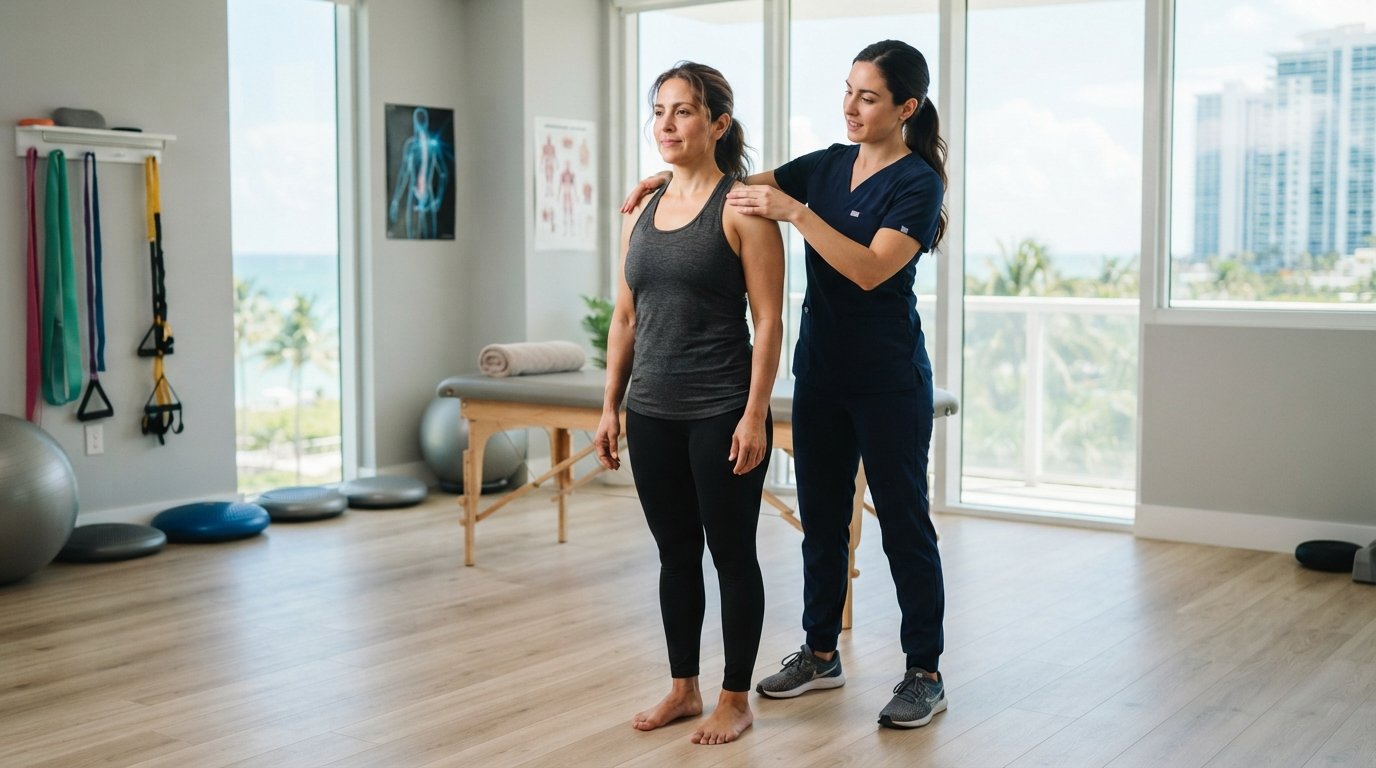
What if the “perfect” posture you’ve been striving for is actually contributing to your persistent neck and shoulder tension? Most of us were taught that sitting like a statue is the gold standard, but your body was designed for fluid, effortless motion. You likely find yourself constantly adjusting your monitor or rolling your shoulders, only to feel that familiar, stiff ache return by midday. At Touch of Health, we believe that true postural education and alignment isn’t about rigid positions. It’s about teaching your nervous system to support you through every movement you make.
You already know the frustration of feeling “stiff” or out of sync with your own frame, especially after long hours of desk work. This clinical guide will show you how specialized therapy can resolve chronic lower back pain and restore your body’s natural balance. We’ll explore how professional neuromuscular retraining empowers you to move without pain, improves your physical confidence, and prevents long-term degenerative issues. By the end of this article, you’ll understand the path toward lasting vitality and how a personalized approach to alignment can transform your daily life.
Key Takeaways
- Understand that posture is a learned neuromuscular behavior rather than a fixed position, allowing you to move with greater ease and efficiency.
- Identify how the kinetic chain connects desk work habits to persistent tension, revealing how imbalances in one area can cause pain in another.
- Discover the critical difference between static and dynamic posture to protect your joints during transitions and active daily movements.
- Learn the “Awareness-Stretch-Strengthen” triad, a practical framework for implementing clinical postural education and alignment into your routine.
- Explore how a personalized therapy plan can resolve chronic lower back pain and prevent long-term degenerative issues through expert guidance.
What is Postural Education and Alignment?
Many people think of “good posture” as a rigid, military-style stance. In reality, postural education and alignment is a sophisticated learning process that bridges the gap between how you think about your body and how you actually move it. Our team at Touch of Health views this as a cognitive and physical journey. We help you identify the optimal distribution of weight through your joints, ensuring that your musculoskeletal system supports you rather than works against you. By integrating physical therapy into your routine, you can dismantle deep-seated habits that lead to stiffness and chronic pain.
The Difference Between Posture and Alignment
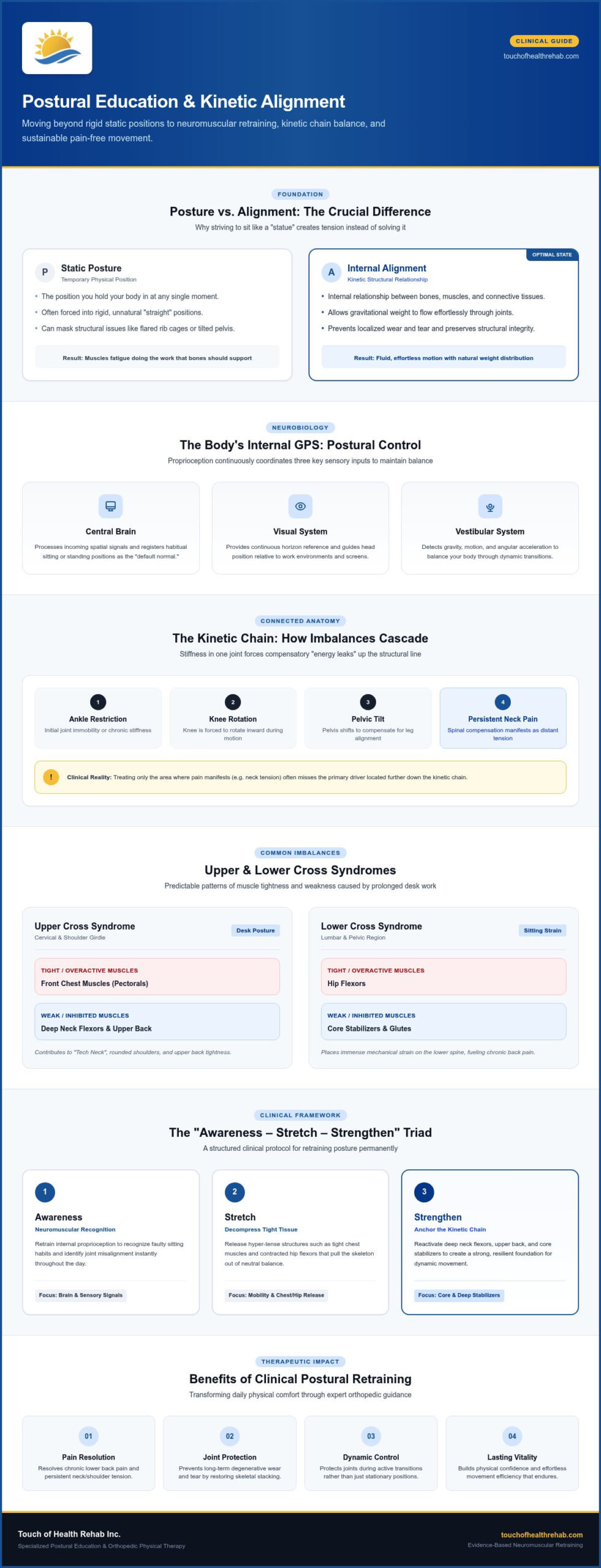
Posture is simply the position you hold at any given moment. Alignment, however, refers to the internal relationship between your bones, muscles, and connective tissues. You might force yourself to stand “straight,” but if your rib cage is flared or your pelvis is tilted, you’re still misaligned. This creates unnecessary stress as gravity pulls on a system that isn’t stacked correctly. When your body is properly aligned, weight flows through your joints effortlessly. This efficiency prevents the localized wear and tear that often results in chronic discomfort, allowing you to move with a sense of freedom and lightness.
Why Education is the Key to Permanent Change
Lasting physical health requires more than just a few stretches. It demands a shift in your postural control mechanisms, which are the complex interactions between your brain, eyes, and inner ear. Your brain relies on proprioception to know where your body is in space. If you’ve spent years slumped over a laptop, your brain accepts that position as “normal.” Simply reminding yourself to “sit up” usually fails because it doesn’t address the underlying neuromuscular patterns.
Professional postural education retrains these internal signals. We act as your dedicated guides, helping you build a new sense of awareness that sticks with you long after you leave the clinic. This specialized approach to postural education and alignment ensures that your progress is permanent, not just a temporary fix. You’ll gain the tools to recognize when you’re slipping into old habits and the knowledge to correct them instantly, fostering long-term vitality and confidence in your body’s capabilities.
The Science of Alignment: How Your Body Stays Balanced
Your body functions as a single, integrated unit rather than a collection of independent parts. When we discuss postural education and alignment, we’re looking at how your nervous system manages the complex physics of balance. Think of proprioception as your body’s internal GPS for movement, constantly sending signals between your joints and brain to maintain your position in space. This internal awareness allows you to stand, walk, and sit without consciously thinking about every muscle contraction. However, when this GPS receives faulty data due to poor habits, your entire structural integrity begins to shift.
The Kinetic Chain and Compensatory Patterns
The “kinetic chain” describes how your joints and segments affect one another during movement. If you have a chronic ankle restriction, your body doesn’t just stop moving; it compensates. That stiffness in the ankle might force your knee to rotate inward, which then tilts your pelvis and eventually manifests as persistent neck tension. These “energy leaks” occur when your skeleton isn’t stacked efficiently, forcing muscles to do the work that bones should be doing. Our experts use orthopedic physical therapy to trace these compensatory links, finding the true source of your pain rather than just treating the symptom.
This chain often breaks down into predictable patterns known as Upper Cross and Lower Cross syndromes. Desk workers frequently experience Upper Cross syndrome, where the muscles in the front of the chest become tight while the deep neck flexors and upper back muscles weaken. Similarly, Lower Cross syndrome involves tight hip flexors and a weak core, which places immense strain on the lower spine. Strengthening your core stability is vital because it acts as the anchor for your entire kinetic chain, protecting your spinal health from these common imbalances.
The Impact of Modern Ergonomics on Alignment
Modern technology has introduced new challenges to our physical health. The “Tech Neck” phenomenon is a prime example of how poor alignment creates massive mechanical stress. Research shows that while your head weighs about 10 to 12 pounds in a neutral position, a 60-degree forward tilt—common when looking at a smartphone—increases the effective load on your cervical spine to 60 pounds. This prolonged strain alters the length-tension relationship of your muscles, leading to chronic stiffness and neurological fatigue as your brain works overtime to keep you upright.
Following static and dynamic posture guidelines can significantly reduce this burden. OSHA standards suggest maintaining a torso angle between 100 and 120 degrees and keeping elbows close to the body at a 90 to 120-degree angle. By optimizing your workstation and practicing micro-pauses every hour, you give your nervous system a chance to reset. If you feel like your body is struggling to find its center, our team in Sunny Isles Beach is here to help you recalibrate your alignment for lasting comfort.
Static vs. Dynamic Posture: Why Proper Alignment is a Movement
Most people associate posture with how they sit or stand while at rest. This is static posture, the baseline of your physical alignment. However, life rarely happens in a vacuum of stillness. Dynamic posture is how you maintain your bodily integrity while in motion, whether you’re walking, reaching for a high shelf, or bending to pick up a child. True postural education and alignment focuses on both, ensuring your body remains resilient throughout the day. It’s during transitions—the moment you move from sitting to standing or pivot to change direction—that most musculoskeletal injuries occur. When your alignment isn’t integrated into your movement, these transitions place sudden, uneven stress on your joints.
Your gait, or the way you walk, is a primary indicator of your overall postural health. If your weight doesn’t shift efficiently from heel to toe, or if your center of gravity isn’t centered over your base of support, your spine must compensate for every step. Harvard Health on spinal alignment suggests that maintaining a neutral spine during daily activities is essential for preventing joint loading and reducing injury risk. Specialized balance and gait rehabilitation serves as a bridge, teaching your brain and muscles to work in harmony during active movement.
Analyzing Your Movement Patterns
Clinical gait analysis is a powerful tool we use to uncover hidden alignment issues that don’t always appear when you’re standing still. By observing how you move, we can identify “micro-errors” in your stride or how you lift objects. For instance, many people round their lower back when reaching forward, which places hundreds of pounds of unnecessary pressure on the spinal discs. Identifying these patterns allows us to recalibrate your postural education and alignment, transforming how you handle the physical demands of your daily routine in Sunny Isles Beach.
The Role of Core Engagement in Every Move
Your core is the anchor for every limb movement you make. Without a stable center, your arms and legs lack the leverage they need to move efficiently. We often see patients who confuse “bracing”—holding their breath and stiffening their trunk—with actual stability. True functional tension is responsive; your core should naturally engage and relax based on the task at hand. We focus on exercises that bridge the gap between static control and dynamic action, such as:
- Controlled Weight Shifting: Learning to move your center of gravity without losing spinal neutrality.
- Functional Reach Patterns: Training the body to maintain alignment while extending your range of motion.
- Dynamic Stabilization: Strengthening the deep muscles that protect your joints during quick pivots or changes in pace.
By mastering these movements, you turn your alignment into a protective habit that guards your long-term physical health.
Corrective Strategies: Practical Steps for Daily Alignment
Achieving lasting physical health requires a shift from passive awareness to active engagement. We utilize the “Awareness-Stretch-Strengthen” triad as the foundation of our postural education and alignment programs. This framework helps you identify a postural slump the moment it happens, release the tension holding you in that position, and build the structural support to stay upright without effort. To achieve true balance, stretching tight muscles must be paired with strengthening weak ones. This ensures your body doesn’t simply snap back into old, painful habits once you step away from your desk.
Simple biofeedback techniques can serve as your most effective tools. You don’t need expensive equipment; instead, use environmental “triggers” to reset your frame. For example, every time you receive a new email or stop at a red light in Sunny Isles Beach, take a deep breath and imagine a string gently pulling the crown of your head toward the ceiling. These micro-adjustments retrain your nervous system, turning proper alignment into a subconscious habit rather than a chore.
Clinical Exercises for Postural Correction
Specific movements target the common imbalances we see in modern life. Scapular retraction exercises are vital for reversing forward head posture by activating the muscles between your shoulder blades. This opens the chest and reduces the strain on your cervical spine. Similarly, performing gentle pelvic tilts while lying down or sitting helps reset your lumbar alignment, providing immediate relief for lower back pressure. We also emphasize thoracic mobility; a flexible mid-back is the engine of your upper body, allowing for deeper breathing and a more open, confident stance.
Integrating Alignment into Your Lifestyle
Your environment plays a significant role in your physical success. In Sunny Isles Beach, your home office setup should prioritize ergonomics, with your monitor at eye level and your feet supported flat on the floor. Don’t overlook your footwear, either. The shoes you wear act as the foundation for your kinetic chain; unsupportive soles can cause your pelvis to tilt, sending ripples of misalignment up to your neck. Consistent wellness and preventative care allows us to catch these minor environmental stressors before they evolve into chronic issues. If you’re ready to reclaim your comfort and move with ease, request your personalized alignment consultation and let us guide you back to balance.
Clinical Postural Education: The Touch of Health Approach
At Touch of Health Rehab, we view our clinic in Sunny Isles Beach as a sanctuary for healing. We don’t just look at your spine; we look at you as a whole person. Our philosophy centers on the belief that recovery is a collaborative journey where we act as your dedicated guides. By focusing on postural education and alignment, we move beyond quick fixes to address the root causes of your discomfort. Whether you’re coming from Aventura, Miami Beach, or North Miami Beach, you’ll find a welcoming environment designed to restore your long-term vitality and physical freedom.
One-on-one therapy is the cornerstone of our success. This personalized attention ensures that every movement you perform is done with the correct technique, preventing the formation of new compensatory habits. Our physical therapists work closely with you to build a plan that fits your unique lifestyle and physical goals. This partnership transforms the clinical experience into a supportive, human-centered path toward peak health. You’ll gain the confidence to move naturally, knowing your body is supported by a foundation of clinical expertise.
What to Expect During Your Initial Evaluation
Your journey begins with a comprehensive musculoskeletal screening and alignment assessment. We don’t just check your range of motion; we identify your specific “postural personality” and the unique pain triggers that affect your daily life. This deep dive allows us to create a roadmap tailored specifically to your body’s needs. You’ll have the opportunity to meet our dedicated team of experts, who bring a wealth of knowledge in orthopedic and musculoskeletal therapy to every session. We take the time to explain our findings, ensuring you understand the “why” behind every step of your care.
Beyond Posture: Holistic Recovery and Vitality
Our approach to postural education and alignment is deeply connected to effective pain management and injury prevention. For aging adults, maintaining proper alignment is a key factor in preserving mobility and preventing falls. By optimizing how your body carries itself, you reduce the mechanical load on your joints, which is essential for long-term physical health. We believe that everyone deserves to move through life with confidence and without the burden of chronic tension or stiffness.
Taking the first step toward recovery is often the most significant part of the process. You don’t have to live with the persistent neck tension or back pain that has become your norm. Our team is ready to partner with you to restore your natural balance and empower your movement. Schedule your alignment assessment at Touch of Health Rehab today and begin your transition toward a pain-free, active future.
Reclaiming Your Body’s Natural Balance
You’ve learned that your posture is a dynamic conversation between your brain and body rather than a static position. By understanding the kinetic chain and the role of core stability, you’ve taken the first step toward resolving persistent aches and stiffness. Clinical postural education and alignment provides the specific tools needed to transform these insights into permanent habits. This process is about more than just standing straight; it’s about moving through your day with efficiency and renewed confidence.
At Touch of Health Rehab, we’ve spent years serving the communities of Sunny Isles Beach and Aventura with a deeply personalized clinical approach. Led by Lead Physical Therapist Berlin, our team acts as your dedicated guide in this restorative journey. We create one-on-one plans that respect your unique physical history and long-term wellness goals. You don’t have to navigate your path to recovery alone. Start your journey to perfect alignment at Touch of Health Rehab and experience the freedom of a body in balance. Your future of pain-free movement is closer than you think.
Frequently Asked Questions
Can physical therapy really fix years of poor posture?
Yes, physical therapy is highly effective at correcting long-standing postural habits by utilizing neuroplasticity to retrain your brain and muscles. Even if you’ve struggled with a slouch for decades, our personalized plans help you build new neuromuscular pathways. We focus on strengthening the specific muscles that have weakened over time while releasing the tension in overactive ones. This restoration allows you to reclaim a neutral alignment that feels natural rather than forced.
How long does it take to see results from postural education?
You’ll often feel a shift in your awareness after just a few sessions of postural education and alignment therapy. While cognitive awareness happens quickly, structural changes in muscle length and strength typically take four to eight weeks of consistent practice. Every person’s journey is unique, but our steady, methodical approach ensures that the progress you make is sustainable. We prioritize quality of movement over speed to ensure your recovery lasts a lifetime.
Is poor posture the cause of my chronic headaches and neck pain?
Persistent neck pain and chronic headaches are frequently rooted in postural imbalances like “Tech Neck.” When your head shifts forward, it places immense strain on the cervical spine and the delicate muscles at the base of your skull. This tension can trigger cervicogenic headaches that disrupt your daily focus. By recalibrating your alignment, we reduce this mechanical stress, providing you with significant relief and preventing these painful episodes from returning during your workday.
Are there specific exercises I can do at my desk in Aventura to help my alignment?
You can perform simple, effective resets right at your desk in Aventura to maintain your alignment throughout the day. Try integrating these micro-movements every hour:
- Chin Tucks: Gently draw your head back to align your ears over your shoulders.
- Scapular Squeezes: Pull your shoulder blades down and back as if tucking them into your back pockets.
- Seated Pelvic Tilts: Small rotations of your pelvis to prevent lower back stiffness.
What is the difference between a posture brace and postural education?
A posture brace is a passive tool that does the work for your muscles; this can actually lead to further weakness over time. In contrast, postural education is an active learning process that empowers you to support yourself. We teach your nervous system how to maintain postural education and alignment naturally. This approach builds genuine strength and internal awareness, ensuring you don’t rely on external supports to feel balanced and pain-free.
Can postural alignment help with balance and fall prevention for seniors?
Proper alignment is critical for seniors because it directly impacts your center of gravity and stability. When your skeleton is correctly stacked, your body can react more quickly to changes in terrain, significantly reducing your risk of trips or falls. Our geriatric physical therapy programs in Sunny Isles Beach combine alignment training with balance and gait rehabilitation. This comprehensive approach gives you the confidence to stay active and independent as you age.
Do I need a doctor’s referral for postural education in Florida?
In Florida, you don’t need a doctor’s referral to begin your journey with us due to “Direct Access” laws. You can receive physical therapy and postural training for up to 30 days before a physician’s signature is required on your plan of care. This allows you to start addressing your pain and stiffness immediately. Our team handles the coordination with your healthcare providers to ensure your recovery is seamless and thoroughly documented.
What happens if I ignore my postural misalignment for too long?
Ignoring misalignment can lead to accelerated joint degeneration and chronic conditions like herniated discs or persistent nerve impingement. Over time, your body’s compensatory patterns become “locked in,” making them more difficult to reverse and increasing your risk of injury during simple movements. Addressing these issues early prevents minor stiffness from evolving into long-term mobility limitations. Taking action now protects your vitality and ensures your body remains a reliable partner for years to come.